Technical Knowledge
How much money does a laser leveling truly save compared to traditional methods?
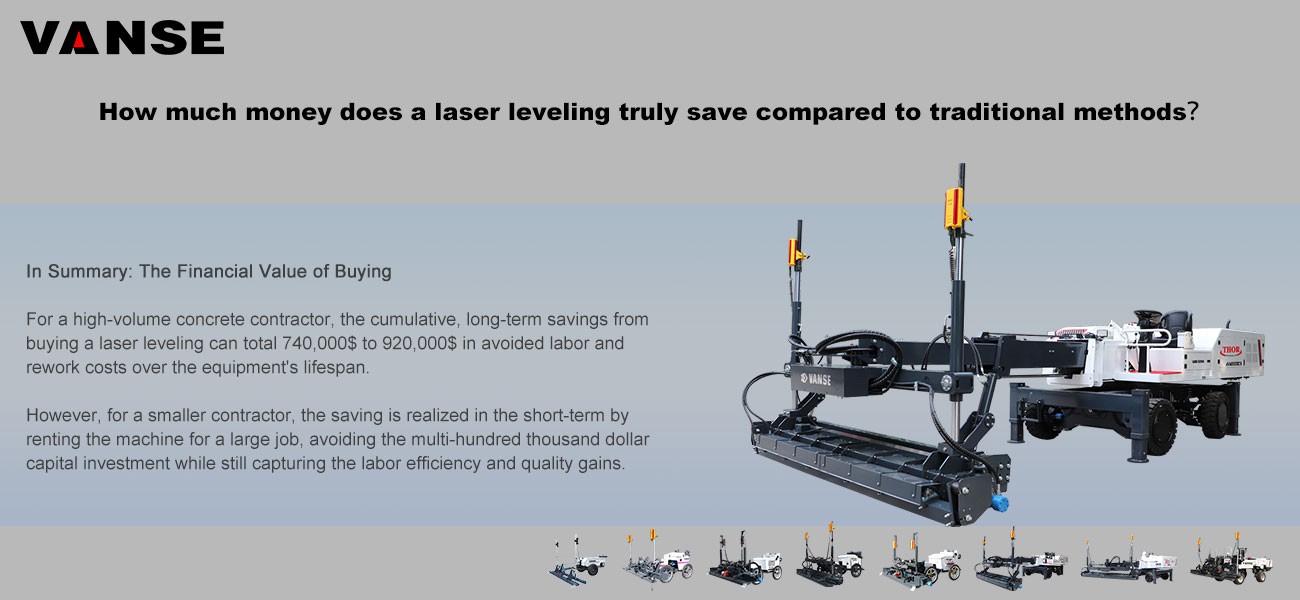
The financial savings from using a laser leveling are substantial, but they are realized primarily through reduced labor, increased speed, and minimized rework, rather than just equipment cost.
Here is a summary of the true cost savings and efficiency gains compared to traditional levelinging methods:
1. Labor Cost Reduction (The Biggest Saving)
A laser leveling dramatically reduces the size and skill level required of a crew, leading to significant savings on payroll and associated costs.
Labor Reduction: Up to 60% fewer workers needed for the levelinging and leveling process.
Example: A large commercial pour might require 20+ people using traditional methods, but only 3–4 people with a ride-on laser leveling.
Skill Dependency: The machine automates the critical leveling function, reducing reliance on expensive, highly specialized skilled laborers (who would otherwise be needed to set string lines and pour guides).
Operational Flexibility: Laser leveling allow for staggered start times, helping contractors avoid overtime and reducing worker fatigue, leading to a healthier, more productive, and less error-prone crew.
2. Time and Productivity Savings
The speed of placement is where high-volume contractors generate major savings and gain a competitive edge.
Increased Speed: Laser leveling can work 4 to 5 times faster than manual levelinging.
Output: A typical ride-on unit can place and level 6,000–10,000 square feet (550–930 m^2) per hour, or potentially 2,500–3,500 m^2 in a single day.
Shorter Construction Period: Contractors report completing slab installations 30%–40% faster, which reduces overall project timelines, minimizes formwork rental costs, and allows follow-up trades (e.g., floor finishing, racking installation) to start sooner.
3. Reduced Rework and Long-Term Operational Savings
By delivering high FF/FL numbers, the machine eliminates costly grinding and maintenance down the line.
Minimized Rework: The laser's high precision 1mm accuracy) virtually eliminates the need for expensive post-pour corrections like bump grinding or filling low spots. This dramatically reduces the risk of the slab failing ACI standards.
Material Uniformity: The consistent vibration and leveling action leads to a denser, more uniform slab, improving the floor's strength and compactness by an estimated 25%.
Equipment Maintenance: In high-tolerance environments (like VNA warehouses), a flatter floor reduces wear and tear on material handling equipment (like forklifts) by reducing bouncing and vibrations. One study suggested eliminating joint mismatches could save over $12 per square foot annually in material handling vehicle maintenance over the long term.
In Summary: The Financial Value of Buying
For a high-volume concrete contractor, the cumulative, long-term savings from buying a laser leveling can total 740,000$ to 920,000$ in avoided labor and rework costs over the equipment's lifespan.
However, for a smaller contractor, the saving is realized in the short-term by renting the machine for a large job, avoiding the multi-hundred thousand dollar capital investment while still capturing the labor efficiency and quality gains.
Note: The parameters provided in this document are for reference only and are not mandatory. Due to differences in technical characteristics between different brands and models of laser levelers, please consult the manufacturer for a suitable solution before actual operation. This reference document assumes no responsibility for any issues arising from failure to follow the manufacturer's instructions.
Thanks to All the Friends Who Support and Trust Shandong Vanse Machinery Technology Co., Ltd.
If you want to know more about Shandong Vanse Machinery Technology Co., Ltd. or have any questions, please feel free to contact us:
Our Factory
Shandong Vanse Machinery Technology Co., Ltd.








Share this article

About the Author: Shandong Vanse Machinery Technology Co., Ltd.
Shandong Vanse Machinery Technology Co., Ltd. is a high-tech manufacturer specializing in concrete construction machinery, including laser screeds and related equipment. The company integrates R&D, production, and global sales, with products exported to over 60 countries and widely used in infrastructure projects worldwide.
Previous Post
Next Post
Related Articles
You Might Also Like
Not to be missed dry goods — The Laser leveling machine standard Maintenance Procedures
No matter what kind of mechanical equipment, if you want to effectively extend its service life, it is necessary to regularly do the maintenance and maintenance of the equipment, which is no exception for the laser leveling machine. In view of the lack of detailed analysis of the maintenance standards and specifications of the laser levelling machine in the relevant technical data, our company will combine many years of work experience to make a simple summary of the correct maintenance methods of the various components of the laser levelling machine, and hope that the majority of users must operate scientifically according to this specification. ► Engine maintenance: Choose an antifreeze suitable for the local temperature and replace it every 1 year. Before the winter, the winter fuel should be replaced with a laser leveller in advance to avoid waxing of ordinary diesel in the filter and pipeline due to low temperature. As a result, the engine could not start normally, the anti-icing device of the compressed air system was opened, and the ether level was checked regularly. Many engines require some additive to be added to the coolant, namely SCA (Supply coolant Additive), which usually acts on aluminum. During the part's contact with the coolant, metal corrosion, mineral precipitation, cavitation and cylinder liner foaming are more effectively prevented. ► Parts maintenance: Before parking the laser leveler for a long time in winter, mechanical articulation point, lubrication and maintenance work should be carried out on the bearing. Check the integrity of the dust jacket of the concrete laser leveling machine, and replace the damaged sealing ring in time. The metal contact surface exposed to the air should be rust-proof, the engine should be started regularly, and all reduction gear boxes should be operated to prevent the shaft seal and rubber seal ring in the gear box from damaging the parking and gear oil for a long time. ► Hydraulic system maintenance: Regularly start the laser levelling machine and turn on all hydraulic functions on the machine, so that the hydraulic drive components work regularly, prevent the relevant seals from being damaged due to long-term parking, metal parts such as cylinder rods and other rust, as much as possible. Retract all cylinder rods into the hydraulic cylinder oil chamber to better protect the cylinder rod surface. ► Electrical system maintenance: Please start the laser leveling machine engine every two months, charge the battery, and run all hydraulic actuators, such as rotary hydraulic motor, telescopic cylinder, etc., do not remove the battery from the machine to prevent long-term parking equipment to control the internal software program failure loss. Special reminder: once the operation, maintenance and management of the laser levelling machine is improper, it will affect the efficiency and life of the equipment, etc., and may even cause equipment failure, resulting in equipment downtime, therefore, only by doing the daily maintenance and management of the system and the whole machine can effectively reduce the probability of equipment failure, ensure the normal operation of the equipment, and improve production efficiency.The inspection methods and acceptance standards for the flatness and smoothness of the floor after the power trowel machine construction
The detection methods and acceptance standards for the flatness and smoothness of the concrete floor (commonly known as the "polished floor") after the power trowel construction are a very practical and crucial issue. The following is a detailed explanation. It should be noted that flatness and smoothness (surface quality) are two independent indicators that need to be inspected and accepted separately. Flatness refers to the degree of height deviation between the floor surface and the absolute horizontal plane. At present, the most authoritative and universal standard is to use the "F-Value" system, which originates from the ASTM E1155 standard in the United States and is widely adopted worldwide (including high-standard projects in China). Main instruments: Continuous road surface smoothness meter (commonly known as "pedal car" or "Dipstick") or digital electronic level. Principle: These instruments continuously measure the height difference between two points at fixed intervals (typically 300mm or 1 foot) within the measurement area, and calculate a series of statistical parameters, namely F-values, through built-in software. Operation process Layout the measurement lines: Arrange the measurement lines in a grid pattern in the area to be measured, usually at intervals of 1.5 to 3 meters. The survey lines should cover all key areas (such as lanes, main passageways) and random areas. Continuous measurement: Operate the instrument to measure along the measurement line. Data recording: The instrument will automatically record and calculate the F-value. The F-numerical system mainly includes two parameters: FF (Flatness F- value) : It reflects the undulation of the floor over short wavelengths (typically 300mm to 600mm), that is, "warpage". The higher the FF value, the flatter the floor. FL (Height difference F- value) : It reflects the overall undulation of the floor over long wavelengths (usually up to 6 meters or more), that is, "levelness". The higher the FL value, the more level the floor as a whole is. Common acceptance standard grades (for reference) : Grade Applicable area FF (Minimum Value) FL (Minimum Value) Ordinary grade Warehouse storage area, general workshop ≥ 20 ≥ 15 Good grade General forklift aisles and production lines ≥ 35 ≥ 25 Excellent grade VNA narrow aisle warehouse, logistics sorting center ≥ 50 ≥ 40 Super level Robot AGV channels, precision assembly areas ≥ 60 ≥ 50 Ultimate level Ultra-precision workshops sensitive to vibration ≥ 100 ≥ 80 Note: The specific acceptance criteria must be clearly stipulated in the project contract or design documents. When there are no specific regulations, the above-mentioned "Good grade" or "Excellent grade" may be referred to as a reference. 2-meter straightedge method: Method: Place a 2-meter-long aluminum alloy straightedge in any direction on the floor and measure the maximum gap between the straightedge and the ground with a feeler gauge. Standard: For ordinary floors, the gap should be ≤ 4mm. The high-standard floor requirement is no more than 2mm. Limitations: This method has a small sampling range and can only reflect the flatness of a small local area. It is unable to comprehensively assess the overall quality of a large area of the floor and has gradually been replaced by the F-numerical system. The smoothness mainly refers to the density, hardness, wear resistance and sensory effect of the floor surface. Its acceptance is more inclined towards visual and functional tests. Visual inspection Standard: The surface color is uniform and consistent, without obvious power trowel marks, color differences, cracking, sanding, peeling, hollowing, holes, oil stains or contamination. Method: Observe from multiple angles under sufficient light (especially side light). Hard object scratch test Method: Use a hard object such as a key or a coin (or a special hardness pen) to scratch the surface forcefully. Standard Excellent: Minor or no scratches, with a hard surface. Qualified: Visible scratches are present, but no powder or sand particles fall off. Unqualified: Obvious sanding, powder or sand particles are scratched off. Rebound instrument test (auxiliary) Method: Measure the surface strength using a concrete rebound tester. The rebound value should meet the design requirements, usually not less than 80% of the designed strength (after the curing period), and the value should be uniform. This indirectly reflects the density and hardness of the surface after being polished by the power trowel. Wear resistance test (high standard requirements) Method: Use a "abrasion tester" (such as DIN abrasion tester, Taber abrasion tester) to take samples for testing in the laboratory or on-site. Standard: The wear per unit area is lower than the design or specification requirements (for example, ≤ 0.15g /cm²). Dust-proof effect evaluation Method: Before delivery for use, observe whether the surface is prone to dusting. It can be rubbed with your feet or wiped with your hands. Standard: A floor that has been well smoothed and may be applied in combination with a curing agent should generate little dust. This is the most direct manifestation of a dense surface. A standardized acceptance process should include the following steps: Document review: Inspect the concrete mix ratio report, strength report, and construction records (especially the construction time node records of the laser screed and power trowel machines). On-site environmental confirmation: Confirm that the floor has been fully maintained (usually at least 28 days), and the surface is clean and dry. Flatness detection: According to the preset measurement lines, use a continuous flatness meter to measure the F-value. Compare the results with the FF/FL standards stipulated in the contract. Surface finish inspection Conduct a comprehensive visual inspection. Conduct multi-point hard object scratch tests. (If required) Conduct rebound testing or take samples for wear resistance testing. Problem marking and repair: Mark the areas that do not meet the standards (such as excessive flatness deviation, local sanding, cracks), and require the construction unit to carry out repairs (such as grinding, patching, etc.). Final report: Issue a formal acceptance report that includes all test data, photos and conclusions. In conclusion, for the floor after the power trowel construction: The flatness needs to be quantitatively evaluated by the scientific F-value, which is a hard and fast indicator for modern floor engineering. The smoothness is comprehensively judged through the visual inspection and scratching method of "seeing and touching", combined with necessary hardness tests. The core is "hard, dense, wear-resistant and flawless". Ensuring that all these testing methods and acceptance criteria are clearly defined in the technical specification before the project commences is the key to avoiding disputes in the later stage and obtaining high-quality floors. Note: The parameters provided in this document are for reference only and are not mandatory. Due to differences in technical characteristics between different brands and models of laser levelers, please consult the manufacturer for a suitable solution before actual operation. This reference document assumes no responsibility for any issues arising from failure to follow the manufacturer's instructions.What is the future development of concrete laser leveling machines?
Concrete laser leveling machine is an advanced construction technology that uses laser beams to scan and measure the ground and automatically control the lifting and lowering of the mixer truck to achieve automatic leveling and leveling of concrete. This technology has the advantages of high efficiency, high quality, and low cost, and is widely used in the construction of concrete structures such as buildings, bridges, and tunnels. In the future, concrete laser leveling machines will develop in a more efficient, intelligent, and multifunctional direction. First, concrete laser levelings will be more efficient. With the acceleration of urbanization, construction period requirements for construction are becoming more and more stringent. The concrete laser leveling machine can realize automated construction, greatly improving construction efficiency and shortening the construction period. In the future, there will be more efficient and intelligent concrete laser leveling machines that can achieve fast and precise construction and further improve construction efficiency. Secondly, concrete laser levelings will be more intelligent. With the development of artificial intelligence, Internet of Things and other technologies, concrete laser leveling machines will have more intelligent functions. For example, by combining with BIM technology, real-time monitoring and data management of the construction process can be achieved to improve construction quality and efficiency; by combining with drones, robots and other technologies, more intelligent and automatic construction can be achieved, reducing manual intervention and reducing construction costs. . Third, concrete laser levelings will have more functions. At present, concrete laser leveling machines are mainly used for leveling and leveling concrete, and will have more functions in the future. For example, it can realize automatic distribution, lightening, compaction and other operations of concrete to realize one-stop concrete construction; it can realize quality inspection such as strength detection and crack detection of concrete, providing a more comprehensive guarantee for construction quality. Finally, the application range of concrete laser levelings will be wider. At present, concrete laser leveling machines are mainly used in the construction of concrete structures such as buildings, bridges, and tunnels, and will be expanded to more fields in the future. For example, in road construction, operations such as automatic leveling and compaction of road surfaces can be realized; in the agricultural field, operations such as leveling and compaction of farmland can be realized to improve agricultural production efficiency and quality. In short, in the future, concrete laser leveling machines will develop in a more efficient, intelligent, and multi-functional direction, providing more high-quality, efficient, and intelligent solutions for building construction. With the continuous advancement of technology and the expansion of application scope, concrete laser leveling machines will play an important role in more fields.