Technical Knowledge
Specific examples of how the use of power trowels reduces reliance on manual labor and increases efficiency.
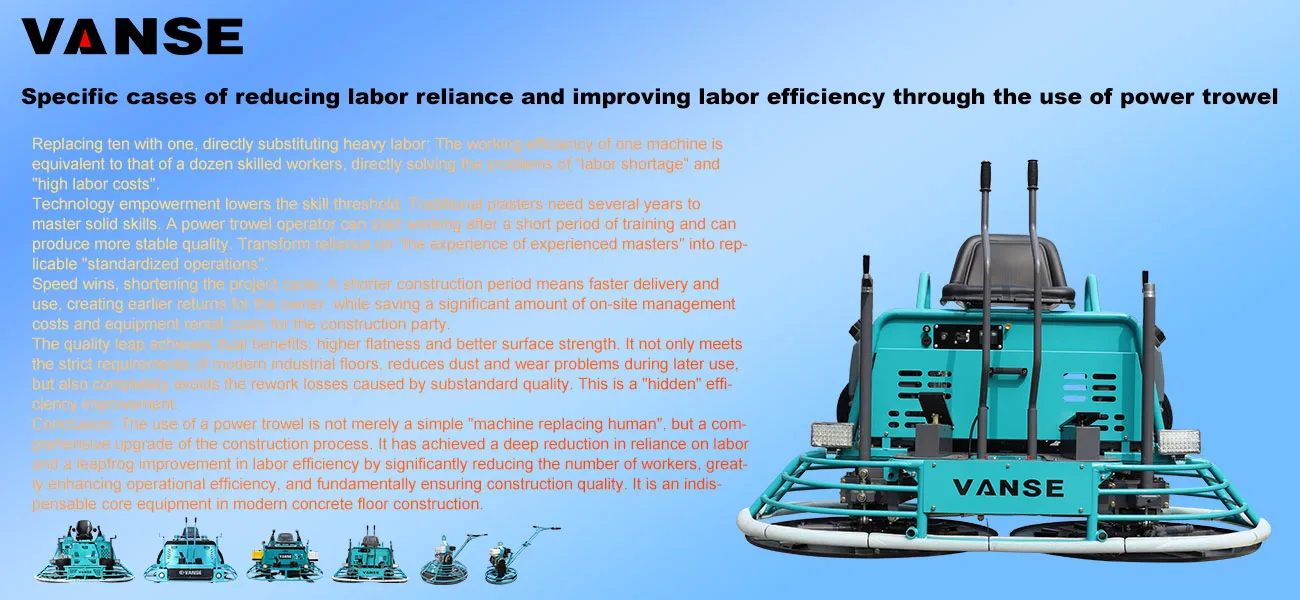
The reduction in labor reliance and the improvement in labor efficiency through the use of power trowel are revolutionary. The following is visually illustrated through a specific comparative case and detailed data dissection.
Case Background: A standard industrial plant floor project
Project area: 10,000 square meters
Concrete thickness: 15 centimeters
Construction requirements: Meet the industrial standards for flatness (±3mm/2m) and smoothness (finishing).
Scene One: Pure manual operation (traditional method)
Labor force allocation (high-intensity dependence) :
Strong laborers (carrying and preparing) : 4-5 people
Plastering workers (responsible for finishing the surface) : 8-10 people (experienced master craftsmen are required)
Total number of people: 12 to 15 people working simultaneously.
Construction process
Workers need to wear boots, line up on the initially set concrete, and use tools such as wooden power trowel and iron power trowel, bending over to repeatedly smooth and smooth it out.
This is an extremely physically demanding process and a huge test for the workers' waists and arms.
Because it involves multiple people working together, it is difficult to ensure even force application and consistent steps, which easily leads to a "wavy" ground.
Labor efficiency and Project duration
Daily completed area: A skilled team can complete a maximum of 800 to 1,000 square meters in a day (calculated based on 8 to 10 hours).
Total construction period: It will take 10 to 12 days to complete 10,000 square meters of ground.
Quality risk: Highly dependent on the technical proficiency and physical condition of workers. The construction quality dropped significantly after fatigue in the afternoon, and the joints were prone to unevenness.
Cost analysis
Extremely high labor costs: Calculated based on 15 people, the daily labor cost is huge.
High management costs: It requires an outstanding foreman to coordinate over a dozen people, making management very difficult.
Hidden costs: The risk of work-related injuries caused by workers' fatigue work and the cost of rework due to substandard quality.
Scene Two: Mechanized operations (mainly using power trowel, with manual labor as a supplement
Labor allocation (significantly reducing dependence) :
Power trowel operator: 2 (take turns to operate to prevent fatigue)
Auxiliary workers (responsible for corner and pipeline handling) : 3-4 people
Total number of people: 5 to 6.
Construction process
After the concrete is spread, vibrated and leveled, it is allowed to set initially.
The operator drives the power trowel machine into the site to carry out large-scale rough power trowel (installing the disc) and fine power trowel (installing the power trowel).
Auxiliary workers simultaneously use small hand-held power trowel or manually handle corners, column bases, and the area around equipment foundations that machines cannot reach.
Labor efficiency and Project duration
Daily completed area: One power trowel team can easily complete 2,500 to 3,000 square meters in a day.
Total construction period: It only takes 3 to 4 days to complete 10,000 square meters of ground.
Quality Assurance: The flatness is guaranteed by the machine, uniform and consistent, eliminating fluctuations caused by human factors. The surface density and smoothness are much higher than those of artificial ones.
Cost analysis
Labor costs have been significantly reduced: the number of employees has decreased by more than 60%.
Equipment cost: The rental or depreciation expenses of the power trowel machine need to be borne, but they are far lower than the labor cost savings.
The overall cost has significantly decreased: The shortening of the construction period has led to a reduction in management and rental fees, and the one-time excellence in quality has avoided rework. The overall cost-effectiveness is extremely high.
A comparison of specific data on human efficiency improvement
| Comparison dimension | Pure manual operation | Mechanized operation | Enhance the effect |
| Quantity of labor force | 12 to 15 people | Five to six people | Reduce by approximately 60% to 70% |
| Daily completed area | 800-1,000 square meters | 2,500-3,000 square meters | Increase by approximately 200% to 300% |
| Per capita daily efficiency | Approximately 70 square meters per person | Approximately 500 square meters per person | Increase by more than 600% |
| Total construction period | 10 to 12 days | Three to four days | Shorten by approximately 60% to 70% |
| Quality consistency | Dependent on individuals and unstable | Guaranteed by machines, it is uniform and stable | From "craftsmanship" to "industrial standards" |
| Labor intensity of workers | Extremely high (bending over, carrying heavy loads | Medium (standing to operate the machine) | Significantly reduced occupational health protection |
Summary: How can a power trowel achieve cost reduction and efficiency improvement
Replacing ten with one, directly substituting heavy labor: The working efficiency of one machine is equivalent to that of a dozen skilled workers, directly solving the problems of "labor shortage" and "high labor costs".
Technology empowerment lowers the skill threshold: Traditional plasters need several years to master solid skills. A power trowel operator can start working after a short period of training and can produce more stable quality. Transform reliance on "the experience of experienced masters" into replicable "standardized operations".
Speed wins, shortening the project cycle: A shorter construction period means faster delivery and use, creating earlier returns for the owner, while saving a significant amount of on-site management costs and equipment rental costs for the construction party.
The quality leap achieves dual benefits: higher flatness and better surface strength. It not only meets the strict requirements of modern industrial floors, reduces dust and wear problems during later use, but also completely avoids the rework losses caused by substandard quality. This is a "hidden" efficiency improvement.
Conclusion: The use of a power trowel is not merely a simple "machine replacing human", but a comprehensive upgrade of the construction process. It has achieved a deep reduction in reliance on labor and a leapfrog improvement in labor efficiency by significantly reducing the number of workers, greatly enhancing operational efficiency, and fundamentally ensuring construction quality. It is an indispensable core equipment in modern concrete floor construction.
Note: The parameters provided in this document are for reference only and are not mandatory. Due to differences in technical characteristics between different brands and models of laser levelers, please consult the manufacturer for a suitable solution before actual operation. This reference document assumes no responsibility for any issues arising from failure to follow the manufacturer's instructions.
Thanks to All the Friends Who Support and Trust Shandong Vanse Machinery Technology Co., Ltd.
If you want to know more about Shandong Vanse Machinery Technology Co., Ltd. or have any questions, please feel free to contact us:
Our Factory
Shandong Vanse Machinery Technology Co., Ltd.








Share this article

About the Author: Shandong Vanse Machinery Technology Co., Ltd.
Shandong Vanse Machinery Technology Co., Ltd. is a high-tech manufacturer specializing in concrete construction machinery, including laser screeds and related equipment. The company integrates R&D, production, and global sales, with products exported to over 60 countries and widely used in infrastructure projects worldwide.
Previous Post
Next Post
Related Articles
You Might Also Like
Introduction to technical parameters of concrete laser leveling machine
Concrete laser leveling: application fields, technical features and advantages of use ▶•1•◀ Application fields of concrete laser leveling machine Precise construction concrete laser leveling machine, as an efficient and reliable equipment, is widely used in many fields. The following are some common application areas of compact soil laser levelings: 1. Road construction: In the field of road construction, concrete laser leveling machines are mainly used for paving and leveling road surfaces. It provides high-precision smoothness, improves road performance and safety, and reduces the need for maintenance and repairs. 2. Bridge engineering: As an important traffic structure, bridges have extremely high requirements for flatness. Concrete laser levelings play an important role in bridge projects and are able to meet high standards of flatness and construction quality. 3. Airport runway: Airport runway is crucial for the safety of aircraft taking off and landing. The concrete laser leveling machine can provide precise surface smoothness, reduce vibration and turbulence during takeoff and landing, and ensure flight safety. 4. Interior decoration: In the field of interior decoration, concrete laser leveling machines are mainly used for leveling floors, floors and platforms. It can improve the flatness and beauty of the ground to meet the high-quality requirements of interior decoration. 5. Precast concrete components: In the production process of precast concrete components, high-precision surface flatness is required. The concrete laser leveling machine can quickly and accurately complete the leveling of component surfaces, improving production efficiency and product quality. ▶•2•◀ Technical characteristics of concrete laser leveling machine The concrete laser leveling machine adopts advanced laser technology and automated control system and has the following technical characteristics: 1. High-precision measurement: Through laser ranging technology, the concrete laser leveling machine can achieve high-precision surface measurement. It detects surface height differences in real time to ensure accuracy and consistency of leveling. 2. Automated operation: The concrete laser leveling machine is equipped with an automated control system, which can achieve continuous concrete laying and leveling work. Operators only need to make simple monitoring and adjustments, greatly reducing the need for manual intervention. 3. One-time forming: The concrete laser leveling machine can achieve the leveling effect of one-time forming, reducing the need for repeated work and improving construction efficiency. 4. Remote control: The concrete laser leveling can also be equipped with a remote control system, so operators can control the equipment away from the construction site, improving the safety and convenience of construction. 5. Easy to maintain: The concrete laser leveling machine has a relatively simple structure, easy component replacement, and low maintenance costs. At the same time, the equipment adopts a modular design, which facilitates disassembly and transportation, improving the maintainability of the equipment. ▶•3•◀ Advantages of using concrete laser leveling machine Compared with traditional construction methods, concrete laser leveling machines have the following advantages: 1. Improve construction efficiency: The concrete laser leveling machine can achieve efficient and fast construction, shorten the construction time and improve production efficiency. This helps reduce construction costs and speed up project delivery. 2. Reduce material waste: The concrete laser leveling machine can minimize material waste through precise control and high-precision measurement. It only needs to be laid and leveled once reducing the need for rework and repetitive work, thus reducing the amount of concrete used. This helps reduce costs and reduce environmental impact. 3. Improve construction quality: Concrete laser leveling machine can provide high-precision surface flatness and improve construction quality. It reduces manual intervention and experience dependence, ensuring consistency and accuracy of construction. This helps improve process quality and safety. 4. Reduce labor costs: The concrete laser leveling machine adopts automated operation, reducing the need for manpower. Operators only need to perform simple monitoring and adjustments, reducing reliance on skills and experience. This helps reduce labor costs and labor input. 5. Remote control and monitoring possible: The concrete laser leveling machine can be equipped with a remote control system and monitoring system to facilitate remote control and real-time monitoring of the equipment. This helps improve the flexibility and convenience of construction and reduces the risk and difficulty of on-site operations. 6. Adaptable to a variety of construction environments: The concrete laser leveler has strong adaptability and can adapt to a variety of construction environments and conditions. Whether indoors or outdoors, its advantages can be exerted in various construction projects with high flatness requirements. This helps improve the device's versatility and applicability. 7. Improve work efficiency and safety: Concrete laser leveling machine can improve work efficiency and safety. Compared with traditional construction methods, this equipment reduces manual labor intensity and work risks, reduces repetitive work and material waste. At the same time, it also improves the accuracy and consistency of construction, ensuring that project quality and safety performance requirements are met. . This helps improve work efficiency, safety and project quality levels. In summary, concrete laser levelings are widely used in many fields and have significant advantages. Through the introduction of technical characteristics and working principles, we can better understand its efficient and precise construction capabilities and application value. In future construction projects, with the continuous development and improvement of technology, concrete laser levelings will play a more important role in promoting the development and innovation of the construction industry.What impact does poor laser signal reception stability of a concrete laser screed have on construction?
The poor stability of laser signal reception in concrete laser levelings is a serious construction quality issue. It can trigger a series of negative chain reactions like a "domino effect". The following are the specific impacts it has on construction, ranging from direct effects to long-term consequences: Manifestation: The ground shows "wavy" undulations, local depressions or protrusions. The reason is that the receiver signal is intermittent or fluctuating, causing the lifting cylinder of the leveling machine to constantly perform incorrect correction actions, and the scraper cannot maintain a constant height. Performance: It is impossible to achieve the absolute level of the design (such as high-standard warehouses) or precise slope (such as ground with drainage requirements). Reason: The laser emitter establishes an accurate reference plane. An unstable receiver means that the leveling has lost this reliable reference and is unable to spread the concrete to the designed height Performance: Frequent shutdowns are required to inspect the laser transmitter, receiver or circuit. The reason is that in order to ensure quality, the operator has to stop the construction for investigation once any abnormality is found in the process of flattening the head, which seriously slows down the progress. Performance: More experienced workers are needed for manual remediation. The reason is that for uneven ground, a large number of workers need to use handheld trowels to "make up" in the later stage. This is not only time-consuming and labor-intensive, but also the accuracy of manual leveling is far lower than that of machines. Manifestation: Inaccurate control of concrete usage. Reason: Uncontrolled elevation may lead to local concrete being too thick (wasting materials) or too thin (requiring replenishment and affecting strength). Manifestation: Irregular cracks appear on the ground after use. The reason is that poor flatness leads to uneven thickness of the concrete surface layer in subsequent pouring. Under the action of load and shrinkage, stress concentration is prone to occur at the junction of thin and thick layers, thus causing cracking. Symptoms: Dust, sand and aggregates appear on the ground too early. The reason is that high places are prone to wear and tear, while low places are likely to accumulate dirt and get damaged. At the same time, subsequent hardeners or sealants are also difficult to apply evenly, further reducing the overall durability of the ground. Performance: High-standard industrial floors (such as VNA ultra-flat warehouses), epoxy floors, PVC roll material laying, etc. cannot be carried out or the cost has increased sharply. The reason is that these processes have extremely high requirements for the flatness of the base layer (such as FF/FL values). If the base is uneven, either construction cannot be carried out or a huge cost needs to be spent on grinding or self-leveling to level it. Performance: Difficult installation of high-rack shelves and questionable stability; Automated equipment such as automatic guided vehicles (AGVs) and stackers operate unstably, have poor precision and a high failure rate. Reason: These devices are extremely sensitive to the flatness of the ground. Even the slightest unevenness can cause the devices to shift, vibrate or stop rotating. After understanding the impact, it is also necessary to know the root cause of the problem in order to solve it in a targeted manner Problems with the laser emitter itself: insufficient battery power, self-accuracy drift, or displacement or vibration caused by human or equipment collision. Receiver and sensor issues: Receiver damage, photosensitive element blocked by dirt, poor contact of signal lines. Environmental interference Obstruction: Construction workers, equipment, and building materials temporarily blocked the laser beam. Vibration: Heavy equipment is in operation nearby, or the tripod of the transmitter is not stable, causing the transmitter to shake. Temperature and air flow: In extreme environments, heat waves can cause changes in air density, leading to slight refraction of laser beams (" mirage "effect), which affects the stability of long-distance signals. Operational issue: When the transmitter is set up at a height that exceeds its effective range, or when the ground has a significant slope, the Angle between the laser line and the receiver is too large, resulting in poor signal reception. Conclusion The stability of laser signal reception is the "lifeline" of concrete laser leveling machine construction. Once a problem occurs, it is by no means just a minor issue of "a slightly uneven ground", but will have a serious impact on the project from multiple dimensions such as quality, efficiency, cost and safety. Before and during construction, ensuring the stability and reliability of the laser system must be regarded as a core task for inspection and management. Note: The parameters provided in this document are for reference only and are not mandatory. Due to differences in technical characteristics between different brands and models of laser levelers, please consult the manufacturer for a suitable solution before actual operation. This reference document assumes no responsibility for any issues arising from failure to follow the manufacturer's instructions.Concrete laser leveling machine helps you overcome the labor shortage problem!
CONCRETE LASER LEVELING MACHINE HELPS YOU OVERCOME THE LABOR SHORTAGE PROBLEM! It is difficult to find labor force in the current market, especially for some industries that are tiring and often exposed to wind and sun. It is even more difficult to recruit people. What should we do in the market floor leveling industry facing a labor shortage? This situation had begun to emerge a few years ago, and VANSE, as a professional laser leveling machine manufacturer, developed a laser leveling machine that can replace manual labor, which greatly eased the current situation. For example, a construction company won 5 new bidding projects from January to February this year, a year-on-year increase of 66.0%. At the end of February, the surveyed companies had the largest number of construction projects in progress, 95. Despite the growth in business, there is still a shortage of skilled workers. The first reason is that there is a large market demand for skilled workers; the "demographic dividend" of low labor wages is gradually disappearing, and labor costs have greatly increased. But the construction industry has to continue to develop, so a better solution is to replace labor with machines. CONCRETE LASER LEVELING MACHINE HELPS YOU OVERCOME THE LABOR SHORTAGE PROBLEM! With the development of logistics and aviation industry, the golden age of floor construction has opened. Thousands of square meters of ground are only allowed to have a flatness error of 3 mm, which has become a new standard for floor construction. It is undoubtedly a dream to realize it by traditional manual labor. Owning a laser leveling machine has become an essential requirement for floor construction companies to undertake projects. CONCRETE LASER LEVELING MACHINE HELPS YOU OVERCOME THE LABOR SHORTAGE PROBLEM! 1. The leveling principle of the laser leveling machine is realized under the automatic control of the computer by using precision laser technology, closed-loop control technology and high-precision hydraulic system. This is the most prominent difference between it and other floor construction processes features. CONCRETE LASER LEVELING MACHINE HELPS YOU OVERCOME THE LABOR SHORTAGE PROBLEM! 2. The leveling principle of the precision laser leveling machine is to rely on the leveling head driven by hydraulic power, cooperate with the laser system and the computer control system to complete the leveling work while automatically leveling. The leveling head is equipped with an integrated scraper, vibrator and leveling plate, which integrates all leveling, leveling, vibration and compaction work, and completes it at one time. The computer control system automatically adjusts the elevation 10 times per second in real time, and the vibration frequency of the vibrator with a balanced design reaches 3000 times per minute. CONCRETE LASER LEVELING MACHINE HELPS YOU OVERCOME THE LABOR SHORTAGE PROBLEM! 3. The laser transmitter used to control the ground level is arranged independently, so that the level of the ground is not controlled by the template, and no cumulative error will occur. CONCRETE LASER LEVELING MACHINE HELPS YOU OVERCOME THE LABOR SHORTAGE PROBLEM! 4. The laser leveling machine can also automatically control the longitudinal and transverse slopes, which is also completed by the laser system, computer system, hydraulic system, and mechanical system. 5. There are many people in the construction of the traditional craft, which requires support formwork (channel steel), spotting, and paving. About 20 people are needed. The daily construction area is 2000㎡. The use of laser leveling machine can reduce the overall number of people to 4-8. Can be operated by one person. The daily construction area is increased to 3000㎡-5000㎡. Greatly reduced labor costs. In the long run, if we want to continue to develop in the flooring industry, we can only use laser leveling machines instead of labor. Now Shandong VANSE Machinery conforms to the needs of the development of the times.