Technical Knowledge
Important considerations for long-term storage of power trowel machines

Long-term storage of power trowel machines requires thorough preparation to prevent corrosion, fluid degradation, and damage to mechanical parts. These steps are crucial to ensure the machine starts up reliably and performs optimally when you need it next.
Here are the most important considerations, broken down by category:
1. Preparation and Cleaning
Thorough cleaning is the foundational step, as concrete and dirt residue can trap moisture and accelerate corrosion.
Remove All Concrete/Debris: Use a scraper, wire brush, and/or a pressure washer to completely remove all hardened concrete, mortar, and dirt from the blades, chassis, guard rings, and around the engine/gearbox.
Crucial Note: Ensure the machine is completely dry after washing to prevent immediate rust formation.
Engine/Motor Cleaning: Use low-pressure air or a brush to clear dust and debris from the heat sink, cylinder block, and any cooling fins. Clean any oil stains or grease from the exterior.
Inspect and Repair: Before storing, check for and replace any worn-out or damaged parts like drive belts, clutch plates, spark plugs, or air filters
2. Fluid and Fuel System Treatment (Engine-Powered Models)
Fluids can degrade and cause serious damage if left in the machine for an extended period.
Fuel System:
Drain Completely: Modern gasoline, especially with ethanol, can absorb water and corrode the fuel lines and carburetor. Completely drain all fuel from the tank.
Run Until Stop: Set the fuel switch to "Off," start the engine, and let it run until it stops naturally. This clears residual fuel from the carburetor/fuel lines.
Engine Oil:
Change Oil: Drain the old engine oil (ideally when the engine is warm) and replace it with new oil. New oil contains better anti-corrosion properties and lacks acidic contaminants from use.
Internal Rust Prevention: For extreme long-term storage, remove the spark plug, drip a small amount of new engine oil (about one tablespoon) into the cylinder, and manually pull the starter rope a few times to coat the cylinder wall. Reinstall the spark plug.
Hydraulic Systems (Ride-On Trowels): Check the hydraulic fluid quality and level. If replacing the fluid, circulate it briefly. Ensure all piston rods of the hydraulic cylinders are fully retracted to protect the chrome surface from exposure and rust.
3. Rust Prevention and Lubrication
Protecting exposed metal and moving components is vital to prevent seizing.
Trowel Blades: Remove the blades, clean them, and apply a layer of heavy grease or a dedicated anti-rust oil (like WD-40 or a specialized coating) to all metal surfaces. Consider wrapping them in oiled paper and storing them separately.
Exposed Metal Surfaces: Spray a thin layer of anti-rust agent or a rust-preventative spray on all exposed metal surfaces, including the chassis, guard rings, and any areas where paint has been scratched off.
Lubrication: Apply grease or oil to all designated lubrication points, including:
Gearbox gears (if applicable)
Clutch forks
Height and tilt adjustment screws and their threaded parts
4. Power System and Battery Care
If the machine has an electric start or motor, special attention is needed.
Air Filter: Remove the air filter element for cleaning or replacement. Seal the air inlet with a clean cloth or plug to prevent dust and pests from entering the engine.
Battery (Electric Start Models):
Disassemble and Charge: Disconnect and remove the battery. Fully charge it.
Store Separately: Store the battery in a cool, dry place off the concrete floor.
Maintenance Charge: Recharge the battery periodically (e.g., once every 1-2 months) to maintain its charge and lifespan, or use a "smart" maintenance charger.
5. Storage Environment
The physical location where the machine is stored is the final defense against damage.
Indoor and Dry: Store the power trowel indoors in a clean, dry, and well-ventilated area. Avoid storage outdoors or in areas with high humidity or extreme temperature fluctuations, which can cause condensation and rust.
Off the Ground: Place the machine on a flat wooden pad, pallet, or trolley to lift it off the concrete floor, which can draw moisture.
Protection: Cover the machine with a breathable, waterproof tarp or a specialized equipment cover. Avoid using plastic sheeting, as it can trap moisture and encourage rust or mildew.
Pest Control:
Ensure the storage area is free of rodents, as they can chew on wiring, hoses, and filters.
Would you like the specific steps for winterizing the engine, as that is the most common form of long-term storage?
Note: The parameters provided in this document are for reference only and are not mandatory. Due to differences in technical characteristics between different brands and models of laser levelers, please consult the manufacturer for a suitable solution before actual operation. This reference document assumes no responsibility for any issues arising from failure to follow the manufacturer's instructions.
Thanks to All the Friends Who Support and Trust Shandong Vanse Machinery Technology Co., Ltd.
If you want to know more about Shandong Vanse Machinery Technology Co., Ltd. or have any questions, please feel free to contact us:
Our Factory
Shandong Vanse Machinery Technology Co., Ltd.








Share this article

About the Author: Shandong Vanse Machinery Technology Co., Ltd.
Shandong Vanse Machinery Technology Co., Ltd. is a high-tech manufacturer specializing in concrete construction machinery, including laser screeds and related equipment. The company integrates R&D, production, and global sales, with products exported to over 60 countries and widely used in infrastructure projects worldwide.
Previous Post
Next Post
Related Articles
You Might Also Like
Does the operating skills of power trowel machine have a big impact on the trowel effect?
– Correct starting position: When starting the trowel, it is important to place it in an area where the concrete surface is flat and has been preliminarily processed (such as vibrated and scraped). If it is started in an uneven place or with debris, the trowel will be subject to uneven resistance at the beginning, which may cause the trowel blade to jump, thereby affecting the trowel effect. For example, on the newly poured concrete floor, if there are protruding stones or uncompacted parts, after starting the trowel, the trowel blade is likely to vibrate here, causing wavy patterns on the surrounding ground. – Stable starting speed: Starting the trowel smoothly can avoid the trowel blade suddenly accelerating and causing impact on the ground. For electric trowels, avoid quickly connecting the power supply to cause the motor to run at a high speed instantly; for gasoline trowels, when starting, you should follow the operating procedures and slowly pull the starting rope to allow the engine to gradually reach the working speed. If the starting speed is too fast, the impact force between the trowel and the ground is too large, which may leave scratches on the ground or cause partial peeling of the mortar layer on the concrete surface. – Travel speed control: The travel speed of the trowel directly affects the quality and efficiency of the trowel. If the speed is too fast, the trowel will stay in each area for too short a time, and the concrete surface cannot be fully compacted and smoothed, which can easily cause the ground to be rough and uneven. If the speed is too slow, although the trowel effect can be more refined, it will reduce work efficiency. For example, when troweling a large area of industrial plant floor, it is generally more appropriate to keep the travel speed at 3-5 meters per minute, which can not only ensure the quality of troweling, but also improve work efficiency to a certain extent. – Travel track planning: A reasonable travel track can make the trowel effect more uniform. Usually, a zigzag, circular or spiral travel track is used. The zigzag track is suitable for narrow and long areas, so that the trowel can fully cover every corner; the circular and spiral tracks are suitable for large circular or square areas, which can ensure that the trowel can evenly trowel from the center to the periphery or from the periphery to the center. If the walking track is chaotic, such as turning randomly or repeatedly over-troweling in certain areas, it will cause uneven troweling of the ground, high and low differences or local over-troweling. – Adjust pressure according to stage: Different pressures need to be applied at different stages during the troweling process. In the rough grinding stage after the initial setting of concrete, a larger pressure can be appropriately applied to compact the concrete surface and eliminate bubbles and pores. In the fine grinding stage, the pressure should be reduced so that the trowel slides gently on the ground, mainly used to improve the finish of the ground. For example, during rough grinding, the hand-held trowel can increase the pressure by pressing the operating handle appropriately; during fine grinding, the handle is relaxed to let the trowel contact the ground naturally. If the pressure is not properly controlled, excessive pressure during the fine grinding stage may damage the ground that has been initially leveled, resulting in new scratches and unevenness. – Importance of even pressure: Ensure that pressure is evenly distributed on the trowel blade, whether in the rough or fine grinding stage. Uneven pressure can cause some parts of the trowel blade to exert too much force on the ground, while other parts exert insufficient force, resulting in local unevenness and inconsistent gloss on the ground. Operators need to achieve even pressure through skilled operation and good control of the trowel. – Special tools or techniques for corners: For areas such as corners and edges that are difficult for the trowel to cover directly, operating skills are particularly critical. You can use a small handheld trowel or a special corner trowel tool for processing. When using a handheld trowel, keep it perpendicular to the corner or edge and rotate it slowly with a small radius to ensure that the concrete in the corner can be fully compacted and smoothed. Without the correct corner treatment skills, these areas can easily be overlooked, resulting in uneven and rough corners, affecting the finishing quality of the entire floor.Selection Strategy for Riding-Type VS Hand-held Trowel Machines: Large Warehouse VS Small Workshop
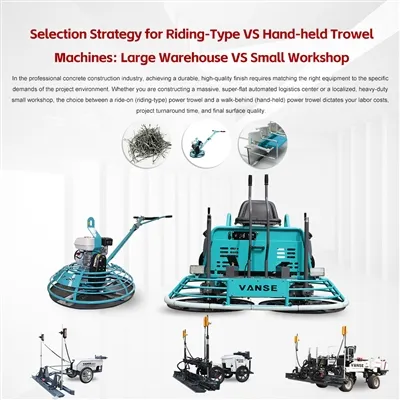
In the professional concrete construction industry, achieving a durable, high-quality finish requires matching the right equipment to the specific demands of the project environment. Whether you are constructing a massive, super-flat automated logistics center or a localized, heavy-duty small workshop, the choice between a ride-on (riding-type) power trowel and a walk-behind (hand-held) power trowel dictates your labor costs, project turnaround time, and final surface quality. To maintain high E-E-A-T (Experience, Expertise, Authoritativeness, and Trustworthiness) standards in concrete flooring, contractors must deploy a strategic equipment selection process. Here is the ultimate guide to selecting the right concrete finishing machinery for your next project, featuring industry-leading insights and equipment solutions from Shandong Vanse Machinery Technology Co., Ltd. (www.vansemac.com). The Requirement: Massive daily pour volumes, strict international Floor Flatness (FF) and Floor Levelness (FL) tolerances, and high surface wear resistance. For expansive commercial and industrial spaces, the riding-type power trowel is the undisputed necessity. Utilizing walk-behind equipment in a massive warehouse is an operational bottleneck that dramatically inflates labor costs and risks the concrete curing before the finishing phase is complete. Superior Surface Compaction: Ride-on trowels, such as the heavy-duty models offered by Vanse Machinery, feature dual-rotor systems and weigh significantly more than hand-held units. This intense mechanical weight drives coarse aggregates down and brings the cement paste to the top, resulting in a highly densified, burnished finish that resists the heavy dynamic loads of forklifts and automated storage and retrieval systems (ASRS). Protecting FF and FL Metrics: When pouring super-flat floors, contractors rely on advanced Concrete Laser Screeds (like the Vanse YZ30-4E or YZ40-4E telescopic boom models) to establish the perfect grade. A ride-on trowel operator sits on the machine, meaning no human footprints disrupt the freshly leveled surface. The wide, overlapping stance of the machine acts as a massive smoothing plane, locking in the laser-guided levelness. Exponential Efficiency (OpEx Savings): A single operator on a high-speed ride-on trowel can cover thousands of square meters in a fraction of the time it takes a manual crew. This rapid turnaround is essential for preventing cold joints and keeping international construction projects ahead of schedule. The Requirement: Maneuverability, cost-effectiveness, and precision around structural obstacles. Not every project has the square footage to justify the deployment of heavy riding equipment. For small workshops, residential garages, retail expansions, or tight mezzanine decks, the walk-behind power trowel is the strategic choice. Unmatched Maneuverability: Walk-behind trowels excel in confined spaces. They can easily navigate around plumbing stub-outs, structural columns, and tight corners where a bulky ride-on machine simply cannot fit or safely maneuver. Lower Capital Expenditure (CapEx): For smaller contracting firms or specialized repair teams, hand-held trowels require a much lower initial investment while still providing the mechanized blade rotation necessary for a smooth, hard trowel finish. Ease of Transport: Walk-behind units are lightweight and can be easily loaded into standard service trucks or elevated to upper-deck projects without the need for heavy-duty telehandlers or cranes. For global contractors handling comprehensive commercial builds, the selection strategy is rarely "either/or." It is highly recommended to view concrete finishing as an integrated ecosystem. As demonstrated by the comprehensive product lineup at Vanse Group, a flawless commercial floor requires a hybrid deployment: The Primary Output: Deploy the Ride-On Power Trowel to handle the vast 90% of the open warehouse floor space, matching the rapid advancement of the laser Leveling. The Perimeter Polish: Simultaneously deploy a team with Walk-Behind Power Trowels to follow the perimeter, expertly finishing the critical edge work along the formwork, walls, and structural pillars where the ride-on machine cannot safely reach. Selecting the correct concrete power trowel is a direct calculation of project scale, labor economics, and required floor specifications. For vast, seamless industrial floors, ride-on trowels are critical for efficiency and super-flat compaction. For confined workshops and precise edge-work, walk-behind trowels remain indispensable. By equipping your fleet with a balanced combination of reliable, high-performance machinery from an authoritative manufacturer like Shandong Vanse Machinery, you ensure your contracting business can competitively bid on-and flawlessly execute-any project, from the smallest workshop to the largest global logistics center. Note: The parameters provided in this document are for reference only and are not mandatory. Due to differences in technical characteristics between different brands and models of laser levelers, please consult the manufacturer for a suitable solution before actual operation. This reference document assumes no responsibility for any issues arising from failure to follow the manufacturer's instructions.Analysis of the Causes of Unstable Laser Signals in Concrete Laser Leveling and Treatment Measures
The following is a detailed answer to the analysis of the causes of unstable laser signals in Concrete Laser Leveling and the corresponding treatment measures. Unstable laser signals are one of the common faults in the construction of Concrete Laser Leveling, which will directly lead to a decrease in the leveling accuracy and affect the flatness and quality of the floor. It is of vital importance to quickly locate and solve problems. The main causes of unstable laser signals come from four aspects: the laser emitter, the signal receiver, the external environment and the machinery itself. Power supply issue: Insufficient battery power or poor contact of the power adapter leads to unstable power supply to the laser and fluctuations in output power. Laser itself malfunction: Aging, damage of the laser module or loosening or contamination of internal optical components (such as lenses) can cause the beam to diverge or drift. Unstable reference point: The tripod of the laser emitter is not stably set up and may slightly move or sink under the influence of wind or human touch. Automatic calibration failure: The calibration system of the transmitter with self-leveling function (such as pendulum, magnetic damping or electronic sensor) malfunctions and cannot maintain a stable level reference. Power connection issue: The connection cable between the receiver and the main body of the leveler is loose, poorly connected or damaged. Sensor failure: The photoelectric sensor on the receiver is aged, its sensitivity has decreased, or it is covered with dirt (dust, cement slurry), making it impossible to accurately identify the laser signal. Improper installation: The receiver is not correctly installed on the mast, or there is severe vibration at the installation position, which affects signal reception. Strong light interference: The intense sunlight at noon, especially its infrared spectrum, can interfere with the receiver's recognition of laser signals. Obstruction: Temporary obstructions such as scaffolding, personnel, and equipment at the construction site block the laser beam, causing signal discontinuity. Vibration interference: There are large equipment (such as excavators, heavy trucks) operating nearby, or the laser emitter is set up on a platform with obvious vibration, causing the reference optical path to jitter. Atmospheric disturbance: At super-large construction sites, heat waves caused by high ground temperatures can lead to uneven air density, resulting in slight refraction and jitter of laser beams. Mechanical vibration: If the engine of the Leveling machine operates unsmoothly or the hydraulic system vibrates excessively, the vibration will be transmitted to the receiver, introducing signal noise. Electrical system interference: The generator, frequency converter or high-current circuit of the leveling machine itself generates electromagnetic interference, affecting the sensitive receiver circuit. Follow the principle of "from simple to complex and from outside to inside" in the investigation. Check the power supply: Ensure that the laser emitter is fully charged and all power connections are firm and reliable. Clean and inspect optical components: Use dedicated lens cleaning paper to clean the output lens of the laser emitter and the sensor window of the receiver. Stable reference: Confirm that the laser emitter tripod is firmly set up on a solid floor and kept away from vibration sources. Use counterweights to stabilize the tripod when necessary. Eliminate environmental interference Shading: Install a sunshade on the receiver to prevent direct exposure to strong light. Obstacle clearance: Inspect and clear all possible obstacles along the laser propagation path. Vibration avoidance: Suspend operations that generate strong vibrations nearby or move the position of the laser emitter. 5. Restart the system: Turn off the power of the laser emitter and the leveler, wait for one minute, and then restart to reset the electronic system. 6. Calibration check Manually rotate the transmitter to check if it can provide a stable signal throughout the entire 360-degree range. Use professional tools to check whether the automatic leveling function of the laser emitter is normal. If necessary, send it for repair and calibration. 7. Substitution method test Install the receiver on another confirmed normal level machine for testing. If the problem persists, it indicates that the receiver is faulty. Replace it with a confirmed normal laser emitter. If the problem is solved, the original emitter needs to be repaired. 8. Inspect the cables and connections: Carefully check all the cables from the receiver to the main controller for any signs of compression, wear or breakage, and reinsert all the connectors. 9. Seek professional support: If none of the above steps can solve the problem, it is very likely that there is a hard fault with the electronic components inside the laser or the receiver. At this point, you should immediately contact the after-sales service department of the equipment manufacturer (such as Shandong Wansai Technology) for diagnosis and repair by professional technicians. Do not disassemble the core components by yourself. Regular maintenance: Clean and calibrate the laser transmitter and receiver regularly in accordance with the operation manual. Standard operation: Set up and move the equipment correctly to avoid violent impacts. On-site investigation: Observe the on-site environment before construction, plan the installation position of the laser emitter in advance, and avoid potential interference sources. Backup equipment: For critical projects, it is recommended to prepare backup laser transmitters or receivers to deal with sudden malfunctions. Through systematic analysis and step-by-step investigation, the problem of unstable laser signals of concrete Laser Leveling machines can be efficiently solved, ensuring the quality and efficiency of construction. Note: The parameters provided in this document are for reference only and are not mandatory. Due to differences in technical characteristics between different brands and models of laser levelers, please consult the manufacturer for a suitable solution before actual operation. This reference document assumes no responsibility for any issues arising from failure to follow the manufacturer's instructions.