Technical Knowledge
How does the control system control the operating status and parameters of the concrete laser leveling?


The control system controls the operating status and parameters of the concrete laser leveling mainly through the following methods:
1. Sensor technology:
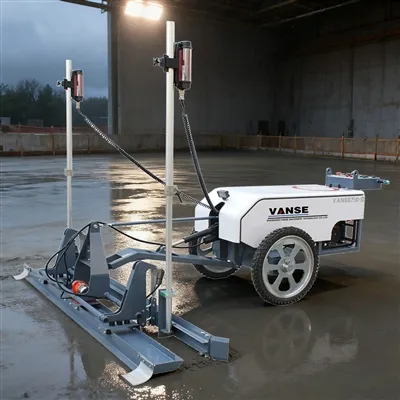
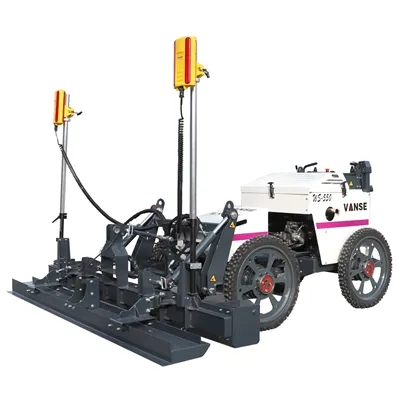
Laser leveling machines are equipped with a variety of sensors, such as laser receivers, level sensors, vibration sensors, etc., to monitor the height, levelness and vibration status of concrete. These sensors feed real-time data back to the control system.
2. Embedded system:
The em
bedded system processes the data received from the sensor and determines the operating status of the leveler based on preset parameters. If data that does not meet the preset conditions is detected (for example, the concrete is too high or too low, or the equipment vibrates too much), the system will automatically adjust the operating parameters of the leveling or issue an alarm to prompt operator intervention.
3. Human-machine interface:
The operator observes the real-time data and graphics provided by the control system through the human-machine interface, such as equipment location, concrete thickness, etc., and can manually adjust operating parameters. In addition, when an error occurs in the system, the interface will display the corresponding error code or information for operator reference.
4. Communication technology:
The control system exchanges data with the leveling machine through wireless or wired communication technology to achieve remote monitoring and operation. For example, operators can remotely control and adjust parameters of a concrete laser leveling from the control room.
5. Database technology:
The control system is usually equipped with a database to store information such as historical data and error codes of equipment operation. This data can be used for troubleshooting, performance analysis and quality control.
6. Safety protection:
The control system also includes a safety protection mechanism to ensure that the leveling machine can automatically shut down or take other safety measures under abnormal circumstances, such as overload protection, overheating protection, etc.
7. Programmable logic controller (PLC):
In some
more advanced systems, programmable logic controllers are used to control various actions and logical processes of the leveling machine. Through programming, complex control logic and automated processes can be realized.
To sum up, the control system controls the operating status and parameters of the concrete laser leveling machine by comprehensively using various technologies and mechanisms to ensure that the equipment completes its work efficiently and safely.
Thanks to All the Friends Who Support and Trust Shandong Vanse Machinery Technology Co., Ltd.
If you want to know more about Shandong Vanse Machinery Technology Co., Ltd. or have any questions, please feel free to contact us:
Our Factory
Shandong Vanse Machinery Technology Co., Ltd.








Share this article

About the Author: Shandong Vanse Machinery Technology Co., Ltd.
Shandong Vanse Machinery Technology Co., Ltd. is a high-tech manufacturer specializing in concrete construction machinery, including laser screeds and related equipment. The company integrates R&D, production, and global sales, with products exported to over 60 countries and widely used in infrastructure projects worldwide.
Previous Post
Next Post
Related Articles
You Might Also Like
Special technical measures for safety protection in concrete pouring construction
Objective: To prevent safety accidents such as collapse, falls from heights, mechanical injuries, and electric shock during concrete pouring construction, ensure the safety of construction workers' lives and equipment and property, and standardize operation procedures, this special measure is formulated in accordance with regulations and standards such as the "Code for Safety Inspection of Construction Sites" (JGJ59) and the "Code for Construction of Concrete Structures" (GB50666). Scope of application: This measure is applicable to various concrete pouring operations in building construction, municipal engineering, Bridges, tunnels, etc., including the pouring construction of different parts such as foundations, main structures, and secondary structures. Before construction, a special construction plan should be prepared, clearly specifying the pouring sequence, material distribution method, machinery selection and safety protection requirements. It should be implemented after approval by the technical supervisor. Conduct three-level safety briefings for all personnel involved in the operation: project-level briefing on the overall safety risks of the construction, team-level briefing on the operation norms of the positions, and on-site briefing on the potential hazards of specific operation points (such as edges, openings, and high-voltage line locations). The briefings must be signed for confirmation and archived. Inspect the surrounding environment of the pouring area: Clear the debris on the work surface, and confirm that 1.2-meter-high guardrails have been set up at the edges (such as foundation pits, floor slab edges) and openings (with 20cm high toe boards at the bottom of the guardrails and an additional horizontal bar in the middle). The guardrails should be painted with red and white warning paint and hung with close-mesh safety nets. Check the load on the working surface: Verify the bearing capacity of the formwork support system to ensure that the concrete stacking height does not exceed the specification requirements (the stacking height during floor slab pouring is ≤100mm), and prevent the support from collapsing due to overloading. Check for electrical safety: Confirm that the distribution box meets the requirements of "one machine, one switch, one leakage protection, and one protection". The cables in the pouring area should be overhead or run through pipes for protection to prevent damage from being crushed. When working in a humid environment, the lighting voltage should be 36V or lower, which is a safe voltage. Concrete conveying equipment (pump trucks, ground pumps, placing machines) : Check whether the braking system, hydraulic system and pipe joints of the equipment are in good condition. The outriggers of the pump truck need to be supported on a solid ground (with steel plates or square timbers as pads), and confirm that the outriggers are fully extended and the ground bearing capacity meets the requirements. Protective supplies: Personal protective equipment such as safety helmets, anti-slip shoes, insulating gloves, and dust masks should be provided. When working at heights, safety belts (high hanging and low use) and operation platforms (fully covered with scaffolding boards and surrounded by guardrails) should be prepared. Backup emergency supplies (such as first aid kits, fire extinguishing equipment, and warning tapes). High-altitude work protection: When the pouring height is ≥2 meters, an operation platform or scaffolding must be used. It is strictly prohibited to stand on formwork or steel bars for work. Workers should fasten their safety belts, and the hooks of the safety belts should be hung on solid structural components. It is strictly prohibited to walk on unfixed components. Edge operation protection: When pouring foundation pits, slopes and other edge parts, set up warning areas and prohibit non-operation personnel from entering. Workers should maintain a safety distance of no less than 1 meter from the edge of the edge. Anti-slip scaffolding boards should be laid if necessary. Dust-proof and heat-proof protection: During summer pouring, shading measures should be taken to prevent personnel from suffering from heatstroke. When pouring in winter, when hot water is used to mix concrete, it is necessary to prevent steam scalding. Workers should wear anti-scalding gloves. When there is a lot of cement dust, wear dust masks and set up spray dust suppression equipment on site. Operation precautions for pump trucks and material distribution machines: No one is allowed to stand within the rotation radius of the material distribution rod of the pump truck. Before operation, make sure there are no high-voltage lines or obstacles within the rotation range. The placing machine should be firmly fixed. Before use, check whether the outriggers and the rotating mechanism are locked. It is strictly forbidden to carry out pouring operations when the placing machine is in motion. Vibrator usage protection: The operator of the vibrator should wear insulating shoes and insulating gloves. The cable of the vibrating rod should be protected from damage. It is strictly forbidden to drag the cable. When vibrating, avoid touching the steel bars and formwork to prevent the vibration rods from bouncing and injuring people. When the vibrator is not in use, cut off the power supply and place it in a dry area. Concrete transportation protection: When transporting concrete by tanker, the driver must abide by traffic rules. No one is allowed to stand under the unloading port of the tanker. The ground pump conveying pipeline is firmly fixed. Check the sealing condition of the pipeline joints to prevent concrete leakage and spraying from injuring people. When replacing the pipeline, first turn off the power of the ground pump, release the pressure, and then disassemble it. During the pouring process, dedicated personnel should be assigned to monitor the formwork support system, with a focus on checking the verticality of the vertical rods, the spacing of the horizontal rods, and the setting of the sweeping rods. If any deformation of the vertical rods or loosening of the horizontal rods is found, the pouring should be immediately halted, and personnel should be organized to evacuate. Work can resume only after the reinforcement and rectification are completed. The pouring sequence follows the principle of "symmetrical pouring and layered pouring" to avoid instability of the support system due to excessive local loads. The thickness of the layered pouring shall be carried out in accordance with the specifications (generally ≤500mm), and it is strictly prohibited to pour the formwork in a centralized manner at one time to avoid deformation. Regular maintenance and servicing of concrete conveying equipment, vibrators and other machinery should be carried out. The operating status of the equipment should be recorded. If any fault is found, the machine should be stopped immediately for repair. It is strictly prohibited to operate with faults. Mechanical operators must be certified and familiar with the equipment operation procedures. Unlicensed personnel are strictly prohibited from operating. When the pump truck is in operation, a dedicated person should be assigned for command. The command personnel should use standard signals (flag language or walkie-talkies) to avoid communication errors with the driver. When the fabricating machine is moving, it should proceed slowly to prevent collision with structural components or personnel. On-site electricity usage should be operated by professional electricians. It is strictly prohibited for non-electricians to connect or disconnect wires. The distribution box in the pouring area is locked and a warning sign saying "Beware of Electric Shock" is posted. There are no debris within 1.5 meters around the distribution box. When working in rainy weather, cover the distribution box and electrical equipment, and check the grounding resistance (grounding resistance ≤4Ω) to prevent leakage accidents. After the operation is completed, cut off the power supply of all equipment, organize the cables, and avoid crushing or soaking them. Collapse accident handling: In the event of a collapse of the formwork support, immediately stop the operation, organize personnel to evacuate to a safe area, and prohibit blind rescue. Call the 120 emergency number and at the same time use excavators, jacks and other equipment to clear the collapsed objects and rescue the trapped people to prevent secondary collapse. Handling of falls from heights and mechanical injuries: In the event of a person's fall or mechanical injury, immediately stop the operation, transfer the injured person to a safe area, check the injured person's consciousness and breathing. If fractures or bleeding occur, take temporary immobilization and hemostasis measures, and call 120 for medical treatment. In the event of an electric shock accident, cut off the power supply first, then rescue the injured person to prevent the rescuers from getting electrocuted. Fire accident handling: In case of fire caused by electrical faults or flammable materials burning, immediately cut off the power supply, use on-site fire extinguishing equipment to put out the fire, evacuate people to a safe area, call 119 to report the fire, and at the same time clear flammable materials around to prevent the fire from spreading. Daily inspection: Before each day's work, the team conducts a pre-shift safety inspection, with a focus on personal protective equipment, equipment status, and protective facilities. The project organizes safety inspections every week to identify potential hazards and issue rectification notices, and follows up on the rectification progress. Special acceptance: Before pouring, a special acceptance shall be conducted on the formwork support system, operation platform and electrical equipment. Only after the acceptance is qualified and signed for confirmation can the pouring operation begin. If the acceptance is not qualified, construction is strictly prohibited until the rectification meets the standards. Safety education and training should be provided to newly arrived workers. Only after passing the assessment can they take up their posts. Regularly organize special training on concrete pouring safety, explaining accident cases, operation norms, and emergency skills to enhance personnel's safety awareness. Special operation personnel (such as pump truck drivers, electricians, and scaffolders) must hold relevant certificates to work. Those with expired certificates or those that have not undergone annual review are prohibited from engaging in related operations. Regularly organize refresher training for special operation personnel to update their safety knowledge. Instructions for Use: This plan is a general template. Before the specific implementation of each project, it should be refined and supplemented according to the characteristics of the project (such as super-high, super-heavy, large-span structures, etc.), especially the control measures for major hazard sources.When using the concrete laser leveling machine, you must control the temperature!
When the concrete laser leveler is working on the road surface, the temperature increase may cause some parts of the equipment to overheat, thus affecting the correct leveling effect of the equipment. So, how should the temperature of the leveler be controlled during operation? Next, let's take a look at how our company's technicians teach you how to control the temperature of the leveler during operation! First of all, controlling the temperature of the leveler is one of the keys to ensuring the quality of leveling. When the equipment is leveling, it should meet the requirements of relevant standards according to the asphalt type, grade, consistency, ambient temperature, leveling thickness, etc. . Secondly, when the construction temperature of expressways and first-class highways is lower than 10℃, and the construction temperature of other grades of highways is lower than 5℃, it is not suitable for leveling. If leveling work must be carried out, the temperature of the road leveler should be increased, and there are also low-temperature leveling requirements that meet the regulations. The material transporter must have insulation measures, and high-precision levelers should be used as much as possible to start paving, and the trade plate should be heated and leveled immediately after the pressure is applied to shorten the length of the pressure. Finally, remember that leveling should meet the requirements of relevant standards according to asphalt type, grade, consistency, ambient temperature, leveling thickness, etc., so that it is relatively simple and easy to control the temperature. 1. After completing the leveling operation, perform routine maintenance operations in accordance with the contents of the routine maintenance procedures. 2. The working devices and motion mechanisms of the leveling machine that are in direct contact with the asphalt mixture during the operation should be sprayed with diesel after the operation and then run for a period of time to remove the residual asphalt on them, so that they can operate freely and rotate flexibly. It is forbidden to spray diesel on the electronic control system and spiral wire to prevent fire when the power is turned on. 3. After leveling the fly ash soil, flush with water to flush away the white material. After flushing, use waste hydraulic oil to lubricate the active parts of the scraper conveyor chain and apply anti-rust oil to the piston rod. Be careful not to flush water to the electrical appliances and bearings to prevent short circuits and foreign objects from entering the bearings. 4. Clean and check the lifting and adjusting device of the longitudinal slope meter, and lubricate the screw with grease. Apply grease to the floating arm slide rail. Fill each oil filling point with grease until the joints overflow. For levelers with oil filling cups, observe the consumption and fill them up at any time. Have you learned all the above? If you want to know more about concrete laser levelers, please continue to pay attention to this websiteCost-Benefit Comparison of Laser Leveling Machine and Traditional Manual Leveling (Labor Savings VS Equipment Investment)
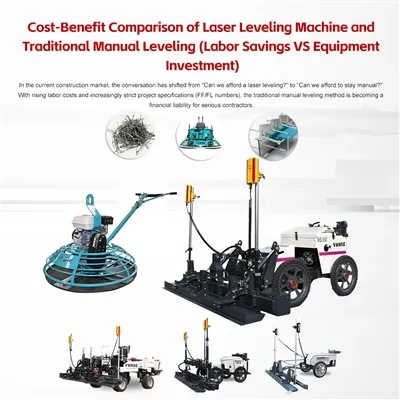
In the current construction market, the conversation has shifted from "Can we afford a laser leveling?" to "Can we afford to stay manual?" With rising labor costs and increasingly strict project specifications (FF/FL numbers), the traditional manual leveling method is becoming a financial liability for serious contractors. If you're weighing the Equipment Investment of a Vanse Concrete Laser Leveling Machine against the perceived "low cost" of manual labor, here is the professional breakdown of the real ROI. Manual leveling is slow, grueling, and dependent on the physical stamina of your crew. Manual: A highly skilled 10-man crew might manage 600–800m² in a long, exhausting day. Vanse Workflow: With a Vanse YZ25-4/YZ28-4S/WS940/WS940C or the telescopic YZ30-4E, that same crew (or even a smaller one) can easily cover 2,500–3,500m² per day. The Math: You are essentially quadrupling your output. In the international market, where project timelines are aggressive, this speed allows you to take on 3x more projects per year with the same headcount. The "hidden cost" of manual leveling isn't just the hourly wage; it's the insurance, the management, and the human error. Manual: You need a massive team for distribution, leveling, and vibrating. The Vanse Fleet Solution: Replace 4 guys with shovels with one Vanse Concrete Distributor or a Mini Dumper. Replace the 6-man leveling team with one Concrete Laser Leveling Machine operator. Instead of manual "dusting," use an Automatic Topping Spreader to ensure uniform wear-resistance. Result: You cut your specialized labor requirements by over 50%. In regions like North America or Europe, the machine often pays for itself in labor savings alone within 6–9 months. Manual leveling rarely hits the "Superflat" specs required for modern VNA warehouses. The Risk: If a manual floor fails an FF/FL test, you face the nightmare of grinding or, worse, a "rip and replace" order. The Vanse Guarantee: Vanse machines react to laser signals 10 times per second. By using a Vanse Power Trowel following the laser leveling, you achieve a "burnished" mirror finish that passes inspection the first time. Precision Concrete Cutting Machines from Vanse then ensure the joints are clean, preventing late-stage cracking. Metric Traditional Manual Leveling Vanse Laser Leveling System Crew Size 10–15 Workers 4–6 Workers Daily Output 500 – 800 m² 2,500 – 3,500 m² Precision (FF/FL) Low to Medium (Subject to fatigue) High to Superflat (Consistent) Physical Strain Extremely High (High turnover) Low (Operated via joystick/seat) Surface Hardness Uneven (Manual spreading) Superior (Automatic Topping Spreader) Long-term Cost High (Labor + Rework risk) Low (Maintenance + Depreciation) When you visit www.vansemac.com, you aren't just looking at a price tag; you're looking at a business transformation tool. The Concrete Distributor and Mini Dumper handle the heavy lifting. The Laser Leveling Machine handles the precision. The Topping Spreader and Power Trowel handle the durability. The Concrete Cutting Machine handles the finish. If your business goal is to stay small and handle residential driveways, manual is fine. But if you want to bid on Amazon-scale warehouses, logistics hubs, or high-end industrial bays, the equipment investment in a Vanse fleet is the only way to remain competitive. The investment isn't just in the steel and hydraulics; it's an investment in guaranteed quality and massive labor efficiency. Explore the full range and request a quote at www.vansemac.com to see how the numbers work for your specific market. Note: The parameters provided in this document are for reference only and are not mandatory. Due to differences in technical characteristics between different brands and models of laser levelers, please consult the manufacturer for a suitable solution before actual operation. This reference document assumes no responsibility for any issues arising from failure to follow the manufacturer's instructions.