Technical Knowledge
How do the sensitivity & reception range of the laser receiver affect the construction effect of the leveler?
The sensitivity and reception range of the laser receiver have an important impact on the construction effect of the concrete laser leveling machine, which is mainly reflected in the following aspects:
1. Construction accuracy:
The higher the sensitivity of the laser receiver, the stronger the laser signal that can be received, thereby more accurately detecting the height and level of concrete. This helps ensure the accuracy of the leveling's construction, reducing errors and improving overall flatness.
2. Construction efficiency:
The reception range of the laser receiver determines the working range and speed of the leveler. If the receiving range is small, the leveler needs to stop frequently to adjust its position, which will reduce construction efficiency. A laser receiver with a larger reception range can support faster and continuous construction, thereby improving the operating efficiency of the leveler.
3. Degree of automation:
Laser receivers with high sensitivity and large receiving range can support a higher degree of automated construction. For example, by integrating with automatic control systems, functions such as remote control, automatic navigation, and real-time monitoring can be realized, further reducing manual intervention and improving the level of automation and intelligence in construction.
4. Adaptability and flexibility:
The sensitivity and reception range of the laser receiver will also affect the adaptability and flexibility of the leveler to different construction environments and conditions. For example, in complex construction environments, laser receivers with high sensitivity and large reception range can better cope with special situations such as obstacles, slopes, and corners, ensuring the consistency and stability of construction effects.
In summary, the sensitivity and reception range of the laser receiver have a multifaceted impact on the construction effect of the concrete laser leveler. Therefore, selecting the right laser receiver and performing proper calibration and adjustment are crucial to optimizing the construction results of the leveling.
Thanks to All the Friends Who Support and Trust Shandong Vanse Machinery Technology Co., Ltd.
If you want to know more about Shandong Vanse Machinery Technology Co., Ltd. or have any questions, please feel free to contact us:
Our Factory
Shandong Vanse Machinery Technology Co., Ltd.








Share this article

About the Author: Shandong Vanse Machinery Technology Co., Ltd.
Shandong Vanse Machinery Technology Co., Ltd. is a high-tech manufacturer specializing in concrete construction machinery, including laser screeds and related equipment. The company integrates R&D, production, and global sales, with products exported to over 60 countries and widely used in infrastructure projects worldwide.
Previous Post
Next Post
Related Articles
You Might Also Like
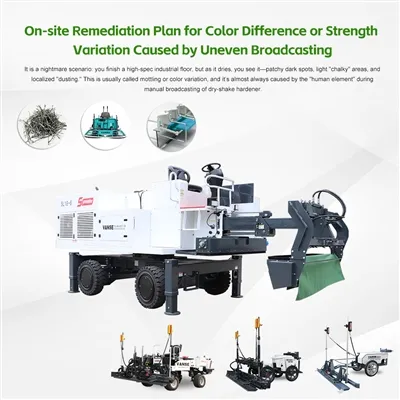
On-site Remediation Plan for Color Difference or Strength Variation Caused by Uneven Broadcasting
It is a nightmare scenario: you finish a high-spec industrial floor, but as it dries, you see it-patchy dark spots, light "chalky" areas, and localized "dusting." This is usually called mottling or color variation, and it's almost always caused by the "human element" during manual broadcasting of dry-shake hardener. If you are facing a "leopard-print" floor or inconsistent surface strength, here is the professional On-site Remediation Plan, along with the Vanse technical workflow to ensure it never happens again. Before you fix it, you need to know why it failed. Uneven Broadcasting: Manual throwing from a bucket creates "thick" and "thin" zones. Timing Issues: Some areas were "over-troweled" while still wet, while others were finished too late. The Vanse Prevention Tip: The best remediation is prevention. Using the Vanse Automatic Topping Spreader instead of manual labor ensures a 100% uniform grams-per-square-meter application. By linking the spreader's output to the machine's speed, you eliminate the "human error" that causes color shifts and weak spots. If the strength variation is severe (the surface is "powdering"), you have to remove the weak layer. The Process: Use a planetary floor grinder with 30/40 grit metal-bond diamonds to strip away the inconsistent "skin." The Vanse Tool for the Job: In cases where deep remediation is needed, use a Vanse Concrete Cutting Machine (Floor Saw) to create clean, straight boundaries around the affected area if a partial re-pour is required. This ensures the "patch" doesn't spall or crack at the edges. Once the surface is opened up, you need to fix the strength variation. The Process: Apply a high-quality Lithium or Sodium Silicate Densifier. This penetrates the concrete, reacts with the free lime, and creates a uniform, hard-shell finish across both the "weak" and "strong" zones. Blending the Color: Use a tinted sealer or a "color-matched" penetrant during the densification process to mask the mottling and create a visually consistent finish. After densifying, you need to "seal" the surface mechanically. The Process: Transition to a Vanse Ride-on Power Trowel. With its high-torque engine and precision pitch control, you can "burnish" the densified surface. The heavy compaction of the Vanse rotors helps to blend the color and close the pores, resulting in a dense, dust-free, and uniform finish. Global buyers are moving away from manual methods because the cost of remediation is 3x higher than the cost of doing it right the first time. Here is the Vanse "Gold Standard" Workflow to avoid color and strength issues: Uniform Placement: Use a Vanse Concrete Distributor or a Mini Dumper to place the base slab. This ensures the water-cement ratio is consistent across the entire bay, preventing "wet spots" that cause color variation. Consolidated Leveling: Use a Vanse Concrete Laser Leveling Machine . Its high-frequency vibration consolidates the slab from the bottom up, ensuring a uniform "paste" is available to bond with the hardener. Mechanical Spreading: The Vanse Automatic Topping Spreader is your insurance policy. It applies the hardener in a single, even pass immediately behind the laser leveling, guaranteeing uniform strength and color. Precision Finishing: The Vanse Power Trowel provides the final compaction, "locking in" the color and density. Look, we've all been there-trying to "save money" by using manual labor for broadcasting, only to spend three times that amount on grinding and densifiers later. If you want to bid on FM1/FM2 high-spec projects, you need the precision of a Vanse fleet (www.vansemac.com). Stop fixing floors and start finishing them. Visit Vanse Machinery today to see how our Topping Spreaders and Laser leveling can guarantee your color and strength consistency on every pour. Note: The parameters provided in this document are for reference only and are not mandatory. Due to differences in technical characteristics between different brands and models of laser levelers, please consult the manufacturer for a suitable solution before actual operation. This reference document assumes no responsibility for any issues arising from failure to follow the manufacturer's instructions.A comprehensive understanding of the components of high performance concrete laser leveling
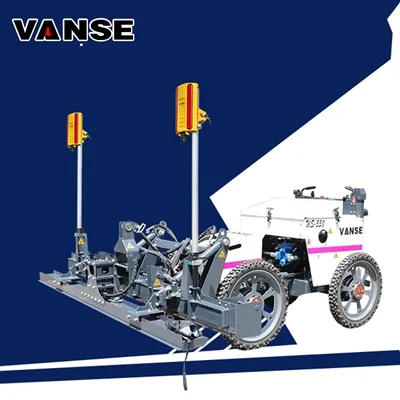
The laser leveling machine can bring us many advantages when it is used. I believe that all the friends who have used it should have realized it. Although everyone is very comfortable when operating the leveling machine, it is necessary to talk about the laser leveling machine. The components, then many friends are not clear, it seems that everyone is not careful enough about the leveling machine, the following article will lead everyone to learn more about the components of the laser leveling machine. Vanse boomed laser leveling machine Components of the laser leveler: 1. Steering system: It consists of steering wheel, steering gear, steering knuckle, steering knuckle arm, tie rod and straight rod. The function is steering. Battery: The function of the battery is to supply power to the starter, and to supply power to the engine ignition system and other consumers during engine start or low speed operation. When the engine is running at high speed, the generator generates enough power and the battery can store excess power. Hydraulic brake structure: The hydraulic brake device consists of a brake pedal, a master cylinder, a sub-pump, a drum (wheel) brake and a fuel pipe. 2. Motor: The motor is the power unit of the laser leveling machine. Its main function is to generate drive torque as a power source for electrical appliances or various machines. Its main function is to use mechanical energy to convert into electric energy. At present, it is more common to use heat energy, water energy, etc. to drive the generator rotor to generate electricity. 3. Transmission: It is composed of transmission case, transmission cover, first shaft, second shaft, intermediate shaft, reverse shaft, gear, bearing, operating mechanism, etc. It is used for variable speed and variable output torque of laser leveling machine. 4, leaf springs and shock absorbers: the role of leaf springs is to maintain a flexible connection between the frame and the body and the wheel or axle. The function of the shock absorber is to moderate the vibration when the laser leveler is subjected to shock. 5. Transmission system: It is mainly composed of transmission, universal joint, transmission shaft and drive axle. 6, driving system: consists of the frame, axle, suspension and wheels. Its basic function is to support the quality of the whole car and to ensure the driving of the laser leveler. 7. Starter: Its function is to convert electrical energy into mechanical energy, drive the crankshaft to rotate, and start the engine. If the continuous starting time is too long, it will cause a large discharge of the battery and the starter coil will overheat and smoke, which will easily damage the laser leveling machine.How does a concrete laser screed machine achieve efficient concrete vibration and compaction?
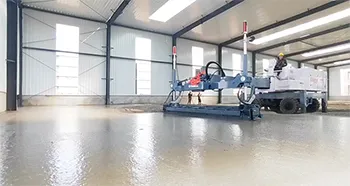
Concrete laser leveling machines achieve efficient concrete compaction through vibration, primarily through the coordinated design of their integrated vibrating system and levelinging process. The core principle is to ensure that the concrete reaches a dense state before initial setting through high-frequency vibration energy transmission, combined with precise laser positioning control. This is achieved as follows: The machine's base is typically equipped with multiple vibrating rods (or blades), which are driven by hydraulics or motors to generate high-frequency vibrations (typically 2,000-5,000 vibrations per minute) . This high-frequency vibration rapidly transmits to the unset concrete, forcing out air bubbles and realigning aggregate particles, filling gaps and reducing defects such as honeycombing and rough surfaces. The vibrating device can be adjusted in depth (typically 0-300mm) based on the concrete thickness, ensuring that the vibration energy reaches the bottom of the concrete, avoiding excessive vibration of the surface layer while leaving deeper layers undercompacted. The vibration range matches the paving width of the leveling machine, operating synchronously with the machine's movement, achieving an integrated "paving-vibration-leveling" process and reducing efficiency losses caused by time-to-step intervals. The laser system provides a horizontal reference, ensuring the surface flatness of the vibrated concrete meets requirements. During the vibration process, the machine's hydraulic leveling mechanism adjusts the height of the vibrator in real time to avoid uneven surface fluctuations caused by uneven vibration force, ensuring both density and paving the way for subsequent leveling. For concretes with different slumps (such as dry hard concrete and plastic concrete), the control system adjusts the vibration frequency and amplitude: Concrete with a lower slump requires a higher frequency to break down friction between aggregates; concrete with a higher slump requires a lower frequency to avoid segregation caused by excessive vibration. In summary, its high efficiency is reflected in its concentrated vibration energy, matching operating range, and seamless integration with the leveling process. Furthermore, its adjustable parameters adapt to diverse construction requirements, ultimately ensuring both concrete density and surface accuracy.