Technical Knowledge
How does the concrete laser leveling’s high-frequency vibration system affect the quality and density of the concrete slab?
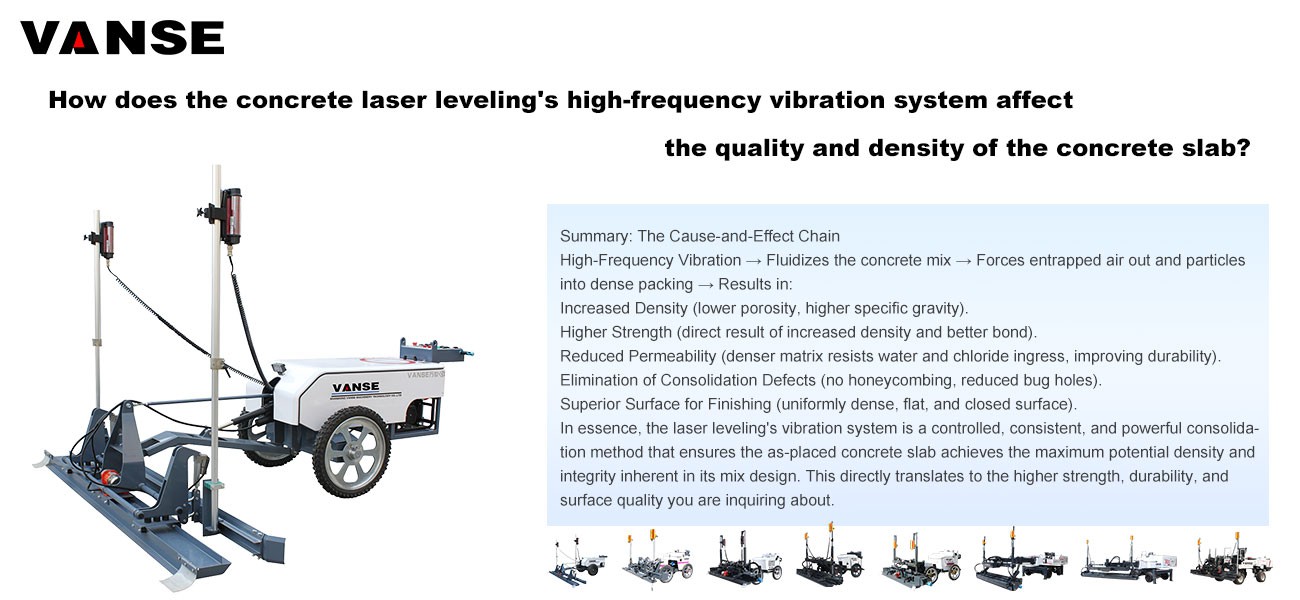
Excellent question. The high-frequency vibration system in a laser leveling is the core technology that directly addresses your inquiries about strength, compaction, and surface defects. Its impact is profound and multifaceted.
Here’s a detailed breakdown of how it affects concrete slab quality and density:
Core Principle: Fluidization and Particle Rearrangement
The system uses rapidly vibrating (high-frequency, typically 3,500 – 6,000+ VPM) blades or pans. This vibration is transmitted directly into the concrete mass, momentarily liquefying the cement paste. This reduces internal friction, allowing aggregate particles to settle and rearrange under gravity into a denser, more efficient packing arrangement.
Direct Impact on Quality and Density:
Achieving Higher Strength
Reduced Void Ratio: The primary driver of increased compressive and flexural strength is the reduction of entrapped air voids. Less air means more solid material per unit volume, allowing the concrete to bear higher loads.
Improved Cement Paste Contact: Better particle packing brings aggregate surfaces into more intimate contact with the cement paste, enhancing the bond and the efficiency of the hydration process.
Homogeneity: Vibration eliminates pockets of weak, aggregate-deficient mortar or paste, creating a uniformly strong matrix throughout the slab.
Achieving Better Compaction
Consolidation from Bottom-Up: Unlike hand-held vibrators that work from the top down, the laser leveling's vibrating pan acts across the entire surface area, consolidating the entire lift (up to its design depth, typically 10-12 inches) uniformly and simultaneously.
Elimination of Entrapped Air: The high-frequency waves effectively force entrapped air bubbles to rise to the surface. This is critical for density. The result is a specific gravity much closer to the theoretical maximum of the mix design.
Handles Stiff Mixes: It allows the use of lower slump (stiffer) concrete mixes, which have higher potential strength and reduced shrinkage, by providing the energy needed to consolidate them properly-a task difficult with manual methods.
Reducing Surface Defects (Honeycombing, etc.)
Prevents Honeycombing: Honeycombing is the direct result of inadequate consolidation, where aggregate pockets form without surrounding mortar. The laser leveling's comprehensive vibration ensures mortar completely fills all spaces between aggregates.
Minimizes Bug Holes: While not eliminating all surface air voids (which often requires surface vibration or finishing techniques), the system dramatically reduces the larger bug holes caused by poor consolidation.
Creates a Level, Closed Surface: The combination of vibration and precise strike-off creates a densified, uniform surface that is ideal for subsequent finishing operations. This reduces the likelihood of surface defects like scaling or crusting later on.
Synergy with Laser Guidance: The "Quality Multiplier"
The vibration system doesn't work in isolation; its effectiveness is magnified by the laser-guided automation:
Speed and Consistency: The machine moves steadily and quickly. The concrete is vibrated and struck off immediately upon placement, before any initial set can begin. This eliminates the variability and delays of manual methods.
Optimal Vibration Duration: The machine applies vibration for a consistent, appropriate time as it passes-neither under-vibrating (causing defects) nor over-vibrating (which can cause aggregate segregation or bleed water channels).
Perfect Flatness on a Dense Base: It achieves exceptional flatness (FF/FL numbers) on top of a fully consolidated substrate. A flat but poorly compacted slab is a future failure waiting to happen.
Limitations and Considerations for Optimal Results
To achieve the stated benefits, the system must be used correctly:
Lift Thickness: It is designed for specific depths. Placing concrete too deep in a single lift will result in inadequate consolidation at the bottom.
Concrete Mix Design: The mix must have a cohesive aggregate gradation and appropriate admixtures to respond well to vibration without segregating.
Operator Skill: The operator must manage the head speed and ensure adequate overlap between passes.
Summary: The Cause-and-Effect Chain
High-Frequency Vibration → Fluidizes the concrete mix → Forces entrapped air out and particles into dense packing → Results in:
Increased Density (lower porosity, higher specific gravity).
Higher Strength (direct result of increased density and better bond).
Reduced Permeability (denser matrix resists water and chloride ingress, improving durability).
Elimination of Consolidation Defects (no honeycombing, reduced bug holes).
Superior Surface for Finishing (uniformly dense, flat, and closed surface).
In essence, the laser leveling's vibration system is a controlled, consistent, and powerful consolidation method that ensures the as-placed concrete slab achieves the maximum potential density and integrity inherent in its mix design. This directly translates to the higher strength, durability, and surface quality you are inquiring about.
Note: The parameters provided in this document are for reference only and are not mandatory. Due to differences in technical characteristics between different brands and models of laser levelers, please consult the manufacturer for a suitable solution before actual operation. This reference document assumes no responsibility for any issues arising from failure to follow the manufacturer's instructions.
Thanks to All the Friends Who Support and Trust Shandong Vanse Machinery Technology Co., Ltd.
If you want to know more about Shandong Vanse Machinery Technology Co., Ltd. or have any questions, please feel free to contact us:
Our Factory
Shandong Vanse Machinery Technology Co., Ltd.








Share this article

About the Author: Shandong Vanse Machinery Technology Co., Ltd.
Shandong Vanse Machinery Technology Co., Ltd. is a high-tech manufacturer specializing in concrete construction machinery, including laser screeds and related equipment. The company integrates R&D, production, and global sales, with products exported to over 60 countries and widely used in infrastructure projects worldwide.
Previous Post
Next Post
Related Articles
You Might Also Like
What’s so good about VANSE laser leveling machine?
[MANUAL PK EQUIPMENT] WHAT'S SO GOOD ABOUT VANSE LASER LEVELING MACHINE? We have all seen the exquisiteness of manual production, but after all, it is aimed at a small number of people and cannot be mass-produced, and manual work will prolong the construction time. Some time ago, VANSE Machinery specially conducted a man-machine battle, asking 8 senior technicians to compete with the laser leveling machine, and the result is self-evident. Concrete laser leveling machine has many advantages compared with traditional construction. Take the YZ30-4E concrete laser leveling machine as an example. After years of research and development, Shandong VANSE Machinery is the first to launch a laser leveling machine in China, which directly solves these troubles of customers . Let me tell you about the five advantages of our concrete laser leveling machine compared with traditional construction: About 8 workers use Wanshi laser leveling machine to form a construction team, which can complete 300 square meters of paving work per hour, and a single shift can complete 3000-5000 square meters. In large-area floor construction, manual construction with traditional techniques requires a team of about 15 people, and the workload of a single shift is within 700 square meters. The original labor needs to pay the formwork in advance, which wastes labor, delays the construction period, and cannot effectively return funds. Using VANSE concrete laser leveling machine, 3000-5000 square meters can be completed in one day. The original artificial formwork is supported in advance, the construction effect is low, and the construction period is prolonged. The working principle of VANSE Concrete Laser Leveling Machine is that the laser transmitter generates rotating laser, the laser receiver on the leveling machine receives the signal, and the laser measurement and control system analyzes it, and the deviation will be fed back to the sensitive computer control system on the leveling machine. The left and right electric push rods will adjust the height of the scraper to ensure leveling accuracy and high leveling. The technological principle of VANSE Concrete Laser Leveling Machine is to rely on gasoline generators to generate electricity, and use electric power to drive the laser measurement and control system, computer control system and servo drive system to use the leveling head to complete the leveling work. Laser leveling machine leveling does not need to pull the control line, and also There is no need for side templates to control the ground elevation, but it is controlled in real time by the laser measurement and control system on the leveling machine. As long as the laser transmitter is not disturbed, no matter where the leveling machine moves, the overall elevation of the paved ground can be ensured Not affected. Our VANSE laser leveling machine uses a high-frequency vibrator of 4,000 times per minute. The uniform high-frequency vibration of the vibrating plate of the leveling head makes the concrete floor dense and can avoid ground cracks caused by stress concentration caused by deformation. It can reduce cracks and effectively solve the problems of hollowing, shelling, cracking and inequality on the ground.How to improve the safety of concrete laser leveling machine?
Operator safety training and qualification management 1. Professional training requirements Certification required: Operators must pass the training of manufacturers or professional institutions, master the equipment principles, operation procedures and emergency shutdown methods, and hold valid certificates to work after passing the assessment. Regular refresher training: Safety operation refresher training is carried out every six months, focusing on strengthening practical skills such as coping with new working conditions (such as slope operation, night construction), emergency handling of equipment abnormalities, etc. Case warning education: Analyze typical accident cases in the industry (such as leveling beam falling, laser system misjudgment leading to collision), and clarify the hazards of illegal operations. 2. Safety awareness training It is strictly forbidden to work after drinking or fatigue, stay focused during operation, and it is forbidden to make phone calls or distracted operations during operation. Establish a "double confirmation" system: key actions (such as equipment displacement, parameter modification) require two people to check and confirm to avoid single-person misoperation. Equipment safety protection device upgrade and maintenance 1. Mechanical safety protection Emergency stop button The machine body and operating handle are equipped with red emergency stop buttons. When pressed, the power system is immediately cut off, and the response time is ≤0.5 seconds. Anti-fall protection The leveling beam lifting system is equipped with a double brake device (hydraulic lock + mechanical lock). When the hydraulic system fails, the mechanical lock automatically locks to prevent the beam from falling. Overload protection The hydraulic system is equipped with a relief valve, which automatically relieves the pressure when the pressure exceeds 110% of the rated value; the motor is equipped with an overload protector to prevent the motor from being burned by excessive current. Protective cover for moving parts Metal protective covers are installed on rotating parts such as chains and pulleys. The protective covers must pass the 100N force test without deformation to prevent people from contacting and getting injured. 2. Electrical and laser system safety Leakage protection: The electrical system is equipped with a leakage circuit breaker (operating current ≤30mA, operating time ≤0.1 second), and the cable joints are waterproof and sealed to prevent rainwater from seeping in and causing electric shock. Laser safety level: Use Class 3B or lower laser transmitters (wavelength 630-670nm, power ≤50mW), avoid direct exposure to human eyes, and set up "Laser Danger" warning signs in the operating area. Anti-electromagnetic interference: The control system line uses shielded cables, away from interference sources such as electric welders and high-frequency equipment, to prevent laser signal misjudgment from causing equipment out of control. Safety management specifications for the working environment 1. Site pretreatment Survey the site before construction, remove hidden dangers such as underground pipelines, steel bar heads, and water pits, and lay steel plates (thickness ≥ 20mm) on soft ground to prevent the equipment from sinking and rolling over. Define the working area, set up cordons and warning signs, and keep non-operating personnel at least 5 meters away from the equipment to avoid collision when the leveling beam rotates. 2. Safety measures for special working conditions Night/low-light operation: Install LED work lights (brightness ≥ 200lux) to ensure that there is no shadow in the operating area; add reflective signs to the laser receiver to assist manual observation of the equipment position. Slope operation: When the slope exceeds 5°, the stability of the equipment must be tested first (run without load for 10 minutes), and the walking speed must be controlled to ≤1.5km/h during operation to avoid sudden stops and sudden turns. Rainy days/humid environment: Stop open-air operations. If construction is necessary, check the waterproof performance of electrical components, and operators must wear insulating shoes and gloves. The grounding resistance of the equipment must be ≤4Ω. Operation process safety control 1. "Three-step inspection" before operation Mechanical inspection: Test the lifting and traveling system of the leveling beam to confirm that there is no jamming in each action and the pressure of the hydraulic system is normal (the pressure gauge shows within the rated value ±0.5MPa). Electrical inspection: Test the calibration accuracy of the laser system (target ruler measurement error ≤3mm), check whether the sensor signal transmission is stable, and the backup battery power is ≥80%. Safety device test: Press the emergency stop button to confirm that the equipment stops immediately; simulate the loss of pressure in the hydraulic system to verify whether the mechanical lock starts automatically. 2. Key points for safe operation during operation It is forbidden to climb the fuselage or adjust the components when the equipment is running. When maintenance is required, the equipment must be shut down and the power must be cut off. When transferring the site, the leveling beam must be raised to the lowest position and locked, the driving speed must be ≤5km/h, and the height and weight limit must be confirmed before passing through the bridge and tunnel (equipment height + 0.5m safety margin). When multiple people work together, a dedicated person should be assigned to direct, and an intercom (fixed channel) or hand signals (such as the "stop" gesture is to extend the arm horizontally forward) should be used to avoid communication errors. V. Safety regulations in maintenance 1. Power-off and sign-out system Before maintenance, turn off the main power switch and hang a "no closing" warning sign. The key is kept by the maintenance personnel to prevent accidental start-up. Hydraulic system pressure relief: Loosen the cylinder exhaust valve and confirm that the pressure drops to 0MPa before disassembling the pipeline to avoid high-pressure oil spray and injury. 2. High-altitude work protection When inspecting the laser transmitter (height ≥ 2 meters), use an anti-slip ladder (load bearing ≥ 150kg) or a lifting platform, and the operator wears a safety belt (hook fixed to an independent anchor point). It is forbidden to stand or walk on the leveling beam. When the beam needs to be inspected, it needs to be supported by a safety bracket (support point load bearing ≥ 1.5 times the weight of the equipment). Emergency response and safety plan 1. Emergency response process for sudden failures Fault type Emergency measures Laser system failure Immediately switch to manual mode, stop operation, evacuate personnel, and notify technicians to calibrate or replace the receiver. Hydraulic system oil leakage Turn off the engine, surround the oil leak area with sandbags to prevent spread, use oil-absorbing cotton to clean, and strictly prohibit open flames from approaching (hydraulic oil ignition point ≥ 180℃). Risk of equipment tipping over Operators immediately evacuate to a safe area, slowly reset with a jack (the support point must be at the specified position of the frame), and it is strictly forbidden to force the equipment to start. 2. Safety plan and drills Formulate the "Laser Leveler Safety Accident Emergency Plan", clarify the handling procedures for electric shock, mechanical injury, laser burns, etc., and equip first aid kits (including tourniquets, burn ointments, etc.). Organize emergency drills every quarter to simulate scenarios such as equipment out of control and personnel injuries, improve the team's response speed, and archive the drill records for future reference. Strengthening the safety management system Daily inspection form: Formulate an "Equipment Safety Inspection Form", which includes 20 inspection items such as braking system, lighting, safety devices, etc., and the operator signs and confirms before daily operation. Responsibility traceability mechanism: Incorporate safety indicators into the performance appraisal of operators. For those who violate the regulations and cause accidents, deduct bonuses or pursue legal liability according to the degree of responsibility. Technology upgrade investment: Regularly update equipment safety modules (such as installing GPS positioning anti-crossing system and blind spot camera), and use intelligent monitoring system to warn abnormal data in real time (such as alarm when hydraulic oil temperature exceeds 90℃). Through the above measures, the operation risk of concrete laser leveling machine can be systematically reduced. It is recommended to combine the equipment instruction manual and industry safety standards (such as GB 2894-2008 "Safety Signs and Guidelines for Their Use"), formulate a personalized safety manual, and continuously track the application of new technologies (such as AI visual anti-collision system) to dynamically improve the level of safety protection.What principles should be followed when adjusting the angle of the power trowel blade?
Slump: 120~180mm (about 150mm is appropriate) Applicable scenarios: Applicable to laser leveling machine or paver construction to ensure that the fluidity of concrete meets the requirements of mechanical paving and vibration. High slump: 180~220mm (when adding water reducer) Applicable scenarios: Complex reinforcement structure or high temperature dry environment, it is necessary to improve the fluidity of concrete to avoid segregation. Low slump: 80~120mm (dry hard concrete) Applicable scenarios: Construction with slipform paver, or projects with high early strength requirements. Laser leveling machine: requires a higher slump (120~180mm) to facilitate mechanical vibration and leveling. Slipform paver: The slump should be strictly controlled at 80~120mm to avoid deformation of the structure due to excessive fluidity. Hot and dry weather: The slump can be appropriately increased (+20~30mm) to reduce the slump loss caused by water evaporation. Low temperature or rainy season: The slump can be appropriately reduced (-10~20mm) to prevent concrete segregation. When the coarse aggregate particle size is large and the grading is poor, the slump needs to be increased to ensure workability. Adding water reducer can reduce the water-cement ratio and improve strength while maintaining the slump. Each truck of concrete needs to be tested for slump before unloading. If the deviation exceeds ±20mm, it needs to be adjusted (such as adding admixtures or secondary mixing). The mixing and pouring of concrete must be completed before the initial setting (usually ≤2 hours) to avoid slump loss due to too long time. Slump is too large: it is easy to cause bleeding and segregation, which can be improved by adding fly ash or reducing the water-cement ratio. Slump is too small: poor fluidity, it is necessary to add water reducer or increase the water consumption appropriately (need to be verified by the laboratory). "Technical Specifications for Construction of Highway Cement Concrete Pavement" (JTG/T 3650-2020): The recommended slump is 100~180mm, which is adjusted according to the construction machinery. "Concrete Structure Engineering Construction Quality Acceptance Code" (GB 50204-2015): The slump detection frequency is required to be no less than once every 100m³. Reasonable control of slump can ensure the construction quality, durability and appearance smoothness of concrete pavement. The specific parameters need to be determined in combination with design requirements, construction technology and environmental conditions.