Technical Knowledge
How are complex slopes, two-way drains,or 3D floor designs poured using a concrete laser leveling?
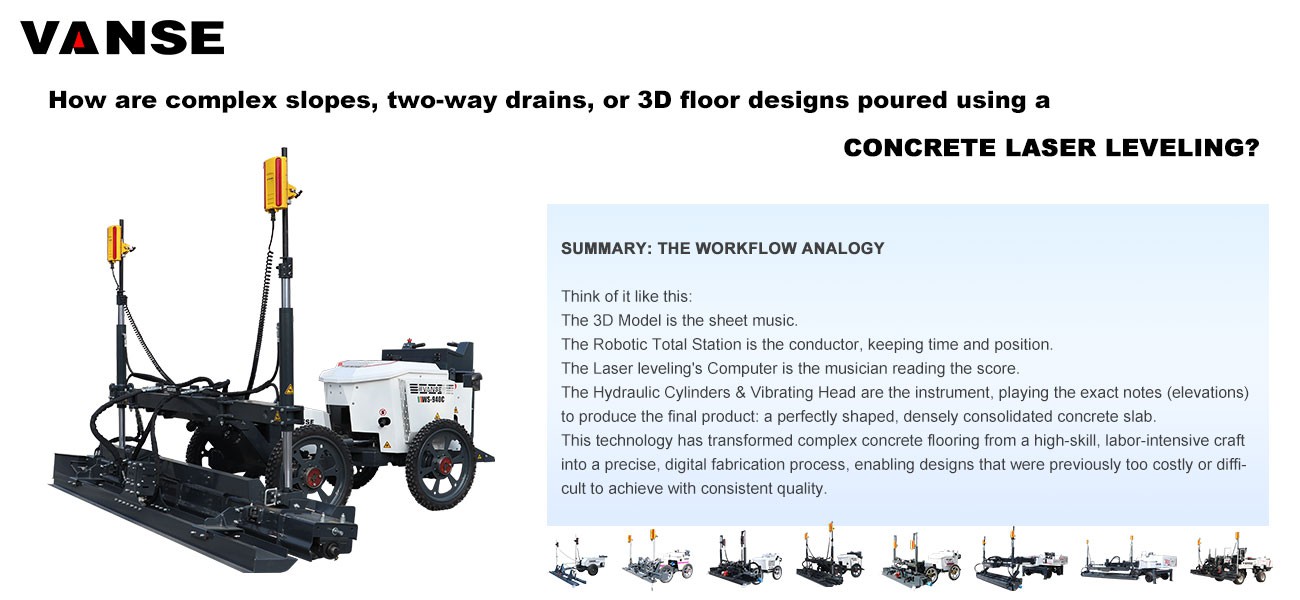
Excellent question. You've pinpointed the exact transition from basic to advanced laser leveling. Moving beyond flat slabs to complex slopes, drains, and 3D designs is where modern laser leveling technology truly becomes revolutionary. It shifts from being a simple leveling tool to a robotic 3D concrete printing and finishing system.
Here’s a detailed breakdown of how it's done, focusing on the advanced systems you mentioned.
The Core Enabler: From 2D Lasers to 3D Machine Control
The critical leap is abandoning the single spinning laser plane (which only creates a flat surface at a fixed grade). Instead, 3D Profiler Systems or 3D Machine Control is used. This system integrates three key components:
The 3D Design Model: A digital blueprint (CAD file) of the finished slab, including all slopes, drains, and elevations. This is often a Digital Terrain Model (DTM).
The Positioning System: Typically a robotic total station or GPS rover that tracks the leveling's exact location (X, Y, and Z) on the job site in real-time.
The Laser leveling's Onboard Computer: This brain takes the design model and the real-time position, calculates the exact required height of the leveling head at that precise coordinate, and automatically adjusts the machine.
The Step-by-Step Process for Complex Shapes
Phase 1: Digital Setup & Modeling
Design: Engineers create a precise 3D model of the slab. For a two-way drain, this is a warped surface (a parabola or cone) sloping to a central point. For a ramp with a cross-slope, it's an inclined plane. For truly complex 3D floors (e.g., skate parks, test tracks), it's a fully sculpted surface.
Site Calibration: The 3D model is geo-referenced to the physical job site. Surveyors establish control points. The robotic total station is set up with a clear view, and its position is registered in the same digital coordinate system as the design model.
Machine Setup: A prism or GPS receiver is mounted on the laser leveling. The total station now "sees" the leveling and relays its position 5-10 times per second to the leveling's computer.
Phase 2: The Pour & Automated leveling
This is where the magic happens. The process is fully model-driven.
For a Two-Way Drain (Warped Surface):
The operator drives the leveling onto the fresh concrete in a systematic pattern (e.g., spiral out from the drain or back-and-forth passes).
In real-time, for every inch the machine moves:
The total station reports: *"You are at coordinate X=105, Y=87."*
The computer checks the 3D model: *"At coordinate (105,87), the design elevation is Z=100.25 inches."*
The computer commands the leveling's hydraulic cylinders: *"Raise/Lower the strike-off head to exactly 100.25 inches NOW."*
The leveling head continuously adjusts, tilting subtly in all directions, to perfectly match the design's curvature. It creates a smooth, mathematically perfect bowl without any manual grade checking.
For a Slope or Ramp (Inclined Plane):
The process is identical. The model defines a constant slope. As the leveling moves up the ramp, the computer constantly updates the target height, keeping the leveling head precisely on the inclined plane.
For Complex 3D Terrain (e.g., a Skate Park Bowl):
The operator drives in a tight, overlapping pattern (like mowing a lawn). The leveling head acts like a 3D printer nozzle, constantly adjusting its height and tilt to "touch" the virtual design surface. One pass might place the concrete for the transition, the next for the flat bottom, all seamlessly.
Key Advantages Over Traditional Methods for These Shapes
Eliminates Physical Forms: No need to build intricate wood forms to define curved drains or slopes. This saves immense labor and material.
Unmatched Accuracy & Consistency: Achieves tolerances of ±1/8" (3mm) or better over the entire complex surface. Manual sloping is prone to waves, flat spots, and inconsistencies.
Speed: Complex geometry can be placed and finished at the same speed as a flat slab-often 10,000+ sq. ft. per day.
Monolithic Quality: Large, complex areas are poured in one continuous operation, eliminating cold joints and ensuring uniform density and strength, which is critical for waterproofing in drainage applications.
Data Verification: The system can log "as-built" data, proving the floor was built to specification.
The Human Role in Advanced 3D leveling
The operator's role shifts from "grade checker" to machine pilot and concrete manager:
Path Planning: Choosing the optimal driving pattern to efficiently cover the area without trapping the machine.
Managing Concrete Supply: Ensuring a consistent volume of concrete is placed ahead of the leveling, critical for maintaining the design profile.
Monitoring Systems: Watching for signal loss from the total station and ensuring the system is functioning.
Edgework & Finishing: The laser leveling does not do edges. Skilled finishers still hand-work perimeter details, using the levelinged surface as their guide. They also perform final finishing (bullfloating, troweling) on the perfectly placed surface.
System Variants
Multi-Prong Laser leveling: For very large pours, machines with multiple, independently controlled vibrating heads can cover more area faster, with each head adjusting to the 3D model.
Gyroscope & Inertial Systems: Used in tandem with GPS for areas where satellite signal is lost (e.g., inside buildings), ensuring continuous accuracy.
Summary: The Workflow Analogy
Think of it like this:
The 3D Model is the sheet music.
The Robotic Total Station is the conductor, keeping time and position.
The Laser leveling's Computer is the musician reading the score.
The Hydraulic Cylinders & Vibrating Head are the instrument, playing the exact notes (elevations) to produce the final product: a perfectly shaped, densely consolidated concrete slab.
This technology has transformed complex concrete flooring from a high-skill, labor-intensive craft into a precise, digital fabrication process, enabling designs that were previously too costly or difficult to achieve with consistent quality.
Note: The parameters provided in this document are for reference only and are not mandatory. Due to differences in technical characteristics between different brands and models of laser levelers, please consult the manufacturer for a suitable solution before actual operation. This reference document assumes no responsibility for any issues arising from failure to follow the manufacturer's instructions.
Thanks to All the Friends Who Support and Trust Shandong Vanse Machinery Technology Co., Ltd.
If you want to know more about Shandong Vanse Machinery Technology Co., Ltd. or have any questions, please feel free to contact us:
Our Factory
Shandong Vanse Machinery Technology Co., Ltd.








Share this article

About the Author: Shandong Vanse Machinery Technology Co., Ltd.
Shandong Vanse Machinery Technology Co., Ltd. is a high-tech manufacturer specializing in concrete construction machinery, including laser screeds and related equipment. The company integrates R&D, production, and global sales, with products exported to over 60 countries and widely used in infrastructure projects worldwide.
Previous Post
Next Post
Related Articles
You Might Also Like
How can the performance and operation of a concrete laser leveling machine be optimized
Regarding the performance and operation optimization of concrete laser leveling machines, this is a systematic project that integrates equipment maintenance, advanced technology, and precise operation. Optimization can be approached from two perspectives: equipment performance optimization and operating method optimization. Equipment performance is the foundation for ensuring construction quality and efficiency. Optimization aims to ensure that the equipment is always in optimal working condition. Laser Transmitter: This is the "eyes" and "brains" of the equipment. Calibration: Perform a calibration check daily before starting work. Secure the receiver to a pole and verify that the elevation set by the laser transmitter matches the actual measurement. Even the slightest deviation can lead to extensive construction failure. Cleaning and Protection: Keep the laser transmitter lens clean to prevent dust and moisture from affecting the laser beam's accuracy. Store properly to prevent collisions. Leveling Head (Scraper and Vibrator): Check for wear: Regularly inspect the scraper for wear. Excessive wear can lead to reduced leveling accuracy and material waste. Replace or adjust promptly. Vibration Frequency Uniformity: Check that the vibrating rod is functioning properly to ensure uniform concrete compaction density across the entire leveling head to avoid localized honeycombing. Chassis and Travel System: Cleaning: After each construction phase, thoroughly clean any solidified concrete debris from the chassis, as this will significantly affect the smoothness of the next construction phase. Check Fasteners: Check all connecting components and bolts for looseness to ensure the structural stability of the equipment. Tires/Tracks: Check tire pressure and track wear to ensure stable ground contact. Multiple Laser Receivers: Equipping the leveling head with multiple laser receivers allows for more comprehensive monitoring of the head's real-time posture. This is particularly important for levelinging over large spans, effectively preventing errors caused by leveling head deformation. Intelligent Control System Upgrade: Monitor control system updates provided by equipment manufacturers. Newer systems may feature more advanced algorithms, enabling smoother control, fault diagnosis, and even grade control. High-Strength Components: For components subject to severe wear, such as scrapers, consider using more wear-resistant high-strength alloys or polyurethane materials to extend their service life. Advanced equipment requires scientific operating methods to maximize its effectiveness. Precise benchmark setting: This is the foundation of all work. A professional surveyor must use a high-precision level or total station to determine the position and elevation of the laser transmitter according to the design drawings. Ensure that the transmitter is set up in a stable, interference-free area. Formwork (steel formwork) installation: The top elevation of the formwork must be precisely aligned with the designed elevation of the laser leveling and securely fixed. The flatness of the formwork directly affects the construction quality of the edge areas. Base preparation and reinforcement mesh laying: The base layer (usually a crushed stone base) must be compacted and leveled; otherwise, uneven concrete thickness may occur, leading to cracking due to settlement. The steel mesh should be laid flat and supported with blocks to ensure its correct position in the concrete and prevent it from scraping against the rebar and shifting during equipment movement. Concrete material control: Slump: This is the key to success! The slump of concrete used for laser leveling must be strictly controlled, typically between 140-160mm. Excessive slump results in high concrete flow, causing backflow on both sides of the leveling as the leveling moves, forming waves. Excessive slump results in poor flow, high resistance to the leveling, prone to cracking, and difficulty maintaining density. Aggregate Size: Avoid using coarse aggregate with excessively large particle sizes to prevent it from clogging the leveling blade or vibrator. Unloading and Initial Spreading: Concrete should be evenly distributed during unloading to avoid piles. Initial spreading can be performed using a small excavator or manually, with a thickness slightly above the design elevation to reduce the load on the leveling. Equipment Path Planning: The operator should plan the leveling's path, typically adopting an S-shaped or spiral path, to avoid sharp turns on unset concrete, which can cause surface disturbance and elevation deviation. Matching Travel Speed and Vibration Frequency: The equipment should maintain a constant and slow speed. Excessive speed will result in incomplete vibration and surface ripples. Adjust the vibration frequency in real time based on the concrete slump. For high slumps, reduce the frequency appropriately; for low slumps, increase the frequency to ensure adequate vibration. Overlap Treatment: There should be a sufficient overlap between the two leveling paths (typically 10-20cm) to ensure a smooth transition at the joint with no height differences. Operator Skills: The operator must not only be able to operate the machine but also understand the characteristics of concrete. They should be able to observe the concrete's response (such as slurry seepage and surface gloss) to determine whether the vibration is sufficient and the speed is appropriate, allowing for immediate adjustments. Timely Curing: After initial setting, laser-leveled concrete floors should be immediately sprayed with a curing agent or covered with a film to retain moisture and prevent plastic shrinkage cracks caused by rapid water loss. The optimized leveled floor is denser, so early curing is particularly important. Connecting with Subsequent Processes: Time the joint cutting process appropriately (usually within 6-24 hours after construction, depending on the temperature and concrete strength development) to prevent random cracking. Optimize Category Specific Measures Purpose Equipment performance Daily laser system calibration Ensures absolutely precise elevation control Inspect and replace the leveling scraper Ensures levelinging results and smoothness Thoroughly clean the chassis of concrete debris Prevents elevation errors and equipment damage Operation Strictly control the concrete slump (140-160mm) Ensures proper fluidity, easy leveling, and no backflow Precisely set the formwork and laser reference Provides a foundation for high-quality construction Drive at a constant and slow speed, matching the vibration frequency Ensures adequate vibration and compaction of concrete Operator experience and fine-tuning Addresses unexpected on-site situations and enables dynamic optimization Timely water conservation and maintenance Prevents surface cracking and ensures overall quality By combining strict equipment maintenance, scientific construction preparation and refined operating procedures, the performance of the concrete laser leveling machine can be maximized, ultimately achieving ultra-high flatness, high density and high efficiency construction results. Note: The parameters provided in this document are for reference only and are not mandatory. Due to differences in technical characteristics between different brands and models of laser levelers, please consult the manufacturer for a suitable solution before actual operation. This reference document assumes no responsibility for any issues arising from failure to follow the manufacturer's instructions.What are the characteristics of concrete laser leveling machine?
Concrete leveling machine is a kind of equipment widely used in the field of concrete construction. Its main features include the following aspects: High efficiency and efficient leveling: The concrete leveling machine can level the concrete surface quickly and efficiently, and can complete a project volume of 200 to 600 square meters per hour, which is more efficient than traditional manual leveling. Good flatness and high precision: The concrete leveling machine can provide precise elevation control and level adjustment. The concrete leveling machine can achieve a flatness of 3 mm/3 meters, and the elevation difference within 1000 square meters is less than 20 mm. , smoother than traditional manual leveling, effectively ensuring the quality of construction. Strong adaptability: The concrete leveler can level different types of concrete, such as sand, gravel, pebbles, etc., and can quickly complete the leveling work on the leveler. Reduce costs: Using a concrete leveler can reduce labor costs and improve construction efficiency. It can also reduce the use of materials, thereby reducing construction costs. High construction quality and high reliability: The concrete leveling machine adopts advanced mechanical structure, which has high reliability and can also ensure the quality of construction. It can significantly improve the flatness of the ground. The ground constructed by laser leveling machine and traditional method were tested at 22 points (one point every 5 meters × 4 meters). The average flatness values were 1.3 mm and 4.1 mm respectively. Laser leveling machine, etc. The leveling quality of the equipment is more than three times higher than that of traditional methods. The use of laser leveling machines can reduce a large number of construction joints, reduce concrete slump, and ensure concrete strength, making the ground more integrated and less prone to cracks. Simplified process and high safety: The operation of the concrete leveling machine is very simple and safe to use. It can save the formwork process. The concrete leveling machine is equipped with 6 to 10 people in a single shift and can complete a project volume of more than 3,000 square meters. It is more efficient than traditional Manual leveling is more convenient and can greatly reduce safety hazards caused by manual operations. Easy maintenance: The maintenance of the concrete levelinger is relatively simple. You only need to regularly check the lubricating oil, clean the machine body, etc. In short, the concrete leveling is an efficient, precise, adaptable, reliable, safe and easy-to-maintain equipment that has been widely used in the field of concrete construction.Does the operating skills of power trowel machine have a big impact on the trowel effect?
– Correct starting position: When starting the trowel, it is important to place it in an area where the concrete surface is flat and has been preliminarily processed (such as vibrated and scraped). If it is started in an uneven place or with debris, the trowel will be subject to uneven resistance at the beginning, which may cause the trowel blade to jump, thereby affecting the trowel effect. For example, on the newly poured concrete floor, if there are protruding stones or uncompacted parts, after starting the trowel, the trowel blade is likely to vibrate here, causing wavy patterns on the surrounding ground. – Stable starting speed: Starting the trowel smoothly can avoid the trowel blade suddenly accelerating and causing impact on the ground. For electric trowels, avoid quickly connecting the power supply to cause the motor to run at a high speed instantly; for gasoline trowels, when starting, you should follow the operating procedures and slowly pull the starting rope to allow the engine to gradually reach the working speed. If the starting speed is too fast, the impact force between the trowel and the ground is too large, which may leave scratches on the ground or cause partial peeling of the mortar layer on the concrete surface. – Travel speed control: The travel speed of the trowel directly affects the quality and efficiency of the trowel. If the speed is too fast, the trowel will stay in each area for too short a time, and the concrete surface cannot be fully compacted and smoothed, which can easily cause the ground to be rough and uneven. If the speed is too slow, although the trowel effect can be more refined, it will reduce work efficiency. For example, when troweling a large area of industrial plant floor, it is generally more appropriate to keep the travel speed at 3-5 meters per minute, which can not only ensure the quality of troweling, but also improve work efficiency to a certain extent. – Travel track planning: A reasonable travel track can make the trowel effect more uniform. Usually, a zigzag, circular or spiral travel track is used. The zigzag track is suitable for narrow and long areas, so that the trowel can fully cover every corner; the circular and spiral tracks are suitable for large circular or square areas, which can ensure that the trowel can evenly trowel from the center to the periphery or from the periphery to the center. If the walking track is chaotic, such as turning randomly or repeatedly over-troweling in certain areas, it will cause uneven troweling of the ground, high and low differences or local over-troweling. – Adjust pressure according to stage: Different pressures need to be applied at different stages during the troweling process. In the rough grinding stage after the initial setting of concrete, a larger pressure can be appropriately applied to compact the concrete surface and eliminate bubbles and pores. In the fine grinding stage, the pressure should be reduced so that the trowel slides gently on the ground, mainly used to improve the finish of the ground. For example, during rough grinding, the hand-held trowel can increase the pressure by pressing the operating handle appropriately; during fine grinding, the handle is relaxed to let the trowel contact the ground naturally. If the pressure is not properly controlled, excessive pressure during the fine grinding stage may damage the ground that has been initially leveled, resulting in new scratches and unevenness. – Importance of even pressure: Ensure that pressure is evenly distributed on the trowel blade, whether in the rough or fine grinding stage. Uneven pressure can cause some parts of the trowel blade to exert too much force on the ground, while other parts exert insufficient force, resulting in local unevenness and inconsistent gloss on the ground. Operators need to achieve even pressure through skilled operation and good control of the trowel. – Special tools or techniques for corners: For areas such as corners and edges that are difficult for the trowel to cover directly, operating skills are particularly critical. You can use a small handheld trowel or a special corner trowel tool for processing. When using a handheld trowel, keep it perpendicular to the corner or edge and rotate it slowly with a small radius to ensure that the concrete in the corner can be fully compacted and smoothed. Without the correct corner treatment skills, these areas can easily be overlooked, resulting in uneven and rough corners, affecting the finishing quality of the entire floor.