Technical Knowledge
What are the key operational differences and ideal uses for walk-behind versus boom type concrete laser leveling models?
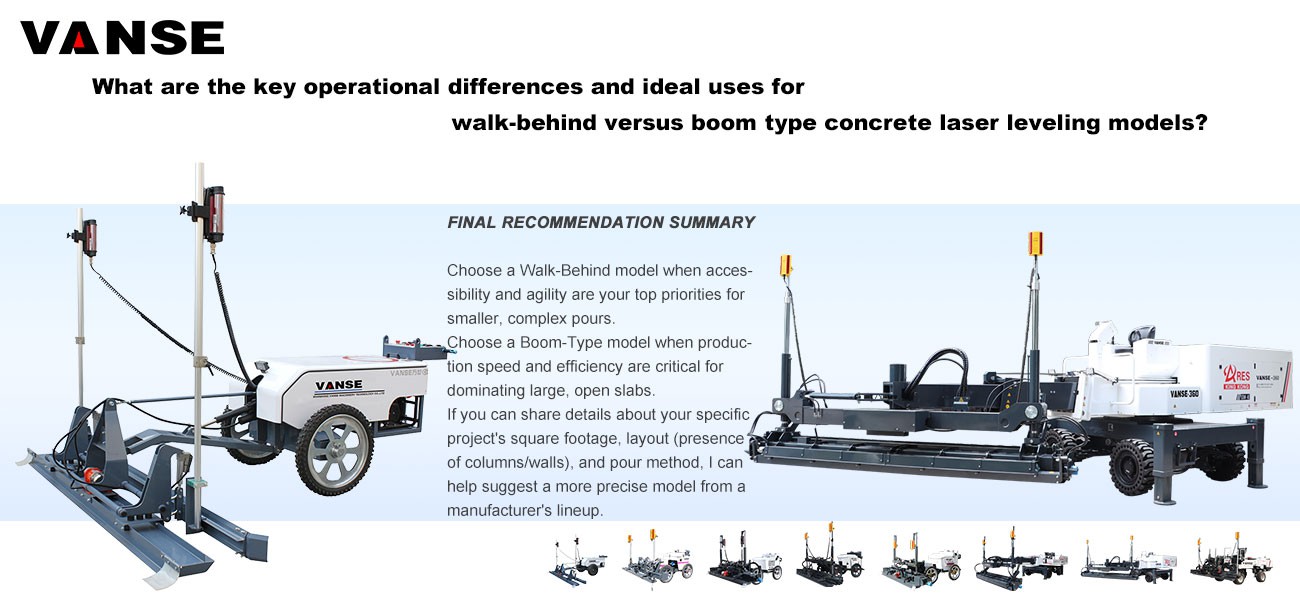
The core operational difference is the operator's position and the machine's reach. Choosing between them is primarily a function of project scale and site accessibility, with walk-behind models excelling in tight, complex areas and boom-type machines dominating large, open floors.
Here is a direct comparison to match the machine type to your job:
| Feature / Consideration | Walk-Behind Laser Leveling | Boom-Type (Ride-On) Laser Leveling |
| Primary Operational Role | Precision Leveling | High-Speed Placement & Leveling |
| Key Operation Difference | The operator walks behind, manually guiding the machine's fixed-width (2.5-3m) Leveling head over placed concrete. | The operator rides in a cab, remotely controlling a long, articulating boom (5.5-6m+) to place, spread, and level concrete from a distance. |
| Ideal Job Size | Small to Medium (up to ~20,000 sq ft / 2,000 m² per day). | Medium to Very Large (30,000 to 100,000+ sq ft / 3,000-10,000+ m² per day). |
| Optimal Site Accessibility | Confined, obstructed, or complex layouts. Perfect for areas with walls, columns, tight corners, and strip pours. | Wide-open, unobstructed slabs. Essential for vast, clear spaces like warehouses and distribution centers. |
| Labor & Skill Impact | Requires a small crew to manage concrete and assist. Operator has direct, physical control. | Dramatically reduces labor; one operator replaces a large raking crew. Requires skill to manage the boom's reach and functions. |
| Mobilization & Logistics | Transportable on a trailer or in a pickup truck. Easy to move around site. | Requires a low-boy trailer, semi-truck, and significant on-site space. Higher mobilization cost. |
| Concrete Placement Strategy | Works with concrete that has been dumped and roughly spread in front of it. | Can actively pull concrete from large piles to fill low areas, enabling efficient "point-load" pouring. |
💡 How to Choose Based on Your Project
Use this decision flow to select the right type:
Start with Site Layout: Is the slab a wide-open "sea of concrete" or a "maze" of walls/columns?
Many Obstructions → Walk-behind (e.g., Vanse DZ25-2/DZ30-2).
Fully Open → Proceed to Step 2.
Evaluate Project Scale: What is the total pour area for the day or phase?
Under ~25,000 sq ft → Compact Ride-on (e.g., Vanse WS940C or compact boom model YZS2-4).
Over ~30,000 sq ft → Full-size Boom-type (e.g., Vanse YZ40-4E, YZ30-4E).
Consider Special Requirements:
Indoor/Enclosed Site → Consider an Electric model (e.g., Vanse WS25-2D) for zero emissions.
Critical Floor Flatness (FF/FL) → Boom-type machines generally produce superior, more consistent results.
Multiple Small Pads or Additions → Walk-behind offers superior mobility between locations.
🎯 Final Recommendation Summary
Choose a Walk-Behind model when accessibility and agility are your top priorities for smaller, complex pours.
Choose a Boom-Type model when production speed and efficiency are critical for dominating large, open slabs.
If you can share details about your specific project's square footage, layout (presence of columns/walls), and pour method, I can help suggest a more precise model from a manufacturer's lineup.
Note: The parameters provided in this document are for reference only and are not mandatory. Due to differences in technical characteristics between different brands and models of laser levelers, please consult the manufacturer for a suitable solution before actual operation. This reference document assumes no responsibility for any issues arising from failure to follow the manufacturer's instructions.
Thanks to All the Friends Who Support and Trust Shandong Vanse Machinery Technology Co., Ltd.
If you want to know more about Shandong Vanse Machinery Technology Co., Ltd. or have any questions, please feel free to contact us:
Our Factory
Shandong Vanse Machinery Technology Co., Ltd.








Share this article

About the Author: Shandong Vanse Machinery Technology Co., Ltd.
Shandong Vanse Machinery Technology Co., Ltd. is a high-tech manufacturer specializing in concrete construction machinery, including laser screeds and related equipment. The company integrates R&D, production, and global sales, with products exported to over 60 countries and widely used in infrastructure projects worldwide.
Previous Post
Next Post
Related Articles
You Might Also Like
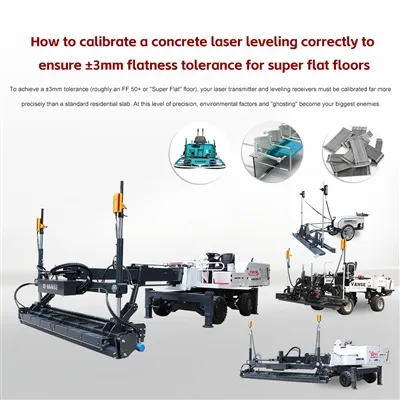
How to calibrate a concrete laser leveling correctly to ensure ±3mm flatness tolerance for super flat floors
To achieve a ±3mm tolerance (roughly an FF 50+ or "Super Flat" floor), your laser transmitter and leveling receivers must be calibrated far more precisely than a standard residential slab. At this level of precision, environmental factors and "ghosting" become your biggest enemies. Here is the professional procedure for calibrating a laser leveling system for super flat requirements. Before the pour, you must verify the laser transmitter itself. Even a high-end unit can drift. The Set-up: Place the laser exactly halfway between two walls (or stakes) approximately 30m (100ft) apart. Step A: Turn the laser to Face 1 (X-axis). Mark the beam height on Wall A and Wall B. Step B: Rotate the laser 180° to Face 2. Re-mark Wall A and Wall B. The Math: If the difference between the two marks on either wall exceeds 1.5mm, the internal pendulum or diode is out of spec. The "Super Flat" Rule: For ±3mm floors, your transmitter should ideally be accurate to ±1.5mm per 30m to allow for cumulative errors in the receiver and leveling hydraulics. If you are using a laser leveling (e.g., Vanse), you must calibrate the relationship between the laser receivers and the leveling head. Hydraulic Warm-up: Run the machine for 15–20 minutes. Cold hydraulic fluid moves slower, causing a "lag" in the auto-leveling that will blow your FF numbers. Auto-Cal Sequence: Set the transmitter 20–30m away. Place the leveling boom at 100% extension. Enter the machine's "Tuning" or "Service" menu and select Auto-Cal. The machine will move the cylinders through their full range to "learn" the exact voltage needed to move the head 1mm. Vibration Check: Ensure the vibrator is ON during the final stages of calibration. The vibration causes "settling" in the head that must be accounted for. Once the machine is calibrated, you must sync it with the physical site datum. Establish a Master Benchmark (usually a brass plug or a column mark) away from the pour area. Set your hand-held laser receiver (grade rod) to this benchmark. Place the grade rod on the leveling's finish blade (not the plow). Adjust the leveling's offset until the machine's "On Grade" light matches the grade rod's "On Grade" signal. Factor Requirement Why? Wind/Heat Use a "dead" zone Wind can vibrate the laser transmitter tripod, causing "beam bounce" (a 1mm shake at the source becomes 5mm at the leveling). Receiver Height Keep it low The higher the receivers are on the masts, the more they amplify any "sway" or vibration from the machine. Tripod Stability Concrete/Solid Earth Never set the transmitter on a wood deck or loose fill. Use a heavy-duty fiberglass tripod. Overlap 10–20% On super flat pours, each pass must overlap the previous one significantly to "erase" the transition line. If your numbers are off despite calibration, check for Refraction. On hot days, the laser beam can "bend" as it passes through heat shimmering off the ground. Solution: Raise the transmitter tripod to 2 meters (6.5 ft) high. This keeps the beam above the hottest air layer near the ground, providing a more stable reference line. Would you like me to explain how to conduct a "Dipstick" or Floor Profiler test to verify these numbers once the concrete has cured? Contact us NOW Note: The parameters provided in this document are for reference only and are not mandatory. Due to differences in technical characteristics between different brands and models of laser levelers, please consult the manufacturer for a suitable solution before actual operation. This reference document assumes no responsibility for any issues arising from failure to follow the manufacturer's instructions.Standard operating procedures for daily cleaning and regular deep maintenance of the power trowel machine
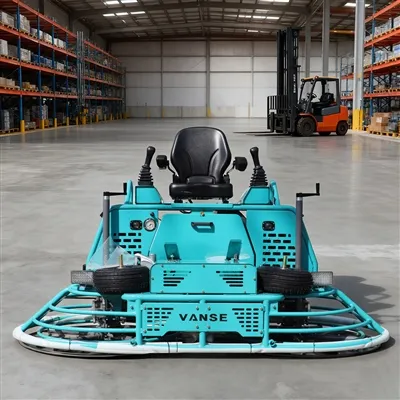
This SOP is designed to ensure equipment performance, extend service life and guarantee operational safety. Standardize the daily cleaning and regular maintenance of the power trowel machine to ensure that the equipment is always in good working condition, reduce the failure rate, eliminate potential safety hazards, optimize the construction quality and extend the service life of the equipment. This program is applicable to the maintenance and servicing of all electric, gasoline or hydraulic-driven power trowels (including driver-operated and hand-guided types) of our company. Operator: Responsible for performing daily cleaning and inspection, and reporting any abnormal conditions. Equipment Administrator/Mechanic: Responsible for conducting regular deep maintenance, repair and record-keeping. Project Manager/Supervisor: Responsible for supervising the implementation of the maintenance plan and providing resource support. Before carrying out any maintenance, make sure that the equipment has been completely turned off, the engine/motor has stopped, the key has been removed, and all moving parts have come to a standstill and cooled down. Wear appropriate personal protective equipment (PPE), such as gloves and safety glasses. Do not clean or maintain the equipment while it is in operation. When handling fuel, engine oil and lubricating oil, keep away from fire sources and do it in a well-ventilated area. Operation process: Cleaning -> Inspection -> Report Remove large debris: Use a scraper or wooden chips to remove large pieces of concrete and mortar adhering to the power trowel plate, the bottom of the blades and the protective cover. Rinse/Wipe Timing: If the concrete has solidified, wipe it with a damp cloth. If the equipment permits and the circuit/air filter is protected, low-pressure water can be used for flushing. However, it is strictly forbidden to directly direct water at key parts such as the engine, motor, bearing housing, and control box. Key areas: power trowel plate, blades, chassis, walking wheels (or tracks). Drying and rust prevention: Use a dry cloth to wipe off water stains on the surface of the equipment. For exposed metal parts (non-friction surfaces), apply a small amount of lubricating oil for rust prevention. Power trowel and blade: Check for excessive wear, cracks or deformation. Make sure the installation bolts are tight and not loose. Transmission system Gearbox/reducer: Check for any oil leakage or abnormal noise. Belt/chain (if any) : Check the tension and wear condition, and adjust or replace them. Engine/Motor Gasoline engine: Check if the air filter is clean and visually inspect the oil dipstick (it should be in a horizontal position). Electric motor: Check if the power cord is damaged and if the plug is intact. Walking mechanism: Check the tire pressure and wear of the walking wheels, or the tightness and wear of the tracks. Fasteners: Quickly check whether the visible bolts and nuts at all parts are loose, especially at the connection points of the power trowel and the fixing points of the handle. Safety: Check whether the emergency shut-off switch and protective cover are in good condition and effective. Fill in the "Daily Inspection Form for Equipment". If any abnormality is detected (such as abnormal noise, oil leakage, severe vibration, inability to start, etc.), immediately hang the "Under Repair" sign and report to the equipment administrator. In addition to the daily content, add: Engine maintenance (gasoline engine) Change the engine oil (refer to the manufacturer's manual. The first maintenance is usually carried out after 20 to 30 hours of operation). Clean or replace the air filter element (more frequently in dusty environments). Check the spark plugs, clean the carbon deposits, adjust the clearance or replace them. Check and clean the fuel filter. Transmission system Gearbox: Check the oil level and replenish or replace the specified gear oil if necessary. Bearings: Apply high-temperature lithium-based grease to the main shaft bearings of the power trowel plate, the bearings of the walking wheels, etc. Comprehensive tightening: Use a torque wrench to re-tighten all key bolts in accordance with the torque values specified by the manufacturer. Electrical system: Check whether all wire connections are firm and clean the dust on the heat sink of the motor housing. Carried out by professional mechanics, it includes all first-level maintenance contents and adds: Deep cleaning and inspection Remove the protective cover and thoroughly clean the accumulated dust and oil stains inside. Check the wear condition of the clutch plates (if any). Deep maintenance of the transmission system Replace all the lubricating oil in the gearbox. Check for wear on the belts/chains and replace them in groups if necessary. Check the clearance and abnormal noise of the bearings, and replace them if necessary. Fuel system (gasoline engine) Clean the carburetor. Empty and clean the fuel tank (this must be done before long-term storage). Walking mechanism Inspect the wheel axles and steering mechanism, and apply grease. For the driving type power trowel, check the hydraulic oil level and whether there is any leakage in the hydraulic pipeline. Performance test After the maintenance is completed, run the equipment no-load for 10 to 15 minutes to check for any abnormal sounds, vibrations, overheating or oil leakage, and to ensure that each control lever operates flexibly and effectively. Thorough cleaning: As mentioned earlier, thoroughly clean the equipment and dry it. Fuel treatment (gasoline engine) : Drain the fuel from the fuel tank and carburetor, or add fuel stabilizer and run the engine for 5 minutes to fill the stabilizer system. Engine maintenance Change the engine oil. Remove the spark plug, inject about 15 milliliters of engine oil into the cylinder, pull the starting rope several times to distribute the oil, and then reinstall the spark plug. Anti-corrosion treatment: Apply anti-rust oil to all exposed metal surfaces. Apply butter to the smears and leaves to prevent rust. Storage location: Store the equipment in a dry, well-ventilated and flat indoor area. Lower the power trowel plate to the ground to release the pressure of the hydraulic system (if applicable). Lift the tire off the ground or maintain the standard air pressure. After each maintenance, the maintenance date, operating hours, maintenance items, replaced parts and oils, and the signature of the maintenance person must be recorded in detail on the "power trowel Maintenance and Repair Record Card". The record card should be randomly saved for easy tracking of the equipment's history. Core principles: Prevention first, cleanliness foremost, follow regulations, and keep complete records. Strict maintenance is not only about cost savings, but also an important guarantee for project quality and construction safety. Note: The parameters provided in this document are for reference only and are not mandatory. Due to differences in technical characteristics between different brands and models of laser levelers, please consult the manufacturer for a suitable solution before actual operation. This reference document assumes no responsibility for any issues arising from failure to follow the manufacturer's instructions.Is a concrete laser leveling practical? Any highlights?
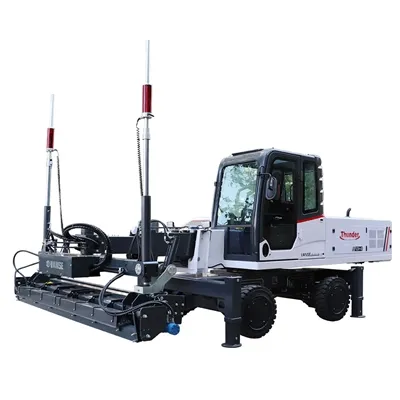
Must be practical! Let me tell you about it~ Let's talk about the advantages first: it is simply the favorite of all major "contractors". First, compare with humans. 1. Save more labor costs. Anyone who has done construction knows that if the concrete leveling work is done manually, at least 15 people will be needed. If calculated according to the current manual labor cost, the daily labor cost will be more than 3,000 yuan. If the latter is used, the labor required is doubled, and 8 people can complete the job, which greatly saves labor costs. 2. Save more construction time. If manual construction is used, the amount that 15 people can complete per day is relatively limited, less than 800 square meters. If time is limited, this cannot meet the completion progress requirements at all. But if you use the latter, its construction speed is faster, several times that of manual construction. In this way, its construction period is shortened a lot, and you don't need to worry about asking for help from everywhere if it can't be completed within the construction period. 3. Better guarantee the construction quality. If manual labor is used, the construction is mostly based on one's own experience. If there is insufficient experience, there will often be some cracking and other substandard quality. If a laser leveling machine is used, its construction procedures have been input into the program before the machine is completed. It is constructed according to free procedures, and the quality can be said to be relatively standard, which greatly saves the need for rework. cost. And the flatness is very good, the error is within 3 mm. Then there are the advantages of construction. First: The working principle of the laser leveling machine is mainly through its own various equipment, such as more advanced laser technology, which enables it to perform hundreds of data calculations and feedback within a minute, and also uses Complex closed-loop control technology accurately reflects various construction conditions to the brain of the equipment through the closed-loop system, and then responds quickly through the program set by the equipment personnel. There is also a very excellent hydraulic control system that reflects the equipment. Various electrical signals can be processed very quickly. This process is automatically completed on the computer. This is the biggest construction feature of the laser leveling machine. It is fully automatic and does not require human help. It only requires preliminary work. Set standard parameters. Second: The laser leveling machine can automatically control the plane, whether it is horizontal or vertical. This means that after setting the parameters on a plane, you do not need to manually control the machine. It automatically searches and positions within this working range, and then performs leveling and vibration through its own equipment, so that the construction can achieve various desired indicators. The accident personnel only need to perform simple operations and care to complete the project plan. It is a construction machine that can free the hands of construction workers. This is the second construction feature of the laser leveling machine, which can effectively release the labor intensity of construction workers, thereby reducing the construction party's expenditure on employees to a certain extent. Third: When using the laser leveling machine, you only need to let the workers place the equipment and set all the parameters in the equipment. After turning on the machine, the construction staff can perform simple controls to complete a very large area. Construction processing, because it uses modern laser equipment. It is easy to operate and uses an electronically controlled operating system. Only one staff member is required to operate and perform timely maintenance at the construction site. The daily working efficiency is 3000 to 5000 square meters. This is his third characteristic: simplicity and efficiency. To put it simply, it saves time, effort, worry, and is very efficient! ! ! If you want to know more you can follow us! ! !