Technical Knowledge
How Does The Concrete Laser Leveler/ Leveling Achieve Such Excellent Leveling Effects?
Laser leveling machines have high requirements and standards for road surface smoothness. When performing road surface smoothing, the requirements for smoothness are still relatively high. This is because the smoothness of the road surface also plays a big role in the beauty of the environment. Generally speaking, if manual leveling is used, the effect will not be very good. Fortunately, there are laser leveling machines now, and many construction units have also chosen laser leveling machines for road smoothing operations. So laser leveling machines How does it achieve such excellent leveling effect?
Laser leveling machines have high requirements and standards for road smoothness
1. Control of the laser leveling machine's baseline:
When the leveling machine performs automatic leveling, it needs an accurate reference surface. Generally, when the main focus is to control the height, the tightrope method is suitable; when the main focus is to control the thickness, the floating datum beam method is adopted. Generally, tightrope is used for the bottom layer, and floating datum beam method is used for the middle layer and surface layer. The benchmark wire rope method is to install benchmark wire ropes on both sides of the road, but note: the spacing between the pillars and steel bars supporting the steel wire ropes cannot be too large, generally 5-10m; the steel bars should be 1-2mm higher than the design elevation, and the elevation of the steel bars must be ensured when laying Always accurate during the construction process.
2. Paving speed control of laser leveling machine:
The leveling machine should work at a constant speed without stopping, and it is strictly forbidden to be fast and slow. During the leveling process, stoppages should be avoided as much as possible, and the necessary daily stoppages should be placed at the location where the contraction joint is scheduled to be made at one end of the structure. In case of shutdown in the middle, the leveling of the leveling should be locked to prevent it from sinking; when the mixture temperature is above 100°C, the pause time should not exceed 10 minutes. When the pause time exceeds 30 minutes or the mixture temperature is below 100°C, Re-seam according to the method of treating cold
seams
3. Laser leveling machine operation control measures:
Skill
ed laser leveling machine operators should be selected and given pre-job training; during the paving process, the material transport truck should stop 10-30m away from the laser leveling machine and In neutral gear, rely on the laser leveler to push forward slowly, and there should be a dedicated person to direct the unloading truck to unload; ensure the continuity of the work of the leveling machine's feeding system, that is, ensure the height of the material level in the casters (conveyor wheels) Stable, uniform and continuous, the material level height should be kept at 2/3 of the blade above the central axis. Before construction, the leveling must be cleaned. After adjusting the height and cross slope of the leveling, preheat the leveling. The preheating temperature of the leveling should be close to the temperature of the asphalt mixture, which can generally be heated to 85°C-90°C.
Thanks to All the Friends Who Support and Trust Shandong Vanse Machinery Technology Co., Ltd.
If you want to know more about Shandong Vanse Machinery Technology Co., Ltd. or have any questions, please feel free to contact us:
Our Factory
Shandong Vanse Machinery Technology Co., Ltd.








Share this article

About the Author: Shandong Vanse Machinery Technology Co., Ltd.
Shandong Vanse Machinery Technology Co., Ltd. is a high-tech manufacturer specializing in concrete construction machinery, including laser screeds and related equipment. The company integrates R&D, production, and global sales, with products exported to over 60 countries and widely used in infrastructure projects worldwide.
Previous Post
Next Post
Related Articles
You Might Also Like
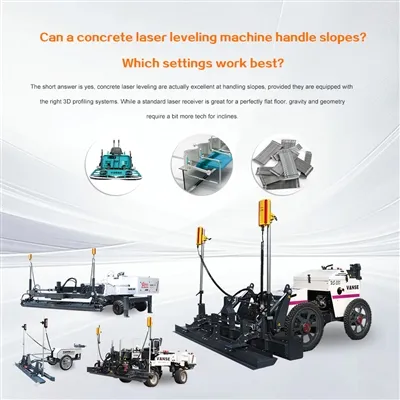
Can a concrete laser leveling machine handle slopes? Which settings work best?
The short answer is yes, concrete laser leveling are actually excellent at handling slopes, provided they are equipped with the right 3D profiling systems. While a standard laser receiver is great for a perfectly flat floor, gravity and geometry require a bit more tech for inclines. Standard laser leveling uses a rotating laser transmitter on a tripod and receivers on the machine. This creates a flat "plane" of light. Single/Dual Slopes (2D): If you are doing a simple parking lot ramp or a consistent drainage slope, you can physically tilt the laser transmitter on its tripod to a specific percentage (e.g., a 1% grade). The machine will then follow that tilted plane.Complex Contours (3D): For complex curbs, valleys, or multi-directional slopes, the machine uses 3D Profiling Systems (often involving a Total Station or GPS). This allows the leveling to automatically adjust the head height based on its exact coordinate position on a digital map. To get the best finish on a slope, you can't just "set it and forget it." You need to account for the way wet concrete behaves under gravity. On a slope, concrete tends to "slump" or migrate downward. Setting: Keep the auger speed high enough to move excess material but not so fast that it creates a "wave" of concrete that pulls away from the high side. The vibrator is what settles the aggregate and brings the "cream" to the top. Setting: On steep slopes, lower the vibration frequency slightly. Over-vibrating on an incline can cause the concrete to fluidize too much, leading it to slide down the hill before it sets (slumping). Best Practice: Generally, you want to pull the machine up the slope or work across the fall. Pulling downhill can lead to "shingling," where the leveling head pushes too much material in front of it, resulting in an uneven thickness. If your machine has slope compensation software, ensure it is toggled on. This adjusts the hydraulic response time to ensure the leveling head reacts instantly to changes in elevation without "hunting" or bouncing, which happens more often on uneven grades. Factor Standard Flat Setting Slope Setting Laser Mode Horizontal / Level Grade / Manual Slope Vibration High / Normal Reduced (to prevent slump) Travel Speed Faster Slower & More Consistent Concrete Slump 4" – 5" 3" – 4" (Lower is better for slopes) Note: The parameters provided in this document are for reference only and are not mandatory. Due to differences in technical characteristics between different brands and models of laser levelers, please consult the manufacturer for a suitable solution before actual operation. This reference document assumes no responsibility for any issues arising from failure to follow the manufacturer's instructions.Interpretation of practical knowledge of laser leveling machine
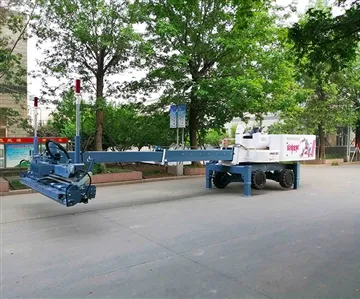
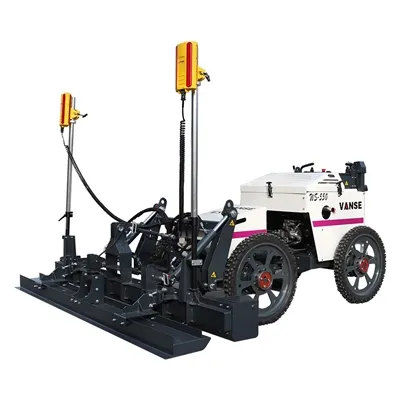
With the continuous improvement of people's requirements for the quality of building construction, the role of laser leveling machines has gradually become more and more obvious. It is indeed a relatively time-saving and labor-saving way to use leveling machines to pave the ground. It saves labor to the greatest extent, and also provides a guarantee for the flatness of the ground construction. We will introduce the relevant knowledge of the laser leveling machine in detail below, please take a look together. First, the leveling principle of the laser leveling machine is: 1. The laser leveling machine relies on the leveling head driven by hydraulic pressure (electricity), cooperates with the laser system and the computer control system to complete the leveling work while automatically leveling. 2. The leveling head is equipped with an integrated scraper, vibrator and leveling plate, which integrates all the work of leveling, leveling, vibrating, compacting and paddle lifting, and completes it at one time. 3. The computer control system automatically adjusts the elevation 10 times per second in real time, and the vibration frequency of the balanced designed vibrator reaches 4000 times per minute. 2. Tips for using laser leveling machine: During the construction of the leveling machine, the concrete sent to the platform needs to be paved and roughly leveled by workers as soon as possible. In addition, the areas around the formwork, walls, columns, trenches, equipment foundations, floor drains, or surrounding equipment that cannot be leveled require manual cooperation for local leveling, and generally 3-4 workers are required to cooperate with the construction. 3. Other matters needing attention: In order to ensure the flatness of the ground, the slump of the concrete sent to the platform needs to be consistent each time to ensure that the concrete feeding speed reaches 40 cubic meters per hour or above, and the initial setting time of each batch of concrete needs to be consistent to ensure the formwork elevation Accurate, and can not be disturbed during the construction period, the newly constructed concrete floor can not be exposed to sunlight, wind, rain and other environments that are unfavorable to concrete health. No reflective objects. The foundation needs to reach the relevant hardness to ensure that the laser leveling machine does not collapse when working on the ground. The height points of the ground in the factory building need to be evenly distributed, and there should be no error in the levelness.Take precautionary measures and say goodbye to the troubles of operating the laser leveler in rainy season!
Any road construction machinery will inevitably be affected by external environmental factors, and this is no exception for laser levelers, especially in the hot and rainy summer. Once the laser leveler is exposed to too much rain, it is very likely to cause a series of problems such as rust on the leveler body and damage to parts. In order to avoid unnecessary maintenance costs and extend the service life of the leveler, it is particularly necessary to do a good job of laser leveling maintenance in the rainy season. Below, our company will combine its own years of work experience to make several suggestions on how to do a good job of protecting the leveler in the rainy season. First, before parking the laser leveler, you should use your naked eyes to observe and judge whether the surrounding geographical environment is safe, stay away from rivers or hillsides that may cause landslides. Under a big tree is not a good parking place. It is easy to be struck by lightning in thunderstorms, and if a big tree is blown down on the laser leveler in windy weather, it will also cause great losses. Choose a place with a solid road surface to park. It is good to be able to park on cement or asphalt, but our leveling machine usually rarely has cement roads. Most of them are operated in the field. In this case, you should choose to park on a stable ground for a long time, and try to avoid parking on the fill ground. Second, if necessary, you need to install anti-skid chains on the laser leveler to increase the safety factor. The installation of anti-skid chains should be carried out in advance. Do not start installing them in an emergency environment. Such hasty installation is unsafe and troublesome. If it is a special case, safety warning signs must be placed before and after the laser leveler. Do not install anti-skid chains when the tire pressure is insufficient. Also pay attention to the different sizes of anti-skid chains. Choose anti-skid chains that match the size of the wheel hub and wheel width. After installing the anti-skid chain, pay attention to the driving speed of the roller should not be too fast, and also pay attention to avoid sudden acceleration or deceleration to cause damage to the anti-skid chain. Third, if conditions permit, you can park in the garage, and try to avoid parking in an overly humid environment and choose indoor storage. The rust prevention of laser leveling machines is very important. If the machine is parked for a long time, it should be started and driven once a month to charge the battery. After the machine is stored for a long time, the grease on the piston rod should be wiped dry and all parts should be filled with grease. When the machine is parked, the working device should be kept dry and clean, and water should not be put in to avoid rust and make the machine inconvenient to operate. In fact, in addition to the above aspects, there are many details that need to be paid attention to during the construction of the laser leveling machine in the rainy season. This site will continue to pay attention to, organize and share related content. Interested users can directly visit the official website of this site to inquire and obtain it. I believe it will be helpful for your future use.