Technical Knowledge
What Fuel-Saving Measures Should Be Taken When Operating A Concrete Laser Leveling?
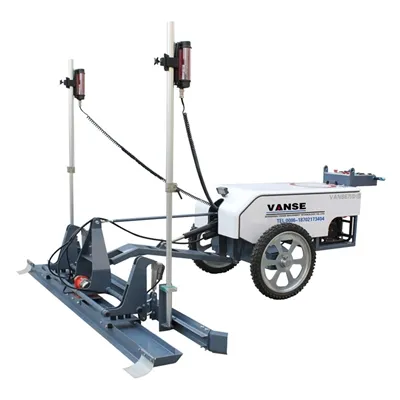
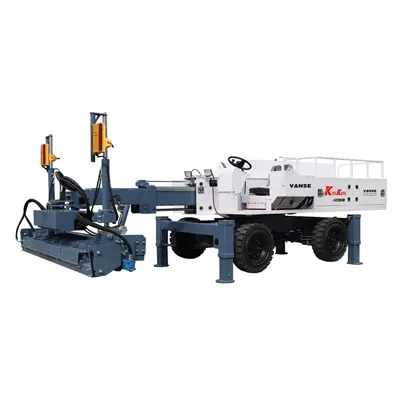
Nowadays, the amount of work is increasing. When operating the concrete laser leveling, you will feel that the fuel consumption of the machine is a bit high. This is because the workload itself is relatively large, and the construction time is also relatively long, so the fuel consumption is It is also a relatively common phenomenon, but in order to further save costs, we still need to take some measures, which can actually reasonably reduce the fuel consumption of concrete laser leveling machines.
1. Be proficient in the operation method of concrete laser leveling machine
In order to reduce the unnecessary increase in fuel consumption in the concrete laser leveling machine, you must first understand the basic operations of the concrete laser leveling machine and master the correct operations of loading, walking, turning, leveling, slope repair and other operations. If the foundation is not good, it will increase the fuel consumption of the concrete laser leveling machine. I would like to remind novices who have just entered the industry to listen to the advice of the master and master the leveling operation.
2. Reduce unnecessary idling
If you want to save fuel, you need to reduce the necessary idling speed of the engine. You should know that when the concrete laser leveling is idling, it is also using a hydraulic pump to circulate hydraulic oil. The longer the idling time, the more fuel is wasted. In fact, the correct way to save fuel is to try not to idle the concrete laser leveler during standby and rest periods. This is one of the secrets to saving fuel.
3. Reduce engine speed
When performing excavation operations, when the engine speed is at a higher speed, the operating speed is fast, but the fuel consumption is high. When operating at non-full throttle, appropriately reduce the engine speed. Although the operating speed is reduced, fuel consumption can be reduced. Improve fuel efficiency.
4. Walking without full throttle
When walking with the engine not at full throttle, everyone should know that the higher the engine speed, the faster the walking speed, and the higher the fuel consumption. Reducing the engine speed during operation can improve fuel consumption efficiency while walking.


Thanks to All the Friends Who Support and Trust Shandong Vanse Machinery Technology Co., Ltd.
If you want to know more about Shandong Vanse Machinery Technology Co., Ltd. or have any questions, please feel free to contact us:
Our Factory
Shandong Vanse Machinery Technology Co., Ltd.








Share this article

About the Author: Shandong Vanse Machinery Technology Co., Ltd.
Shandong Vanse Machinery Technology Co., Ltd. is a high-tech manufacturer specializing in concrete construction machinery, including laser screeds and related equipment. The company integrates R&D, production, and global sales, with products exported to over 60 countries and widely used in infrastructure projects worldwide.
Previous Post
Next Post
Related Articles
You Might Also Like
How to do a good job of laser leveling machine construction cooperation ?
In order to ensure the construction quality of concrete floors, more and more construction units are choosing to use precision laser leveling machines to lay concrete floors. However, in the process of actual construction work, because some enterprises do not cooperate in the construction work in place, or do not strictly follow the regulations and operate correctly, the problem of low construction quality of concrete floors sometimes occurs. In order to avoid the recurrence of this kind of situation, our company has detailed some construction cooperation matters during the construction process of the laser leveling machine as follows, and we hope that the relevant construction personnel must keep in mind. ❖Wire setting and leveling at the wall: Since the laser leveling machine at the wall cannot be touched, manual leveling is required within 200mm from the wall, so line setting is required as a reference for manual leveling. At the same time, 2 to 3 benchmark points (ground design elevation, ie ±0.0) that will not be disturbed during the construction period are set up for the laser leveling machine at one time, and good communication with each other is required. Bench point accuracy ±1mm. ❖Set formwork (steel formwork, position according to design requirements) along the periphery of the column to form separation joints. The elevation of the top surface of the formwork should be controlled within +0mm and -2mm, so as not to affect the flatness of the joints. ❖Install the construction joint formwork (steel formwork is recommended) along the range to be poured on the day, and the formwork should reserve holes with a spacing of 300mm for the insertion of dowel bars. The elevation of the top surface of the formwork should be controlled within +0mm and -2mm, so as to avoid large deviations in the flatness of the joints of different warehouses. ❖Establishment of the laser transmitter: It is intended to be erected on the column. The specific position should be set in a better position according to the amount of shop injection on the day. If it cannot be erected on the column, it should be erected on a special tripod. ❖In order to ensure the quality of concrete floor paving, each group needs to arrange 10-12 workers to cooperate to level the surface of the concrete paved on the ground, so that the stacking height is slightly higher than the design level (about 20-30mm). At the same time, for the parts near the wall, the outcropping pipeline and the surrounding formwork, arrange 2 workers to manually smooth the concrete material about 20~30cm away from the wall (formwork) side (using a 2m scraper and an iron trowel). Workers responsible for plastering must be trained skilled plasterers. These workers must obey the command and follow the arrangement in order to ensure the quality of the construction. ❖Since the thickness of the concrete reaches 200mm, and due to the setting of steel mesh, in order to ensure that the concrete is compacted by vibration, this project needs to arrange a vibrator to cooperate with the vibration. At the same time, in order to ensure that the protective layer of steel mesh reaches the thickness required by the design (70mm), it is necessary to arrange in advance to manually lift the steel mesh and place support blocks in the area to be laid. ❖The width of the concrete material laid on the platform is required to be no more than 5m each time, and the length is subject to the formwork boundary. The construction direction is from left to right (along the short side direction), from front to back (along the long side direction). The daily injection volume is recommended to be 1200~1500㎡. Calculated on the basis of 12 hours of working time per day, this requires a feed rate of 30 to 40m³. ❖Others: In order to ensure the flatness of the ground, special attention should be paid during the construction of the laser leveling machine: the slump of the concrete sent to the platform must be consistent each time; the concrete feeding speed must reach 40m/h or above, and each batch of concrete The initial setting time must be consistent; ensure that the formwork elevation is accurate, and cannot be disturbed during construction; the environment is coordinated. The concrete floor that has just been constructed cannot be exposed to sunlight, wind, rain, etc. that are unfavorable to concrete health.How adaptable is the laser leveling machine to different terrain conditions?
Study on the adaptability of laser leveling machines under different terrain conditions In modern construction and infrastructure construction, laser leveling machines, as a high-tech equipment, are widely used in the construction process of concrete pouring and ground leveling. Shandong VANSE Machinery Technology Co., Ltd. is a leading domestic laser leveling machine manufacturer. Its products not only occupy an important share in the domestic market, but are also exported to more than 60 countries around the world, reflecting the international influence of China's smart manufacturing. This article aims to explore the adaptability of laser leveling machines under different terrain conditions, and provide practical reference and reference for professionals in the industry through specific cases and technical analysis. 1. Overview of laser leveling machine technology Laser leveling machines use high-precision laser systems and leveling robotic arms to achieve precise leveling and compaction of concrete surfaces. Shandong VANSE's laser leveling machines, whether large laser leveling machines or small laser leveling machines designed for confined spaces, can maintain a high level of flatness and horizontality (FL≥15, FF≥20) during construction, greatly improving construction efficiency and ground quality. 2. Adaptability analysis under different terrain conditions 1) Plain and urban environment The advantages of laser leveling machines are particularly obvious in plain and urban construction environments. Because the ground is relatively flat, the transmission interference of laser signals is small, and the leveling machine can complete the work quickly and accurately. Shandong VANSE's laser leveling machine has been successfully applied in many large-scale commercial underground parking garage projects. By adopting bonded row steel fiber concrete, the crack resistance and bearing capacity of the ground are significantly enhanced, meeting the needs of high-intensity use. 2) Mountainous areas and complex terrain In mountainous areas or construction environments with complex terrain, laser leveling machines face the challenges of terrain undulations and line of sight obstruction. Shandong VANSE has enhanced the penetration and stability of signals through technological innovations, such as the introduction of high-precision laser transmitters and receivers, so that laser leveling machines can maintain good working performance even under complex terrain conditions. In the construction of a large warehouse in the mountainous area of Sichuan, VANSE's laser leveling machine successfully coped with the problem of terrain undulations and achieved efficient and high-quality ground leveling. 3) Plateau and extreme climate In plateau areas or extreme climate conditions, such as low temperature and high wind speed, the performance of laser leveling machines is put to the test. Shandong VANSE's laser leveling machines ensure stable operation in harsh environments by optimizing the equipment's heat dissipation system and wind-resistant design. In the construction of an airport in Tibet, despite the dual challenges of low temperature and hypoxia, VANSE's laser leveling machines still successfully completed the concrete pouring and leveling of the runway, ensuring the on-time delivery of the airport. 3. Technical optimization and innovation In order to improve the adaptability of laser leveling machines under different terrain conditions, Shandong VANSE Machinery Technology Co., Ltd. continues to optimize and innovate technology. For example, by using water-soluble adhesive row steel fibers, it not only improves the crack resistance of concrete, but also simplifies the construction process and improves construction efficiency. In addition, by improving the accuracy and stability of the laser transmitter, the laser leveling machine can achieve ideal flatness and levelness control under various terrain conditions. 4. Conclusion and Prospect The adaptability of laser leveling machines under different terrain conditions is due to its precise laser measurement system, flexible mechanical structure and continuous technological innovation. Shandong VANSE Machinery Technology Co., Ltd. has expanded the application scope of laser leveling machines to almost all terrains and environmental conditions through continuous research and development and practice. In the future, with the development of more complex terrain projects and the continuous improvement of construction quality and efficiency requirements, the technology of laser leveling machines will develop in a smarter and more efficient direction, bringing revolutionary changes to the global construction industry. The successful cases and technological innovations of Shandong VANSE Machinery Technology Co., Ltd. not only set a benchmark for domestic peers, but also provided valuable experience and inspiration for the global construction and infrastructure construction fields. With the increasing influence of China's smart manufacturing, VANSE's laser leveling machines are expected to leave their footprints in more countries and regions and write a new chapter in the history of world architecture. This article studies the adaptability of laser leveling machines under different terrain conditions, combined with the specific cases and technical analysis of Shandong VANSE Machinery Technology Co., Ltd., aims to provide practical reference and reference for the construction and infrastructure construction industry, and promote technological progress and innovative development in the industry.Can laser leveling be used for uneven concrete floors (such as slopes)? What parameters need to be set?
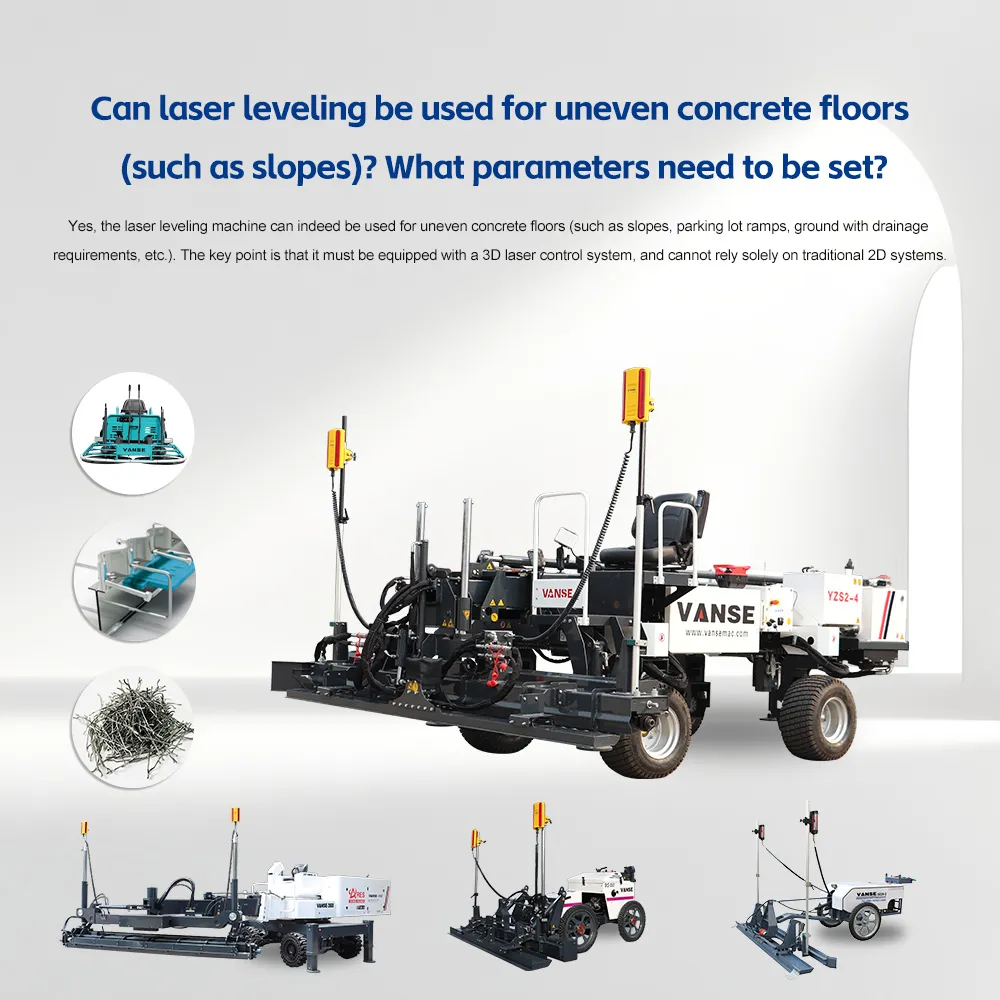
Yes, the laser leveling machine can indeed be used for uneven concrete floors (such as slopes, parking lot ramps, ground with drainage requirements, etc.). The key point is that it must be equipped with a 3D laser control system, and cannot rely solely on traditional 2D systems. According to the information provided on the Vanse Machinery website, the YZ30-4E model clearly indicates "Sloping ground" in the "Special project" section, and states that "with the 3D laser system, it can precisely level ground with drainage slopes (such as parking lot ramps)". This provides a direct basis for your question. To achieve precise leveling of the slope, the following key parameters need to be set, which are usually accomplished through the control panel of the 3D system or the accompanying software: Parameter Categories Specific settings: Function and Description 1. Slope Direction and Ratio Set the slope values for the X-axis (horizontal) and Y-axis (vertical). Usually expressed as percentages (%) or angles. For example, set a slope from point A to point B, with a 1 cm drop per meter (i.e., 1% slope). This is the core data that defines the shape of the slope, informing the machine about the direction and angle at which the ground slopes. 2. Elevation Reference Point Input the absolute elevation of at least one known point on the slope as the reference for the entire slope calculation. The 3D system will use this as a starting point, combined with the slope parameters, to automatically calculate the target elevation of any point on the slope. 3. Import of 3D Digital Model For complex slopes (such as bidirectional slopes, curved surfaces), directly import the 3D design drawings from the design institute (in formats like DXF, DWG). This is the most efficient and accurate method. The machine can "understand" the design intent and automatically guide the leveling head operation. 4. Settings of Laser Emitter Set the laser emitter to slope mode (instead of horizontal mode), and adjust the prism or tilt sensor inside the emitter head according to the input slope parameters. Ensure that the laser plane emitted is itself an accurate slope, providing the machine with the correct reference benchmark. Apart from parameter settings, there are also specific requirements during the construction process: Equipment selection: It is preferable to use telescopic arm type or large seated laser leveling machines (such as the YZ series and WS series from Vanse). These types of equipment have good stability and provide a good field of vision for the operator, making them more suitable for safe and precise operation on slopes. Construction from low to high: The sequence of concrete pouring and leveling should start from the lowest point at the bottom of the slope and progress towards the top. This allows the use of the self-weight and fluidity of the concrete to facilitate the control of elevation and density. Controlling concrete slump: Slope construction has higher requirements for the fluidity of the concrete. If the slump is too large, the concrete will flow downward after vibration, making it difficult to form; if it is too small, it will be difficult to level. Generally, the slump should be reduced appropriately compared to flat construction (for example, controlled at 12 ± 2 cm), and adhesives may be needed to enhance the concrete's anti-flowing ability. Strengthening formwork support: The formwork at the bottom of the slope needs to withstand greater lateral pressure and must be reinforced and supported to prevent the formwork from shifting during pouring, resulting in distorted slope. Manual assistance: At the top, edges, or blind spots where machines cannot operate, manual replenishment and assistance for leveling are necessary to ensure the overall slope is consistent and coherent. Using a laser leveling machine equipped with a 3D system for slope construction, the accuracy and efficiency are far superior to traditional methods. The key lies in digitally transmitting the design intent to the machine (through slope parameters or 3D models), and having experienced operators adjust it flexibly during the construction process. If your project has specific slope requirements (such as one-way or two-way slope? What is the slope percentage?), please let me know. I can help you further analyze the parameter settings or details of equipment selection. Contact us NOW Note: The parameters provided in this document are for reference only and are not mandatory. Due to differences in technical characteristics between different brands and models of laser levelers, please consult the manufacturer for a suitable solution before actual operation. This reference document assumes no responsibility for any issues arising from failure to follow the manufacturer's instructions.