Technical Knowledge
Concrete laser leveling machine VS. traditional manual leveling, how much has the efficiency increased?
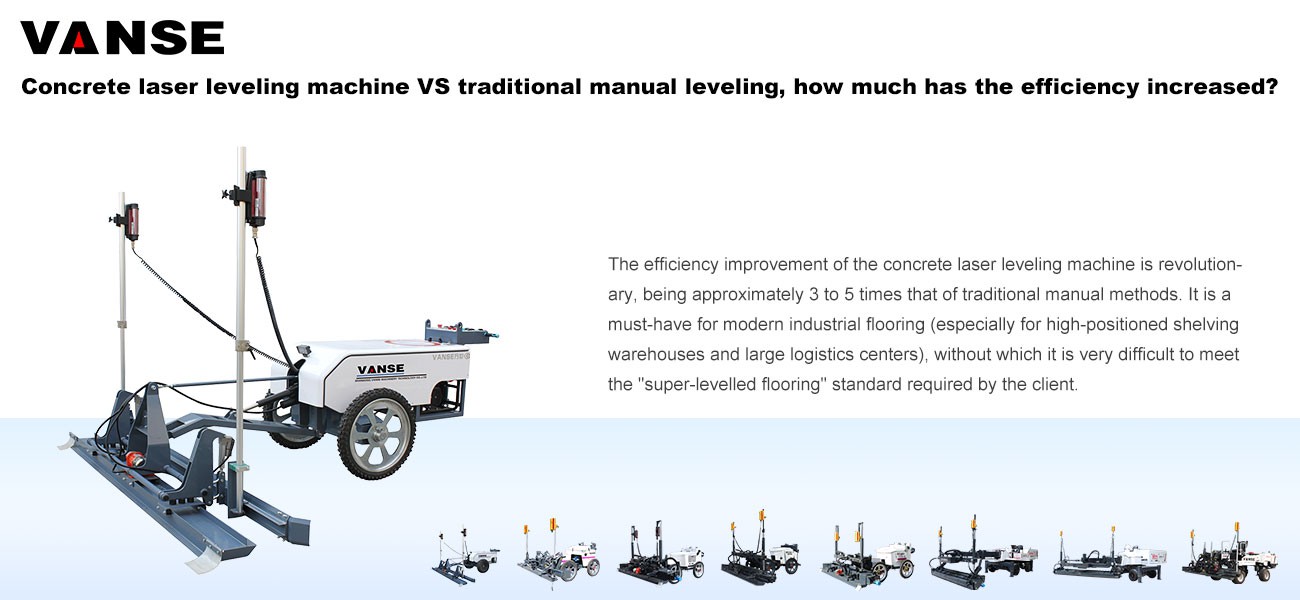
The comprehensive construction efficiency of the concrete laser leveling machine is typically 3 to 5 times that of the traditional manual method (that is, an increase of 300% to 500%).
It is not merely about "doing it quickly"; its advantages in terms of labor saving and uniformity are even more revolutionary than just the speed.
The following is a detailed data comparison and analysis of laser leveling versus manual leveling:
Core Data Comparison Table (Efficiency and Quality)
To make it clear for you, we will compare the key indicators of the two types of work methods side by side:
| Core indicators | Traditional manual leveling | Laser Leveling Machine (Laser leveling) | Improvement percentage/difference |
| Daily construction area | Approximately 500 – 800 m² per day | Approximately 2,500 – 4,500 m² per day | Efficiency increased by 300% – 500% |
| Required manpower | 15 – 20 people (high-intensity physical labor) | 4 – 6 people (mainly for assistance and operation) | Labor reduced by approximately 60% |
| Leveling error | 5mm – 10mm (even larger) | ≤ 2mm (measured with a 2-meter level) | Precision reaches the standard of a perfectly flat floor |
| Concrete slump | Requires a larger slump (120-140mm) for dragging | Suitable for low slump (80-100mm) | Concrete strength and density are higher |
| Construction joint | Must be poured in sections, with many construction joints | Capable of continuous large-area laying | Reduced construction joints, resulting in a more integrated floor surface |
2. Specific dimensions of efficiency improvement
A. Qualitative change in speed: From "piece-by-piece construction" to "large-scale paving"
Traditional method: First, formwork (channel steel) needs to be erected, then points need to be marked and lines drawn.Workers have to bend over and repeatedly level the surface using a trowel. This requires a lot of physical effort. As time goes by, workers become more fatigued, and their efficiency and quality in the afternoon usually decline significantly.
Laser leveling: The machine is equipped with a high-frequency vibrator (about 4,000 times per minute). While moving, it automatically levels, vibrates, and stirs the mixture.It doesn't require side formwork and can achieve large-area, continuous laying. The machine is tireless and maintains consistent quality day and night.
B. Liberation of Human Resources: From "Human Sea Strategy" to "Elite Forces"
Traditional approach: To meet the deadline, the only solution is to hire more workers. However, having too many workers can lead to chaos at the site, and skilled plasterers (foremen) currently have very high daily wages.
Laser leveling: Only one operator is needed, along with 2-3 assistants (responsible for pulling the concrete pipes and providing simple materials). This not only reduces the daily wage expenses, but also lowers the management difficulty and the risk of workplace injuries.
C. The "invisible efficiency" brought about by quality
This is the point that is most easily overlooked.
No need for rework: Manual leveling is prone to "ripple patterns" or hollowing out. If the storage and logistics center has strict requirements for leveling accuracy, after manual leveling, it may still require a significant amount of time for self-leveling repair or sanding, which are all hidden costs.
High-strength concrete: The laser leveling machine can handle more dry and harder concrete (with lower slump), which means that the risks of sanding and cracking after the floor dries completely are significantly reduced, thereby lowering the maintenance costs in the later stage.
3. Financial Report: Is It Worth It?
Although the laser leveling machine is highly efficient, the cost of purchasing the machine is high (ranging from several hundred thousand to even over a million). Let's do a simple calculation:
Applicable scenario (the critical point where profits turn into losses):
If your project is a small basement less than 1000 square meters or a small room divided by walls: traditional manual methods are more cost-effective, as it is troublesome to bring in and set up the machinery, as well as to transport it.
If your project involves a factory building, warehouse or parking lot with an area of over 3,000 square meters: The laser leveling machine is the undisputed champion.
Example: 10,000 square meters of factory floor area
The manual team: It might take 10 to 12 days to complete the task, and we will pay the wages of 15 people every day.
Machine team: The job can be completed within 3 to 4 days. We will pay the wages of 5 workers plus the depreciation of the machines and the cost of fuel.
Result: The construction period was shortened by 70%. The client (the owner) was more satisfied, and you could receive the project payment more quickly to take on the next job.
Conclusions and Recommendations
The efficiency improvement of the concrete laser leveling machine is revolutionary, being approximately 3 to 5 times that of traditional manual methods. It is a must-have for modern industrial flooring (especially for high-positioned shelving warehouses and large logistics centers), without which it is very difficult to meet the "super-levelled flooring" standard required by the client.
Note: The parameters provided in this document are for reference only and are not mandatory. Due to differences in technical characteristics between different brands and models of laser levelers, please consult the manufacturer for a suitable solution before actual operation. This reference document assumes no responsibility for any issues arising from failure to follow the manufacturer's instructions.
Thanks to All the Friends Who Support and Trust Shandong Vanse Machinery Technology Co., Ltd.
If you want to know more about Shandong Vanse Machinery Technology Co., Ltd. or have any questions, please feel free to contact us:
Our Factory
Shandong Vanse Machinery Technology Co., Ltd.








Share this article

About the Author: Shandong Vanse Machinery Technology Co., Ltd.
Shandong Vanse Machinery Technology Co., Ltd. is a high-tech manufacturer specializing in concrete construction machinery, including laser screeds and related equipment. The company integrates R&D, production, and global sales, with products exported to over 60 countries and widely used in infrastructure projects worldwide.
Previous Post
Next Post
Related Articles
You Might Also Like
When constructing the concrete factory building, what is the significance of laying a double-layer steel mesh?
– Enhance the bending resistance: The roof panels, floor panels and other structures of concrete plants will bear various loads during use, such as self-weight, equipment weight, and personnel activity loads. The double-layer steel mesh can arrange steel bars in the tension zone and compression zone of the concrete structure respectively, effectively improve the bending resistance of the structure, resist the bending deformation caused by the load, prevent excessive cracks or even fractures on the plate surface, and ensure the safety and stability of the plant structure. – Improve shear resistance: Large shear forces will be generated in the beam-column nodes and the intersections between the plates and beams of the plant structure. The steel bars in the double-layer steel mesh can enhance the shear resistance of the concrete through the action of pins and the tension of the inclined section, avoid shear failure in these parts, and ensure the overall force transmission performance of the structure. – Increase deformation capacity: Ductility refers to the ability of a structure to withstand large deformations without losing its bearing capacity before failure. The double-layer steel mesh arrangement enables the steel bars to yield before the concrete when the concrete structure is subjected to tensile failure, and absorbs and dissipates energy through the plastic deformation of the steel bars, giving the structure better ductility. This means that when encountering accidental loads such as earthquakes and wind disasters, the plant structure can have a greater deformation capacity and is less likely to suffer brittle failure, thus providing more opportunities for personnel evacuation and structural repair. – Improve seismic performance: For concrete plants in earthquake-prone areas, the role of double-layer steel mesh is particularly important. Under the action of an earthquake, the structure will produce complex deformations and internal forces. The double-layer steel mesh can constrain the deformation of concrete in different directions, enhance the integrity and seismic resistance of the structure, reduce the degree of damage to the plant structure caused by the earthquake, and ensure the repairability and safety of the plant after the earthquake. – Limit shrinkage cracks: Concrete will shrink and deform during the solidification process, especially in large-volume concrete or concrete components with large exposed areas. Shrinkage stress can easily cause cracks on the concrete surface. Double-layer steel mesh can restrain the shrinkage deformation of concrete, reduce the tensile stress inside the concrete, and effectively control the generation and development of shrinkage cracks, thereby improving the impermeability and durability of the concrete structure. – Disperse temperature cracks: During the use of the factory, it will be affected by changes in ambient temperature, and temperature stress will be generated inside the concrete. Double-layer steel mesh can disperse temperature stress to a larger range to avoid cracks in the concrete due to local temperature stress concentration. At the same time, the presence of steel bars can also improve the thermal conductivity of concrete, make the temperature distribution inside the concrete more uniform, and further reduce the occurrence of temperature cracks. – Provide a protective barrier: The steel bars in concrete are easily eroded by the external environment, such as oxygen, moisture and harmful chemicals in the air. The double-layer steel mesh is arranged inside the concrete to form a protective barrier to isolate the steel bars from external corrosive media. At the same time, the gripping effect of concrete on the steel bars can also prevent the steel bars from rusting, thereby extending the service life of the steel bars and the entire concrete structure and ensuring the durability of the plant structure. – Maintaining structural integrity: By improving the crack resistance and bearing capacity of the structure, the double-layer steel mesh can reduce the damage to the integrity of the plant structure caused by crack development and structural deformation. When the integrity of the structure is guaranteed, it can better resist the influence of external environmental factors and avoid the performance degradation of the entire structure due to local damage, thereby achieving long-term safe use of the plant structure. Click the below to jump immediately!!! AMOUR JOINT CONCRETE LEVELING MACHINE LIGHT TOWER POWER TROWEL SLIPFORM MACHINE STEEL FIBER TOPPING SPREADER TRACKED MINI DUMPERHow does concrete laser leveling technology ensure construction safety?
Concrete laser leveling technology not only improves construction efficiency and quality, but also has an important impact on construction safety. In building construction, safety is always the primary consideration. The following is a detailed analysis of how concrete laser leveling technology ensures construction safety. Introduction In traditional concrete construction, construction safety problems occur from time to time due to the limitations of manual operation. The application of concrete laser leveling technology reduces the safety risks in the construction process by reducing direct manual participation. 1. Technical Overview Concrete laser leveling technology uses laser as a reference benchmark and automated equipment to accurately level the concrete surface. This technology not only improves construction efficiency and quality, but also helps to improve the safety of the construction process. 2. Working Principle The working principle of concrete laser leveling technology includes the following key links: Laser transmitter: emits a stable laser beam to form a horizontal reference plane. Receiver: installed on the leveling machine, receives laser signals and converts them into electrical signals. Control system: automatically adjusts the working state of the leveling machine according to the received electrical signal. Leveling equipment: level the concrete surface according to the instructions of the control system. 3. Safety measures Concrete laser leveling technology ensures construction safety through the following aspects: Reduce manual operation: The automated leveling process reduces the chance of direct manual contact with concrete and reduces the risk of work-related injuries. Improve construction accuracy: Accurate leveling reduces subsequent finishing work and reduces safety accidents caused by improper finishing. Stabilize the construction environment: Laser leveling technology reduces the use of mobile equipment and tools during the construction process and reduces safety hazards in the construction environment. Improve construction quality: The flat concrete surface reduces the risk of falls and slips caused by uneven ground. 4. Safety considerations in the construction process In the construction process, the safety of laser leveling technology is reflected in the following aspects: Site preparation: Ensure the flatness and cleanliness of the construction site to reduce the risk of tripping and slipping during construction. Equipment operation: Operators need to receive professional training and understand the operating procedures and safety precautions of the equipment. Construction monitoring: During the construction process, the laser transmitter and leveling equipment need to be monitored in real time to ensure their normal operation. Emergency plan: Develop an emergency plan so that measures can be taken quickly to reduce losses in the event of equipment failure or construction accidents. 5. Technical advantages and safety benefits The safety benefits of laser leveling technology in practical applications include: Reduce work-related injuries: Automated leveling reduces manual operations and reduces the risk of work-related injuries. Increase construction speed: The fast construction speed reduces the exposure time of workers at the construction site. Improve construction quality: High-quality concrete surface reduces safety hazards in subsequent construction. 6. Technical challenges and safety countermeasures Although laser leveling technology has safety advantages, it also faces some challenges in practical applications: Equipment operation complexity: The operation of laser leveling equipment requires professional knowledge, and improper operation may cause safety accidents. Equipment maintenance: The equipment needs to be maintained regularly to ensure its normal operation and avoid safety problems caused by equipment failure. Environmental adaptability: Laser leveling technology needs to adapt to different construction environments, such as wind force, temperature changes, etc., which may affect equipment performance. Response strategies include: Professional training: Provide professional training for operators to ensure that they are familiar with equipment operation and safety procedures. Equipment maintenance: Establish an equipment maintenance system, regularly inspect and maintain the equipment to ensure its good operation. Environmental adaptability improvement: Improve the stability and adaptability of the equipment through technical improvements. 7. Safety culture and awareness enhancement During the construction process, the establishment of safety culture and the improvement of safety awareness are equally important: Safety education: Regularly conduct safety education for construction personnel to improve their safety awareness. Safety supervision: Establish a safety supervision mechanism to ensure that various safety measures are implemented during the construction process. Safety incentives: Through the reward mechanism, encourage construction personnel to comply with safety regulations and improve construction safety. 8. Conclusion Concrete laser leveling technology significantly improves the safety of the construction process by reducing manual operations, improving construction accuracy, stabilizing the construction environment and improving construction quality. Construction safety can be further ensured through professional training, equipment maintenance, environmental adaptability improvement and the establishment of a safety culture. With the continuous development and innovation of technology, concrete laser leveling technology will play a greater role in ensuring construction safety. This article introduces in detail how concrete laser leveling technology ensures construction safety. From technical principles, safety assurance measures, safety considerations in the construction process, technical advantages and safety benefits, technical challenges and safety countermeasures, to safety culture and awareness enhancement, the important role of this technology in ensuring construction safety is comprehensively analyzed. I hope this article can provide readers with valuable information and in-depth understanding.The necessity of choosing the laser leveling machine!
The laser leveling machine uses laser to level the ground, which is more accurate and has smaller ground errors after paving. Moreover, the construction of this equipment is very efficient, which is basically more than 3 times that of manual labor, and one device can do it, saving labor input and reducing capital cost investment. Definition of laser leveling machine: A laser-guided device for leveling and leveling fresh concrete. A concrete construction method that uses a laser leveling machine to spread and level the newly poured concrete. The laser leveling machine can significantly improve the flatness of the ground by leveling the ground. The ground constructed by the laser leveling machine and the traditional method is tested at 22 points (one point every 5mx4m), and the average flatness is 1.3mm and 4.1mm respectively. The leveling quality of laser leveling machines and other equipment is more than 3 times higher than that of traditional methods. The application of laser leveling machines and other equipment can realize large-scale construction, reduce a large number of construction joints, reduce the slump of concrete, and ensure the strength of concrete, so that the ground has good integrity and is not prone to cracks. Using laser leveling machines and other equipment to construct large concrete slabs can improve work efficiency by 3 times and save 30% compared with the traditional beam vibrator method. The construction area per hour is more than 300 square meters, and the workload can be completed every day at more than 3,000 square meters to 5,000 square meters, which greatly improves the work efficiency. Of course, high-quality and efficient large-area integral floor construction requires not only high-quality and reliable laser leveling machines, but also a fast and convenient spreader. Wanshi SL18-6 spreader equipment eliminates a series of defects such as uneven spreading, dust pollution, footprints, color difference, etc. caused by traditional wear-resistant aggregate spreading that affect the final beauty and quality of the floor, and truly realizes high-efficiency one-time mechanized spreading of wear-resistant aggregates. ● Integrated leveling head: It is composed of scrapers, vibrators, vibration plates, stirring cages and other components, which integrates multiple processes such as mixing, leveling, vibrating, and vibrating together, and is completed by the machine at one time. Improve efficiency and save labor. ● The high-frequency vibrator vibrates 4000 times per minute, and the vibrating plate of the leveling head vibrates evenly at high frequencies, making the concrete floor dense and avoiding cracking caused by stress concentration caused by deformation. It can effectively solve the problems of hollowing, peeling, cracking, and inequality on the ground. ● The leveling head can maintain the horizontal plane of construction under the dual transformation of the ups and downs of the foundation and the inclination of the ground. ● The laser measurement and control system automatically controls the elevation: The design elevation of the top surface of the floor is automatically controlled by the laser machine computer, which can ensure a very high ground flatness and can directly achieve precise leveling on the concrete layer. The ground flatness is not affected by the vibration of the construction template, and there is no need to support the template in the middle, which reduces the input of labor and materials, reduces the construction procedures, and speeds up the construction progress. Finally, it should be noted that if you want to use a concrete laser leveling machine, you must choose a professional concrete laser leveling machine brand equipment and pay attention to the use method. Without professional training, it may lead to inability to keep up with the construction efficiency and the effect will be greatly reduced.