Technical Knowledge
Application Techniques of Concrete Laser Leveling Machine in Slope Ground Construction
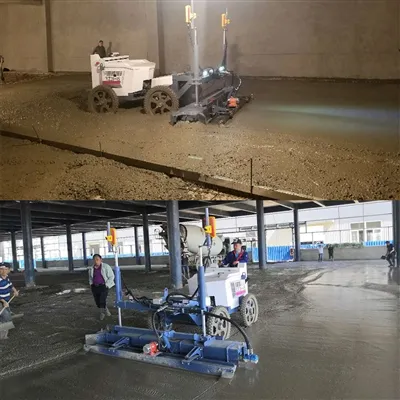
In the routine application of concrete laser leveling machines (Laser leveling), 90% of the cases are for creating "horizontal" surfaces. However, when dealing with slope conditions such as parking lot ramps, drainage slope finding, and outdoor squares with slopes, many construction teams tend to encounter problems and "go off track".
When using a laser leveling machine on a slope, the key lies in **"deceiving the machine's reference point"** and **"controlling the flow of concrete"**. Here are some advanced application techniques for slope construction:
Core Setting: How to Make the Laser "Take a Diagonal Path"
The machine itself only recognizes laser planes. To create a slope, it is necessary to first have the laser emitter emit a "tilted reference surface".
Single Slope setting method:
Alignment: The Y-axis (or X-axis, depending on the brand) of the laser emitter must be precisely parallel to the direction of the slope. If the axis is off, the resulting slope will be crooked (like the blades of a propeller).
Input slope: Directly enter the slope percentage (%) on the transmitter.
Formula: Slope % = (Height Difference / Length) × 10
Example: The length is 100 meters. The height of the top is 2 meters higher than the bottom, and the slope is 2.00%.
Dual Slope and 3D System:
If the slope change is complex (such as a funnel-shaped drainage), ordinary single/double slope laser emitters cannot handle it. At this point, a 3D spreading system (3D Profiler System) must be used. It does not rely on a single laser plane but instead tracks the machine's position in real time using a total station (Total Station), and adjusts the scraper height in real time based on the CAD topographic map in the computer.
⚠️ Important blind spot: After setting the slope laser, it is essential to use the handheld receiver to verify the elevation at the bottom, middle, and top of the slope. Even if the machine is "blind", it won't tell you if it's off; only a person can do the verification.
2. Material Control: The "Fall-Off Rule" Against Gravity
On the slope, the greatest enemy is not the precision of the machinery, but gravity. The concrete is too thin. As soon as the machine finishes leveling it, the concrete starts to flow down, causing the top of the slope to become thinner and the bottom to become thicker.
Gold slump value: The slump value of concrete during slope construction must be lower (more dry) than that on flat ground.
Recommended value: 100mm – 120mm.
If the slope exceeds 2% (that is, a 100-meter drop of 2 meters), the recommended slump range is 80mm – 100mm.
Admixtures: Avoid using formulations with excessive retarders, as the concrete needs to "lose its fluidity" and set up as soon as possible.
3. Operator Tactics: Walking Direction and Aircraft Nose Control
The driving logic of the operator on the slope is completely different from that on the flat ground.
| Operation steps | Tips and Precautions |
| Direction of movement | Recommendation: Walk vertically in the direction of the slope (horizontally) (if the width of the site allows it). |
| This way, the machine will always work in a relatively horizontal state, the tire grip will be more stable, and the pressure on both sides of the scraper will be balanced. | |
| Alternative: Retreat from the lower position to the higher position. | |
| If you must work along the slope, try to have the front of the machine facing upwards and back up to level it out. This way, the scraper can "support" the concrete, preventing it from flowing. It is strictly prohibited to level from a higher position to a lower position; otherwise, the concrete will flow over the scraper like an avalanche and cannot be scraped at all. | |
| Leveling Head floating | Many machines have "floating mode" or "tilt compensation for machine head". On slopes, the vehicle body is inclined, but the scraper must be parallel to the laser surface. Ensure that the hydraulic system can sensitively compensate for the errors caused by the vehicle body's inclination. |
| Fabric quantity | The spreading here must be "eat less, more frequently" than on flat ground. If the accumulated material in front of the scraper is too heavy, it will drag the machine and cause it to slip (especially for tire-type machines). |
4. Common Hazards and Limitations
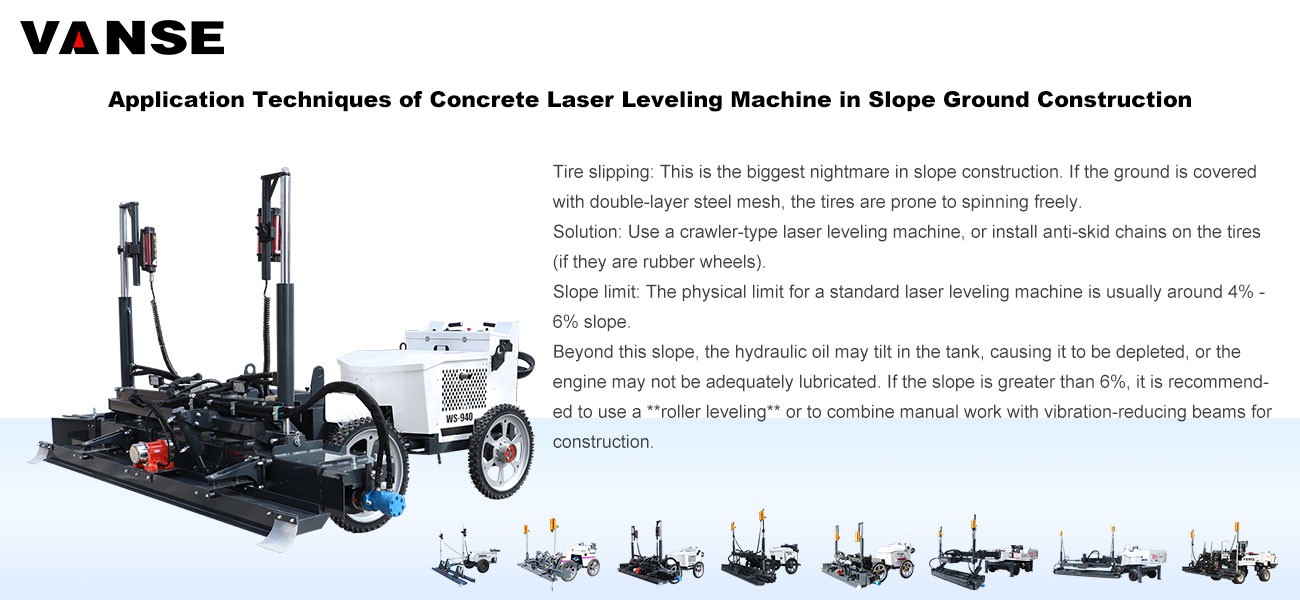
Tire slipping: This is the biggest nightmare in slope construction. If the ground is covered with double-layer steel mesh, the tires are prone to spinning freely.
Solution: Use a crawler-type laser leveling machine, or install anti-skid chains on the tires (if they are rubber wheels).
Slope limit: The physical limit for a standard laser leveling machine is usually around 4% – 6% slope.
Beyond this slope, the hydraulic oil may tilt in the tank, causing it to be depleted, or the engine may not be adequately lubricated. If the slope is greater than 6%, it is recommended to use a **roller leveling** or to combine manual work with vibration-reducing beams for construction.
The next suggestion is…
If your project involves a spiral ramp in an underground garage, a laser leveling machine is usually not applicable (because it is curved and has a narrow space). However, if it is a large-scale logistics park unloading ramp, then a laser leveling machine would be an ideal solution.
We suggest that before conducting a large-scale formal construction, you should first create a "test section" measuring 5 meters by 5 meters, specifically to test whether the concrete you ordered will "flow" under this slope condition.
Note: The parameters provided in this document are for reference only and are not mandatory. Due to differences in technical characteristics between different brands and models of laser levelers, please consult the manufacturer for a suitable solution before actual operation. This reference document assumes no responsibility for any issues arising from failure to follow the manufacturer's instructions.
Thanks to All the Friends Who Support and Trust Shandong Vanse Machinery Technology Co., Ltd.
If you want to know more about Shandong Vanse Machinery Technology Co., Ltd. or have any questions, please feel free to contact us:
Our Factory
Shandong Vanse Machinery Technology Co., Ltd.








Share this article

About the Author: Shandong Vanse Machinery Technology Co., Ltd.
Shandong Vanse Machinery Technology Co., Ltd. is a high-tech manufacturer specializing in concrete construction machinery, including laser screeds and related equipment. The company integrates R&D, production, and global sales, with products exported to over 60 countries and widely used in infrastructure projects worldwide.
Previous Post
Next Post
Related Articles
You Might Also Like
What should we pay attention to when maintaining concrete?
Concrete curing is a key link to ensure the quality of concrete. The following points need to be noted: 1. Maintain appropriate humidity and temperature: During concrete curing, appropriate humidity and temperature should be maintained to promote the hardening and strength development of the concrete. Excessively high temperature and leakage may cause concrete to crack or deform, while too low temperature and humidity may cause drying shrinkage cracks on the concrete surface. Therefore, appropriate moisturizing and heat preservation measures need to be taken according to specific maintenance conditions and requirements. 2. Avoid excessive exposure time: During the setting curing period, the exposure time of surface mixing should be minimized, and the exposed surface of the concrete should be tightly covered in a timely manner to prevent surface moisture from evaporating. Before the concrete of the exposed surface protective layer is initially set, the covering should be rolled up, and the surface should be rubbed with a trowel at least twice to make it flat and then covered again. At this time, care should be taken that the covering should not directly contact the concrete surface until the concrete is finally set. 3. Increase the thickness of the protective layer appropriately: In order to increase the wear resistance and durability of concrete, the thickness of the protective layer can be appropriately increased. When pouring concrete, you can lay a layer of plastic film or wet cloth on the surface to keep the concrete surface moist and smooth. During the maintenance period, the thickness of the protective layer should be checked regularly to ensure that it meets the design requirements. 4. Control the construction temperature: During the concrete construction process, the construction temperature should be controlled to avoid excessively high or low temperatures affecting the quality of the concrete. During summer construction, measures should be taken to reduce the temperature of concrete entering the mold to avoid the phenomenon of "thermal bridge"; during construction in winter, measures should be taken to increase the temperature of concrete entering the mold to avoid the phenomenon of "cold bridge". 5. Regular inspection and maintenance: During the concrete curing period, the concrete structure should be inspected and maintained regularly to ensure its quality and safety. If cracks, deformation or other problems are found in the concrete structure, timely measures should be taken to repair and reinforce it. In short, concrete curing is a key link to ensure the quality of concrete. It is necessary to pay attention to maintaining appropriate humidity and temperature, avoiding excessive exposure time, appropriately increasing the thickness of the protective layer, controlling construction temperature, and regular inspection and maintenance. Only in this way can we ensure that the strength and durability of the concrete structure meet the design requirements and provide a strong guarantee for the safety and quality of the construction project.What is the difference between using a concrete laser leveling?
The advent of the concrete laser leveling machine has brought not only high-quality and high-efficiency construction to the floor industry, but also a symbol of technological progress. Compared with the traditional artificial vibrating beam construction, the laser leveling machine has A qualitative leap forward, it is guided by a laser and is easy and convenient to operate. Working principle of concrete laser leveling machine The Laser Transmitter Generates Rotating Laser Light, And The Laser Receiver On The Leveling Machine Receives The Signal, Which Is Analyzed By The Laser Measurement And Control System, And The Deviation Will Be Fed Back To The Sensitive Computer Control System On The Leveling Machine, And The Left And Right Electric Push Rods Will Adjust The Position Of The Scraper. Height To Ensure Leveling Accuracy. Paving, Scraping, Vibrating, And Leveling The Floor Concrete, Mainly Laying The Concrete To An Elevation Higher Than The Design Requirements, And Vibrating And Leveling The Concrete. The floor-concrete laser leveling machine uses a scraper to take away the raised concrete and initially level it to reach the elevation required by the design. The two-wheel automatic walking system is adopted, and the vibration frequency is 4000 times/minute, which drives the entire vibration plate to vibrate the concrete together. The construction width of the floor concrete laser leveling machine is 2.5 meters. The leveling of the laser leveling machine does not need to pull the control line, nor does it need the side template to control the ground elevation, but is controlled by the laser measurement and control system on the leveling machine in real time. As long as the laser transmitter is not disturbed, no matter where the leveling machine moves, It can ensure that the overall elevation of the paved ground will not be affected. Super Flat: Through the combination of concrete laser leveling machine and professional and precise personnel, the flatness level of the (floor) ground can be raised from the current specification of 2 meters by 4mm to the standard of 2 meters by 2mm, and the (floor) ground The levelness can be achieved within the range of ±5mm/100m through the laser detection and control of two laser leveling devices and the leveling of the "Thunder Dragon" laser leveling machine. Super Strong: Through professional floor treatment equipment-single-disc and double-disc drive troweling machines several times, the (building) floor forms a real "clear water concrete" surface layer. It is also possible to sprinkle and add color hardening agent during surface construction or to brush liquid concrete sealing and curing agent on the surface of the original slurry "clear water concrete" to improve the surface strength again and truly realize the super strong surface. Super Saving: Through the simultaneous construction of the (building) ground concrete, the building (ground) method is completed at one time, which not only saves the materials, labor, and machinery of the second method, but also avoids the "empty drums and cracks" caused by the second method. , Peeling, sanding" and other common quality problems; it also reduces the load generated by the materials used in the secondary method between floors, saves the delay in the construction period caused by the secondary method, and greatly saves the turnover caused by the extension of the construction period The rental fees of tools and various equipment save a lot of cost and achieve economic benefits created by super saving. After calculation, the secondary method is based on 6-8cm concrete, and the cost of labor, machinery, and materials required should be more than 40 yuan/m2, and the cost savings will be more than 30/m2 even after deducting the cost of finished product protection. By solving the concrete surface layer at one time, all the "common quality problems" caused by the second method are completely eliminated. The "three super" floor is flat, clean, dense, high-strength, one-layer overall, with reduced cost, shortened construction period, and absolute durability. It should be said that there is no better method to replace it, whether domestic or foreign.How does the concrete laser leveling machine cope with different construction environments and conditions?
As an important equipment in modern building construction, the concrete laser leveling machine's operating efficiency and construction quality are directly affected by the construction environment and conditions. In order to ensure that the leveling can perform optimally in various environments, its adaptability must be thoroughly studied. This article aims to explore how concrete laser leveling machines can effectively respond to different construction environments and conditions. ◇◆◇◆◇◆◇◆◇◆◇Basic principles and functions of concrete laser leveling machine The concrete laser leveling machine uses laser technology to perform ground leveling operations. It emits precise laser beams through the laser transmitter to guide the scraper of the leveling machine for precise leveling. Leveling machines are usually equipped with key components such as power systems, control systems, and laser receiving systems, which can achieve efficient and accurate ground leveling operations. ◇◆◇◆◇◆◇◆◇◆◇Classification and characteristics of construction environments and conditions 1. Outdoor environment: The outdoor environment is changeable and may encounter different climatic conditions such as high temperature, low temperature, rain, snow, wind and sand. In addition, outdoor terrain may also be complex, such as slopes, curves, etc. 2. Indoor environment: The indoor environment is relatively stable, but you may also encounter problems such as insufficient light and space restrictions. 3. Ground conditions: Ground conditions include newly poured concrete, old concrete, cement mortar, etc. Different ground materials have different requirements for the leveling machine. ◇◆◇◆◇◆◇◆◇◆◇ Strategies for concrete laser leveling machines to deal with different environments 1. Strategies for outdoor environments: • High temperature environment: Enhance the heat dissipation performance of the leveler, such as increasing the radiator area, optimizing the fan design, etc. At the same time, arrange the working time reasonably to avoid working during high temperature periods. • Low-temperature environment: Adopt low-temperature startup technology, such as using low-temperature lubricating oil and installing preheating devices, to ensure that the leveler can start and operate normally in low-temperature environments. • Rain and snow environment: The leveler should be waterproof and dustproof to prevent rain and snow from entering the equipment and causing damage. In addition, when operating in rainy and snowy weather, anti-slip measures should be taken to ensure stable operation of the leveler. • Windy and sandy environment: Strengthen the sealing performance of the leveling machine to prevent sand from invading the inside of the equipment. At the same time, clean and maintain the equipment regularly to reduce the impact of windy sand on the equipment. 2. Strategies for indoor environments: • Insufficient light: The leveling machine should be equipped with sufficient lighting equipment to ensure that it can operate normally in an environment with insufficient light. In addition, auxiliary positioning technologies such as infrared can also be used to improve leveling accuracy. • Space limitations: For indoor space limitations, you can choose a miniaturized leveler or use block operations to adapt to different space conditions. 3. Strategies for ground conditions: Newly poured concrete: The surface of newly poured concrete is relatively moist. When the leveler is operating, attention should be paid to the humidity control of the scraper to avoid excessive moisture causing sanding on the concrete surface. . • Old concrete: There may be cracks, sanding and other problems on the surface of old concrete. Surface treatment should be carried out before leveling machine operation to ensure that the surface is smooth and clean. • Cement mortar: The cement mortar ground is relatively soft. When the leveler is operating, the height and speed of the scraper should be appropriately reduced to avoid excessive pressure on the ground and resulting in deformation. ◇◆◇◆◇◆◇◆◇◆◇Technical measures to improve the adaptability of concrete laser levelings 1. Intelligent control system: By introducing an intelligent control system, the operating parameters of the leveling machine (such as scraper height, speed, etc.) can be automatically adjusted according to real-time environmental parameters (such as temperature, humidity, light, etc.) to achieve the best results. Work results. 2. Multi-functional accessories: Design and develop accessories (such as different scrapers, tools, etc.) suitable for different ground conditions and construction environments to meet diverse construction needs. 3. Maintenance system: Establish a complete maintenance system and regularly inspect, maintain and repair the leveling machine to ensure that it is always in good working condition. 4. Training and education: Strengthen the training and education of operators to improve their skill level and safety awareness so that they can better cope with various construction environments and conditions. ◇◆◇◆◇◆◇◆◇◆◇Case Analysis Taking a large commercial plaza as an example, the project encountered various environments and conditions such as high temperature, low temperature, rain and snow, and insufficient indoor light during the construction process. To ensure construction progress and quality, the project team selected an advanced concrete laser leveler and took the following countermeasures: 1. For high and low temperature environments, the leveling machine adopts a special heat dissipation system and low-temperature starting technology to ensure the stable operation of the equipment. 2. For rainy and snowy environments, the leveling machine is equipped with waterproof and dustproof pipes and sufficient lighting equipment to ensure the safety and accuracy of the operation. 3. In view of the problem of insufficient indoor light, the leveling machine adopts infrared auxiliary positioning technology, which effectively improves the leveling accuracy. 4. In response to different ground conditions, the project team flexibly adjusted the operating parameters and attachment configuration of the leveling machine to ensure construction quality. Through the application of the above measures, the project successfully met the challenges of various construction environments and conditions and achieved high-quality ground leveling operations. This also fully proves the powerful ability and flexibility of the mixed soil laser leveling machine in dealing with different environments and conditions. ◇◆◇◆◇◆◇◆◇◆◇Conclusion and Outlook As one of the important equipment in modern building construction, the concrete laser leveling machine's adaptability and flexibility are crucial to ensuring construction quality and efficiency. Through in-depth research on the waiting points of different construction environments and conditions as well as corresponding response strategies and technical measures, we can further improve the adaptability and operating performance of the leveling. Looking to the future, with the continuous development and advancement of building construction technology, concrete laser levelings will face more diverse environmental and condition challenges. Therefore, we need to continuously innovate and improve the design and technology of leveling machines to adapt to the needs of future building construction. Specifically, further research and development can be conducted from the following aspects: 1. Intelligentization and automation: By introducing advanced sensors, control systems and artificial intelligence technology, the intelligent and automated operation of the leveling machine can be realized. This will help further improve the accuracy and efficiency of the leveling machine while reducing manual intervention and errors. 2. Energy saving and environmental protection: With the increasing awareness of environmental protection, future leveling machines should pay more attention to energy saving and environmental protection. The energy consumption and emissions of the leveling machine can be reduced and the impact on the environment can be reduced by optimizing the power system and adopting high-efficiency and energy-saving technologies. 3. Multi-functionality: In order to meet the needs of different construction environments and conditions, future leveling machines can further expand their functions and uses. For example, a leveling machine with multiple functions such as automatic leveling, grinding, and cutting can be developed to meet diverse construction needs. 4. Modular design: By adopting modular design ideas, the leveling machine is divided into different functional modules to facilitate flexible combination and adjustment according to different construction environments and conditions. This will help improve the adaptability and flexibility of the leveling machine and better cope with various complex construction environments. In summary, the concrete laser leveling machine has broad application prospects and potential in dealing with different construction environments and conditions. Through in-depth research and practical exploration, we can continue to promote the advancement and innovation of leveling machine technology and provide more efficient, accurate and environmentally friendly solutions for modern building construction.