Technical Knowledge
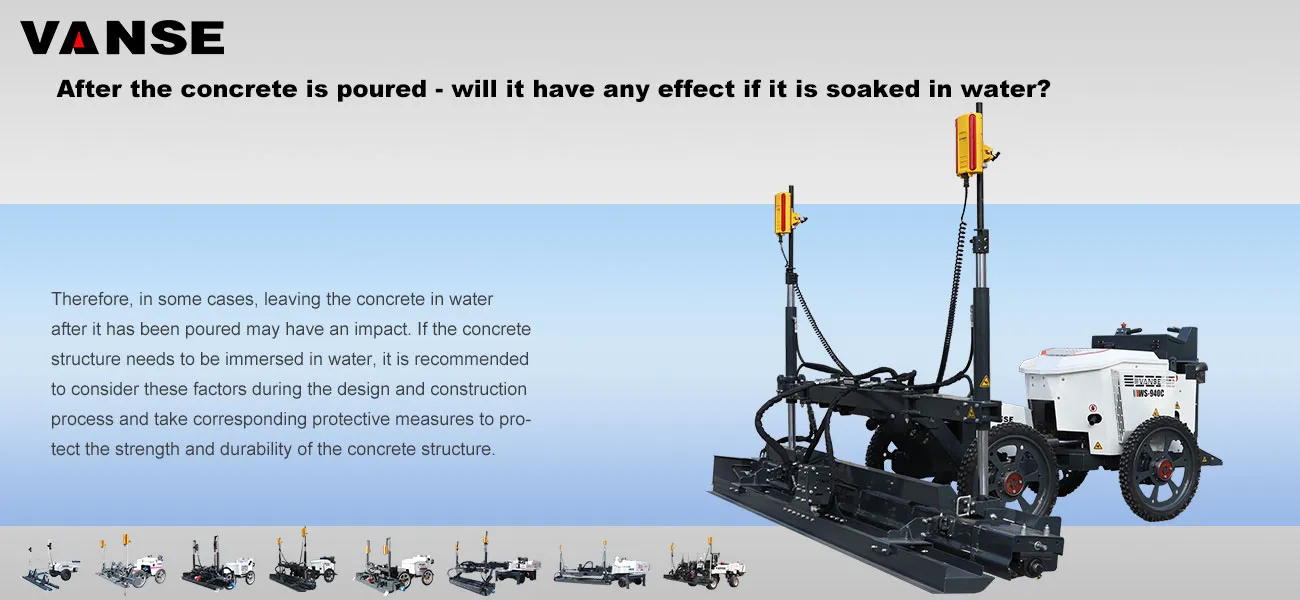
After the concrete is poured – will it have any effect if it is soaked in water?
Keeping the compacted soil in water after pouring may have an impact
Concrete is a building material mixed with materials such as sand, stone, cement and water. It hardens in the air and has high strength, durability and excellent wear resistance. However, if the compacted soil is soaked in water for a long time, it may suffer some effects.
First, long-term immersion in water may affect the strength of concrete. The cement in concrete reacts with water to form substances such as hydrated calcium silicate, which make the concrete stronger and more durable. However, if the compacted soil is soaked in water for a long time, the hydration reaction may be inhibited, resulting in a reduction in concrete strength. In addition, if chemicals in the water react with certain ingredients in the concrete, they may also affect the strength and durability of the concrete.
Secondly, long-term immersion in water may affect the wear resistance of concrete. The wear resistance of the concrete surface is related to its hardness, and soaking in water will soften the concrete, thereby reducing its wear resistance. In addition, chemicals in the water may also reduce the wear resistance of concrete if they react with certain components in the concrete.
Finally, prolonged immersion in water may subject concrete to water pressure and flow rates. If a concrete structure is surrounded by water water pressure can cause stress on the structure, especially if the water depth is large. Additionally, flow rates can cause abrasion and erosion of concrete surfaces, especially in environments such as rivers and oceans.
Therefore, in some cases, leaving the concrete in water after it has been poured may have an impact. If the concrete structure needs to be immersed in water, it is recommended to consider these factors during the design and construction process and take corresponding protective measures to protect the strength and durability of the concrete structure. construction period be ensured, ultimately achieving high-precision and high-efficiency floor construction and significantly reducing the operating costs throughout the entire life cycle.
Note: The parameters provided in this document are for reference only and are not mandatory. Due to differences in technical characteristics between different brands and models of laser levelers, please consult the manufacturer for a suitable solution before actual operation. This reference document assumes no responsibility for any issues arising from failure to follow the manufacturer's instructions.
Thanks to All the Friends Who Support and Trust Shandong Vanse Machinery Technology Co., Ltd.
If you want to know more about Shandong Vanse Machinery Technology Co., Ltd. or have any questions, please feel free to contact us:
Our Factory
Shandong Vanse Machinery Technology Co., Ltd.








Share this article

About the Author: Shandong Vanse Machinery Technology Co., Ltd.
Shandong Vanse Machinery Technology Co., Ltd. is a high-tech manufacturer specializing in concrete construction machinery, including laser screeds and related equipment. The company integrates R&D, production, and global sales, with products exported to over 60 countries and widely used in infrastructure projects worldwide.
Previous Post
Next Post
Related Articles
You Might Also Like
What are the applicable scopes of concrete trowels?
Concrete trowel is a kind of equipment specially used for concrete surface treatment. It is widely used in various construction sites, municipal roads, factory warehouses, park roads, community roads, rural streets and other fields. It can perform rough and fine troweling on concrete floors, and has functions such as slurry lifting, compaction, smoothing, and troweling. It is one of the indispensable equipment in modern building construction. ★★★★. Scope of application 1.Construction site In construction sites, concrete troweling machines are mainly used for construction on floors, roofs, outdoor floors and other occasions where troweling is required. By using a concrete trowel, you can greatly improve work efficiency, shorten the construction period, reduce project costs, and ensure project quality. 2. Municipal roads Municipal roads are one of the most widely used areas for concrete trowels. In urban planning, road construction, bridge construction and other projects, the road surface needs to be polished to improve the wear resistance and skid resistance of the road surface and ensure traffic safety. 3. Factory warehouse Factory warehouse is one of the important places where concrete trowel machine is used. In the industrial field, the ground needs to be polished to improve the wear resistance and slip resistance of the ground, and the ground also needs to be leveled to meet the requirements of the production process. 4. Park Road Park roads are one of the important places where concrete trowels are used. In parks, the ground in public places such as walking paths, parking lots, and squares needs to be polished to improve the appearance and comfort of the ground. 5. Community streets Community streets are one of the important places where concrete trowels are used. In residential areas, the floors in public places such as roads and squares need to be polished to improve the aesthetics and comfort of the floors. At the same time, local ground needs to be leveled to meet the living needs of residents. ★★★★. Applicable objects Concrete trowels are suitable for a wide range of applications, including but not limited to the following: 1.Construction Developer Construction developers need to polish the ground during the construction process to improve the overall quality and aesthetics of the house. Using a concrete trowel can greatly improve work efficiency and reduce costs. 2. Property management company Property management companies need to perform routine maintenance and upkeep on the floors of the properties under their jurisdiction. Using a concrete trowel machine can quickly and accurately trowel the ground, improving the service life and aesthetics of the ground. 3.Building construction unit The construction unit needs to polish the ground during construction. Using a concrete trowel can improve work efficiency, shorten the construction period, and ensure project quality. 4. Municipal management department Municipal administrations need to maintain and maintain city roads. The concrete troweling machine can be used to quickly and accurately trowel urban roads, improving the service life and safety of the roads. 5. Public Administration Office The Park Service is required to maintain and maintain park roads. The concrete troweling machine can be used to quickly and accurately trowel park roads, improving the service life and aesthetics of the road. In short, the scope of application of concrete troweling machines is very wide. Whether it is high-standard factories, warehouses, parking lots, squares, airports and other tall buildings, or ordinary civil buildings and road construction, compact soil troweling machines can be used. construction. At the same time, due to its excellent treatment effect on the surface of concrete, it is also widely used in bridge construction and other fields.How to adjust power trowel settings for concrete floors with integrated heating systems
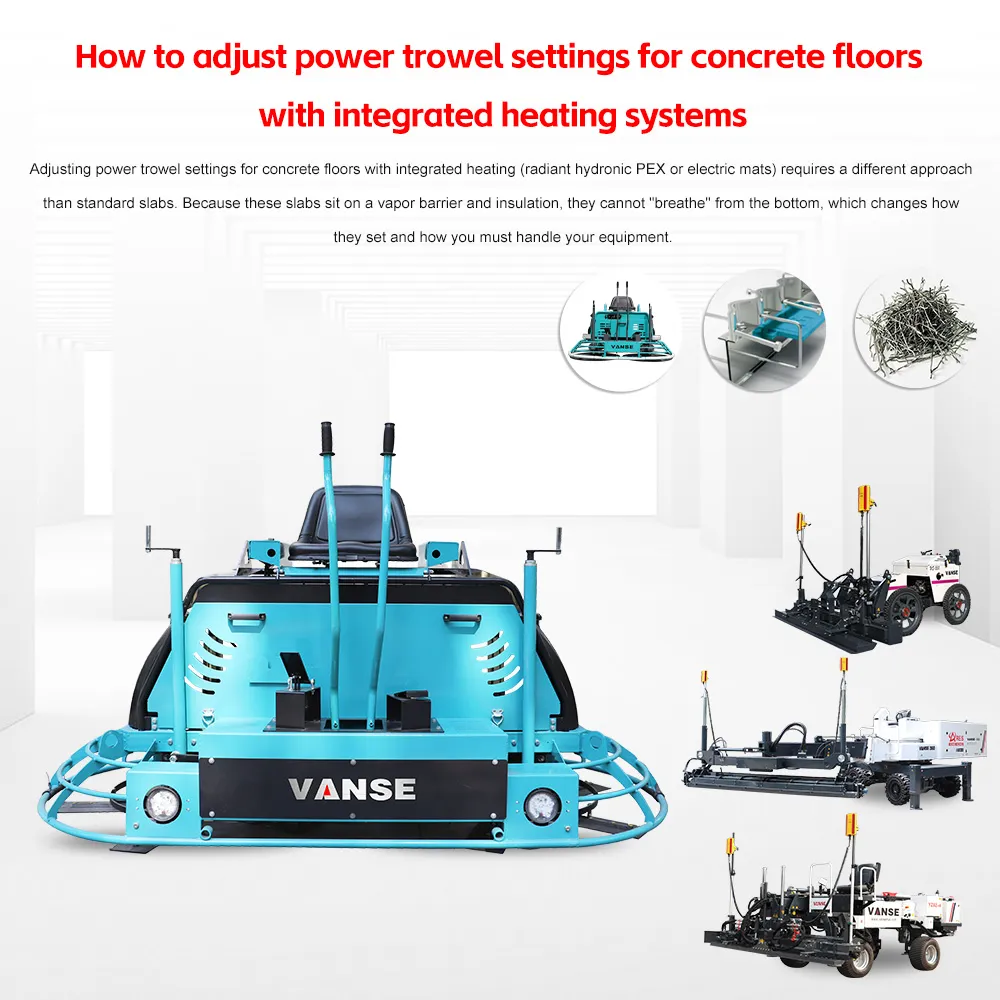
Adjusting power trowel settings for concrete floors with integrated heating (radiant hydronic PEX or electric mats) requires a different approach than standard slabs. Because these slabs sit on a vapor barrier and insulation, they cannot "breathe" from the bottom, which changes how they set and how you must handle your equipment. The following guide outlines how to manage your pitch, speed, and timing to ensure a dense finish without causing delamination or "crusting." The "floating" phase is about leveling and embedding aggregate. For radiant slabs, the presence of insulation below means all bleed water must travel to the top. Timing: Wait for the "Footprint Test." The concrete should support the machine and an operator, leaving a depression no deeper than 3–6 mm (1/8" to 1/4"). Blade Pitch: Flat (0° to 2°). Use float pans or combination blades set completely flat. Rotor Speed: Low (60–80 RPM). Strategy: Keep the machine moving. Because the slab is "unbonded" (sitting on insulation), it is more prone to shifting or "curling" if you dwell in one spot too long. Once the surface sheen (bleed water) has disappeared, you move to the intermediate passes. This is where the risk of "crusting" is highest. Blade Pitch: Slight Pitch (5° to 10°). Increase the angle by about two turns of the hand crank. Rotor Speed: Medium (80–110 RPM). The "Crust" Warning: Because the bottom of the slab stays wet (due to the vapor barrier) while the top dries, you may experience a "crust" where the top seals while the inside is still plastic. Adjustment: If you see the surface peeling or "tearing," reduce your pitch and slow down. You need to let more moisture escape before sealing the surface. This stage creates the hard, polished look typical of modern concrete floors. Blade Pitch: Steep (15° to 25°). As the concrete gets harder, the blades should be tilted sharply to apply high pressure to a small surface area. Rotor Speed: High (120–150+ RPM). Blade Choice: If the floor is to remain as exposed polished concrete, consider plastic or composite blades for the final passes. Steel blades can leave "burnish marks" (dark streaks) which are more visible on heated slabs due to the way they cure. Pass Stage Blade Pitch (Angle) Rotor Speed (RPM) Purpose Float Flat (0°–2°) 60–80 (Low) Leveling & Agg. Embedding Intermediate 5°–10° (Moderate) 90–110 (Medium) Closing the surface Finish 15°–25° (Steep) 120–150 (High) Polishing & Densifying Keep the Heat OFF: Never have the radiant heating system running during the pour or the finishing process. The heat will cause "flash setting" on the bottom of the slab while the top remains wet, leading to severe curling and cracks. Monitor "Cover Depth": Ensure your heating elements are at least 40–50 mm (1.5" to 2") below the surface. If the PEX is too shallow, a heavy ride-on trowel or a high-pitch blade can "chatter" against the high spots, potentially damaging the tubes. Weight Matters: For radiant slabs, walk-behind trowels are often preferred over heavy ride-ons for the first pass. The insulation layer (EPS/XPS) can compress slightly under extreme weight, causing the slab to deflect while it's still green. Pressure Test Throughout: Keep the heating system pressurized with air (typically 20–30 PSI) during the troweling. If a blade accidentally clips a shallow tube, you will hear the air escaping immediately, allowing for a repair before the concrete hardens. Would you like me to find a specific concrete mix recommendation (slump or additives) that helps reduce the "crust" formation on radiant floors? Contact us NOW Note: The parameters provided in this document are for reference only and are not mandatory. Due to differences in technical characteristics between different brands and models of laser levelers, please consult the manufacturer for a suitable solution before actual operation. This reference document assumes no responsibility for any issues arising from failure to follow the manufacturer's instructions.How does the acceptance of concrete laser leveling machine reflect the reliability of equipment performance?
The acceptance of concrete laser leveling machines is a core step in verifying the reliability of equipment performance. This requires multi-dimensional verification through systematic testing, data verification, and operating simulation to ensure that the equipment meets design standards and construction requirements in key performance indicators such as accuracy, stability, durability, and safety. The reliability evaluation process can be broken down into the following five core acceptance dimensions, each with its own specific testing methods and reliability assessment criteria: The core value of a laser leveler lies in its "high-precision leveling." This dimension's acceptance directly determines whether the equipment can meet construction quality requirements and is the primary verification point for reliability. Acceptance requires a two-way verification of both "laser positioning accuracy" and "mechanical execution accuracy." The specific methods are as follows: Acceptance Project Test Method Reliability judgment criteria Risk of failure (if not met) Laser transmitter accuracy 1. Place the laser transmitter on a horizontal reference point and use a precision level (accuracy ≥ 0.1mm) to calibrate the transmitter's levelness. Within the full operating radius, the laser receiving height deviation is ≤±0.5mm; the deviation fluctuation during rotation is ≤0.3mm, and there is no "break" or "jump" phenomenon. Unstable laser signals lead to deviations in the leveling height, resulting in ground height differences and substandard flatness, necessitating rework. 2. Place a laser receiver at 10m/20m/30m (maximum operating radius of the coverage device) and record the receiving height deviation. 3. Rotate the transmitter 360° and record the deviation value every 45°. Leveling mechanism execution accuracy 1. Simulate standard construction conditions (concrete slump 120-180mm) and cast a 3m×3m test block; The flatness deviation of the 2m straightedge is ≤3mm/2m; the elevation deviation is ≤±2mm; the fluctuation of the 3 test data is ≤1mm, with no obvious dispersion. Poor mechanical execution accuracy results in excessive ground flatness, affecting the subsequent construction of the wear-resistant layer or the use of the ground (such as storage and workshop floors). 2. After the concrete has initially set, use a 2m straightedge to check the surface flatness (measure one point every 1m, for a total of 9 points) and use a laser leveler to check the overall elevation deviation; 3. Repeat the test three times and compare the data consistency each time. Slope control accuracy 1. Set the slope mode of the laser transmitter (e.g. 2%, 5% bidirectional slope); The deviation between the actual slope and the set slope is ≤±0.1%; the slope of the entire working surface is uniform, with no local "steep drops/sharp rises". Failure of slope control results in poor ground drainage (such as roofs and outdoor areas), causing water accumulation and leakage problems. 2. Measure one point every 2 meters along the diagonal direction of the test block and calculate the deviation between the actual slope and the set slope; 3. Test the slope accuracy in both horizontal and vertical directions. The power system (engine/motor) and drive system (travel and leveling roller drive) are the "power source" for continuous operation of the equipment. Their stability directly determines whether the equipment can cope with long-term, high-load construction and is the foundation of reliability. Acceptance requires a combination of "static parameter verification" and "dynamic operating condition testing": Parameter verification: Check the engine/motor model, rated power, speed (e.g., diesel engine rated speed 2200-2800 rpm), output torque and other parameters to ensure they are consistent with the equipment manual to avoid "downgrading" and resulting in insufficient power. Dynamic testing: Run the machine at no load for 30 minutes, monitoring the power system speed fluctuation (≤±50r/min), oil temperature (≤85°C), and noise (≤95dB). No abnormal vibration or noise should be observed. Run at full load (the leveling head is pressed into the concrete to a depth of 50-80mm) for 1 hour, observe whether the power system experiences any "speed drop" or "stall", and verify the overload capacity (run at 120% of the rated load for 10 minutes without any fault). Travel reliability: Test forward/reverse/turning functions on a concrete surface (before initial setting). Ensure the travel speed (adjustable from 0-15 m/min) is smooth, the turning radius complies with the specifications (e.g., minimum turning radius ≤ 2 m), and the drive wheels do not slip and the bearings do not overheat (≤ 70°C) after one hour of continuous travel. Leveling auger drive: Test the forward and reverse rotation of the leveling auger and the speed adjustment (0-60r/min). Observe whether the auger rotates evenly, without "stuck" or "eccentric shaking", and whether the auger rotates freely after shutdown (to verify the reliability of the brake). Laser leveling machines are required to operate for long periods of time under bumpy and high-load conditions. The strength and durability of their structural components (frame, leveling rollers, laser bracket) directly affect the life of the equipment. Therefore, acceptance must be verified through "static strength verification" and "dynamic fatigue testing": Size and material: Use calipers and spectrometers to inspect key structural parts (such as the wall thickness of the leveling roller ≥12mm, the cross-sectional size of the frame main beam ≥150×80mm). The material must be Q355B grade steel or above, and the welding points must be free of pores and cracks (using penetrant testing). Load-bearing capacity: Apply a load 1.5 times the rated pressure to both ends of the leveling roller (e.g., 750 kg for a rated load of 500 kg) for 30 minutes. Measure the deformation of the structural components (frame deflection ≤ 2 mm/m, leveling roller bending ≤ 1 mm). No permanent deformation should be observed after unloading. Simulate bumpy road conditions at a construction site (set a 50mm high bump and a 10° slope). Drive the machine continuously at a medium speed (8m/min) for 2 hours with the leveling function enabled. After the test, check the tightness of the structural connection parts (bolts, pins) (torque attenuation ≤ 10%), whether the welding points are cracked, and whether the laser bracket is loose (laser receiver position deviation ≤ 0.3mm) to verify the structural fatigue resistance. Modern laser levelers rely on electronic control systems (PLC, touch screen, sensors) for automated operation. The stability of the control system directly affects the safety and efficiency of equipment operation. Acceptance verification focuses on "operational response" and "fault handling capabilities": Human-computer interaction: Test the touch screen (or operating handle) command response speed (e.g., slope adjustment, speed switching response time ≤ 0.5s), with no "delay" or "misoperation", and the display interface data (laser height, travel speed, oil temperature) is updated in real time (refresh rate ≥ 1 time/second). Automatic leveling function: Artificially create a height deviation of the laser receiver (e.g., raise it by 5mm) and observe whether the equipment can automatically adjust the leveling roller height to the set elevation within 3 seconds. Repeat 10 times with an adjustment accuracy deviation of ≤0.5mm, with no over-adjustment or under-adjustment. Simulate common faults (such as laser signal interruption, low engine oil pressure, and drive motor overload) to verify that the control system can alarm within 3 seconds (audio-visual alarm + on-screen fault code display), and that the alarm information is consistent with the actual fault; Test the fault protection function: for example, when the laser signal is interrupted, whether the equipment automatically shuts down (to avoid blind operation); when the oil pressure is too low, whether the power output is automatically reduced and an alarm is issued to prevent engine damage. Equipment reliability not only means "being able to work", but also "working safely". The acceptance of safety protection measures is the bottom line for ensuring the safety of operators and equipment. It must comply with the "Technical Regulations for Safety in the Use of Construction Machinery" (JGJ33-2012): Safety features Acceptance requirements Reliability judgment criteria Emergency stop function Test the operating handle and the emergency stop button on the side of the machine. After pressing it, the device must cut off power within 1 second (engine shutdown, motor power off), and must be manually reset after restarting. Emergency shutdown response time ≤ 1s, no "failure" or "false triggering". Protective devices 1. There must be a guardrail (height ≥ 1.2m) on the outside of the leveling roller to prevent people from contacting it; The protective device is firm (withstands 500N force without deformation) and is not missing or damaged. 2. The engine exhaust port must be equipped with a heat shield with a surface temperature of ≤60°C; 3. Wires and hydraulic pipes must have protective covers and no exposed parts. Stability Park the equipment on a 15° slope (empty or fully loaded) and observe whether it slides or overturns. Test the supporting strength of the outriggers (if any) to ensure they do not sink after loading. There is no sliding when parking on the slope, and the horizontal deviation of the fuselage after support by the outriggers is ≤0.5°. The acceptance of concrete laser levelings essentially involves transforming the abstract concept of "reliability" into measurable, concrete data (such as accuracy deviation, fault response time, and structural deformation) through quantitative performance testing and simulated operating conditions. Only when these five dimensions meet design standards and the test data demonstrates consistency (no significant fluctuations across multiple tests) and redundancy (such as dynamic overload capacity and structural load margin) can the equipment be proven to deliver reliable performance with long-term stable operation, low failure rates, and high fault tolerance in actual construction, thus preventing quality defects and project delays caused by equipment issues.