Technical Knowledge
Safety tips for ride-on power trowels in tight indoor spaces
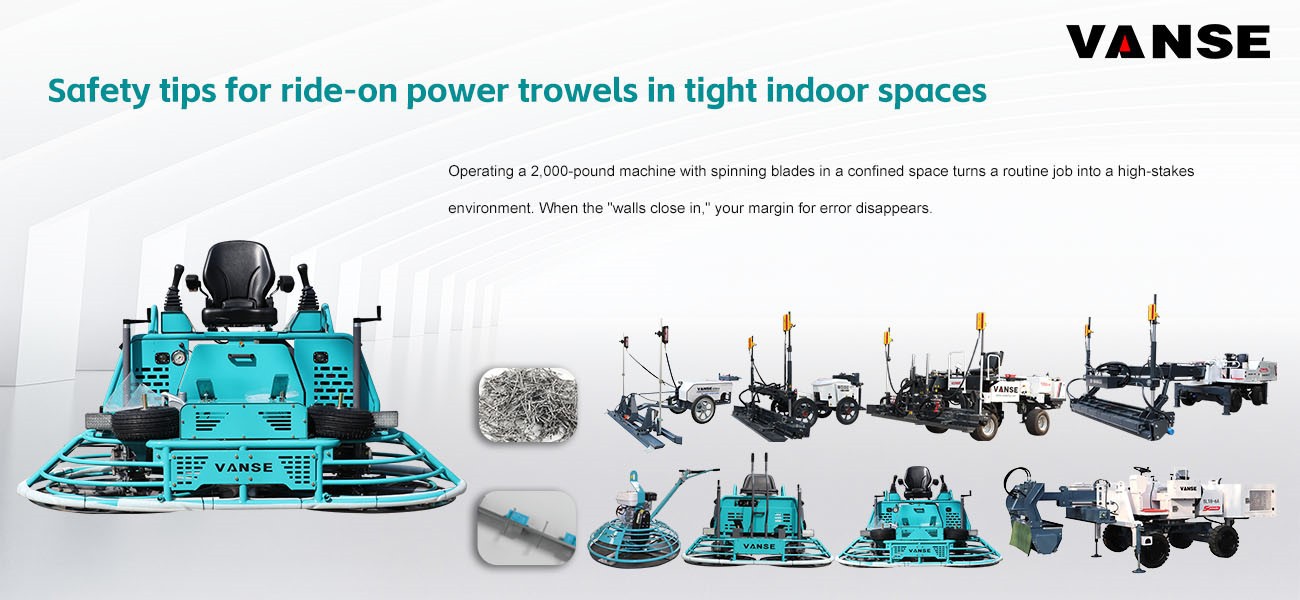
Operating a 2,000-pound machine with spinning blades in a confined space turns a routine job into a high-stakes environment. When the "walls close in," your margin for error disappears.
Here is the safety protocol for maneuvering ride-on trowels in tight indoor quarters.
1. Exhaust Gas: The Silent Killer
This is the #1 danger for indoor ride-on use. Standard gas or diesel engines produce Carbon Monoxide (CO), which can reach lethal levels in minutes in a closed room.
Active Ventilation: Do not rely on "open doors." You need high-volume axial fans (blowers) to create a "push-pull" airflow system.
CO Monitors: The operator must wear a personal CO monitor clip. If it beeps, the site is evacuated immediately.
Catalytic Converters: Ensure your machine is fitted with a "scrubber" (catalytic muffler) to reduce emissions, or better yet, use Propane-powered or Electric trowels for indoor work.
2. The "Crush Zone" Awareness
In tight spaces, the machine’s "tail swing" is your biggest enemy.
No-Go Zones: Establish a rule that no ground crew (manual finishers) can be within 10 feet of the machine when it is near a wall or pillar.
Pillar Strategy: When circling columns, always keep the machine moving in a direction where the operator has a clear line of sight to the gap between the machine and the obstruction.
Avoid "Backing Into" Corners: Always try to nose into tight corners so you have the best visibility to back out into the open.
3. Blade Strike and "Kickback"
If a spinning blade hits a protruding pipe, drain, or a structural steel column, the machine can jerk or spin violently.
Mark Obstructions: Use bright spray paint or "flags" on any floor penetrations (pipes/conduit) that are shorter than the operator's seated eye level.
Low Speed Near Edges: Reduce RPM when working within 2 feet of a wall. This gives you more reaction time if the machine "catches" an edge.
4. Fire Safety: The "Hot Refuel" Risk
Indoor spaces often have poor airflow for flammable vapors.
Cool Down Before Fueling: Never refuel a hot engine inside. The "flash point" of spilled gas on a hot manifold in a room with no wind is a recipe for a fireball.
Spill Kits: Keep a spill kit nearby. A hydraulic hose burst on fresh concrete is a slip hazard and a nightmare to clean.
Essential Safety Checklist
| Danger | Preventive Action |
| CO Poisoning | Use CO monitors + High-velocity fans |
| Wall Impact | Maintain "Slow-Zone" within 3ft of walls |
| Tip-Over | Watch for floor "drop-offs" or open elevator shafts |
| Communication | Use hand signals (it's too loud for shouting) |
| Lighting | Ensure 2,000+ lumens of temporary work lighting |
Pro-Tip: The "Dead Man" Switch
Before starting, test the kill switch. In a tight space, if you lose control or the throttle sticks, you have a fraction of a second to shut down before hitting a structural wall. If the seat-activated safety switch is bypassed or broken, do not operate the machine.
Would you like me to look up the OSHA (or local) requirements for CFM airflow based on the square footage of your indoor project? Contact us NOW
Note: The parameters provided in this document are for reference only and are not mandatory. Due to differences in technical characteristics between different brands and models of laser levelers, please consult the manufacturer for a suitable solution before actual operation. This reference document assumes no responsibility for any issues arising from failure to follow the manufacturer's instructions.
Thanks to All the Friends Who Support and Trust Shandong Vanse Machinery Technology Co., Ltd.
If you want to know more about Shandong Vanse Machinery Technology Co., Ltd. or have any questions, please feel free to contact us:
Our Factory
Shandong Vanse Machinery Technology Co., Ltd.








Share this article

About the Author: Shandong Vanse Machinery Technology Co., Ltd.
Shandong Vanse Machinery Technology Co., Ltd. is a high-tech manufacturer specializing in concrete construction machinery, including laser screeds and related equipment. The company integrates R&D, production, and global sales, with products exported to over 60 countries and widely used in infrastructure projects worldwide.
Previous Post
Next Post
Related Articles
You Might Also Like
How does a concrete laser leveling improve the flatness?
Concrete laser levelings improve flatness by: 1. Utilize laser technology to ensure the flatness and thickness of the concrete surface by precisely controlling the position and height of the laser beam. 2. Automated control technology can realize continuous and automatic leveling operations and improve work efficiency. 3. When performing automatic leveling, there is an accurate reference plane. Generally, when the main focus is to control the height, the tightrope method is suitable; when the main focus is to control the thickness, the floating datum beam method is adopted. Generally, tightrope is used for the bottom layer, and floating datum beam method is used for the middle layer and surface layer. 4. The leveling machine has a vibration function, which can effectively compact the concrete material to the required thickness evenly, further improving the flatness. 5. Leveling machines are usually equipped with high-precision sensors and controllers that can monitor and adjust the flatness and height of the concrete surface in real time. Therefore, through the above methods, the concrete laser leveling can effectively improve the flatness of the concrete surface, thereby improving the quality of stinging.Practical information | Answers to many questions about purchasing laser levelers
With the increasing demand for laser leveling machines, the number of leveling machine manufacturers and their types and models is also increasing. The increase in number has undoubtedly created conditions for users to choose, but at the same time, it has also brought a lot of troubles. How to choose a laser leveling machine with high cost performance from many laser leveling machines with varying quality and prices has become a challenge that every user has to face. In order to help everyone choose a laser leveling machine that suits their needs, our company has summarized some issues related to the purchase of leveling machines in detail, and now we will answer them one by one in detail. Answer: In the era of popularization of the Internet, we rely more and more on the Internet. For example, when we get information, we think of the Internet, and when we shop, we will choose to buy online. When buying a laser leveling machine, many users also want to order it online, mainly because they feel it is convenient. But is it reliable to order this kind of equipment online? This is undoubtedly a matter of concern to everyone. But in fact, it is not impossible to order online when purchasing this equipment, but you should keep your eyes open. It is better to choose the cash on delivery method, so that you can decide whether to pay for the purchase after judging the quality of the equipment, so that the quality of the purchased equipment will be more guaranteed. Answer: The second-hand market of laser levelers is very hot now, and there are many people buying them. But some people have expressed doubts, that is, is it cost-effective to buy such second-hand equipment? Judging from the current market situation, many people still trust second-hand laser levelers. They think that the price of second-hand is affordable, and many second-hand ones are even 80% to 90% new. It is a very cheap thing to buy them at a second-hand price. Therefore, it actually reveals a point, that is, second-hand ones can be bought, but the quality still depends on it. If it is just affordable, but the quality is not good, then this thing is not worth buying, so as to avoid too frequent and expensive repairs after buying it in the future. Answer: Which brand of laser leveler is better? This should be a question that every user will ask before buying. After all, everyone hopes that what they buy is better and they hope to worry less when using it. However, judging from the current market situation, many well-known brands of laser levelers are good, and they are doing well in terms of quality and after-sales service. So when choosing a brand, you will not go wrong if you choose those with relatively guaranteed reputation and popularity. You can use it with confidence, and you don't have to worry about too many problems when the equipment is working. The most important point is that the operation is efficient. Due to space limitations, we will discuss the issue of purchasing laser levelers with you here. Our company is a comprehensive enterprise integrating R&D, manufacturing, sales, and technical services. It is a professional manufacturer specializing in concrete laser levelers. If you choose to cooperate with us, we will wholeheartedly provide you with high-quality leveling equipment and complete after-sales service.How to evaluate the performance & stability of laser receivers?
There are several aspects to consider when evaluating the performance and stability of a laser receiver: 1. Sensitivity: Sensitivity refers to the minimum optical power that the receiver can detect. Evaluating the sensitivity of a laser receiver usually requires knowledge of parameters such as the laser's output power, beam divergence, optical system efficiency, and receiver noise. 2. Dynamic range: Dynamic range refers to the ratio of the maximum optical power to the minimum optical power that the receiver can receive under normal operating conditions. Evaluating the dynamic range of a laser receiver requires considering factors such as the maximum output power of the laser, the linear range of the receiver, the saturation output, and the nonlinear effects of the optical system. 3. Stability: Stability refers to the performance changes of the laser receiver under different environmental conditions. Evaluating the stability of a laser receiver requires testing its performance under different environmental factors such as temperature, humidity, and air pressure, and observing changes in parameters such as output power, response speed, and noise. 4. Reliability: Reliability refers to the service life and stability of the laser receiver. Evaluating the reliability of a laser receiver requires considering factors such as the stability of its internal circuitry, optical components and mechanical structure, as well as the production process. 5. Compatibility: Compatibility refers to the degree of matching between the laser receiver and lasers of different types and specifications. Evaluating the compatibility of a laser receiver requires consideration of its spectral response range, modulation frequency, and polarization state. To sum up, multiple aspects need to be considered when evaluating the performance and stability of a laser receiver, and a comprehensive evaluation needs to be carried out based on actual application requirements.