Technical Knowledge
Common concrete laser leveling machine errors – and how to quickly correct them?
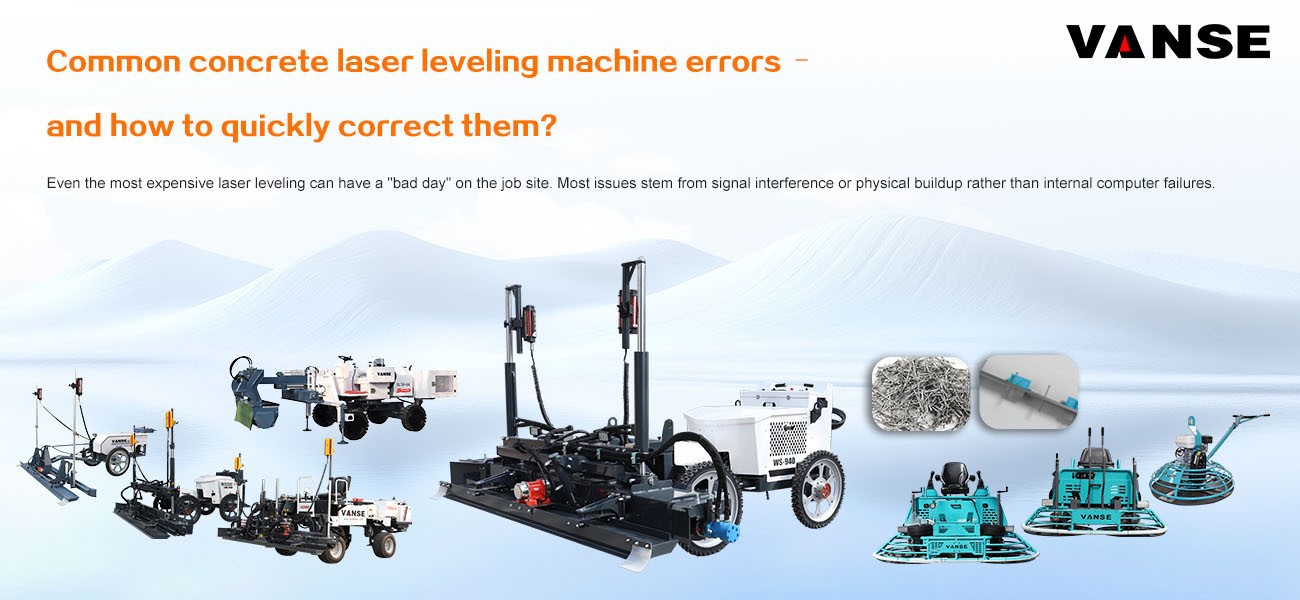
Even the most expensive laser leveling can have a "bad day" on the job site. Most issues stem from signal interference or physical buildup rather than internal computer failures.
Here is a breakdown of the most common errors and the "on-the-fly" fixes to keep your pour on schedule.
1. "Searching" or Lost Laser Signal
The machine head starts bouncing or stops adjusting because the receivers cannot "see" the laser transmitter.
The Cause: Often "Line of Sight" issues. A truck, a pile of rebar, or even heavy dust/steam has blocked the beam.
The Quick Fix: * Check the Transmitter: Ensure the laser tripod hasn't been bumped by a worker.
Clean the Eyes: Use a soft cloth to wipe the receivers on the machine head. Concrete splatter or heavy dust acts like a blindfold.
Relocate: If working in high heat, "heat shimmer" can refract the laser. Move the transmitter closer to the machine to shorten the distance the beam has to travel.
2. "Wavy" or "Step" Finish
The concrete looks like corduroy or has small ridges rather than a glass-smooth finish.
The Cause: Usually an issue with travel speed or vibrator frequency. If you move too fast, the head "skips." If the vibrator is too high, it creates resonance waves.
The Quick Fix:
Slow Down: Reduce your pull speed by 10-15%.
Tune the Vibrator: Adjust the frequency until the "cream" rises steadily without the head visibly shaking the wet concrete 3 feet in front of it.
Check the Grade: Ensure your "Cold Start" (the initial manual height setting) wasn't set too high, forcing the machine to fight against too much excess material.
3. Elevation Drift (Floor is High or Low)
The machine says it's on grade, but your manual check shows you are off by 1/4 inch or more.
The Cause: Bench-set error or Differential Settling. The laser transmitter may have settled into soft ground or "drifted" due to wind vibration.
The Quick Fix:
Re-Bench: Periodically check the laser against a known physical benchmark (like a fixed wall mark) every hour.
Tripod Stability: Move the transmitter to a "dead" spot (like a cured slab) rather than on raw dirt or near a running generator that causes vibration.
4. Hydraulic "Hunting"
The leveling head is jittery and constantly moving up and down in small, rapid increments.
The Cause: The hydraulic gain (sensitivity) is set too high for the slump of the concrete you are using.
The Quick Fix: * Adjust Gain Settings: Lower the "Gain" or "Sensitivity" on the control panel. This tells the hydraulics to be less aggressive when making corrections.
Check Fluid: Ensure hydraulic fluid is at the proper temperature; "cold" oil can cause sluggish or jerky movements.
Troubleshooting Checklist
| Error Symptom | Primary Suspect | Action |
| Bouncing Head | High Gain / High Speed | Lower gain; Slow down travel |
| Laser Signal Loss | Obstruction / Dirty Lens | Clear path; Wipe receivers |
| Inaccurate Grade | Transmitter Drift | Re-bench to a fixed point |
| Heavy Slump Down | Gravity / Over-vibration | Reduce vibrator Hz; Use lower slump |
Are you currently seeing a specific error code on your control panel, or are you just prepping your crew for an upcoming pour? Contact us NOW
Note: The parameters provided in this document are for reference only and are not mandatory. Due to differences in technical characteristics between different brands and models of laser levelers, please consult the manufacturer for a suitable solution before actual operation. This reference document assumes no responsibility for any issues arising from failure to follow the manufacturer's instructions.
Thanks to All the Friends Who Support and Trust Shandong Vanse Machinery Technology Co., Ltd.
If you want to know more about Shandong Vanse Machinery Technology Co., Ltd. or have any questions, please feel free to contact us:
Our Factory
Shandong Vanse Machinery Technology Co., Ltd.








Share this article

About the Author: Shandong Vanse Machinery Technology Co., Ltd.
Shandong Vanse Machinery Technology Co., Ltd. is a high-tech manufacturer specializing in concrete construction machinery, including laser screeds and related equipment. The company integrates R&D, production, and global sales, with products exported to over 60 countries and widely used in infrastructure projects worldwide.
Previous Post
Next Post
Related Articles
You Might Also Like
How to ensure that the parameters and performance of the concrete laser leveling machine meet the requirements
To ensure that the parameters and performance of the concrete laser leveling machine meet the standards, the core is to establish " Source selection → Preoperative calibration → Intraoperative verification → Postoperative maintenance "The whole process is closed-loop controlled, and each link is closely linked to "parameter standards" and "matching of actual working conditions", avoiding single reliance on debugging or calibration. The factory parameters of the equipment itself are the performance bottom line and must be strictly checked upon purchase and arrival to avoid "innate deficiencies". Selection and benchmarking parameter standards: Clarify core parameter requirements: Based on construction requirements (such as ground flatness grade and working area), benchmark against national standards (such as "Concrete Laser Leveling Machine" GB/T 37497-2019), and lock in key parameters – laser system accuracy (≤±0.1mm/m), maximum leveling thickness (such as 100-300mm), travel speed (0-6m/min adjustable), and flatness error (≤3mm/2m) to ensure that the selected parameters cover construction requirements. Give priority to brands with "parameter traceability": require manufacturers to provide calibration certificates for laser transmitters and receivers (such as those issued by a third-party metrology agency) to confirm that the parameters of core components are within the validity period, and avoid purchasing equipment with "three no's" or ambiguous parameters. After unpacking, check the "document compliance" first: check the product certificate and instruction manual, and confirm that the standard values of each parameter (such as the effective distance of the laser signal and the working pressure of the hydraulic system) are clearly marked in the manual. Simple core performance test: Use a high-precision level (0.02mm/m) to check the levelness of the laser transmitter. After powering on, observe the signal stability of the receiver within a range of 5 meters (uninterrupted flashing). Manually push the leveler to check that the travel wheels are not stuck and the blade rises and falls smoothly, preliminarily eliminating mechanical faults. Calibration before use is the key to "making the equipment work according to the standard". The core system needs to be calibrated item by item according to the instructions and standards. Transmitter calibration: Place it on a stable base and adjust the bottom feet so that the built-in level bubble is centered (or the electronic level displays "0±0.1mm"). Set the "elevation reference" according to the instructions and use a tape measure to measure the height from the center of the transmitter to the ground. The deviation from the designed elevation must be ≤1mm. Receiver and mechanical linkage: Fix the receiver to the "zero point scale" of the lifting rod and ensure that the receiver sensing surface is flush with the bottom surface of the leveling blade (verify by placing a ruler close to the blade); start the equipment and let the receiver sense the laser signal. If the display on the operation panel is not "0", adjust it to zero using the "zero point calibration" button to ensure that "signal deviation = mechanical action deviation". Travel system: Mark a 10-meter straight line on the ground, start the leveling machine and move it along the straight line. After the line is drawn, use a tape measure to measure the deviation of the machine body. The requirement is ≤5mm/10m. If it exceeds the standard, use the "travel speed fine-tuning" function on the operation panel to calibrate the speed difference of the motors on both sides. Level the blade: Use a spirit level to press against both ends of the blade. If the bubble is offset, adjust the hydraulic cylinders on both sides of the blade until the spirit level shows level (deviation ≤ 0.02mm/m) to prevent the blade from tilting and causing a height difference on the ground. After calibration, performance needs to be verified through actual operation, and parameters must be monitored in real time during construction to avoid "calibration passed but operation failed". Pour 2-3㎡ concrete test blocks according to the normal process. After completion, use a 2-meter ruler + feeler gauge to check the flatness. The deviation is required to be ≤3mm/2m (in accordance with the "Concrete Structure Engineering Construction Quality Acceptance Code" GB 50204); use a laser altimeter to check the ground elevation. The deviation from the design value is ≤2mm. If it does not meet the standard, return for calibration. Test performance stability: Operate continuously for 30 minutes to observe whether the laser signal is continuously stable (the receiver indicator light does not flicker) and whether the blade raises and lowers in a timely manner (the blade moves within 0.5 seconds after the signal offset) to avoid parameter drift caused by long-term operation. For every 100 square meters of work, stop the machine and randomly check 3-5 points with a ruler. If the flatness deviation exceeds 3mm, stop the machine immediately to check whether the laser transmitter is shifted or the receiver is blocked by dust, and recalibrate in time. Pay attention to abnormal signals: If the operation panel displays errors such as "weak laser signal" or "low hydraulic pressure", stop the machine immediately for investigation to avoid operating with faults that may cause parameters to lose control. Equipment parameters will decay with use, and long-term maintenance is required to prevent performance degradation. The core is "regular inspection + recalibration upon expiration." Daily maintenance: preventing parameter drift After each use: Clean the lenses of the laser transmitter and receiver (wipe with a dust-free cloth to avoid scratches), and check whether the travel wheel and blade connecting bolts are loose (tightening torque is in accordance with the instructions, such as M16 bolt torque 40-50N·m). Weekly inspection: Check the hydraulic oil level (must be between the oil mark "MIN-MAX") and the circuit terminals for oxidation to avoid delayed operation due to insufficient hydraulic pressure or poor circuit contact. Perform a "simple recalibration" once a month: focus on calibrating the laser transmitter level and the receiver zero point to ensure that the parameters are within the standard range. Perform a "full recalibration" every 3 months or after 500 hours of operation: contact the manufacturer or a third-party metrology agency to conduct professional testing of the laser system's accuracy, travel linearity, and blade levelness, and issue a calibration report. If any parameters are out of tolerance, immediately adjust or replace components (such as aging laser modules). Ensuring that equipment parameters and performance meet requirements is essentially "Don't let standards remain on paperFrom benchmarking during model selection to precise calibration before use, real-time verification during operation, and regular maintenance, every step is based on measurable parameters, avoiding empirical judgment. Only by establishing a "traceable and verifiable" control system throughout the entire process can we continuously ensure leveling accuracy.How to upgrade and improve the supporting facilities and technical support of concrete laser leveling machines?
As the core equipment of modern floor construction, the upgrade and improvement of supporting facilities and technical support of concrete laser leveling machine directly affects the construction efficiency, project quality and equipment service life. The following elaborates on the specific path from the two dimensions of supporting facilities upgrade and technical support improvement: The supporting facilities need to be carried out around the three goals of "maximizing equipment efficiency", "full coverage of construction scenarios" and "improving operation safety", including: Laser system upgrade: The accuracy of traditional laser transmitters is mostly ±3mm/10m, which can be upgraded to high-precision green laser system (accuracy up to ±1.5mm/10m), and add "anti-interference module" (such as filtering technology) to reduce the impact of strong light and electromagnetic environment on the signal; at the same time, it integrates multi-region laser control technology to support multi-machine collaboration during large-area construction to avoid laser signal conflicts. Drive and leveling mechanism optimization: The drive wheel adopts wear-resistant rubber composite material (such as adding ceramic particles) to improve the grip and wear resistance on rough ground; the leveling scraper is upgraded to adjustable alloy material, which supports 0-5° angle fine-tuning to meet the leveling needs of concrete with different slumps (such as dry hard and fluid concrete). Power system adaptation: For indoor scenes with high environmental protection requirements, electric laser leveling machine is developed, equipped with high-capacity lithium battery (8-10 hours of battery life) and fast charging pile (full in 2 hours); large-scale outdoor projects can be upgraded to hybrid power system (diesel + motor), realizing low-speed leveling electricity and high-speed mobile oil, reducing fuel consumption by more than 30%. Material conveying matching: With automatic concrete spreader (such as telescopic spiral spreader), through the linkage of sensors and leveling machine, the integrated process of "concrete conveying-paving-leveling" is realized to reduce the time loss of manual spreading; for narrow spaces (such as around elevator shafts), small auxiliary leveling accessories (such as foldable leveling heads) are developed to adapt to the main equipment to complete the corner construction. Environmental monitoring and adaptation equipment: Add temperature and humidity sensors and concrete initial setting time detector to monitor the construction environment in real time (such as high temperature in summer and low temperature in winter), and automatically adjust the leveling speed through the equipment control system (such as 20% faster at high temperature to avoid premature solidification of concrete); matching dust and noise reduction devices (such as silent engine + high-efficiency filter) to meet the environmental protection standards of indoor construction (noise ≤70dB). Intelligent safety protection: 360° millimeter wave radar and infrared human body sensing device are installed. When the operator or obstacle enters the 1.5-meter range, the equipment automatically slows down and issues an audible and visual alarm; the cab is upgraded to a rollover protection (ROPS) structure, equipped with a suspended seat and seat belt warning system to reduce the risk of injury in the event of an accidental collision. Lightweight and modular design: The fuselage adopts a high-strength aluminum alloy frame (20% lighter than traditional steel structure), with quick-detachable components (such as laser receivers, scrapers), which are easy to transport and repair; for small construction teams, a portable laser leveling machine (weight ≤500kg) is developed, equipped with a small trailer to improve transfer flexibility. Technical support needs to shift from "passive response" to "active service" and build a "full life cycle service chain", including: Remote monitoring and fault warning: Install Internet of Things (IoT) module on the equipment to collect operation data (such as engine speed, laser system status, battery power, etc.) in real time, analyze the health of the equipment through the cloud platform (such as management system based on Alibaba Cloud/Huawei Cloud), warn of potential faults in advance (such as motor overheating, laser calibration deviation), and push maintenance solutions to the user's mobile phone to reduce downtime. Digital construction guidance: Develop a construction parameter database, and preset the "optimal leveling parameters" (such as walking speed 2-5m/min, vibration frequency 3000-5000 times/minute) based on the project type (such as workshop floor, parking lot), concrete grade (C20-C50), and thickness (50-300mm). Novices can call parameters through the device touch screen to reduce the difficulty of operation; supporting AR real-scene guidance system, scan the construction area through the camera, superimpose the virtual image of the laser reference line and leveling trajectory, and assist operators in precise control. Hierarchical training system: For operators, carry out "theory + practice" training (such as laser principle, troubleshooting), and issue operation certificates after passing the assessment; for maintenance personnel, provide "core component maintenance certification courses" (such as laser transmitter calibration, motor maintenance), and regularly organize manufacturer technical exchange meetings to share maintenance skills for new models of equipment. Construction of localized service outlets: Set up regional service centers in key areas (such as the Yangtze River Delta and the Pearl River Delta), equipped with special maintenance vehicles and spare parts warehouses (reserving vulnerable parts such as laser heads and sensors), and promise "2-hour response within 200 kilometers, 4-hour on-site maintenance"; for remote areas, through the "remote video guidance + spare parts express" mode, ensure that basic faults are resolved within 48 hours. Special scenario adaptation technology: For sloped floors (such as parking lot ramps), develop a "slope adaptive system" to adjust the leveling benchmark in real time through the inclination sensor to ensure that the slope error is ≤0.5%; for ultra-large floor areas (such as storage and logistics parks), provide a "multi-machine collaborative management system" to support 1 main control device to monitor the construction progress of 5-8 leveling machines, and achieve an overall flatness error of ≤2mm/2m. Second-hand equipment remanufacturing support: Provide "refurbishment and upgrade services" for old equipment (such as replacing laser systems, upgrading control systems), and issue performance test reports to extend the service life of equipment (usually 3-5 years), and reduce the cost of replacement for users. 1. Industry-university-research cooperation: Cooperate with universities (such as construction machinery majors) and scientific research institutions to develop new materials (such as wear-resistant scraper alloys) and intelligent algorithms (such as multi-machine collaborative control) to maintain technological leadership. 2. User feedback mechanism: Collect user usage data through the equipment Internet of Things system, regularly investigate construction pain points (such as long maintenance cycles and complex operations), and optimize products and services in a targeted manner. 3. Policy and standard adaptation: Pay attention to industry standards (such as "Technical Conditions for Concrete Laser Leveling Machines") and environmental protection policies, and develop equipment that meets new regulations in advance (such as power systems that meet the National IV emission standards) to avoid policy risks. Through the above measures, the supporting facilities of the concrete laser leveling machine can achieve "higher precision, stronger adaptability, greater safety and durability", and the technical support can achieve "fewer faults, quick start-up and timely service", ultimately helping users improve construction efficiency by more than 30%, and the floor flatness qualification rate will be increased from 85% to more than 95%. Click the below to jump immediately!!! ARMOUR JOINT CONCRETE LEVELING MACHINE LIGHT TOWER POWER TROWEL SLIPFORM MACHINE STEEL FIBER TOPPING SPREADER TRACKED MINI DUMPERThe tunnel concrete pavement adopts the entire construction technology of laser truss split roller paver
Concrete laser leveling: an important tool to improve construction efficiency ☑1. Introduction In the field of construction engineering, concrete is the main building material widely used in various infrastructures and buildings. However, leveling concrete is a time-consuming and labor-intensive task. In order to improve construction efficiency and reduce labor costs and material waste, concrete laser leveling machines came into being. This advanced leveling equipment uses laser technology to achieve high-precision concrete leveling, providing an efficient and precise construction method for construction projects. ☑2. Precise control, one-time molding The traditional concrete leveling method relies on the experience and technology of workers, and is prone to problems such as uneven flatness and rework. In contrast, the concrete laser leveling uses a laser transmitter and receiver, which can quickly and accurately detect the height difference on the concrete surface through high-precision laser ranging technology. The leveler adjusts the height of the scraper based on real-time detection data to achieve precise concrete leveling. By forming in one go, the need for rework and repetitive work can be significantly reduced, significantly improving construction efficiency. ☑3. Automated operation, saving manpower Traditional concrete leveling work requires a lot of manual operations such as scraping, plastering, etc. These jobs are not only labor-intensive, but also require a large amount of manual labor. The concrete laser leveling machine adopts an automated control system to achieve continuous concrete laying and leveling work. Operators only need to make simple monitoring and adjustments during the operation of the equipment, which greatly reduces the need for manpower. Automated operations can not only save labor costs, but also improve the accuracy and consistency of construction, further improving construction efficiency. ☑4. Shorten construction time Traditional concrete leveling methods take longer to complete the job because they require repeated scraping and plastering. The concrete laser leveling machine can significantly shorten the construction time through the advantage of one-time molding. In addition, since automated operations reduce the need for manual intervention, construction progress is further accelerated. Shortening construction time means faster project delivery and higher productivity, which is of great significance to construction companies. ☑5. Reduce material waste Traditional concrete leveling methods tend to waste materials because they require multiple scrapings and plasters, resulting in excess concrete being discarded. Concrete laser levelings minimize material waste through precise control and high-precision measurement. It only needs to be laid and leveled once, reducing the need for rework and repetitive work, thus reducing the amount of concrete used. Reducing material waste not only helps reduce costs, but also contributes to environmental protection and sustainable development. ☑6. Conclusion In summary, concrete laser leveling machines improve construction efficiency by precisely controlling automated operations, shortening construction time, and reducing material waste. As an advanced construction method, it brings many advantages and benefits to the field of construction engineering. With the continuous development and improvement of technology, concrete laser levelings will play a more important role in future construction projects. It not only improves construction efficiency, but also helps reduce costs, improve project quality, and has a positive impact on the development of the construction industry.