Technical Knowledge
Leveling Head Maintenance on a Laser Guided Concrete Leveling
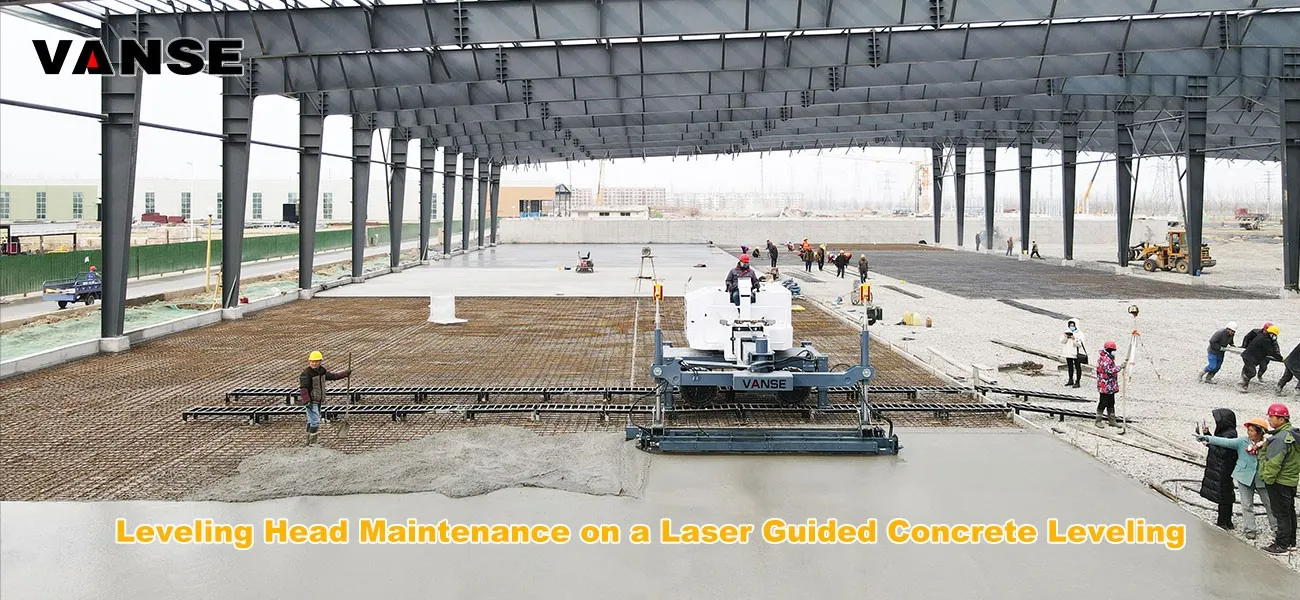
This is an excellent question and one of the most critical maintenance areas for a laser leveling machine. The leveling head is the component that determines your final floor quality, and it operates directly in the most corrosive environment (wet concrete).
Here is the expert guide to maintaining the leveling head on a laser-guided concrete leveling.
🛠️ The Three Pillars of leveling Head Maintenance
1. Daily Bearing Purge (The Greasing Ritual)
The bearings on the auger and the vibrator assembly are exposed to water, slurry, and abrasive concrete dust. Failure to service them daily is the fastest way to destroy them.
When to Grease: You must grease the bearings every time the machine is used, immediately after cleaning.
The "Purge" Principle: The goal of daily greasing is not just to add lubrication, but to force out any water, cement paste, or abrasive sand particles that may have entered the bearing seal during the pour or the wash-down.
The Process: Use the manufacturer-specified grease (often NLGI-2 Lithium Base Grease). Continue pumping grease slowly until you see clean, fresh grease pushing out past the seals. This confirms the contamination has been expelled.
Spares: Keep spare bearings on hand. They are wear parts and will eventually fail, and having a spare prevents downtime on a tight pour schedule.
2. Concrete Build-up and Geometry (The Accuracy Check)
Hardened concrete on the head is the enemy of flatness and machine function.
Immediate Cleaning: Power wash the entire leveling head immediately after the pour. Use a brush (stiff plastic or natural fiber, avoid steel unless scraping dry concrete) to remove all residue from the auger flights, the plow, the vibrator bar, and the finish blade.
Why it Matters: Concrete build-up changes the weight and balance of the head, causing the machine's automatic leveling and counter-balance systems to work incorrectly, leading to inaccuracies in your floor.
Check Head Geometry: The components (plow, auger, finish blade) must be in a specific geometric relationship for the machine to level correctly.
Common Setting : The plow is often set approx 1/4 above the bottom of the auger.
Wear Check: The finish blade and auger are high-wear items. If they are worn or bent, they change the geometry, and the head will no longer produce the required flatness. Check the flatness of the finish blade with a level and replace it if necessary.
3. Hardware and Structural Integrity
Vibration is essential for consolidation, but it also causes hardware to loosen.
Fastener Check: Inspect and tighten every nut and bolt on the leveling head before and after a pour. Pay special attention to the bolts holding the vibrator motors and the auger to the main frame, as these are subject to constant, intense vibration.
Structural Inspection: Look for small cracks around the mounting points and welds, especially where the head attaches to the boom. These must be addressed immediately by a certified welder to prevent catastrophic failure.
Laser Receivers: Ensure the laser receivers (the "eyes") mounted on the masts are clean and secure. Dirt or buildup on the receiver glass can cause signal "jitter," which transfers to the head as slight, uncontrollable movement.
Summary Checklist: After Every Pour
Clean: Pressure wash the entire head until spotless.
Purge: Grease all auger and vibrator bearings until clean grease is visible.
Inspect: Check all nuts/bolts for tightness and verify the plow/auger/blade geometry.
Note: The parameters provided in this document are for reference only and are not mandatory. Due to differences in technical characteristics between different brands and models of laser levelers, please consult the manufacturer for a suitable solution before actual operation. This reference document assumes no responsibility for any issues arising from failure to follow the manufacturer's instructions.
Thanks to All the Friends Who Support and Trust Shandong Vanse Machinery Technology Co., Ltd.
If you want to know more about Shandong Vanse Machinery Technology Co., Ltd. or have any questions, please feel free to contact us:
Our Factory
Shandong Vanse Machinery Technology Co., Ltd.








Share this article

About the Author: Shandong Vanse Machinery Technology Co., Ltd.
Shandong Vanse Machinery Technology Co., Ltd. is a high-tech manufacturer specializing in concrete construction machinery, including laser screeds and related equipment. The company integrates R&D, production, and global sales, with products exported to over 60 countries and widely used in infrastructure projects worldwide.
Previous Post
Next Post
Related Articles
You Might Also Like
Concrete Knowledge
This paper introduces in detail what strength levels of concrete, what are the requirements of concrete for water quality, what factors the durability of concrete is related to, and how concrete is maintained. Why should concrete be graded in intensity? To ask why concrete should be graded in strength, you should first know what the strength level of concrete is. The concrete strength level is artificially divided according to the value of the concrete cube's anti-pressure strength, which is the characteristic strength of concrete. According to the current relevant standards and specifications, the concrete cube pressure strength is a standard size of 150mm of the edge of the standard size of the cube test piece sproducing according to the standard method, the temperature consistent with the ISO test method is 20 pc 2 degrees C, humidity is more than 95% of the standard maintenance room, maintenance to 28d age. The pressure strength of the concrete cube measured according to the standard test method. According to the relevant standards, building material strength grade should be expressed by the name of the material plus its strength standard value. Therefore, the concrete strength grade is divided into the standard valueofs of the symbol C (short for the English concrete Concrete) and the pressure strength of the cube behind it: C10, C15, C20, C25, C30, C35, C40, C45, C50, C55, C60, C65, C70, C75, C80. Because the general engineering of different parts of the concrete load is not the same, some large, some small, can not fully use a strength grade of concrete. For the heavy pressure of the site, it is necessary to use high-strength grade concrete, for the low pressure of the site, the use of low- strength grade of concrete, therefore, the concrete is divided into different strength levels to meet the needs of different projects, through the design and calculation of selection. Why does concrete specify 28d strength as the standard strength? Concrete is based on the cement bonding action, gradually hardening, and improve the strength of pressure. Because the cement stiffness is not done at once, but gradually perfected over time. Under normal maintenance conditions, the first seven days of pressure resistance increased faster, between 7d and 14d growth slightly slower, and after 28d, the intensity growth is relatively slow. In other words, after 28d the pressure strength is the standard strength, as the standard for design and construction inspection quality. Obviously, if the strength of less than 28d as the standard strength, will make the concrete performance can not be fully exploited. If the strength of greater than 28d as the standard strength, although the performance of concrete can be fully developed, but because of the time to reach the standard strength is too long, affecting the construction progress. Concrete level leveling on concrete working Why does concrete had request standard of water? Industrial wastewater containing fat, vegetable oil, sugar, acid and so on can not be used to mix concrete. Because the water containing impurities will reduce the cement bonding force, so that the strength of the concrete decreased, so can not use mineral water contains a large number of salts, so that cement can not be very resistant to water erosion. For the chemical composition of mineral water, must meet the indicators set by the family, or compared with ordinary drinking fresh water test, see the intensity does not decrease before use. As for the general tap water and drinkable water, can be used to mix concrete. Concrete level leveling on concrete working Why are concrete blocks in groups of three? Concrete test block is the standard to measure the strength of concrete components, that is, the strength of the test block is destroyed by pressure, as the strength of the component can have. Therefore, in addition to the test block should be made according to the component, the test block must also have a certain number. Because although we try to make the concrete of the test block and the concrete of the component is the same, but after all, there are some differences, if only a test block to identify the strength of the component, it is difficult to be reliable. So in three groups, the strength of the three test blocks is used as the strength of the three test blocks (in special cases, some values need to be removed), that is, the strength of the component symup. Next artical we will go on share concrete knowledge etc, please follow our Youtube or Facebook to get more~How to inspect and accept the double-layer steel mesh after laying in the concrete pavement?
– Steel mesh surface: Observe whether there are obvious rust, oil stains, dirt and other pollutants on the surface of the steel mesh. If such conditions exist, it will affect the bonding between the steel bars and the concrete and needs to be cleaned. – Mesh flatness: Check whether the steel mesh is flat and whether there is warping or deformation. Observe with the naked eye or pull the wire to check. If the mesh is not flat, it may cause insufficient thickness of the local steel bar protective layer or uneven steel bar spacing during concrete pouring. – Cross-point binding: Check whether the steel bar intersection is firmly tied and whether the wire is loose or missing. It can be checked by manually pulling the steel bar intersection. For loose or missing parts, they should be re-tied in time. – Steel bar spacing: Use a steel tape measure to randomly select multiple parts to measure the spacing of steel bars, including the horizontal and longitudinal steel bar spacing of the same layer of steel mesh, and the spacing between the upper and lower layers of steel mesh. Check whether it meets the design requirements, and the allowable deviation is generally ±10mm. – Rebar position: Check whether the steel mesh is laid according to the design position, whether it deviates from the center line or exceeds the specified laying range. It can be determined by measuring the distance between the edge of the steel mesh and the control line drawn on the pavement base, and the deviation should be controlled within the allowable range. – Protective layer thickness: Use a steel bar protective layer thickness tester for detection, and measure at multiple points at different positions to ensure that the thickness of the concrete protective layer meets the design and specification requirements. Generally, the thickness of the steel bar protective layer of concrete pavement is between 30-50mm, and the allowable deviation is ±5mm. – Binding connection: For steel mesh connected by binding, check whether the number and spacing of binding points meet the requirements. Generally, the wire buckles of adjacent binding points are required to be in an eight-shaped shape to prevent the mesh from being skewed and deformed. At the same time, check the specifications and strength of the binding wire to ensure that it can withstand the tension during concrete pouring. – Welding connection: If welding connection is used, check the welding quality, including the length, height, and fullness of the weld. The weld surface should be smooth, without obvious defects such as pores, slag inclusions, cracks, etc. Use ultrasonic or radiographic testing methods to perform non-destructive testing on welds in important parts to ensure that the welding quality meets the requirements. – Material quality certification documents: Check the quality certificate, inspection report and other materials of the steel bars to ensure that the variety, specification, performance, etc. of the steel bars meet the design requirements. At the same time, check the qualification certificate of the steel mesh processing manufacturer to ensure that the product quality is traceable. – Construction records: Check the construction records of the laying of the steel mesh, including the cutting size, processing process, laying time, laying personnel and other information of the steel mesh, to ensure that the construction process has detailed records for quality traceability and problem analysis. – Concealed project acceptance records: Check whether the concealed project acceptance records are complete and whether the acceptance personnel have signed and confirmed. The records should record in detail the laying of the steel mesh, the inspection results, and the rectification of existing problems. During the inspection and acceptance process, if any problems are found, they should be recorded in time and the construction unit should be required to make rectifications. After the rectification is completed, acceptance will be carried out again until it meets the requirements. Only after acceptance can the next construction process be carried out. AMOUR JOINT CONCRETE LASER LEVELING MACHINE LIGHT TOWER POWER TROWEL STEEL FIBER TRACKED MINI DUMPERConcrete laser leveling machine helps you overcome the labor shortage problem!
CONCRETE LASER LEVELING MACHINE HELPS YOU OVERCOME THE LABOR SHORTAGE PROBLEM! It is difficult to find labor force in the current market, especially for some industries that are tiring and often exposed to wind and sun. It is even more difficult to recruit people. What should we do in the market floor leveling industry facing a labor shortage? This situation had begun to emerge a few years ago, and VANSE, as a professional laser leveling machine manufacturer, developed a laser leveling machine that can replace manual labor, which greatly eased the current situation. For example, a construction company won 5 new bidding projects from January to February this year, a year-on-year increase of 66.0%. At the end of February, the surveyed companies had the largest number of construction projects in progress, 95. Despite the growth in business, there is still a shortage of skilled workers. The first reason is that there is a large market demand for skilled workers; the "demographic dividend" of low labor wages is gradually disappearing, and labor costs have greatly increased. But the construction industry has to continue to develop, so a better solution is to replace labor with machines. CONCRETE LASER LEVELING MACHINE HELPS YOU OVERCOME THE LABOR SHORTAGE PROBLEM! With the development of logistics and aviation industry, the golden age of floor construction has opened. Thousands of square meters of ground are only allowed to have a flatness error of 3 mm, which has become a new standard for floor construction. It is undoubtedly a dream to realize it by traditional manual labor. Owning a laser leveling machine has become an essential requirement for floor construction companies to undertake projects. CONCRETE LASER LEVELING MACHINE HELPS YOU OVERCOME THE LABOR SHORTAGE PROBLEM! 1. The leveling principle of the laser leveling machine is realized under the automatic control of the computer by using precision laser technology, closed-loop control technology and high-precision hydraulic system. This is the most prominent difference between it and other floor construction processes features. CONCRETE LASER LEVELING MACHINE HELPS YOU OVERCOME THE LABOR SHORTAGE PROBLEM! 2. The leveling principle of the precision laser leveling machine is to rely on the leveling head driven by hydraulic power, cooperate with the laser system and the computer control system to complete the leveling work while automatically leveling. The leveling head is equipped with an integrated scraper, vibrator and leveling plate, which integrates all leveling, leveling, vibration and compaction work, and completes it at one time. The computer control system automatically adjusts the elevation 10 times per second in real time, and the vibration frequency of the vibrator with a balanced design reaches 3000 times per minute. CONCRETE LASER LEVELING MACHINE HELPS YOU OVERCOME THE LABOR SHORTAGE PROBLEM! 3. The laser transmitter used to control the ground level is arranged independently, so that the level of the ground is not controlled by the template, and no cumulative error will occur. CONCRETE LASER LEVELING MACHINE HELPS YOU OVERCOME THE LABOR SHORTAGE PROBLEM! 4. The laser leveling machine can also automatically control the longitudinal and transverse slopes, which is also completed by the laser system, computer system, hydraulic system, and mechanical system. 5. There are many people in the construction of the traditional craft, which requires support formwork (channel steel), spotting, and paving. About 20 people are needed. The daily construction area is 2000㎡. The use of laser leveling machine can reduce the overall number of people to 4-8. Can be operated by one person. The daily construction area is increased to 3000㎡-5000㎡. Greatly reduced labor costs. In the long run, if we want to continue to develop in the flooring industry, we can only use laser leveling machines instead of labor. Now Shandong VANSE Machinery conforms to the needs of the development of the times.