Technical Knowledge
The role of concrete floor grinders in refining the flatness of laser-leveled surfaces
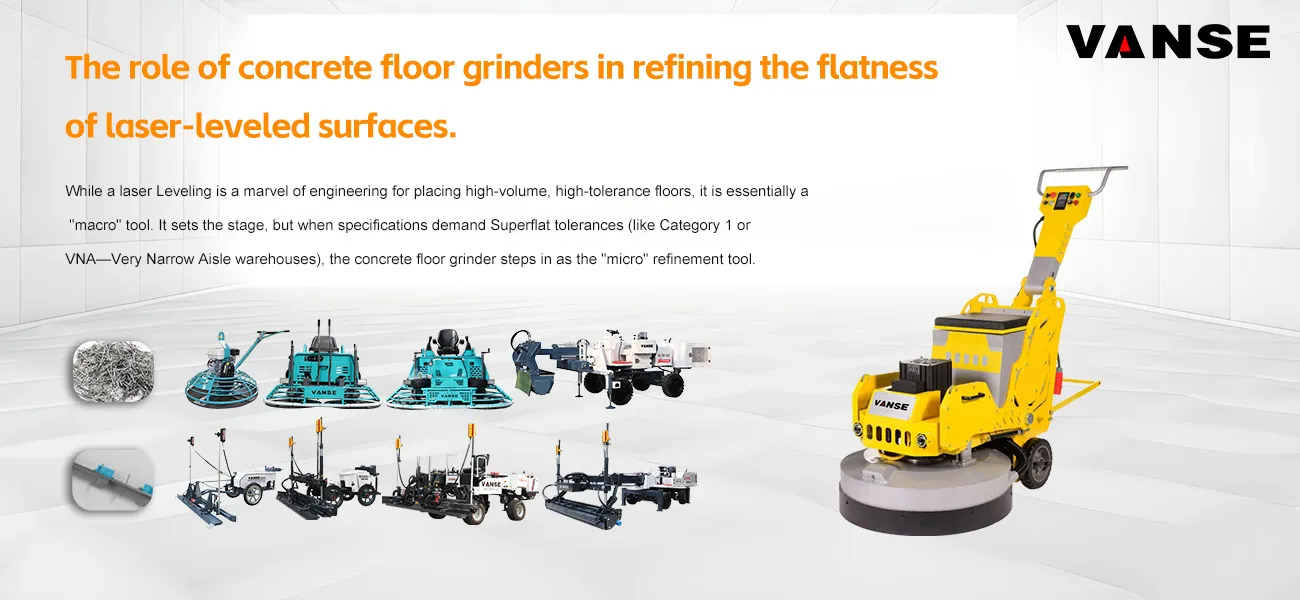
While a laser Leveling is a marvel of engineering for placing high-volume, high-tolerance floors, it is essentially a "macro" tool. It sets the stage, but when specifications demand Superflat tolerances (like Category 1 or VNA-Very Narrow Aisle warehouses), the concrete floor grinder steps in as the "micro" refinement tool.
Here is how grinding bridges the gap between a good pour and a perfect surface.
1. Correcting the "Wave" (Waviness Index)
Even the best laser Leveling can leave behind subtle periodic waves caused by the vibration frequency of the Leveling head or slight settling of the concrete.
The Problem: These waves might only be 1–2 mm high, but at high speeds, a forklift will feel them as significant vibrations.
The Solution: Heavy-duty planetary grinders equipped with coarse metal-bond diamonds act as a "plane." Because the machine has a large, rigid footprint, it bridges the valleys and shaves off the peaks (high spots), effectively flattening the Waviness Index.
2. Managing Joint "Curl"
One of the biggest enemies of laser-leveled floors is drying shrinkage, which causes the edges of the concrete slabs to "curl" upward at the saw-cut joints.
The Impact: A floor that was perfectly level on day 1 may have "steps" at the joints by day 28.
The Refinement: Grinders are used to "chase" these joints. By grinding across the joint, the machine transitions the height difference into a long, imperceptible slope, ensuring smooth wheel transitions for equipment.
3. Achieving High F-Numbers (FF and FL)
In the world of floor tolerances, we use F-numbers to measure quality:
FF (Flatness): Relates to the bumpiness of the surface.
FL (Levelness): Relates to the tilt of the slab.
Laser leveling is excellent at achieving high FF (Levelness) because it follows a laser plane. However, achieving an FF (Flatness) above 60 or 80 usually requires mechanical grinding. The grinder removes the "noise" in the data, smoothing out the micro-texture that a Leveling simply cannot address.
4. Operational Comparison: Leveling VS Grinder
| Feature | Laser Leveling (Placement) | Floor Grinder (Refinement) |
| Primary Goal | Bulk leveling and consolidation. | Precision flattening and smoothing. |
| Tolerance Range | Good to Great (FF 25–45). | Exceptional (Up to FF 100+). |
| Material State | Wet/Plastic concrete. | Cured/Hardened concrete. |
| Surface Profile | Closed-face (cream) finish. | Refined, open, or polished finish. |
5. The "Bump Grinding" Strategy
For high-spec projects, contractors use a "Measure-Grind-Measure" loop:
Initial Measurement: Use a floor profiler (like a Dipstick) to map the high and low spots of the laser-leveled floor.
Targeted Grinding: The grinder is used specifically on the "red zones" (high spots) identified by the software.
Verification: The floor is re-measured to ensure it meets the Narrow Aisle (VNA) specification.
Note: Grinding to refine flatness is different from grinding for aesthetics. In flatness refinement, the goal is stock removal (shaving the concrete), which often exposes the aggregate. If the client wants a uniform look, the entire floor must be ground to the same depth.
Would you like me to explain the different types of diamond grit sequences used for stock removal versus final polishing? Contact us NOW
Note: The parameters provided in this document are for reference only and are not mandatory. Due to differences in technical characteristics between different brands and models of laser levelers, please consult the manufacturer for a suitable solution before actual operation. This reference document assumes no responsibility for any issues arising from failure to follow the manufacturer's instructions.
Thanks to All the Friends Who Support and Trust Shandong Vanse Machinery Technology Co., Ltd.
If you want to know more about Shandong Vanse Machinery Technology Co., Ltd. or have any questions, please feel free to contact us:
Our Factory
Shandong Vanse Machinery Technology Co., Ltd.
Share this article

About the Author: Shandong Vanse Machinery Technology Co., Ltd.
Shandong Vanse Machinery Technology Co., Ltd. is a high-tech manufacturer specializing in concrete construction machinery, including laser screeds and related equipment. The company integrates R&D, production, and global sales, with products exported to over 60 countries and widely used in infrastructure projects worldwide.
Previous Post
Next Post
Related Articles
You Might Also Like
Does the adjustment of the scraper Angle of the concrete laser leveling have a significant impact on the leveling effect? How can it be precisely adjusted?
The adjustment of the scraper Angle of the concrete laser leveling machine has a significant impact on the leveling effect and can be said to be one of the key operations to achieve a high-quality floor. If not properly adjusted, it will directly lead to a series of quality problems. Below, I will explain in detail its impact and how to adjust it precisely. The main functions of the scraper (also known as the scraper plate or scraper shovel) are twofold: scraping off excess concrete and preliminary leveling. Its Angle directly determines the way it interacts with concrete. The scraper acts like a "wall", pushing the concrete in front instead of flattening it. Consequences: It leads to material accumulation, creates a wavy surface, and is prone to scraping out aggregates (stones), resulting in surface defects. The walking resistance of the leveling machine has increased, affecting its efficiency. The scraper is unable to effectively lift and remove the excess concrete. Consequence: It is unable to effectively fill the low-lying areas, the leveling effect is poor, and it is easy to form a "mirror-like" but uneven surface. Excess slurry will flow under the scraper, resulting in uneven slurry distribution on the surface. Effect: The front edge of the scraper can smoothly lift and guide the excess concrete to fill the low-lying areas without over-pushing or leaving scratches. It can form a slight "material pile", providing uniform and appropriate concrete for the subsequent laser vibration plate, thereby achieving high-precision leveling. Summary: Incorrect scraper angles can disrupt the homogeneity of concrete, affect the elevation accuracy controlled by the laser system, and ultimately lead to substandard floor flatness, poor surface appearance, and even later problems such as sanding and cracking. Precise adjustment requires following a standard process and making fine adjustments in combination with the actual working conditions. The following are the detailed steps: Most laser leveling machines have an adjustable mechanical structure for the scraper (such as a hydraulic cylinder, screw or pin hole position). First, it is necessary to find its "zero position" or "neutral position". Usually, at this position, the bottom cutting edge of the scraper is parallel to the base plate of the leveling machine (or the ground). Please refer to your device operation manual to confirm how to find this reference position. Based on the reference position, make the initial Settings: General rule: Let the front edge of the scraper blade be slightly higher than the back edge to form a small forward inclination Angle (usually recommended between 2° and 5°). This Angle is sufficient for the scraper to scrape away the excess material without over-pushing it. Visual management: Some experienced operators will use a simple visual inspection method: Standing on the side of the machine, the edge of the scraper seems to have just touched the ground, but in fact, there is about a 3-5 millimeter gap between the rear end and the ground. This is the most crucial step. Theoretical Settings must be tested through practice. Test laying should be conducted beside the area under formal construction or at the starting point of a section of construction. Observe the state of the concrete after the scraper: If the concrete is pushed along and forms obvious waves, it indicates that the Angle is too large. The Angle needs to be reduced to make the scraper flatter. If there is no small amount of excess concrete left after the scraper to fill the low-lying areas, it indicates that the Angle is too small. The Angle needs to be increased to make the scraper stand more upright. Ideal state: A uniform and appropriate amount of surplus concrete is left behind the scraper, which is further leveled by the subsequent vibrating plate, and the surface is smooth without any pushing marks. The slump (dryness and thinness) of concrete is the most important basis for adjusting the Angle. For relatively dry concrete with a small slump: Characteristics: High internal friction and poor fluidity. Adjustment: It is necessary to appropriately increase the Angle of the scraper to provide stronger scraping and pushing force, ensuring effective leveling. For thinner concrete with a large slump: Characteristics: Good fluidity and easy to bleed water. Adjustment: It is necessary to appropriately reduce the Angle of the scraper to avoid excessive pushing and stirring, and prevent aggregate separation and surface bleeding. Use measuring tools: In the trial laying area, immediately check the flatness with a 3-meter or 4-meter straightedge. If uneven areas are found to be related to the traveling pattern of the scraper, it is very likely that the Angle still needs to be fine-tuned. Observe the surface slurry: After the scraper, there should be a uniform layer of cement slurry on the surface, but there should not be too much water or slurry being scraped to one side. Push the material flat, accumulate it upright : When you find the material being pushed, level it a little; when you find the material that cannot be scraped off, straighten it a little. Stand firm when dry and level when thin : When the concrete is dry, the Angle should be larger; when it is thin, the Angle should be smaller. Be diligent in observation: Don't set it once and then leave it alone. As the construction progresses and the batches of concrete change, it is necessary to develop the habit of observing and making minor adjustments at any time. Keep clean: Ensure that the bottom surface of the scraper is clean and free of hardened cement slurry blocks, otherwise it will seriously affect the leveling effect. Finally, please be sure to read the operation manual of your specific equipment model, as the adjustment mechanisms and specific designs of different brands and models of the leveling machine may vary slightly. Through the above-mentioned system adjustment methods, you can master the control of the scraper Angle proficiently, thereby fully exerting the performance of the laser leveling machine and pouring high-standard and high-quality concrete wear-resistant floors. Note: The parameters provided in this document are for reference only and are not mandatory. Due to differences in technical characteristics between different brands and models of laser levelers, please consult the manufacturer for a suitable solution before actual operation. This reference document assumes no responsibility for any issues arising from failure to follow the manufacturer's instructions.Detailed introduction to the operating procedures of the driving power trowel
– Check the overall appearance of the trowel to see if there is any damage, cracks or deformation on the body. Focus on checking the trowel disc, trowel and connecting parts to ensure their integrity and firmness. – Check whether the tire pressure is normal and whether there is any damage or bulge on the tire surface. Generally, the tire pressure of a ride-on trowel should be maintained at around 2-3 atmospheres. At the same time, check the steering system to ensure that the steering is flexible and the connections are not loose. – Check the engine (if it is a fuel engine) or the motor (if it is an electric trowel). Check whether the fuel level of the fuel engine is sufficient, whether the engine oil is at the normal level, and whether the air filter is clean. For electric trowels, check whether the battery is fully charged, whether the wire connection is firm, and whether the plug is damaged. – Check the transmission parts, such as the tension of the transmission chain or belt. The chain or belt should not be too loose or too tight. Too loose will result in insufficient power transmission, and too tight may damage the transmission parts. Also check for signs of wear and tear. – Check the sprinkler (if any). Check whether there is water in the water tank, whether the water pipe is tightly connected, and whether the nozzle is blocked. Make sure that the sprinkler can work properly to avoid quality problems on the concrete surface due to lack of water during the troweling process. – Remove debris, large stones, steel bars and other objects in the work site that may damage the trowel or affect the troweling effect. – If the operation is performed on the surface of newly poured concrete, make sure that the slump of the concrete meets the requirements and that the concrete has been initially vibrated and leveled before the trowel is operated. Generally, the slump of concrete is more suitable between 30 and 50 mm. – Place the trowel on a flat, solid ground and put the gear lever in the neutral position. – Turn on the fuel switch and pull the choke to the appropriate position (if it is a cold start, the choke can be closed more appropriately; if it is a hot start, the choke can be closed less or not closed). – Hold the starter rope handle and pull the starter rope firmly and steadily to start the engine. After the engine starts, gradually open the choke to the appropriate position according to the engine's operating conditions. – Confirm that the power plug is connected correctly and the surrounding environment is safe (no water, flammable and explosive items, etc.). – Press the start button to start the motor. During the startup process, pay attention to the operation of the motor, such as abnormal noise, vibration, etc. – The operator sits in the driver's seat, keeps his body balanced, and holds the steering wheel or joystick with both hands. The feet can be placed naturally on the pedals to facilitate the forward, backward and steering control of the machine. – During driving, the speed of the trowel should be reasonably controlled according to the size, shape and state of the work site. Generally speaking, the speed can be controlled at 0.5-1m/s in the initial troweling stage; in the fine troweling stage, the speed can be appropriately increased to 1-1.5m/s. At the same time, it is necessary to flexibly control the driving direction of the trowel through the steering system to ensure that the trowel area is fully covered without omission. – When the trowel reaches the concrete surface, put down the trowel disc and trowel to make it contact with the concrete surface. During the contact process, pay attention to observe the working condition of the trowel to ensure that the trowel can act evenly on the concrete surface. – According to the degree of solidification of the concrete and the requirements of troweling, reasonably adjust the working parameters of the trowel. For example, for concrete in the initial setting stage, the speed of the trowel can be appropriately lowered to avoid excessive disturbance of the concrete surface; for concrete in the final setting stage, the speed can be appropriately increased to obtain a better troweling effect. – During the troweling process, it is necessary to keep the driving route of the trowel neat to avoid crossing, excessive overlap or omission. Generally, the troweling operation can be carried out by straight driving, circular driving or partition operation. – After the troweling work is completed, first raise the trowel disc and trowel to leave the concrete surface. – For fuel engines, gradually reduce the engine speed, then turn off the fuel switch and let the engine shut down naturally. For electric trowels, press the stop button to turn off the motor. – Put the gear lever in the neutral position and pull the handbrake (if any). – During operation, if the trowel is found to have abnormal conditions, such as engine smoke, abnormal noise, or trowel out of control, an emergency stop should be performed immediately. For fuel engines, the fuel switch can be turned off directly; for electric trowels, press the emergency stop button (if any). After the emergency stop, the machine should be inspected and the fault can be eliminated before restarting. – Clean the dust, concrete residue and other debris on the trowel body. Use a damp cloth to wipe the surface of the body, focusing on cleaning the trowel plate, trowel, tires, transmission parts and other parts. – Clean the water tank (if any) and drain the remaining water in the water tank to prevent the water from breeding bacteria or corroding the water tank. – Check the various parts of the trowel, such as the wear of the trowel, the tension of the transmission parts, the air pressure of the tires, etc. Deal with or record the problems found in a timely manner for subsequent repairs or maintenance. – Place the trowel in a dry and ventilated place to avoid direct sunlight and rain erosion. If it is not used for a long time, it is also necessary to maintain the machine according to the maintenance requirements for long-term storage.Analysis of the demand differences and preferences for power trowels in key regional markets such as North America, Europe, and Asia
Below, I will conduct a detailed analysis of the demand differences and preferences for matting machines in the three key regional markets of North America, Europe, and Asia. The North American market: It pursues high efficiency, high power and durability, prefers large-scale and automated equipment, has a high brand loyalty, and the rental market is an important driving force. The European market: Emphasizing safety, environmental friendliness, and precise craftsmanship, it prefers well-designed, energy-efficient, and environmentally friendly small and medium-sized equipment that meets strict standards. The Asian market: Demand is highly polarized. The high-end market pursues brand and performance, while the mainstream market pays extreme attention to cost-effectiveness and multi-functionality, and is extremely sensitive to price. North America, especially the United States, is one of the world's largest markets for trowels, characterized by its vast territory, sparse population, high labor costs, and large-scale construction projects. High efficiency and large-scale: As they are commonly used in large-scale concrete floor construction in large warehouses, shopping centers, industrial plants, etc., the market strongly prefers large riding trowelers and large-diameter hand-held trowelers. Strive to complete the construction of the largest area within the shortest initial setting time of concrete. Power and durability: Large-displacement gasoline engines (such as the Honda GX series) are widely used, aiming for strong power and reliability during long-term continuous operation. The structure of the equipment must be sturdy and durable to withstand high-intensity use and potential rough operation. Automation and ease of use: Interested in automation functions that can reduce the skill requirements for operators, such as the integration of laser leveling systems and automatic leveling functions, etc. The ergonomic design of operation is also very important. Brand preference: Extremely high brand recognition, an established brand (regarded as the industry's gold standard). Users have a strong loyalty to the brand and believe that the brand represents quality and reliability. Drive mode: Gasoline drive is the absolute mainstream as it offers the best power and mobility. Electric models are mainly limited to small-scale indoor construction with strict emission requirements. Procurement channels: The leasing market is extremely developed. A large number of contractors choose to lease equipment from large leasing companies rather than purchase it directly. This, in turn, affects the product design and marketing strategies of manufacturers (which need to meet the durability and standardization requirements of leasing companies). Safety standards: Strictly comply with safety regulations such as OSHA, and require equipment to be equipped with necessary protective devices and emergency stop switches. The European market is renowned for its strict regulations, high environmental protection standards and exquisite craftsmanship requirements. Environmental protection and low noise: The world's strictest control over emissions and noise. Therefore, there is a strong demand for electric trowelers (including battery-powered and cable-powered types) and low-emission gasoline/diesel engines. In urban construction and interior decoration, electric equipment is almost the only option. Safety and Health: Strictly adhere to CE certification and mechanical directives, with extremely high requirements for operator safety protection. The equipment must be equipped with complete protective measures, such as cutter head guards, vibration isolation handles, etc. The focus on ergonomics far exceeds that of other markets to prevent occupational injuries and illnesses. Precision and high-quality construction: For commercial Spaces, residences and other projects, extremely high ground flatness and smoothness are pursued. Therefore, there are strict requirements for the precise adjustment functions of the trowel machine (such as fine-tuning the blade Angle), smooth operation and the final trowel effect. Compact and multi-functional: In European cities, streets are narrow and construction sites have limited space, so there is a greater preference for equipment that is compact in structure and lightweight. There is also a certain demand for multi-functional models that can adapt to various working conditions. Brand preference: Domestic brands have an advantage. Users attach great importance to the "German craftsmanship" or "Italian design" of the product. Drive mode: Electric and gasoline/diesel are given equal weight, and the trend of electrification is much faster than that in North America. The market acceptance of medium-sized three-phase electric trowels and light-duty trowels driven by lithium batteries is very high. Technical preference: Tends to choose products that are technologically advanced and well-designed, even if they are relatively expensive. There is a good acceptance of equipment that integrates technologies such as frequency converters (to achieve stepless speed regulation) and lightweight composite material bodies. The Asian market is the most complex, presenting a typical "pyramid" structure with both high-end and low-end demands coexisting. Extreme cost sensitivity: In mainstream markets other than developed regions such as Japan, South Korea, and Singapore (such as China, India, and Southeast Asia), price is the primary determining factor. This has given rise to a huge domestic mid-to-low-end manufacturing industry, with products mainly meeting basic functions. Polarized market demand High-end market: Large-scale infrastructure projects (airports, ports), high-end commercial complexes, foreign-funded projects, etc. Its demand is similar to that of the North American market, pursuing high-performance and highly reliable products from international first-line brands. The mid-to-low-end market: A large number of civil buildings and small and medium-sized projects mainly use domestic brands with low prices. There is no high demand for durability and fineness. What is more valued is "usable, sufficient and quick return on investment". Versatility and adaptability: As construction teams often need a single machine for multiple uses, there are requirements for the adaptability of the equipment, such as the ability to replace different blades to adapt to concrete of different hardness. The emerging trend of electrification: With the rise of China's manufacturing industry and the tightening of environmental protection policies, cost-effective lithium battery polishing machines are rapidly gaining popularity, especially in interior decoration and urban renewal projects. Brand preference High-end: Similar to the North American market, the brand holds an unshakable position in top-tier projects and is a symbol of quality and credibility. Mid-range/mainstream: Chinese domestic brands have occupied the vast majority of the market share with their extremely high cost performance. Japanese brands also have a certain influence in Southeast Asia and other regions. Procurement behavior: Price-driven is very obvious. The purchase decision-making cycle is short, and the requirements for after-sales service are gradually increasing, but price remains the overwhelming factor. The rental market is developing, but not as mature as that in North America. Product preference: Prefers models with simple structures, easy maintenance, and inexpensive and readily available spare parts. The pursuit of operational comfort and advanced functions is limited to high-end customers. Characteristic dimension The North American market European market The Asian market Core requirements Efficiency, power, durability Safety, environmental protection and precision Cost-effectiveness, multi-functionality (polarization) Product preference Large riding type, large-diameter hand-guided type Compact, electric/low-emission, precision The main type is the economical hand-guided type, and the high-end demand is on par with that in North America Motivation preference Gasoline engines are the main type. Equal emphasis is placed on electric and gasoline/diesel Gasoline engines are dominant, while electric (lithium battery) vehicles are growing rapidly Brand landscape Dominated by international giants, the brand loyalty is high Strong domestic high-end brands, technology-oriented International brands dominate the high-end market, while domestic brands are in the mainstream. The competition is highly intense Price sensitivity Moderately low (emphasis on value Medium (emphasizing quality and compliance Extremely high (mainstream market Procurement channel The rental market is key Professional distributors, direct sales Dealers, online platforms, direct sales from manufacturers Regulation-driven OSHA safety standards CE certification, environmental protection directive (the strictest Standards vary from country to country, but those of China and other countries are rapidly improving Advice for manufacturers/exporters: Entering North America: It is necessary to offer durable and powerful products and cooperate with a strong distribution and after-sales network. Brand building and gaining recognition from leasing giants are the keys to success. Entering the European market: Products must be 100% compliant with CE and other regulations, with a focus on investing in electric and low-noise technologies, emphasizing the safety, precision and environmental friendliness of the products. Entering Asia: Flexible strategies are needed. Either position it at the high end and rely on brand and technological advantages; Either enter the mainstream, design highly cost-competitive products, and establish an efficient supply chain and distribution system. Pay close attention to the market transformation opportunities brought about by lithium battery technology. Note: The parameters provided in this document are for reference only and are not mandatory. Due to differences in technical characteristics between different brands and models of laser levelers, please consult the manufacturer for a suitable solution before actual operation. This reference document assumes no responsibility for any issues arising from failure to follow the manufacturer's instructions.