Technical Knowledge
What matters should be noted in the daily maintenance of Concrete Laser Leveling What consequences will there be if it is not maintained in time
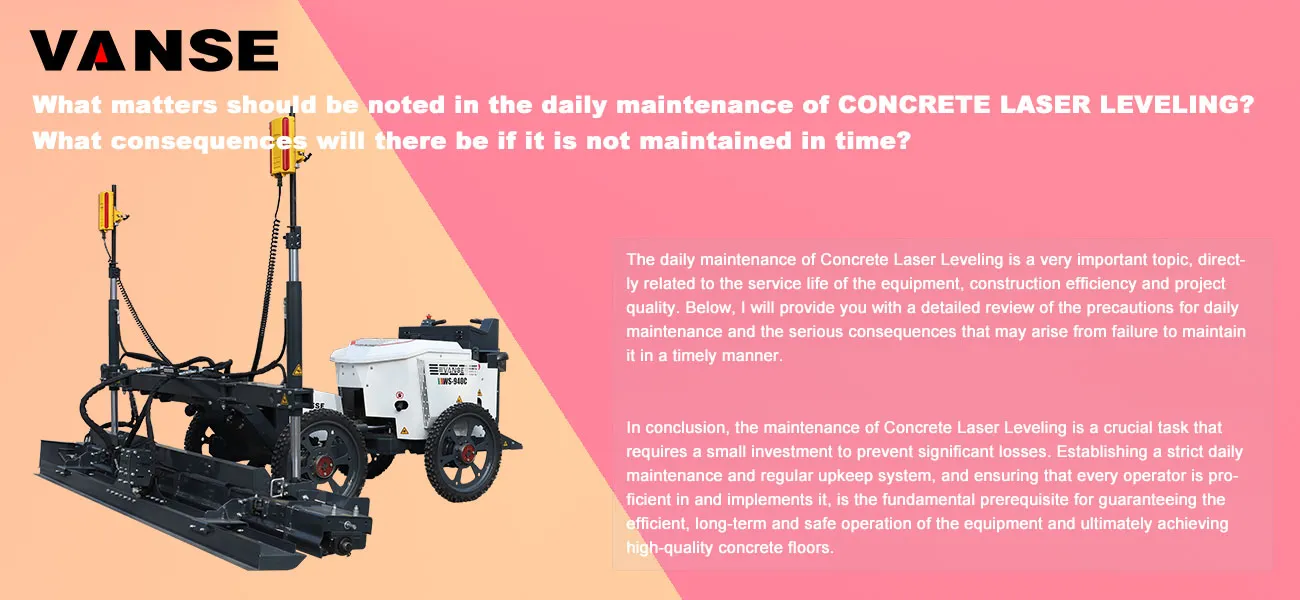
The daily maintenance of Concrete Laser Leveling is a very important topic, directly related to the service life of the equipment, construction efficiency and project quality. Below, I will provide you with a detailed review of the precautions for daily maintenance and the serious consequences that may arise from failure to maintain it in a timely manner.
I. Daily Maintenance Precautions for Concrete Laser Leveling Machines
Daily maintenance should follow the eight-character guideline of "cleaning, inspection, tightening and lubrication", and can be divided into three stages: before construction, during construction and after construction.
(1) Pre-construction Inspection (Mandatory before the start of work every day)
Overall appearance inspection of the machine
Cleaning: Remove cement slurry, oil stains and debris from the machine, especially the accumulated materials on the scraper, vibrator, traveling wheels and frame, to ensure there are no hard lumps.
Structural components: Inspect the main structural components (such as the frame and hydraulic arm) for any cracks, deformations or damages.
Fasteners: Check all bolts and nuts for looseness, especially the connecting bolts at key parts such as the vibrator, scraper, and walking system.
Laser system inspection
Cleaning: Use a soft dry cloth to clean the lenses of the laser transmitter and laser receiver, ensuring there is no dust or oil stains.
Battery power: Check if the battery power of the laser transmitter is sufficient.
Functional test: Turn on the machine to test whether the laser system is working properly and whether the receiver signal is sensitive and stable.
Hydraulic system inspection
Oil level: Check whether the oil level in the hydraulic oil tank is within the standard range. If it is insufficient, add the same grade of hydraulic oil in time.
Leakage: Check the hydraulic oil pipes, joints and cylinders for any signs of leakage or damage.
Abnormal noise: Start the engine and listen for any abnormal noises when the hydraulic pump and motor are working.
Vibration system inspection
Check the oil level of the lubricating oil in the vibration box.
Check if there are any abnormal noises from the vibration motor and transmission components.
Inspection of the walking system
Check the wear condition of the tracks or tires and adjust the tension of the tracks to an appropriate state.
Clear the debris entangled on the tracks or walking wheels.
Engine inspection (if diesel-powered)
Check the levels of engine oil, coolant and fuel.
Check if the air filter is clogged and clean or replace it if necessary.
(2) Observation during construction
Operation monitoring: During the construction process, pay attention to listening for any abnormal vibration or noise from the operation of the leveling machine.
Temperature monitoring: Pay attention to whether the temperatures of the hydraulic system and the engine are within the normal range.
Timely cleaning: When excessive concrete is found adhering to the scraper or track, the machine should be stopped immediately for cleaning to avoid affecting the flatness or increasing the load.
(3) Post-construction maintenance (must be done after work every day
Thorough cleaning: This is the most crucial daily maintenance step. The entire machine must be thoroughly rinsed with water before the concrete is fully hardened, especially the scraper, vibrator, tracks/tires and the underside of the frame. Prevent the concrete from solidifying and damaging the components and affecting the machine balance.
Rust prevention treatment: After cleaning, dry the water stains with a dry cloth or blow dry them with compressed air. For exposed metal surfaces (such as scrapers and hydraulic rods), apply a small amount of lubricating oil or anti-rust oil.
Parking environment: Park the equipment in a flat, dry and cool place, avoiding direct sunlight and rain.
Battery: If not in use for a long time, the negative terminal of the battery should be disconnected.
(4) Regular maintenance (carried out on an hourly or monthly basis
In addition to daily maintenance, regular maintenance should also be carried out in accordance with the requirements of the equipment's user manual, such as:
Regular replacement: hydraulic oil, engine oil, and filters (hydraulic oil filter, engine oil filter, air filter).
Regular lubrication: Apply the specified grease to all lubrication points (such as bearings and pins).
System inspection: Regularly have professionals inspect the hydraulic system and control system.
Ⅱ. Serious Consequences of Failure to maintain in a timely manner
If daily maintenance is neglected, it will lead to a series of problems, ranging from increased costs to causing serious safety accidents.
The construction quality has declined.
Non-compliance with flatness/smoothness standards: Dirt on the laser head can cause unstable signal reception, hard concrete adhering to the scraper can damage the already leveled surface, and vibrator failure can lead to uneven concrete density. All these will directly cause the ground to be uneven, wavy or rough.
Failure to operate normally: Failure of key components can cause the leveling to be unable to execute precise instructions, seriously affecting the construction progress and quality.
The equipment is damaged and the maintenance cost is high
Core component scrapping: Impurities entering the hydraulic system will wear out the oil pump, motor and valve group, and the replacement cost is extremely high. Solidified concrete will increase the load on the vibration system and the walking system, leading to motor burnout and bearing damage.
Structural damage: Long-term lack of cleaning and tightening may cause structural components to crack due to uneven force, leading to deformation of the entire machine.
A minor issue can turn into a major one: A loose bolt may cause damage to a component, eventually triggering a chain reaction, with maintenance costs and downtime doubling.
Work efficiency has decreased and the project schedule has been delayed
Frequent equipment malfunctions can lead to construction interruptions, requiring a significant amount of time for maintenance, seriously slowing down the project progress and causing a huge waste of human and material resources.
Safety hazard
Hydraulic oil leakage may cause a fire.
Sudden breakage of structural components, detachment of bolts or loss of control of the walking system may all cause personal injury to on-site operators.
Shortened equipment lifespan
Machines that lack maintenance and operate in a "sub-health" state for a long time will experience a sharp decline in their overall performance and may be scrapped prematurely after only a few years. In contrast, well-maintained equipment can be used for more than ten years.
In conclusion, the maintenance of Concrete Laser Leveling is a crucial task that requires a small investment to prevent significant losses. Establishing a strict daily maintenance and regular upkeep system, and ensuring that every operator is proficient in and implements it, is the fundamental prerequisite for guaranteeing the efficient, long-term and safe operation of the equipment and ultimately achieving high-quality concrete floors.
Note: The parameters provided in this document are for reference only and are not mandatory. Due to differences in technical characteristics between different brands and models of laser levelers, please consult the manufacturer for a suitable solution before actual operation. This reference document assumes no responsibility for any issues arising from failure to follow the manufacturer's instructions.
Thanks to All the Friends Who Support and Trust Shandong Vanse Machinery Technology Co., Ltd.
If you want to know more about Shandong Vanse Machinery Technology Co., Ltd. or have any questions, please feel free to contact us:
Our Factory
Shandong Vanse Machinery Technology Co., Ltd.








Share this article

About the Author: Shandong Vanse Machinery Technology Co., Ltd.
Shandong Vanse Machinery Technology Co., Ltd. is a high-tech manufacturer specializing in concrete construction machinery, including laser screeds and related equipment. The company integrates R&D, production, and global sales, with products exported to over 60 countries and widely used in infrastructure projects worldwide.
Previous Post
Next Post
Related Articles
You Might Also Like
Why is the price difference of laser leveling machines so big?
Compared with manual work, laser leveling machines are more efficient and effective, so more and more people are choosing laser leveling machines. So do you know why the price difference between laser leveling machines is so big? The editor will give you a brief introduction, let's take a look. The main reason why the prices of laser leveling machines vary in the market is the difference in quality and brand. Many products look very similar, but when you actually use them, you will find that these products actually seem to be somewhat different. Learn to conduct a comprehensive analysis of the quality of the products, so that you can better Make sure you end up buying a good product. Of course, you still have to make comparisons when faced with different prices. Features of an excellent laser leveler: 1. The leveling principle of the laser leveling machine is achieved by using precision laser technology, closed-loop control technology and a highly precise hydraulic system, under the automatic control of a computer. This is its most prominent feature that distinguishes it from other floor construction processes. . 2. The leveling principle of the laser leveling machine is to rely on the hydraulically driven leveling head to cooperate with the laser system and computer control system to complete the leveling work while automatically leveling. The leveling head is equipped with an integrated scraper, vibrator and leveling plate, which integrates all leveling, leveling, vibration and compaction work into one and completes it at one time. The computer control system automatically adjusts the height 10 times per second in real time, and the balanced designed vibrator has a vibration frequency of 3,000 times per minute. 3. The laser transmitter used to control the ground elevation is arranged independently. In this way, the floor elevation is not controlled by the template and does not produce cumulative errors. 4. The laser leveling machine can also automatically control the longitudinal and transverse slopes, which is also completed by the laser system, computer system, hydraulic system and mechanical system. For complex-shaped floors with high requirements such as drainage, a three-dimensional special-shaped ground treatment system can also be selected.VANSE Group’s excellent after-sales service team serves every customer with heart, builds the VANSE brand with quality, and makes products go global.
VANSE Group's excellent after-sales service team serves every customer with heart, builds the VANSE brand with quality, and makes products go global. The large-scale 360 degree laser leveling machine is equipped with advanced laser system and full hydraulic control system, which makes the concrete construction ground more precise and dense, and meets the high standard construction requirements while efficiently constructing. The application of a large 360 degree laser leveling machine will ensure the achievement of various high standard engineering construction standards, comprehensively improve the quality of engineering construction, and create higher value for customers. A large 360 degree laser leveling machine is a device that uses the laser emitted by the transmitter as the reference plane, and controls the leveling head in real-time through the laser receiver on the laser leveling machine, thereby achieving high-precision and rapid concrete leveling. It is developed for modern industrial factories, large shopping malls, warehouses, and other large areas of cement concrete floors, which have increasingly high requirements for ground quality such as strength, flatness, and levelness. VANSE Group engineers serve Turkish customers. The telescopic arm of a large 360 degree laser leveling machine is 6 meters long, and the leveling work width is 4 meters. It can complete the leveling of 24 square meters of concrete per minute. The flexible and efficient hydraulic control system can control the height of the scraper and fabric rotation, maintaining the flatness of the leveling layer. Another characteristic of the 360 degree concrete laser leveling machine is to save labor, improve efficiency, shorten the construction period by two-thirds, and reduce more than half of the labor. Large 360-degree laser leveling machine is your best choice!Where should I start buying a laser leveling machine?
WHERE SHOULD I START BUYING A LASER LEVELING MACHINE? In order to alleviate the tension of the labor force, many companies have purchased concrete laser leveling machines, which can reduce the amount of labor used and reduce capital investment to a certain extent. But for consumers to buy this device, they should find the manufacturer to buy it on the basis of a thorough understanding. "High degree of automation, low labor intensity, save formwork, channel steel, reduce labor input, and make the ground smoother"… Based on various advantages, laser leveling machines are now highly sought after by the construction floor industry and become a star product in construction machinery and equipment. Driven by unlimited business opportunities and market interests, many companies have begun to join in and promote themselves as professional brands, professional manufacturers, and product experts. This phenomenon makes consumers unaware when purchasing laser leveling machine products. How to choose, here Shandong Wanshi Machinery Xiaobian has compiled a few precautions for purchasing laser leveling machines to help users stay away from being "fooled" and find good brands and products that are truly professional and focused. 1. Carefully select brands just getting started For high-tech products such as concrete laser leveling machines, in addition to technological innovation, there is another important factor that affects the quality of concrete laser leveling machines, and that is experience. How to define laser leveling machine products of different models and specifications? How to deal with the flatness of the ground? How to position the laser transmitter and other issues require years of long-term accumulation to accurately grasp. When users choose laser leveling machine products, if they rush to buy the products of the brand that has just started, they are likely to become "guinea pigs" and encounter various troubles. It is very simple to identify whether this brand is just getting started, just check its patent registration time and understand the real cases in the past. 2. Do not choose low-priced e-commerce products, but also consider the comprehensive strength of the enterprise Regarding the current phenomenon and confusion in the laser leveling machine industry, industry insiders believe that for an enterprise, the trust of consumers in the final purchase is a comprehensive consideration. The price factor may account for 25% of it, but in the end, consumers still consider comprehensive factors. Today, as consumption habits become more and more rational, low prices can only become a gimmick to attract consumers' attention. The real measure of a company's success or failure is the company's product quality, after-sales service and its own strong strength. At present, when the reshuffle trend of the laser leveling machine industry is becoming more and more obvious, laser leveling machine companies with insufficient terminals, insufficient networks, and insufficiently well-known brands will face greater pressure. Shandong VANSE Machinery has been committed to the research and development and production of concrete laser leveling machines for many years. Its core components are all produced by large manufacturers in advanced countries such as Germany and the United States. The production process is strictly in accordance with national standards, enterprise standards, and quality control guarantees. System production, to ensure that product quality meets or exceeds the requirements of corporate standards and relevant national standards, and has won the trust and praise of users with excellent quality, excellent performance, and superior cost performance.