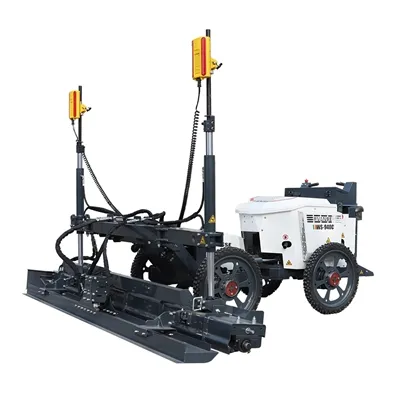
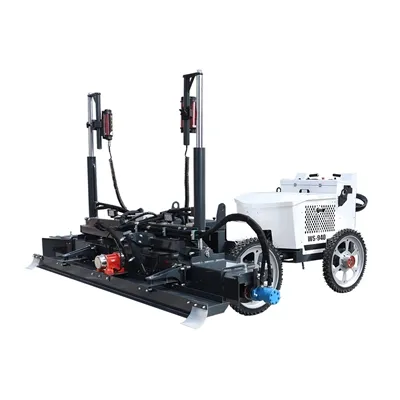
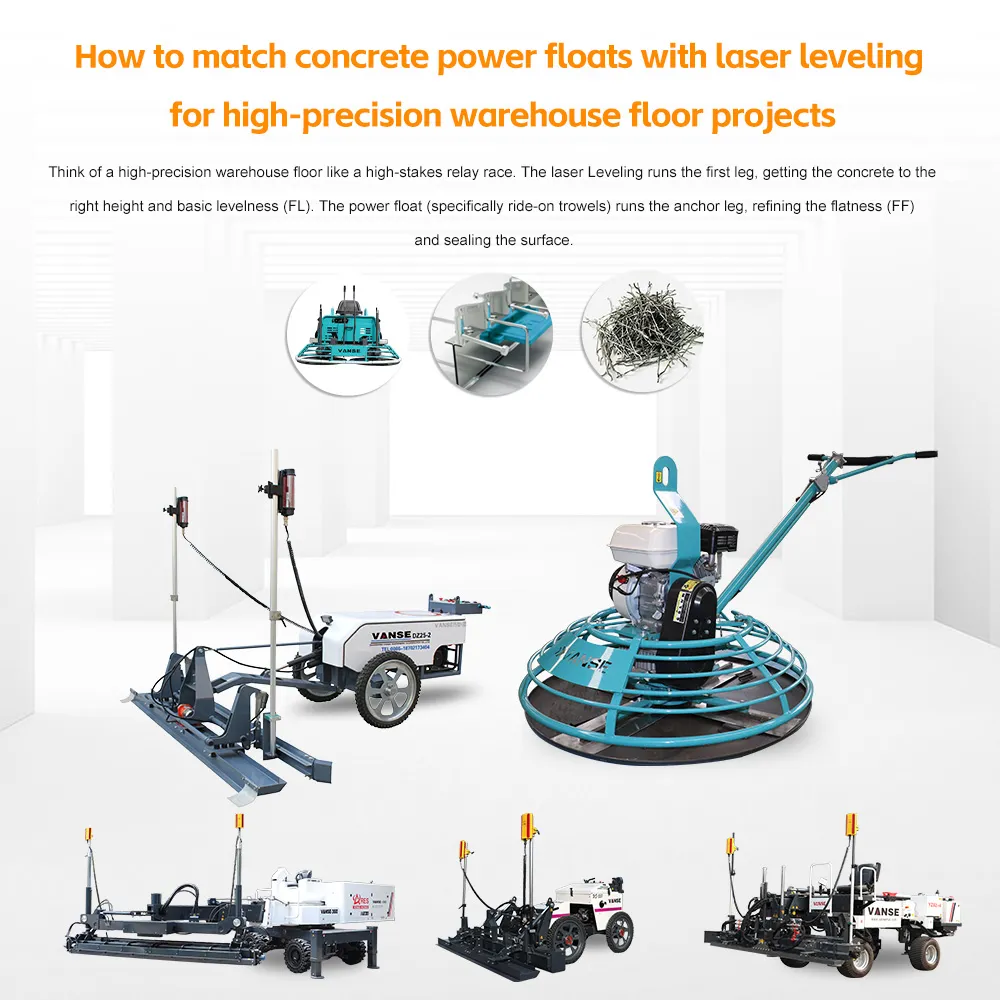
Technical Knowledge
Future Development Trends of Concrete Laser leveling Machines Combined with GPS Technology
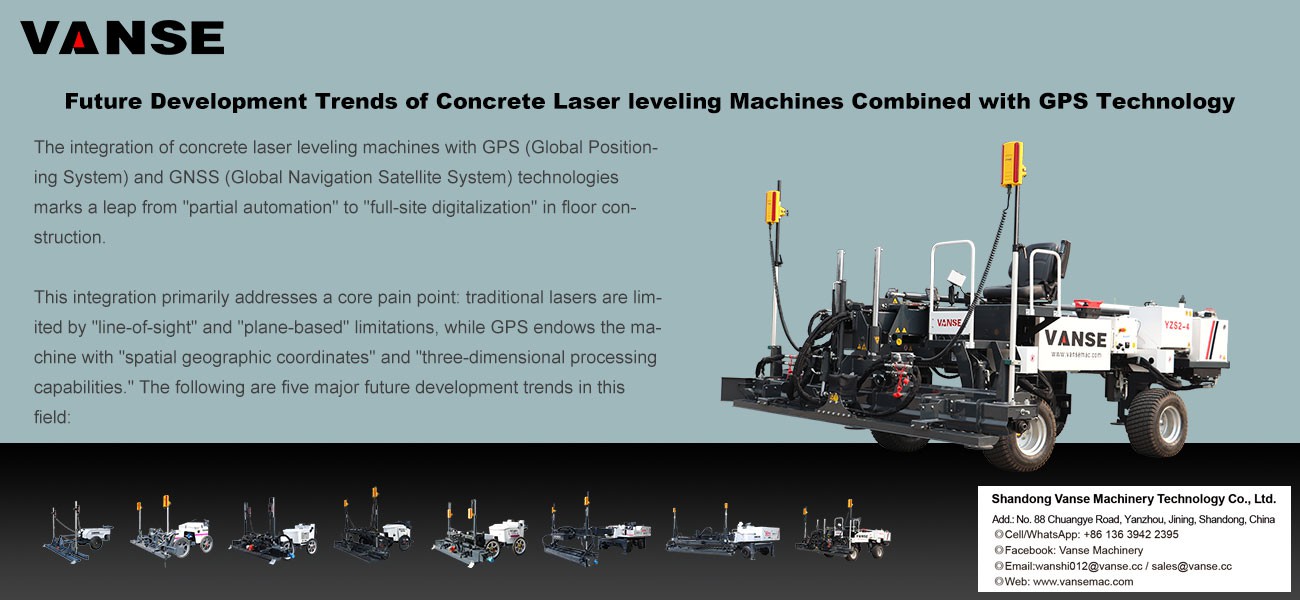
The integration of concrete laser leveling machines with GPS (Global Positioning System) and GNSS (Global Navigation Satellite System) technologies marks a leap from "partial automation" to "full-site digitalization" in floor construction.
This integration primarily addresses a core pain point: traditional lasers are limited by "line-of-sight" and "plane-based" limitations, while GPS endows the machine with "spatial geographic coordinates" and "three-dimensional processing capabilities." The following are five major future development trends in this field:
1. Evolving from "Super-flat" to "3D Curved Surfaces"
Traditional laser leveling machines are primarily used for horizontal or single/double-slope surfaces. Combined with GPS/GNSS, the machine can achieve:
Complex 3D Modeling: Accurately leveling surfaces directly on large outdoor parking lots, roundabouts, and roads with complex drainage slopes, based on 3D coordinates designed using BIM (Building Information Modeling).
Millimeter-Level GPS (mmGPS): By enhancing GPS signals with lasers (such as Topcon's Lazer Zone technology), the centimeter-level horizontal accuracy of GPS is combined with the millimeter-level vertical accuracy of lasers, enabling high-precision operations on complex terrains.
2. Digital Twin of the Entire Construction Process
In the future, laser leveling machines will no longer be standalone construction tools, but rather nodes within a digital construction site:
Real-time data trans mission: While the machine is leveling, GPS records the actual elevation of each point. Upon completion, the system automatically generates an "as-built elevation difference heat map."
Automatic progress monitoring: Managers can view the completed paving area, thickness deviation, and trajectory distribution via the cloud from their offices, achieving precise project progress management.
3. Path Planning and Semi-Automatic/Unmanned Driving
The introduction of GPS has laid the foundation for "unmanned construction":
Track Optimization: The system automatically plans the leveling path based on the site shape, reducing repetitive paths, improving work efficiency, and avoiding omissions or excessive overlap that may occur during manual operation.
Automatic Driving Assistance: The operator only needs to monitor the machine, which uses RTK (Real-Time Kinematic) positioning to automatically control steering and movement, minimizing human interference, especially in poor visibility or nighttime environments.
4. Collaborative Operations and Precise Material Management
Multi-machine Collaboration: In large-scale projects, multiple leveling machines equipped with GPS can share a coordinate system, ensuring perfect alignment of elevations at joints in different areas.
Material Waste Reduction: Precise control of paving thickness via GPS (deviation reduced to \pm 2{mm}) effectively prevents concrete waste due to uneven thickness, resulting in significant material cost savings in large-scale projects.
5. Cross-sensor fusion: GPS + LiDAR + 5G
LiDAR obstacle avoidance: GPS handles macroscopic positioning, while LiDAR handles microscopic environmental perception, preventing collisions with pillars or obstacles on the construction site.
5G remote control: Leveraging the low latency of 5G, experts can remotely guide or even directly control leveling machines thousands of kilometers away from headquarters using GPS coordinates.
Technology Trend Comparison Table
| Features | Traditional laser leveling | GPS/GNSS Enhanced Leveling |
| Operational Dimensions | Two-dimensional planes/simple inclined planes | 3D Complex Surfaces (3D Contour) |
| Reference Benchmarks | Physical laser emitter (line-of-sight required) | Satellite Signals + Ground Reference Stations (Full Site Coverage) |
| Construction Environment | Primarily indoors and enclosed spaces | Large-scale Outdoor Projects, Infrastructure Projects, Complex Terrain |
| Data Capabilities | No or simple offline recording | Real-time Online Support, BIM Integration, Fully Digital Reporting |
Note: The parameters provided in this document are for reference only and are not mandatory. Due to differences in technical characteristics between different brands and models of laser levelers, please consult the manufacturer for a suitable solution before actual operation. This reference document assumes no responsibility for any issues arising from failure to follow the manufacturer's instructions.
Thanks to All the Friends Who Support and Trust Shandong Vanse Machinery Technology Co., Ltd.
If you want to know more about Shandong Vanse Machinery Technology Co., Ltd. or have any questions, please feel free to contact us:
Our Factory
Shandong Vanse Machinery Technology Co., Ltd.








Share this article

About the Author: Shandong Vanse Machinery Technology Co., Ltd.
Shandong Vanse Machinery Technology Co., Ltd. is a high-tech manufacturer specializing in concrete construction machinery, including laser screeds and related equipment. The company integrates R&D, production, and global sales, with products exported to over 60 countries and widely used in infrastructure projects worldwide.
Previous Post
Next Post
Related Articles
You Might Also Like
What safety precautions should be taken when maintaining the concrete laser leveling machine?
As an important construction equipment in the modern construction industry, the maintenance of a concrete laser leveling machine is of great significance to ensure the normal operation of the equipment and extend its service life. However, in the process of maintenance, we must attach great importance to safety issues to ensure the safety of operators and the integrity of the equipment. This article will discuss in detail the safety precautions that need to be taken when maintaining a concrete laser leveling machine, mainly including safety preparations for the leveling machine shutdown, cleaning up debris in the work area, checking maintenance and operation sequence, following safety operation specifications, maintenance parts replacement precautions, personal protective equipment wearing, and emergency response plans. 01 Safety preparations for leveling machine shutdown Before performing maintenance, first ensure that the concrete laser leveling machine has been completely shut down and all operating switches have been placed in the "off" or "stop" position. This can effectively prevent safety accidents caused by misoperation or accidental start-up of the equipment. At the same time, the power supply of the leveling machine must be cut off to prevent the current from causing electric shock to the maintenance personnel. If the equipment is equipped with a battery or other energy storage device, it must also be ensured to be in a safe state. In addition, for possible hydraulic and pneumatic systems, it is necessary to wait for a period of time after shutdown to ensure that the pressure in the system is completely released. Before releasing the pressure, do not disassemble any parts related to the pressure system to avoid injury caused by the spraying of high-pressure liquid or gas. 02 Clean up debris in the work area Before maintenance begins, the work area must be thoroughly cleaned and all items and tools not related to maintenance must be removed to prevent them from becoming a hidden danger of tripping or slipping. Pay special attention to cleaning the space under the equipment to ensure that maintenance personnel can safely approach and operate the key components of the equipment. At the same time, it is also necessary to ensure that the lighting in the work area is sufficient so that maintenance personnel can clearly see every detail and potential danger points. If maintenance is required at night or in a dimly lit environment, appropriate lighting equipment should be used. 03 Inspection, maintenance and operation sequence When maintaining the concrete laser leveling machine, the correct inspection and operation sequence should be followed. First, the overall condition of the equipment should be checked, including whether the appearance, structure, connectors, etc. are intact. Secondly, follow the guidance of the equipment maintenance manual to check the wear and damage of key components one by one, such as blades, bearings, belts, etc. During the operation, the principle of easy first, difficult second, external first, internal second should be followed. For complex maintenance tasks, such as disassembling and replacing parts, make sure to understand the structure and function of the relevant parts, and follow the correct disassembly and installation sequence. During the operation, appropriate tools and methods should be used to avoid using violence or improper operation to cause equipment damage or personal injury. 04 Follow safe operation specifications When performing maintenance, you must strictly follow the safety operation specifications. First, make sure you are familiar with the operation and maintenance manual of the equipment, and understand the performance, characteristics and safety requirements of the equipment. Secondly, before performing any operation, you should carefully read the relevant safety tips and warnings to ensure that you understand the possible risks and precautions. During the operation, you should stay focused and cautious, and avoid distraction or impatience. For uncertain operations or problems, you should consult experienced colleagues or professionals in time. At the same time, it is strictly forbidden to carry out activities unrelated to work during maintenance, such as smoking, eating, etc., to avoid fire or other safety accidents. 05 Precautions for replacement of maintenance parts During the maintenance process, some worn or damaged parts may need to be replaced. When replacing parts, make sure to use regular brand and model parts that match the equipment. Do not use inferior or substandard parts to avoid affecting the performance and safety of the equipment. Before replacing parts, make sure that the power of the equipment is turned off and take necessary safety measures, such as wearing protective glasses and gloves. When removing and installing parts, use appropriate tools and methods and follow the correct operating sequence. After replacing parts, check whether the equipment is firmly connected and whether the parts are installed correctly, and perform necessary trial runs and tests to ensure the normal operation of the equipment. 06 Wearing of personal protective equipment When maintaining the concrete laser leveling machine, the operator must wear appropriate personal protective equipment. This includes but is not limited to safety helmets, protective clothing glasses, earplugs, gloves and non-slip shoes. These equipment can effectively protect the operator's head, eyes, ears, hands and feet from injury. For example, a safety helmet can protect the head from falling objects or collisions; protective glasses can prevent splashing particles or liquids from entering the eyes; earplugs can reduce the damage to hearing caused by noise at the work site; gloves can prevent hands from being cut or burned by sharp edges or high-temperature parts; non-slip shoes can provide good grip to prevent slipping during operation. 07 Emergency Response Plan Although we have taken various safety measures to prevent accidents, some emergencies may still occur in actual operations. Therefore, it is crucial to formulate and implement emergency response plans. First, all maintenance personnel should be familiar with the safety operation manual of the equipment, understand possible emergencies and corresponding response measures. Secondly, the maintenance site should be equipped with necessary first aid equipment and medicines so that initial treatment can be carried out in time when injuries occur. In addition, a clear emergency evacuation and rescue plan should be formulated to ensure that personnel can be quickly organized to evacuate and notify professional rescue teams in the event of serious accidents such as fires and leaks. At the same time, maintenance personnel should regularly conduct emergency response training and drills to improve their ability and level to respond to emergencies. By simulating emergencies in actual scenarios, maintenance personnel can remain calm, take response measures quickly and accurately when real accidents occur, and minimize casualties and property losses. In addition to the safety matters mentioned above, it is also necessary to pay attention to the handling of some details and special situations. For example, during the maintenance process, if serious faults or damage are found in the equipment, the work should be stopped immediately and reported to professional maintenance personnel for processing. Do not disassemble or repair it privately. In addition, during the maintenance process, you should always be vigilant and pay attention to changes in the surrounding environment. If there are any abnormal situations, you should deal with them or evacuate in time. In addition, for the long-term maintenance and maintenance of concrete laser leveling machines, a complete set of systems and processes must be established. This includes regular comprehensive inspection and maintenance of the equipment, recording the operating status and maintenance history of the equipment, so as to promptly discover potential safety hazards and deal with them. At the same time, regular training and education of maintenance personnel are also required to improve their safety awareness and operating skills to ensure the normal operation and safe use of the equipment. In summary, the safety matters that need to be paid attention to when maintaining the concrete laser leveling machine cover the aspects of safety preparation for shutdown, cleaning up debris in the work area, checking maintenance and operation sequence, following safety operation specifications, precautions for replacement of maintenance parts, wearing of personal protective equipment, and emergency response plans. Only under the premise of strictly abiding by these safety matters can the smooth progress of maintenance work be ensured, and the safety of personnel and the integrity of equipment can be guaranteed. Therefore, we must attach great importance to the maintenance of concrete laser leveling machines and continuously improve our safety awareness and operating skills. It is worth noting that although this article elaborates on the safety issues when maintaining concrete laser leveling machines, various special situations and unknown risks may still be encountered in actual operations. Therefore, in actual work, maintenance personnel should remain vigilant and cautious, respond flexibly according to actual conditions, and consult and seek help from professionals in a timely manner. At the same time, companies should also strengthen the training and management of maintenance personnel, improve their safety awareness and response capabilities, and ensure the smooth progress of maintenance work and the sustainable development of the company.Which factors ought to be thought about when purchasing a concrete laser leveling machine?
When purchasing a concrete laser leveling, you need to consider construction requirements, equipment performance, cost-effectiveness and other factors to ensure that the equipment can adapt to the project scenario, improve construction efficiency and reduce long-term costs. The following are the core factors that need to be focused on: – For large-area floors (single area exceeds 1000㎡) such as large industrial plants (such as automobile plants and logistics warehouses), it is suitable to choose large laser levelings ( such as VANSE YZ40-4E, YZ30-4E, etc. ), which have a large operating width (3-4 meters) and high efficiency (average daily construction of 4000-5000㎡), can reduce joints and ensure overall flatness. – For small plants, workshops or narrow areas (such as around equipment foundations and corners), small hand-held laser levelings ( such as DZ25-2, DZ30-2, etc. ) are suitable, with flexible bodies that can operate in small spaces. – If the factory has AGV robots, precision equipment or high-bay warehouses (forklifts need to travel at high speed), the flatness requirements are extremely high (such as 2-meter ruler deviation ≤3mm, or even ≤1mm), and you need to choose a high-precision laser system (such as imported laser transmitters, accuracy ±0.5mm/10m) and a more rigid leveling head (to reduce the impact of body deformation). – Ordinary industrial plants (such as warehouses) can choose medium-precision equipment to meet the basic flatness. – When the floor thickness is large (such as 200-300mm, including steel fiber and steel mesh), you need to pay attention to the paving capacity of the equipment, choose a high-power engine (such as 40-60 horsepower), a heavy-duty scraper and a vibrating system (vibration depth ≥300mm) to ensure that the concrete is vibrated densely and avoid honeycomb surface. – If the ground needs to carry heavy equipment (such as forklifts and machine tools above 10 tons), the equipment must have sufficient paving uniformity to reduce local settlement caused by differences in concrete density. – Laser transmitter: Prioritize imported brands ( such as Trimble in the United States, Leica in Switzerland, and Topcon in Japan ), whose laser signals have strong anti-interference ability (avoid the influence of sunlight and other equipment signals), to ensure the uniformity of the benchmark during large-scale construction. – Control system: Whether it has automatic leveling function (such as automatic slope compensation, real-time correction of height difference), which can reduce human errors when operated by novices. – Engine power: High-power (such as more than 50 horsepower) equipment is suitable for high-intensity and continuous operation, especially in high-temperature environments where concrete sets quickly, and can quickly complete paving. – Operation speed: It needs to match the concrete supply (such as paving 80-150m³ per hour) to avoid the inability to trim the concrete after initial setting due to the equipment being too slow. – Leveling machine head: Rigid frame (such as square steel welding) has strong anti-deformation ability and prolongs service life; scraper and vibrator materials (such as high chromium alloy) need to be wear-resistant to reduce replacement frequency. – Tires/tracks: If the ground is soft during construction in the factory, crawler equipment (large ground contact area) is more anti-sinking; tire type (flexible movement) can be selected for hardened ground. – Whether it supports synchronous spreading of wear-resistant materials (such as integrated spreader) to reduce subsequent processes; – Folding design (such as foldable head) for easy transportation and entry into narrow factories. – The choice of imported or domestic equipment depends on personal budget and construction projects. – Fuel consumption: high-power equipment has high fuel consumption (such as 8-15L per hour), which needs to be calculated in combination with the construction volume; – The price and replacement frequency of wearing parts (vibrators, scrapers), choose a brand with sufficient supply of accessories. – Whether the manufacturer provides localized services (such as nearby repair outlets) to avoid delays in construction due to equipment failure (Shandong VANSE Machinery Technology Co., Ltd. has its own agents in the United States, Mexico, Russia, Spain, Thailand, Uzbekistan, the United Kingdom, Australia, Brazil and other countries, with branches + overseas warehouses in Malaysia and its own overseas warehouses in Saudi Arabia. Engineers are online 24 hours a day, and dedicated personnel will answer your questions, worry-free throughout the process); – Training support: whether operation and maintenance training are provided, especially important for novice teams; – Warranty policy: warranty duration (such as 1-2 years) and scope (whether core components are covered). – Reference industry cases: give priority to brands that are widely used in industrial plant construction ( VANSE Machinery Technology Co., Ltd.'s equipment has undertaken the construction of large and small logistics parks, as well as large supermarkets, and provides construction solutions. It has completed TR34 and DM1 standard floor laying in Saudi Arabia ), and its equipment performance has been verified in practice. – User evaluation: Understand the stability and failure rate of the equipment through peer feedback and industry forums to avoid choosing niche brands that lead to subsequent maintenance difficulties. When purchasing, it is necessary to combine the area, flatness requirements, and concrete thickness of the plant construction, give priority to matching the accuracy, efficiency and structural durability of the equipment, and balance the procurement cost with the long-term operating cost, and choose a brand with guaranteed after-sales service. For example, automobile plants (high flatness, large area) are suitable for imported large laser leveling machines; small and medium-sized new energy plants (medium area, high precision) can choose domestic mid-to-high-end equipment to maximize cost performance. Click the below to jump immediately!!! ARMOUR JOINT CONCRETE LEVELING MACHINE LIGHT TOWER POWER TROWEL SLIPFORM MACHINE STEEL FIBER TOPPING SPREADER TRACKED MINI DUMPERHow to match concrete power floats with laser leveling for high-precision warehouse floor projects
Think of a high-precision warehouse floor like a high-stakes relay race. The laser Leveling runs the first leg, getting the concrete to the right height and basic levelness (FL). The power float (specifically ride-on trowels) runs the anchor leg, refining the flatness (FF) and sealing the surface. If these two machines aren't perfectly "matched" in timing and technique, you'll end up with a floor that is level across the building but bumpy under a forklift. Here is how to synchronize them for elite results. For high-precision (Superflat) projects, weight is your friend. While walk-behind floats are fine for small shops, warehouse floors require heavy-duty ride-on power trowels. These machines provide the necessary downward pressure to "cut" high spots and "fill" low spots left by the Leveling. Machine Role Laser Leveling (The Macro) Power Float (The Micro) Primary Goal Elevation & Levelness (FL) Flatness & Density (FF) Key Component Laser receiver & Augers Float pans (Clip-on) Timing Immediate (Wet/Plastic) Delayed (Walkable/Plastic) Correction Moves bulk material Shaves "micro-waves" The most critical "match" between the Leveling and the float happens during the panning phase. * The Pan: Instead of using individual blades, you clip large, flat steel disks (pans) onto the bottom of the power float. The Synergy: The laser Leveling leaves a "closed" surface, but it's never perfectly flat. The pans act as a giant plane. Because the ride-on float has a wide wheelbase, the pans cannot fall into small dips; they "bridge" them and shave the peaks. The Technique: To maximize precision, the operator should run the power float perpendicular to the direction the laser Leveling traveled. This cross-cutting action cancels out any rhythmic waves the Leveling may have left behind. A laser Leveling is fast-it can place 20,000 square feet in a few hours. If your power floating crew can't keep up, the concrete will "get away" from them. The "Footprint" Test: You shouldn't start power floating until a man can stand on the concrete and leave a footprint about 3 mm to 6 mm deep. Matching the Pace: For every laser Leveling on-site, you typically need at least two high-speed ride-on trowels to ensure the entire slab is panned and finished within the same moisture window. If the concrete hardens unevenly, the float will "bounce" over high spots rather than cutting them. One common mistake is over-floating the edges or the areas around columns. The Problem: Power floats naturally want to "dig in" at the edges. The Match: High-precision projects use hand-leveling tools (like a 10-foot highway straightedge) in tandem with the power float. After the first pass of the float, a worker "restraightens" the floor manually to ensure the float didn't create any new "dishes" while trying to fix the old ones. Use Clip-on Pans: Never use just blades if you are chasing high FF numbers. Cross-Pass Pattern: Always float at a 90-degree angle to the laser Leveling's path. Non-overlapping Passes: Ensure the float operator maintains a consistent overlap (usually 50%) to prevent creating new ridges. Monitor Blade Pitch: As the floor hardens, increase the blade pitch gradually. Moving too fast to a high pitch can "chatter" the surface, ruining the flatness the laser Leveling worked so hard to establish. Pro Tip: On Superflat jobs, use a Floor Profiler (like a Dipstick) between floating passes. This allows the team to identify a low spot while the concrete is still "green" enough to be corrected with the power float. Would you like to see a step-by-step "Finishing Schedule" that outlines exactly when to switch from pans to combo blades for maximum floor density? Contact us NOW Note: The parameters provided in this document are for reference only and are not mandatory. Due to differences in technical characteristics between different brands and models of laser levelers, please consult the manufacturer for a suitable solution before actual operation. This reference document assumes no responsibility for any issues arising from failure to follow the manufacturer's instructions.