Technical Knowledge
Establish standard operating procedures for the daily cleaning and regular deep maintenance of concrete laser leveling
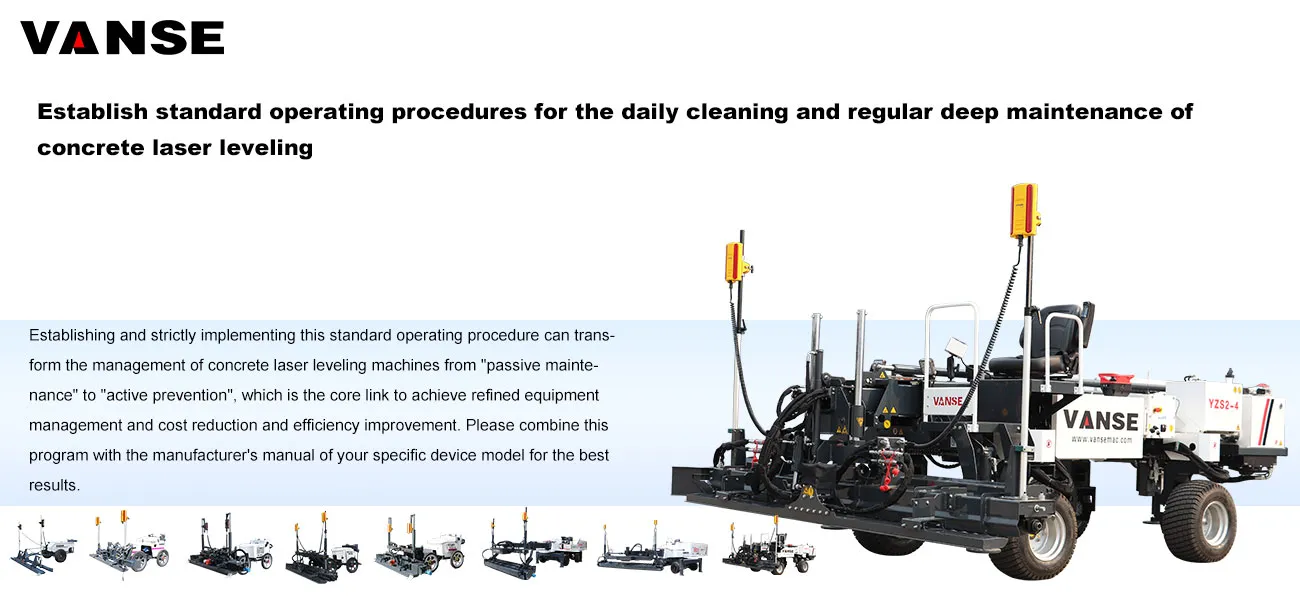
Standard operating procedures for concrete laser leveling: Cleaning and maintenance
1. Purpose
Standardize the daily cleaning and regular maintenance of concrete laser leveling machines to ensure that the equipment is in the best technical condition, prevent abnormal wear and failure, improve equipment utilization and economic benefits, and eliminate potential safety hazards.
2. Scope of application
This program is applicable to all operators, maintenance personnel and equipment managers of concrete laser leveling machines.
3. General Safety Rules
All cleaning and maintenance work must be carried out after the equipment has completely stopped, the engine has been turned off, and the key has been removed.
For the operation of hydraulic and electrical systems, it must be confirmed that the system has been completely depressinized.
Wear appropriate personal protective equipment, including but not limited to: protective gloves, safety glasses, and anti-crush work shoes.
When working under the equipment, it is essential to use safety brackets or jack brackets for reliable support to prevent the equipment from accidentally falling.
A warning sign reading "Under maintenance, Do not start" must be placed on site.
Part One: Daily Cleaning and Inspection Procedures (To be carried out after each shift's work
Objective: Remove the dirt accumulated on the day, inspect the basic condition, and get ready for the next day's work.
| Serial number | Assignment project | Standards and Requirements |
| 1 | Preliminary cleaning of the entire machine | Use high-pressure water guns or manual tools (scrapers, brushes) to remove large blocks of concrete and mud adhering to the chassis, scrapers, vibrators, walking tracks/wheels. Note: Avoid directly flushing the engine air intake, radiator, bearing housing, electrical interfaces and laser receiver with high-pressure water. |
|
2
|
Fine cleaning of key areas | Under the scraper and vibrator: They must be thoroughly cleaned to ensure there is no hard concrete buildup, guaranteeing no resistance during the next start-up. |
| • Laser receiver sensor: Wipe it clean with a soft cloth to ensure there is no dirt blocking it. | ||
| • Piston rods of each cylinder: Before retracting, wipe their surfaces clean with a soft cloth to prevent cement particles from scratching the seals. | ||
|
3
|
Cleaning of the walking system | • Crawler type: Clean the crushed stones and mud blocks in the crawler chain links, drive wheels and guide wheels. |
| • Wheel type: Remove debris from the tire treads. | ||
|
4
|
Post-operation inspection | • Leakage inspection: Visually inspect the hydraulic pipelines, joints, and cylinders for any oil leakage. |
| • Loosening check: Inspect whether the main connecting bolts (such as scraper and vibrator mounting seats) are loose. | ||
| • Visual inspection: Check for obvious cracks or deformations in structural components. | ||
| 5 | Park | Park the equipment on a flat and solid ground. Retract the cylinder to lift the scraper off the ground. Disconnect the power supply (if any). |
Part Two: Regular Deep Maintenance Procedures
Objective: Conduct systematic inspection, adjustment, lubrication and component replacement to fundamentally maintain equipment performance.
A. Periodic maintenance plan
Note: The following cycles are general recommendations. Please be sure to refer to the final regulations in the equipment manufacturer's manual. The maintenance cycle should be shortened under harsh working conditions.
| Maintenance cycle | Maintenance items | Standards and Requirements |
| 50 working hours per week | 1. Lubrication and maintenance | Apply the specified lithium-based grease to all lubrication nozzles (grease nozzles) until the new grease is squeezed out from the seal. Key points include: |
| All bearing housings (vibrator bearings, walking wheel bearings). | ||
| All pins and joint joints (lifting connecting rods, adjusting mechanisms). | ||
| • Clean up any spilled old butter and keep it clean. | ||
| 2. Fastening inspection | Use a torque wrench to check and tighten the key bolt connections according to the specified torque value. | |
| 3. Hydraulic system inspection | Check the oil level in the hydraulic oil tank. If it is insufficient, add hydraulic oil of the same grade. | |
| Check whether the color and smell of the hydraulic oil are normal. | ||
| 250 working hours per month | 1. Hydraulic oil breathing filter | Clean or replace the air breather filter element on the top of the fuel tank. |
| 2. Electrical system inspection | Check whether the battery terminals are corroded or loose and clean them. | |
| Check whether the joints of each line are firm and whether the wire harnesses are worn or aged. | ||
| Check whether all control switches and sensors are working properly. | ||
| 3. Laser system calibration | Check the consistency between the laser emitter and the control system of the leveling machine, and calibrate it if necessary. | |
| Every six months / 1,000 working hours | 1. Replacement of hydraulic oil and filter elements | Completely replace all the hydraulic oil. |
| All hydraulic filter elements (suction oil filter, return oil filter, pressure oil filter) should be replaced simultaneously. | ||
| • Clean the interior of the hydraulic oil tank (a special cleaner and dough can be used for adhesion). | ||
| 2. Engine maintenance | • Replace the engine oil, oil filter, fuel filter and air filter. | |
| Check and adjust the tension of the fan belt. | ||
| 3. Inspection of the walking system | Check the wear of the tracks/tires and adjust the tension of the tracks. | |
| • Check the drive motor and reducer. | ||
| 4. In-depth inspection | Check the installation and tightness of major components such as hydraulic pumps, motors, and multi-way valves. | |
| Check whether there are any scratches or rust on the surface of the piston rods of each cylinder and whether the seals are intact. | ||
| 2,000 working hours per year | Comprehensive and systematic inspection and calibration | It is recommended to be carried out by professional service engineers, including: |
| Check whether the pressure and flow rate of the hydraulic system meet the standards. | ||
| • Conduct a comprehensive inspection of the electrical control system and sensors. | ||
| • Conduct flaw detection on structural components (if necessary). |
B. Long-term storage and maintenance procedure (more than one month)
Thorough cleaning: Wash thoroughly according to the daily procedure and dry completely.
Rust prevention treatment: Apply rust prevention grease to all exposed metal surfaces (such as cylinder piston rods, guide rails, bolt threads).
Oil protection: Add hydraulic oil to the upper limit and carry out anti-rust treatment on the engine crankcase and fuel system.
Tires/Tracks: Lift the equipment up to lift the tires/tracks off the ground.
Battery: Disconnect the negative terminal of the battery, take it out and store it in a dry and well-ventilated place, and charge it regularly.
Parking environment: Store in a dry and well-ventilated indoor area and cover with tarpaulin to prevent dust.
4. Records and Responsibilities
After each cleaning and maintenance is completed, the date, working hours, maintenance content, replaced parts and the person who performed the task must be recorded in detail on the "Equipment Maintenance Record Form".
The operator is responsible for daily cleaning and inspection, while the mechanic or equipment administrator is responsible for regular deep maintenance.
Managers should regularly check the completeness and authenticity of maintenance records.
Summary
Establishing and strictly implementing this standard operating procedure can transform the management of concrete laser leveling machines from "passive maintenance" to "active prevention", which is the core link to achieve refined equipment management and cost reduction and efficiency improvement. Please combine this program with the manufacturer's manual of your specific device model for the best results.
Note: The parameters provided in this document are for reference only and are not mandatory. Due to differences in technical characteristics between different brands and models of laser levelers, please consult the manufacturer for a suitable solution before actual operation. This reference document assumes no responsibility for any issues arising from failure to follow the manufacturer's instructions.
Thanks to All the Friends Who Support and Trust Shandong Vanse Machinery Technology Co., Ltd.
If you want to know more about Shandong Vanse Machinery Technology Co., Ltd. or have any questions, please feel free to contact us:
Our Factory
Shandong Vanse Machinery Technology Co., Ltd.








Share this article

About the Author: Shandong Vanse Machinery Technology Co., Ltd.
Shandong Vanse Machinery Technology Co., Ltd. is a high-tech manufacturer specializing in concrete construction machinery, including laser screeds and related equipment. The company integrates R&D, production, and global sales, with products exported to over 60 countries and widely used in infrastructure projects worldwide.
Previous Post
Next Post
Related Articles
You Might Also Like
Analysis of the Causes of Unstable Laser Signals in Concrete Laser Leveling and Treatment Measures
The following is a detailed answer to the analysis of the causes of unstable laser signals in Concrete Laser Leveling and the corresponding treatment measures. Unstable laser signals are one of the common faults in the construction of Concrete Laser Leveling, which will directly lead to a decrease in the leveling accuracy and affect the flatness and quality of the floor. It is of vital importance to quickly locate and solve problems. The main causes of unstable laser signals come from four aspects: the laser emitter, the signal receiver, the external environment and the machinery itself. Power supply issue: Insufficient battery power or poor contact of the power adapter leads to unstable power supply to the laser and fluctuations in output power. Laser itself malfunction: Aging, damage of the laser module or loosening or contamination of internal optical components (such as lenses) can cause the beam to diverge or drift. Unstable reference point: The tripod of the laser emitter is not stably set up and may slightly move or sink under the influence of wind or human touch. Automatic calibration failure: The calibration system of the transmitter with self-leveling function (such as pendulum, magnetic damping or electronic sensor) malfunctions and cannot maintain a stable level reference. Power connection issue: The connection cable between the receiver and the main body of the leveler is loose, poorly connected or damaged. Sensor failure: The photoelectric sensor on the receiver is aged, its sensitivity has decreased, or it is covered with dirt (dust, cement slurry), making it impossible to accurately identify the laser signal. Improper installation: The receiver is not correctly installed on the mast, or there is severe vibration at the installation position, which affects signal reception. Strong light interference: The intense sunlight at noon, especially its infrared spectrum, can interfere with the receiver's recognition of laser signals. Obstruction: Temporary obstructions such as scaffolding, personnel, and equipment at the construction site block the laser beam, causing signal discontinuity. Vibration interference: There are large equipment (such as excavators, heavy trucks) operating nearby, or the laser emitter is set up on a platform with obvious vibration, causing the reference optical path to jitter. Atmospheric disturbance: At super-large construction sites, heat waves caused by high ground temperatures can lead to uneven air density, resulting in slight refraction and jitter of laser beams. Mechanical vibration: If the engine of the Leveling machine operates unsmoothly or the hydraulic system vibrates excessively, the vibration will be transmitted to the receiver, introducing signal noise. Electrical system interference: The generator, frequency converter or high-current circuit of the leveling machine itself generates electromagnetic interference, affecting the sensitive receiver circuit. Follow the principle of "from simple to complex and from outside to inside" in the investigation. Check the power supply: Ensure that the laser emitter is fully charged and all power connections are firm and reliable. Clean and inspect optical components: Use dedicated lens cleaning paper to clean the output lens of the laser emitter and the sensor window of the receiver. Stable reference: Confirm that the laser emitter tripod is firmly set up on a solid floor and kept away from vibration sources. Use counterweights to stabilize the tripod when necessary. Eliminate environmental interference Shading: Install a sunshade on the receiver to prevent direct exposure to strong light. Obstacle clearance: Inspect and clear all possible obstacles along the laser propagation path. Vibration avoidance: Suspend operations that generate strong vibrations nearby or move the position of the laser emitter. 5. Restart the system: Turn off the power of the laser emitter and the leveler, wait for one minute, and then restart to reset the electronic system. 6. Calibration check Manually rotate the transmitter to check if it can provide a stable signal throughout the entire 360-degree range. Use professional tools to check whether the automatic leveling function of the laser emitter is normal. If necessary, send it for repair and calibration. 7. Substitution method test Install the receiver on another confirmed normal level machine for testing. If the problem persists, it indicates that the receiver is faulty. Replace it with a confirmed normal laser emitter. If the problem is solved, the original emitter needs to be repaired. 8. Inspect the cables and connections: Carefully check all the cables from the receiver to the main controller for any signs of compression, wear or breakage, and reinsert all the connectors. 9. Seek professional support: If none of the above steps can solve the problem, it is very likely that there is a hard fault with the electronic components inside the laser or the receiver. At this point, you should immediately contact the after-sales service department of the equipment manufacturer (such as Shandong Wansai Technology) for diagnosis and repair by professional technicians. Do not disassemble the core components by yourself. Regular maintenance: Clean and calibrate the laser transmitter and receiver regularly in accordance with the operation manual. Standard operation: Set up and move the equipment correctly to avoid violent impacts. On-site investigation: Observe the on-site environment before construction, plan the installation position of the laser emitter in advance, and avoid potential interference sources. Backup equipment: For critical projects, it is recommended to prepare backup laser transmitters or receivers to deal with sudden malfunctions. Through systematic analysis and step-by-step investigation, the problem of unstable laser signals of concrete Laser Leveling machines can be efficiently solved, ensuring the quality and efficiency of construction. Note: The parameters provided in this document are for reference only and are not mandatory. Due to differences in technical characteristics between different brands and models of laser levelers, please consult the manufacturer for a suitable solution before actual operation. This reference document assumes no responsibility for any issues arising from failure to follow the manufacturer's instructions.Professionals explain in detail how to operate the laser leveling machine
Do you know what a laser leveler is? This is a device that uses laser as the reference plane, adopts the original receiving and transmitting system, and controls the leveling head in real time to achieve high-precision and fast leveling of concrete. The use of laser levelers provides a lot of convenience for engineering construction. So how should we maintain the laser leveler after normal use? In the following article, we will give you a detailed introduction. Thank you for your reading and support. ① The operator checks the machine equipment before starting work, sets up the transmitter with the operator, and installs the handheld receiver; adjusts the scraper of the floor machine in a static state, and there must be no error between the two points; operates the concrete leveler, observes whether the machine is working properly, checks whether the laser receiver is in a horizontal position, and supervises whether the material feeder is timely in scraping and filling; at the end of the construction on the day, clean the machine after the laser leveler cools down, checks whether the functions of the machine are normal, and checks the power of the transmitter. ② The operator assists the operator in installing and debugging the machine, sets up the transmitter with the main operator, and installs the handheld receiver. Check whether the transmitter is placed safely; measure the height of the concrete after preliminary paving (the range is controlled within 2mm≥, ≤10MM); measure the height of the concrete after the laser leveling machine is leveled (the range shall not be lower than -2MM and not higher than 3MM). Focus: concrete edge and manually scraped concrete surface; after the construction is completed on the same day, clean the machine after the machine cools down and check the power of the handheld receiver. ③ When the 2 laser levelers are not in operation, the pavers will perform preliminary leveling of the concrete together with the pavers; when following the machine, they must obey the command of the main operator and scrape and fill the machine scraper position (the concrete material must not be lower than the scraper edge and must not be higher than 35MM from the scraper edge). ④ 2-4 pavers must obey the command of the operator; perform preliminary leveling of the concrete. ① The LCD surface on the laser leveling machine body also needs to be cleaned. You can use organic resin or lens-specific cleaning cloth to wipe the dirt. If there is too much dirt, you can use lens cleaning fluid to remove it. ② There will be a lot of dust and mud on the laser leveling machine after construction. First, wipe the dust off the laser leveling machine, and wipe the dirt and oil stains with thin paper or cotton cloth. ③ If the laser signal is lost during the construction of the laser leveling machine, the machine needs to be restarted, and the interval time needs to be more than ten seconds. ④ If there are too many stains, you can soak a soft cloth in water diluted with a neutral detergent, wring it out and wash it. The laser leveling machine manufacturer reminds everyone not to use volatile oil, thinner, gasoline and other chemicals for cleaning and wiping. The use of advanced construction equipment, concrete laser leveling machine, can not only shorten the construction period, but also ensure the construction quality to a great extent. This high-grade floor can guarantee normal use for more than 20 years, which can greatly reduce the cost of use and maintenance. Through the introduction of the article, I believe everyone has learned about how to operate the laser leveling machine. If you have other aspects that you need to know or are interested in our products, please continue to pay attention to our official website. More exciting information is expected to be read and supported by you later.What are the common causes and troubleshooting methods for concrete laser leveling machines?
– Laser Beam Unstable: Check that the laser transmitter and receiver are clean and correctly aligned, clean the lens and reflector, clean the dust and dirt. – The device cannot be calibrated horizontally: Make sure the device is placed on a flat ground and the reference point is set correctly. – Flating head slides by itself: Clean the surface of the valve group, remove the hydraulic lock to check whether there is dirt inside, check whether the seal ring is damaged and replace it. – The lifting cylinder is not sensitive: Remove the proportional valve core and clean up the dirt, check whether the valve core is operating normally, and remove air in the oil pipe. – Vibration or noise abnormality: Turn off the equipment to check for loose or damaged parts, fasten screws or replace damaged parts. – The device does not start: Check whether the power supply and cable connection are normal to ensure that the power supply is normal. – Flating head lifting motor cannot be operated manually: Check the control box relay and plug, motor or controller. – Flating head cannot work automatically: Replace the automatic manual switch or inclination sensor. – Flating head slides by itself: Clean the surface of the valve group, remove the hydraulic lock to check whether there is dirt inside, check whether the seal ring is damaged and replace it. – The lifting cylinder is not sensitive: Remove the proportional valve core and clean up the dirt, check whether the valve core is operating normally, and remove air in the oil pipe. – Construction accuracy decreases: Regular cleaning and maintenance of lenses or sensors. – The upper and lower rollers of the leveler do not run: Check whether the chain is off, check whether the motor activation button or contactor is faulty, and check whether the motor line is normal. – Flooring materials are left and right, and the feeding is unstable: Check whether the twisting dragon and the correction roller are parallel and adjust the material.