Technical Knowledge
Compaction Degree of Sub-base in Superflat Floors and Its Impact on Final Flatness
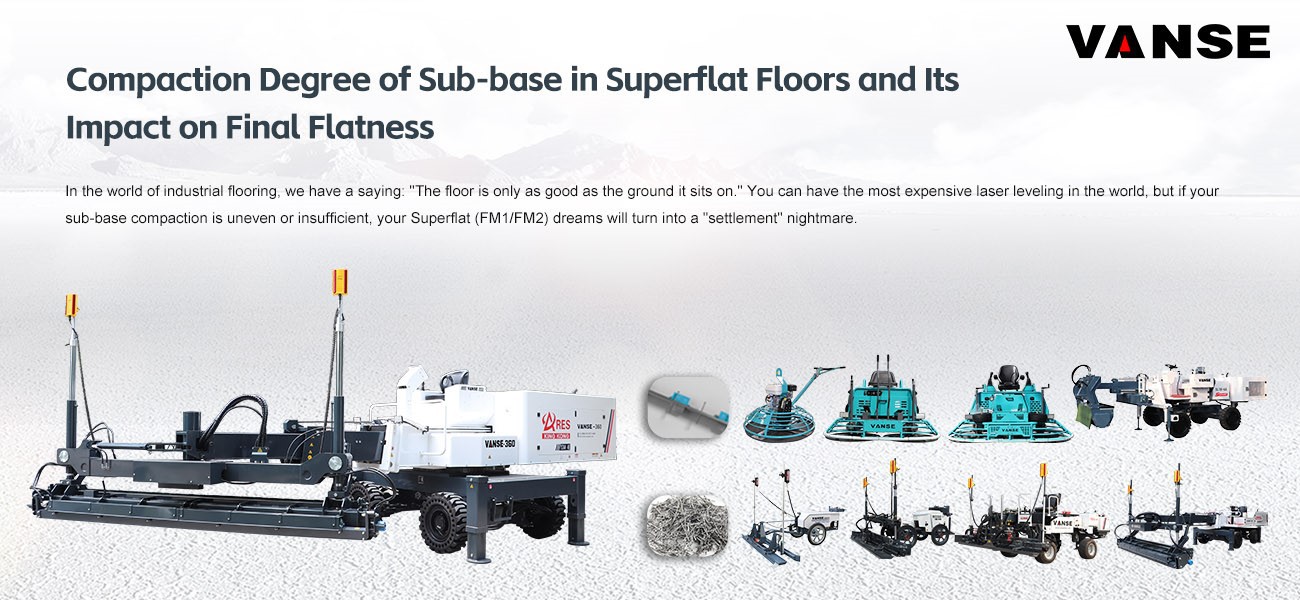
In the world of industrial flooring, we have a saying: "The floor is only as good as the ground it sits on." You can have the most expensive laser leveling in the world, but if your sub-base compaction is uneven or insufficient, your Superflat (FM1/FM2) dreams will turn into a "settlement" nightmare.
If you’re a contractor or facility owner, understanding the link between sub-base compaction degree and final flatness (FF/FL numbers) is critical. Here’s a professional breakdown of how to get the foundation right, featuring the technical workflow from Vanse Machinery.
1. The "Anvil Effect": Why Compaction is the Starting Line
Think of the sub-base as an anvil. When you use a Power Trowel to densify the concrete, the concrete is being compressed between the blades and the sub-base. If the sub-base has "soft spots" (low compaction degree), the slab will deflect under the weight of the machines and the concrete itself.
The Impact: Even a 2mm settlement in the sub-base during the pour can tank your FL (Levelness) scores. This is why a compaction degree of at least 95% to 98% Proctor density is usually the standard for high-spec warehouses.
2. Moving Material Without Creating "Ruts"
A common mistake is compacting the sub-base perfectly, then driving heavy concrete trucks over it, creating deep ruts that ruin the uniformity.
The Vanse Solution: Instead of heavy trucks, pro contractors use a Vanse Concrete Distributor or the Vanse Mini Dumper. These machines are designed to be agile. The Vanse Mini Dumper (available in electric or gasoline) allows you to move concrete to the exact spot without the massive point-load of a transit mixer, preserving the integrity of your compacted sub-grade.
3. Laser leveling on "Sensitive" Ground
Even with good compaction, the weight of a leveling machine can sometimes cause micro-movements in the sub-base.
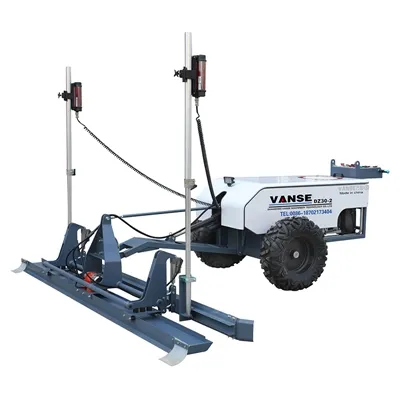
The Vanse Solution: This is where the Vanse YZ30-4E Telescopic Boomed Laser leveling is a game-changer. Unlike traditional "drive-in" leveling, the telescopic boom allows the leveling head to reach out 6 meters while the machine stays stationary. This minimizes the "footprint" on the compacted sub-base, ensuring that the laser-accurate strike-off is based on a stable reference point, not a moving one.
4. Surface Density & Long-term Flatness
If the sub-base isn't uniform, the concrete will cure at different rates, leading to "curling" at the joints-the #1 enemy of long-term flatness.
The Vanse Solution:
Use a Vanse Automatic Topping Spreader to apply hardener uniformly. This ensures the "skin" of the concrete is as tough as the base.
Follow up with a Vanse VS1046H Ride-on Power Trowel. The high-torque 35HP BRIGGS & STRATTON engine provides the force needed to "burnish" the floor. If your sub-base is solid, this troweling process creates a rock-hard, Superflat surface that won't shift over time.
Finally, protect those joints with a precision Vanse Concrete Cutting Machine (Floor Saw) to ensure stress is relieved exactly where it should be.
Summary: The ROI of Proper Sub-base Prep
| Factor | Poor Compaction Result | Vanse-Enabled Professional Result |
| FF/FL Scores | Fails due to micro-settlement. | Hits FM1/FM2 consistently. |
| Joint Health | Spalling and curling. | Clean, stable transitions with Floor Saws. |
| Labor Cost | High (due to rework/grinding). | Low (Get it right the first time). |
| Equipment Performance | Machines "sink" or vibrate poorly. | Maximum precision with Telescopic leveling. |
Final Word
You can’t cheat the physics of a Superflat floor. Hitting ±1mm over 3 meters requires a solid sub-base and the world's most precise machinery. By combining the placement agility of the Mini Dumper with the telescopic reach of the Vanse Laser leveling (www.vansemac.com), you ensure that your floor stays flat from the day of the pour until decades of forklift traffic later.
Don't build on a weak foundation. Explore the full Vanse fleet today and see how our technology supports your highest-spec projects.
Note: The parameters provided in this document are for reference only and are not mandatory. Due to differences in technical characteristics between different brands and models of laser levelers, please consult the manufacturer for a suitable solution before actual operation. This reference document assumes no responsibility for any issues arising from failure to follow the manufacturer's instructions.
Thanks to All the Friends Who Support and Trust Shandong Vanse Machinery Technology Co., Ltd.
If you want to know more about Shandong Vanse Machinery Technology Co., Ltd. or have any questions, please feel free to contact us:
Our Factory
Shandong Vanse Machinery Technology Co., Ltd.








Share this article

About the Author: Shandong Vanse Machinery Technology Co., Ltd.
Shandong Vanse Machinery Technology Co., Ltd. is a high-tech manufacturer specializing in concrete construction machinery, including laser screeds and related equipment. The company integrates R&D, production, and global sales, with products exported to over 60 countries and widely used in infrastructure projects worldwide.
Previous Post
Next Post
Related Articles
You Might Also Like
Three common misunderstandings about maintenance of concrete laser levelers. Have you fallen into any of these misunderstandings?
Concrete laser leveling machines can meet the construction requirements of large areas with high requirements for flatness and levelness. They play a very important role in the construction process. After the equipment is used, I believe everyone knows the maintenance of the leveling machine, but it is very likely that wrong operations will occur during the maintenance process, which will only have a counterproductive effect. In this article, our staff will explain the three major maintenance misunderstandings of concrete laser leveling machines. There are many fasteners of bolts and nuts in the concrete laser leveling machine. In order to make the connection reliable, it should be ensured that there is sufficient preload. However, it is not wrong to think that the tighter the bolts are tightened, the better. Blindly increasing the torque of the bolts will not only cause the fasteners to be permanently deformed by excessive external force, but also the screw will cause thread stripping or screw breakage due to excessive tension. The tire inflation pressure of the concrete laser leveling machine is the main factor that determines its service life and work quality. When the air pressure is too low, the deformation of the tire body increases, which will cause the internal stress to increase, and accelerate the aging of rubber and the fatigue of the cord; at the same time, the rolling resistance increases, so the tire shoulder wear is aggravated. However, when the inflation pressure is too high, the tire cord will produce a lot of tension, the resistance to impact will be weakened, and the rock edges will easily damage the tire; at the same time, the tire tread will be aggravated, causing the tire to slip, which will reduce the operating efficiency of the concrete laser leveler. The concrete laser leveler has many hydraulic components and requires sufficient hydraulic oil. Whenever the hydraulic oil deteriorates due to long-term use and needs to be replaced, there will always be people who mistakenly think that they only need to drain the oil in the hydraulic oil tank and fill it with new hydraulic oil. In fact, the correct oil change procedure should first drain the hydraulic oil in the hydraulic oil tank, then clean the tank and add new hydraulic oil; then remove the circuit main pipe, start the engine and run it at a low speed, which will cause the oil pump truck operator to operate manually. If each mechanism is operated separately, the old oil in the circuit will be discharged one by one by relying on hydraulic oil until new oil flows out of the return oil main pipe; then connect the return oil main pipe to the oil tank, and then add new hydraulic oil to the concrete laser leveler tank to the specified position. If you make the mistakes mentioned in the above article when maintaining the concrete laser leveler, we hope you can correct them in time and use the correct maintenance method to avoid machine failure due to improper maintenance. We will continue to organize and publish relevant information about the leveler, and you are welcome to follow our website.How to control the power trowel speed and pressure to prevent surface cracking on super flat floors?
Achieving a "super flat" (SF) floor is a high-stakes game of timing. If you're too aggressive early on, you'll create ripples; if you're too late, you'll be fighting "burnt" spots and a surface that won't close. To prevent surface cracking-specifically crazing (fine spiderweb cracks) or plastic shrinkage cracks-you need to manage the relationship between the machine's RPM and the pitch of the blades. The general rule for super flat floors is: Slow and steady wins. High speeds create centrifugal force that can pull moisture to the surface prematurely or "tear" the paste. Initial Passes: Keep the engine at a low-to-medium throttle. You want just enough speed to move the machine smoothly without "digging in." Finishing Passes: Increase speed gradually as the slab hardens. However, on SF floors, avoid "redlining" the engine, as excessive vibration can interfere with the floor's levelness ($F_{L}$) and flatness ($F_{F}$) numbers. Uniformity: Maintain a consistent walking or riding speed. Sudden accelerations create "waves" in the concrete paste that are nearly impossible to flatten out later. Blade pitch is your primary tool for controlling how much pressure is exerted on the slab. Stage Blade Pitch Objective Panning (Float) Flat (0°) Use float pans to break open the surface, bring up "cream," and knock down high spots. First Power Trowel Slight Tilt (1-2°) Close the pores without tearing the surface. Late Finishing High Pitch (Increasing) Increase pressure to "burnish" or densify the surface. Pro Tip: If you notice "chatter marks" (rhythmic ripples), your pitch is likely too steep for the current hardness of the slab. Flatten the blades immediately. Cracking on super flat floors often happens because the surface dries faster than the base. Avoid "Dusting": Never throw dry cement or "shake" on a floor that has already lost its bleed water. This is a recipe for delamination and crazing. Watch the Wind: If you are working in an open bay, use windbreaks. Rapid evaporation is the #1 cause of plastic shrinkage cracks. The "Touch" Test: Do not start troweling until you can step on the slab and leave a footprint no deeper than 1/8 to 1/4 inch. For a high FF rating, your movement pattern is just as vital as your speed: Overlap: Ensure a 50% overlap on every pass. Direction: Always change your direction by 90 degrees on subsequent passes to "cross-cut" any minor ridges created by the previous pass. The "Sweet Spot": If the concrete begins to turn dark (the "burn"), you have reached maximum density. Stop pitching the blades higher, or you risk brittle surface cracking. Would you like me to create a checklist for the curing process to ensure those super flat specs hold up after the troweling is done? Contact us NOW Note: The parameters provided in this document are for reference only and are not mandatory. Due to differences in technical characteristics between different brands and models of laser levelers, please consult the manufacturer for a suitable solution before actual operation. This reference document assumes no responsibility for any issues arising from failure to follow the manufacturer's instructions.How does a concrete laser leveling machine work?
The core operating principle of a concrete laser leveling machine is a closed-loop control system combining "laser positioning reference + real-time signal feedback + automatic mechanical execution" to achieve high-precision leveling and vibration of the concrete surface. Essentially, this system replaces the traditional manual "relative level determination" with the laser's "absolute level reference," eliminating human error and ensuring that the flatness and levelness of the finished surface meet high standards. Its workflow can be broken down into four core steps: reference establishment, signal detection, command calculation, and mechanical execution. The detailed principles are as follows: Before understanding the principles, it is necessary to first understand the core components of the device. All actions revolve around the coordination of these three systems: System Name Core Components Core Functions Laser Positioning System Laser Transmitter, Laser Receiver Establishes an "absolute level/slope baseline" and detects height deviations between the concrete surface and the baseline in real time. Electrical Control System Central Controller (PLC), Sensors Receives deviation signals from the receiver, calculates them, and sends action commands (raise/lower, accelerate/decelerate) to the actuators. Mechanical Actuation System Leveling Scraper, Vibrator, Travel Mechanism Executes controller commands: adjusts scraper height for leveling, vibrators for compacting concrete, and travel mechanisms for moving the equipment. The operation of a concrete laser leveling is a dynamic closed-loop process of **"real-time detection → instant adjustment → continuous leveling"**, which can be divided into four steps: This is the prerequisite for high-precision leveling, the purpose of which is to set a fixed, unchangeable reference datum for the leveling surface (replacing the traditional "level + ruler" artificial datum). Operation: Place the laser transmitter on a stable support at the construction site (away from sources of vibration and electromagnetic interference). Use a level to align the transmitter so that it emits a 360° circular laser beam (which can be set to a "level reference" or a "preset slope reference," such as a 2% drainage slope). Principle: Lasers have the physical properties of strong directionality, good monochromaticity, and stable propagation. They exhibit virtually no attenuation over short distances (typically within 100 meters), forming an "absolute level/slope" baseline that remains stable despite manual operation or equipment movement. Key: The laser transmitter must be independently powered and securely fixed to prevent vibration or impact that could cause the baseline to shift. Any shift will cause errors in all subsequent leveling operations. The laser receiver (usually installed on the leveling support or top of the machine) is responsible for capturing the laser reference line in real time, comparing the "concrete surface height" with the "reference line height" and detecting the deviation value. Detection Process: The receiver contains multiple built-in photosensors (or photoelectric sensors). When a laser beam strikes the receiver, the photosensors at different locations determine the current concrete surface height based on the "height at which they are illuminated." If the location of the receiver illuminated by the laser is above a preset reference (indicating a low concrete surface), a signal indicating "raise the scraper" is output; if the location is below the reference (indicating a high concrete surface), a signal indicating "lower the scraper" is output. Deviation signals are transmitted to the central controller in real time via wired or wireless means (such as Bluetooth or radio frequency), typically at a frequency of 10 to 50 times per second, ensuring that the controller is instantly aware of surface height changes. Additional Note: Some high-end equipment may be equipped with multiple receivers (such as one at the front and one at the rear) to simultaneously detect heights at different locations, preventing single-detection errors caused by equipment tilt. The central controller (with a programmable logic controller (PLC) at its core) is the "brain" of the equipment. It receives deviation signals from the receiver, performs rapid calculations based on preset parameters (such as leveling thickness and vibration frequency), and generates specific execution instructions. Operational Logic: If the deviation is small (e.g., ±1mm), the controller will only fine-tune the oil flow in the scraper lift cylinder to achieve slight scraper movement, avoiding over-adjustment and surface fluctuations. If the deviation is large (e.g., ±5mm), the controller will increase the hydraulic cylinder movement and may also adjust the travel mechanism speed (e.g., slowing down the travel mechanism to allow the scraper sufficient time to level). If a "loss of signal" is detected (e.g., the receiver temporarily leaves the laser beam), the controller will immediately pause scraper adjustment and issue an alarm to avoid unintended action. Key: The controller's response speed directly impacts accuracy-high-quality equipment typically has a command calculation and execution delay of less than 0.5 seconds, allowing it to keep up with changes in concrete surface height in real time. The controller's instructions are ultimately transmitted to the mechanical execution system, which adjusts the height of the leveling scraper and compacts the concrete with the vibrator, completing the dual functions of "leveling + compacting". This is also the core advantage of laser leveling machines compared to traditional manual leveling. Leveling Scraper Operation: The scraper is driven by a hydraulic cylinder, raising and lowering in real time according to controller commands. When the concrete surface is low, the cylinder raises the scraper to reduce the amount of concrete removed (or even allows the concrete to naturally accumulate to the reference height). When the surface is high, the cylinder lowers the scraper to remove excess concrete and push it to the lower area, ensuring the surface is flush with the laser reference line. Synchronous Vibrator Operation: Under the scraper are typically multiple sets of high-frequency vibrators (vibrating at a frequency of 3,000 to 5,000 times per minute). These vibrators are inserted into the concrete while leveling, removing air bubbles and compacting the aggregate. This prevents honeycombing and rough surfaces caused by uneven vibration with traditional manual vibrating, while also creating a denser concrete surface and higher strength later on. Travel Mechanism: The equipment moves slowly on wheels or tracks (the travel speed is adjustable, typically 0.5 to 2 m/min), allowing the scraper and vibrator to continuously cover the concrete surface, avoiding "joints." Some ride-on models can also operate autonomously, reducing operator error. Traditional manual leveling relies on a "level rod + ruler" method, requiring repeated measurement and leveling. This is not only inefficient but also prone to poor flatness due to human judgment errors (such as visual deviation and uneven force). The core logic of the laser leveling machine is: The laser's absolute horizontal reference replaces the manually set relative reference, eliminating reference errors. The "detect → calculate → execute" automated closed-loop system replaces the manual "read the ruler → adjust" process, eliminating operator errors. High-frequency vibration combined with continuous leveling replaces the manual "scraping + vibrating" process, ensuring both smoothness and density. Ultimately, the result is a concrete surface construction effect with "millimeter-level precision (usually up to ±2mm/2m), high efficiency (3 to 5 times that of manual labor), and high density." This is particularly suitable for large-scale, high-precision ground projects (such as factories, garages, airport runways, etc.). Click the below to jump immediately!!! ARMOUR JOINT view more CONCRETE LASER LEVELING MACHINE view more POWER TROWEL view more SLIPFORM MACHINE view more STEEL FIBER view more TOPPING SPREADER view more