Technical Knowledge
How long does a novice need training to operate a ride-on laser leveling independently?
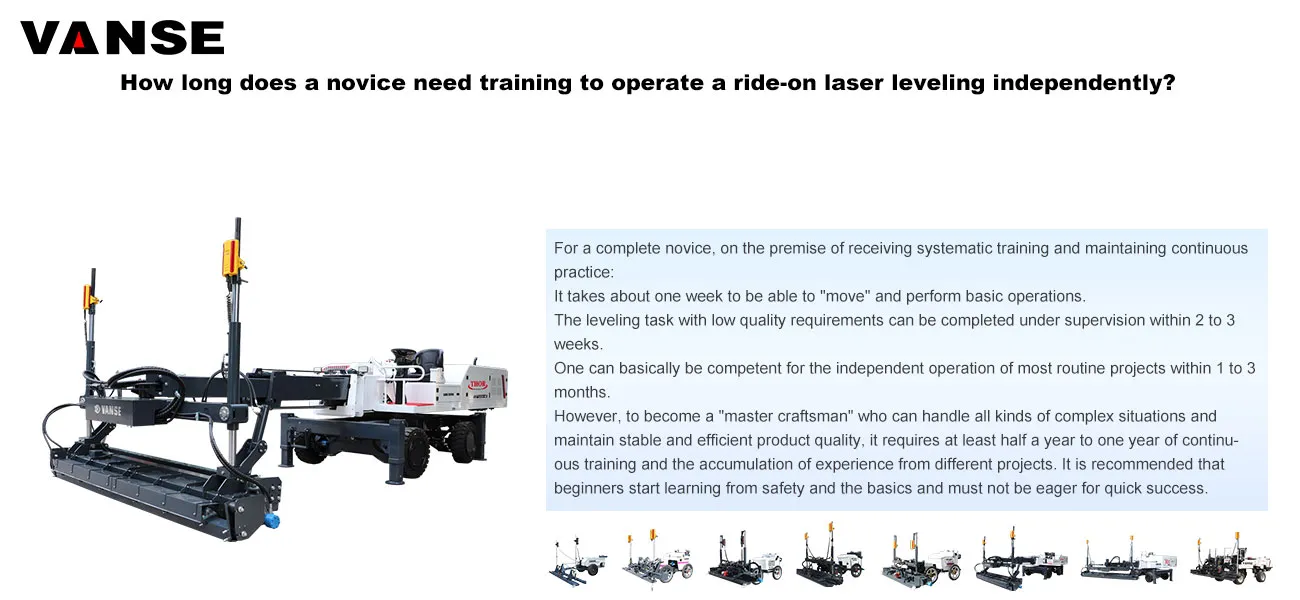
For novice operators of ride-on laser leveling machines, to reach the level of being able to independently and with high quality complete construction tasks, a systematic training process that combines theory with practice is required.
Generally, this cycle can be divided into the following stages:
Overview of the training period
Basic Introduction and Safe Operation (about 3-7 days)
Objective: Under the guidance of an experienced master, be able to perform simple equipment movement and basic leveling operations, and have a deep understanding of safety regulations.
Initial independent operation (about 1-3 weeks)
Objective: Be capable of independently completing the entire process from startup inspection to shutdown under supervision, and finish ground leveling with low quality requirements.
Proficiency and mastery (1 to 3 months or more)
Objective: Be capable of independently handling various complex construction conditions and concrete working conditions, achieve high-quality and efficient ground leveling, and be able to deal with some common equipment malfunctions.
Detailed explanations in stages
Phase One: Basic Introduction and Safety Education (approximately 3-7 days)
This stage is the core, determining the operator's future operation habits and safety awareness.
Theoretical training (1-2 days)
Safety knowledge: This is of Paramount importance. This includes the position of emergency stop buttons for equipment, dangerous areas of rotating parts, electrical safety (such as the use of laser emitters), fire safety, etc.
Equipment structure: Understand the names and functions of each component of the leveling machine (engine, hydraulic system, leveling head, laser receiver, control panel, etc.).
Principle of laser system: Understand how the laser transmitter establishes a horizontal plane, and how the receiver receives signals and controls the rise and fall of the flattening head. This is the "brain" of the laser leveling machine and must be understood.
Daily maintenance: Learn the key points of inspection before starting up, during operation and after shutdown, such as checking the oil, hydraulic oil and grease filling points, etc.
Simulation operation (2-5 days) :
It is carried out in non-construction areas (such as solid open ground).
Basic movement practice: starting, stopping, moving forward, moving backward, turning (especially turning in place and making large-radius turns).
Flat head control: Practice raising and lowering the flat head to feel its response speed.
Laser system practical operation: Set up the laser emitter and practice setting and calibrating the automatic leveling mode of the machine.
Phase Two: Initial Independent Operation (about 1-3 weeks)
Under the on-site supervision of the coach, they began to enter the actual construction site for operation.
Car Learning (Week 1)
Observe how the master craftsman starts the first cut, plans the walking path, and handles complex areas such as boundaries and column feet.
Do it yourself, but each step is confirmed by the coach. The key is to learn how to adjust the operation techniques and machine speed according to the dryness and wetness (initial setting state) of the concrete.
Operate independently under supervision (for the second to third weeks)
Independently completed the entire process from equipment inspection, laser setup to actual leveling, but the coach was present throughout.
Learning to judge the "heat" of concrete is a key experience to ensure the quality of leveling.
Start learning to handle some minor issues, such as laser signal loss and remedial measures when the ground is locally too high or too low.
Phase Three: Proficiency and Mastery (1 month to over 3 months)
Even if one can operate independently, to become an excellent operator still requires the accumulation of time and experience.
Experience accumulation: Having worked on various types of projects (factories, warehouses, shopping malls, etc.), dealing with different grades of concrete and different requirements for steel bar laying.
Efficiency improvement: Optimize walking paths, reduce repetitive leveling, and enhance work efficiency.
Fault prediction and handling: By listening to sounds, observing instruments, and sensing equipment vibrations, potential faults (such as abnormal hydraulic systems, weak engines, etc.) can be detected in advance.
Cooperate with the construction team: Skillfully collaborate with the concrete pouring team, formwork support workers, finishing workers, etc., and become an efficient part of the construction process.
The key factors influencing the training cycle
Training mode
Manufacturer's systematic training > guidance from experienced workers on construction sites > self-study and exploration. Receiving formal training from the manufacturer leads to the fastest growth and the most systematic knowledge.
Student foundation
People with experience in operating construction machinery such as excavators and loaders will get the hang of it much faster.
Training intensity
Continuous practice on construction sites is worlds apart from intermittent learning.
Equipment type
Operating a leveling with a "swing arm" function requires higher skills and a sense of space, and the learning time will be slightly longer.
Complexity of construction projects
The requirements for operators are completely different from those for projects that always involve simple large planes and those that need to handle a large number of corners, column bases, and slope changes.
Summary
For a complete novice, on the premise of receiving systematic training and maintaining continuous practice:
It takes about one week to be able to "move" and perform basic operations.
The leveling task with low quality requirements can be completed under supervision within 2 to 3 weeks.
One can basically be competent for the independent operation of most routine projects within 1 to 3 months.
However, to become a "master craftsman" who can handle all kinds of complex situations and maintain stable and efficient product quality, it requires at least half a year to one year of continuous training and the accumulation of experience from different projects. It is recommended that beginners start learning from safety and the basics and must not be eager for quick success.
Note: The parameters provided in this document are for reference only and are not mandatory. Due to differences in technical characteristics between different brands and models of laser levelers, please consult the manufacturer for a suitable solution before actual operation. This reference document assumes no responsibility for any issues arising from failure to follow the manufacturer's instructions.
Thanks to All the Friends Who Support and Trust Shandong Vanse Machinery Technology Co., Ltd.
If you want to know more about Shandong Vanse Machinery Technology Co., Ltd. or have any questions, please feel free to contact us:
Our Factory
Shandong Vanse Machinery Technology Co., Ltd.








Share this article

About the Author: Shandong Vanse Machinery Technology Co., Ltd.
Shandong Vanse Machinery Technology Co., Ltd. is a high-tech manufacturer specializing in concrete construction machinery, including laser screeds and related equipment. The company integrates R&D, production, and global sales, with products exported to over 60 countries and widely used in infrastructure projects worldwide.
Previous Post
Next Post
Related Articles
You Might Also Like
How to use concrete laser leveling machine
The concrete laser leveling machine is an indispensable and efficient equipment in modern building construction. It uses laser technology to ensure the flatness after concrete pouring, thereby greatly improving the quality and construction efficiency of the floor. This article will elaborate on the use of concrete laser leveling, including preliminary preparation, equipment debugging, operating procedures, common problems and solutions, etc., aiming to help operators better understand how to use the equipment and ensure construction quality. 1. Equipment inspection: Make sure that all components of the concrete laser leveling are intact and that the mechanical structure, electrical system, hydraulic system, etc. are in normal working condition. 2. Site preparation: Clean the construction site to ensure there is no debris or water accumulation, and the ground is solid and flat to provide a good environment for equipment operations. 3. Material preparation: Prepare the appropriate amount of concrete materials to ensure that the material quality meets the design requirements. 1. Laser emitter installation and debugging: Install the laser emitter at the designated location, and adjust its height and angle as needed to ensure that the laser beam can be accurately projected onto the concrete surface to be leveled. 2. Laser receiver installation and debugging: Install the laser receiver on the concrete laser leveler to ensure that the laser signal emitted by the laser transmitter can be accurately received. 3. Control system debugging: Check whether the various functions of the control system are normal, including the reception, processing, and output of laser signals, etc. 1. Start the equipment: Start the laser transmitter first, and then start the concrete laser leveling machine after the laser is stable. 2. Concrete pouring: According to the design requirements, pour the concrete evenly on the ground to be leveled. 3. Leveling operation: Operate the concrete laser leveling machine to follow the predetermined path. During the walking process, the equipment will automatically adjust the height and angle of the sharp plate according to the laser signal to achieve precise leveling of concrete. 4. Monitoring and adjustment: During the leveling process, the operator should monitor the leveling effect in real time and adjust the height and angle of the scraper according to the actual situation to ensure that the concrete surface is flat and smooth. 5. The job is completed: When all the leveling areas are completed, turn off the concrete laser leveling machine, clean the site, and do a good job in the care and maintenance of the equipment. 1. The laser signal is unstable: it may be that the laser transmitter or receiver is interfered with or damaged. Check whether there are any obstructions or sources of interference in the environment around the equipment. If necessary, adjust the location of the equipment or replace damaged parts. 2. Poor leveling effect: It may be that the height or angle of the scraper is improperly set, or the quality of the concrete material does not meet the requirements. The height and angle settings of the scraper should be checked and adjusted according to the actual situation; at the same time, ensure that the quality of the concrete materials used meets the design requirements. 3. Equipment failure: If you encounter equipment failure, you should stop working immediately and turn off the power of the equipment. Then check the faulty part and take corresponding maintenance measures according to the fault situation. If parts need to be replaced, original parts should be used to ensure stable and reliable performance of the equipment. 1. Operators should receive professional training and be familiar with equipment operating procedures and safety knowledge to ensure that they can use the concrete laser leveling correctly and safely. 2. During the operation of the equipment, it is strictly prohibited to put your hands or other parts of the body into the inside of the equipment or under the scraper to avoid accidental injury. 3. When the equipment is in operation, the site should be kept clean and tidy to prevent debris or personnel from entering the working area to avoid damage to the equipment or personnel. 4. During the operation, if any equipment abnormalities or safety hazards are discovered, the operation should be stopped immediately and reported to relevant personnel for processing in a timely manner. 1. Regularly inspect and maintain the concrete laser leveling, including cleaning the surface of the equipment, checking the tightening of mechanical parts, adding lubricating oil, etc., to ensure that the equipment is in good working condition. 2. Key components such as laser transmitters and receivers should be calibrated and debugged regularly to ensure their accuracy and stability. 3. When the equipment is not used for a long time or encounters bad weather, corresponding protective measures should be taken, such as covering the equipment, turning off the power, etc., to prevent the equipment from being damaged or corroded. As an efficient and accurate floor construction equipment, concrete laser leveling machine plays an increasingly important role in modern building construction. Through the introduction of this article, I believe that the operators have a deeper understanding of the use of concrete laser leveling machines. During the actual operation, the operators should strictly follow the machine operation steps and pay attention to the construction effects and adjustments. Equipment parameters to ensure stable and reliable construction quality. At the same time, the safety management and maintenance of equipment should also be strengthened to ensure long-term stable operation of the equipment and provide a strong guarantee for construction construction. Note: The parameters provided in this document are for reference only and are not mandatory. Due to differences in technical characteristics between different brands and models of laser levelers, please consult the manufacturer for a suitable solution before actual operation. This reference document assumes no responsibility for any issues arising from failure to follow the manufacturer's instructions.How should the bearings of the power trowel be checked during operation?
– Normal sound characteristics: When the concrete trowel is running, the normal sound of the bearing is a smooth and slight "buzzing" sound. This sound should be continuous and uniform, without sharp noises, knocks or irregular changes. For example, when the trowel is running at normal speed on a flat concrete surface, the sound of the bearing should be clearly distinguishable above the background noise, but not too harsh. – Abnormal sound judgment: If you hear a "squeaking", "clicking" or sharp "hissing" sound from the bearing, it usually means that there is a problem with the bearing. The "squeaking" sound may be caused by the wear of the balls or raceways inside the bearing, resulting in an uneven surface, friction and collision during operation; the "clicking" sound may be caused by foreign matter entering the bearing, hindering the normal rolling of the balls; the sharp "hissing" sound may be caused by poor bearing lubrication and increased friction between the balls and raceways. – Normal temperature range: After the trowel has been running normally for a period of time (for example, 30-60 minutes of continuous operation), touch the area near the bearing seat with your hand (be careful to avoid touching moving parts), and it should feel warm but not hot. Generally speaking, the normal operating temperature of the bearing is usually around 40℃-70℃, and the specific temperature may vary slightly depending on factors such as the bearing specifications, load and operating environment. – Abnormal temperature: If the bearing seat feels very hot when touched, which is significantly higher than the normal temperature range, this may be a sign of bearing failure. Excessive temperature may be due to excessive friction inside the bearing, caused by insufficient lubrication, too tight bearing assembly or excessive load. For example, when the trowel blade of the trowel machine is subject to greater resistance (such as uneven concrete surface or hard lumps), the load on the bearing increases. If the lubrication is poor at this time, it is easy to cause the bearing temperature to rise sharply. – Normal vibration level: When the trowel machine is running, the normal vibration of the bearing is very small and almost imperceptible. You can gently place your hand on the body of the trowel (near the bearing) to feel the vibration. Under normal circumstances, only slight and uniform vibrations will be felt, which are normal vibrations caused by the operation of the trowel itself and the contact with the ground. – Abnormal vibration judgment: If you feel obvious and irregular vibrations, especially sudden changes in vibration frequency and amplitude, this may be a sign of bearing damage. For example, when the ball of the bearing is damaged or the outer ring of the bearing is cracked, it will cause the rotating parts to lose balance, causing the trowel to vibrate more. This vibration will not only affect the troweling effect, but may also further damage other parts. – Observe the grease status: When checking the bearing, pay attention to the grease of the bearing. Under normal circumstances, the grease should be evenly distributed inside and around the bearing, and the color and texture remain relatively stable. If the grease is found to be black, dry, or there are obvious impurities mixed in, this may affect the lubrication effect of the bearing. For example, when the grease turns black, it may be because the wear particles generated during the operation of the bearing are mixed in, resulting in a decrease in lubrication performance. – Grease leak check: Also check for grease leaks. If you see grease seeping around the bearing seat, this could be due to a damaged seal or too much grease. Grease leaks are not only wasteful, but can also contaminate the concrete surface and cause the bearing to fail due to insufficient lubrication.Adjustment Strategies for Concrete Laser leveling Machines Under Different Concrete Slumps
The performance of a concrete laser leveling machine is highly dependent on the slump of the concrete. Slump not only reflects the flowability of the concrete but also directly affects the resistance of the leveling head and the density of the finished product. For concrete with different slumps, operators need to adjust the vibration frequency, paving height, machine travel speed, and the downward pressure of the auger to ensure the quality of the flooring. This mix is typically used for heavy-duty industrial floors or areas requiring high strength. The concrete is relatively "dry" and has poor flowability. Vibration frequency: Requires adjustment to a higher frequency (usually increasing by 10%–20%). Dry, stiff concrete requires stronger vibration to remove air bubbles and allow the slurry to float. Travel speed: Slow. A slow travel speed allows sufficient compaction time for the leveling head, preventing surface "tearing" or honeycomb pitting caused by excessively rapid movement. Auger adjustment: Increase downforce to allow the auger to cut deeper into the concrete, ensuring large aggregate particles are effectively leveled. Plow height: Slightly lower the slow height. Because dry concrete has less rebound after leveling, the initial leveling needs to be closer to the design elevation. This is the ideal working range for laser leveling, balancing pumpability and structural stability. Vibration Frequency: Maintain a medium standard frequency. Travel Speed: Medium speed. Observe the slurry thickness behind the leveling head to ensure a uniform "skin" (slurry layer) on the surface. Overlap: Maintain a standard 200mm–300mm overlap to eliminate seam marks between adjacent passes. Common in projects using high-efficiency water-reducing agents or with high pumping heights. The concrete is extremely fluid and may even exhibit segregation. Vibration Frequency: Adjust to a low frequency or reduce it appropriately. Excessive vibration can cause mortar and aggregate separation (segregation), resulting in a large amount of laitance and potential sandiness on the surface. Travel Speed: Can be appropriately increased. Prevent the machine from remaining stationary in one spot for extended periods, which could lead to excessive subsidence in that area. Auger Adjustment: Reduce the auger pressure or raise its position. High slump concrete is very mobile; the auger only needs to guide the flow slightly. Excessive agitation will disrupt the levelness. Scraper Height: Set the scraper height slightly above the design elevation (approximately 3mm–5mm) to compensate for the slight settling of the high-flowability concrete after compaction. Adjustment items Low slump (dry) High slump (thin) Vibration frequency ↑ High frequency (strong vibration compaction) ↓ Low frequency (prevents segregation) Travel speed ↓ Slow speed (fine grinding) ↑ Relatively fast speed (uniform spreading) Auger depth Deeper (forced material discharge) Relatively shallow (slight guidance) Elevation allowance Less (low rebound) More (significant settlement) Risk points Surface cracking, poor flatness Excessive slurry thickness, later peeling, slope loss On construction sites, the slump of concrete often fluctuates as the mixer trucks arrive. A skilled observer will closely follow the machine, monitoring the cream thickness behind the leveling head. If the cream thickness exceeds 5mm, the concrete is too thin; the speed should be increased or the vibration reduced. If the surface is dry and the aggregate is exposed, it is too dry; the walking speed should be immediately reduced and the vibration increased. Note: The parameters provided in this document are for reference only and are not mandatory. Due to differences in technical characteristics between different brands and models of laser levelers, please consult the manufacturer for a suitable solution before actual operation. This reference document assumes no responsibility for any issues arising from failure to follow the manufacturer's instructions.