Technical Knowledge
Technical guarantee measures for safe production of concrete projects

Technical guarantee measures for safe production in concrete engineering
I. General Provisions
Technical objective: Through standardized technical management, precise process control, and scientific risk prediction, quality and safety hazards such as collapse, cracking, and leakage in concrete projects are eliminated from the technical level, ensuring the safety of personnel, equipment, and structures during the construction process, and guaranteeing that concrete projects comply with the "Code for Acceptance of Construction Quality of Concrete Structures" (GB50204) and relevant safety production regulations.
Scope of application: This measure is applicable to the entire life cycle of concrete engineering, including all links such as the selection of concrete raw materials, mix proportion design, mixing and transportation, pouring and vibration, curing and formwork removal, covering various concrete structure projects such as housing construction, municipal works, Bridges and tunnels.
Ⅱ. Pre-emptive technical support measures
(1) Technical control of raw materials
Raw material selection and inspection:
Strictly screen raw materials such as cement, sand and gravel, admixtures, and admixtures. Select cement products that meet the design strength grade (such as P.O42.5 and above), and the sand and gravel gradation should comply with the specification requirements (the particle size of the gravel is determined based on the structural dimensions, with the maximum particle size not exceeding 1/4 of the minimum cross-sectional size of the component). After each batch of raw materials arrives at the site, a third-party testing institution is entrusted to conduct performance tests (such as cement strength and stability, mud content and crushing value of sand and gravel, water reduction rate and setting time of admixtures). Only after passing the tests can they be used.
Technical requirements for raw material storage:
Cement should be stored in a closed warehouse, stacked in zones according to the batches entering the site, and kept at least 30cm above the ground to prevent moisture and caking. The sand and gravel yard is hardened and treated, with rain shelters set up. Sand and gravel of different specifications are stored separately to avoid mixing. Admixtures are stored in dedicated tanks and labeled to prevent confusion with other materials.
(2) Mix proportion design and optimization
Customized mix ratio:
According to the type of engineering structure (such as beams, slabs, columns, foundations), strength grade (such as C30, C40), construction environment (temperature, humidity) and construction technology (pumping, self-compaction), entrust a qualified laboratory to design a special mix ratio. Clarify key parameters such as water-binder ratio, sand ratio, and admixture dosage (for example, the slump of pumped concrete should be controlled at 120-160mm, and the spread of self-compacting concrete should be ≥550mm).
Mix proportion optimization technology:
By adding admixtures such as fly ash and mineral powder, the amount of cement is reduced, the heat of hydration is lowered, and temperature cracks in mass concrete are avoided. For winter construction, early-strength admixtures should be added to the mix proportion to ensure the early strength growth of concrete. During summer construction, adjust the dosage of retarder, extend the initial setting time, and prevent the initial setting of concrete during transportation.
(3) Technical argumentation of special construction plans
Plan formulation and review:
Prepare a special construction plan for concrete projects, clearly defining the construction process, technical parameters (such as the thickness of each pouring layer, vibration time, and curing period), and quality and safety control points. For special projects such as large-volume concrete (pouring volume ≥1000m³ or thickness ≥1m), ultra-high pumping concrete (pumping height ≥100m), and special-shaped structure concrete, experts are organized to conduct technical arguments on the plans, with a focus on reviewing temperature control, support systems, and distribution methods, etc., to ensure the scientific and feasible nature of the plans.
Technical briefing and Training:
After the plan is approved, a comprehensive technical briefing will be conducted for technical personnel and construction teams, detailing the mix ratio requirements, pouring sequence, vibration key points, and emergency response measures. Organize technical training for operators, conduct practical exercises on key procedures such as the use of vibrators and the connection of pumps and pipes, and only allow them to take up their posts after passing the assessment.
Ⅲ. Technical Control Measures during the process
(1) Technical control of mixing and transportation
Technical supervision of the mixing process:
The mixing plant adopts a fully automatic metering system to ensure that the metering deviation of raw materials complies with the specification requirements (the metering deviation of cement and admixtures is ≤±1%, and that of sand and gravel is ≤±2%). The mixing time should be strictly controlled (for ordinary concrete, the mixing time should be ≥90 seconds; for concrete with admixtures or admixtures, it should be ≥120 seconds). During the mixing process, technicians should be arranged to inspect and observe the workability of the concrete (such as slump, cohesion, and water retention). If problems such as segregation and bleeding occur, the mix proportion should be adjusted immediately or the mixing should be stopped.
Technical support during transportation:
Special tank trucks are used for concrete transportation. The inner walls of the tank trucks are thoroughly cleaned to prevent residual concrete from affecting the quality of fresh concrete. The transportation route should be planned in advance to avoid congested sections and ensure that the transportation time is ≤ the initial setting time of the concrete (≤2 hours at normal temperature and ≤1.5 hours at high temperature). During transportation, the tanker should maintain a low rotational speed (2-4r/min) to prevent concrete segregation. After the concrete arrives, technicians will test the slump on site. If the deviation exceeds ±20mm, the laboratory will issue an adjustment plan. It is strictly prohibited to add water at will.
(2) Control of pouring and vibration techniques
Pouring sequence technical optimization:
Follow the principle of "layered pouring, symmetrical advancement, and continuous operation". The concrete pouring of beams and slabs should be advanced from one end to the other, while the concrete pouring of columns and walls should be done layer by layer, with each layer thickness ≤500mm (when using insert-type vibrators), to avoid local accumulation causing overloading of formwork supports. The "inclined plane layering" pouring method is adopted for mass concrete, with a layering thickness of 300-500mm. The pouring speed is controlled (generally ≤2m/h) to reduce internal temperature stress.
Vibration Technical:
Specification The type of vibrator should be selected based on the slump of the concrete (high-frequency vibrators should be used for a smaller slump, and medium-frequency vibrators for a larger slump). When using an insertable vibrator for vibration, the spacing between the vibration rods should be no more than 400mm, and the insertion depth should be 50-100mm to the lower layer of concrete. The vibration time should be controlled at 15-30 seconds (until the concrete surface shows slurry and no air bubbles escape). Over-vibration (to prevent aggregate segregation) or missed vibration (to avoid honeycomb and pitted surfaces) is strictly prohibited. During the vibration process, avoid the vibration rod touching the steel bars, formwork and embedded parts to prevent structural deformation or displacement of embedded parts.
(3) Temperature and humidity control technology
Temperature control for bulk concrete:
The "internal reduction and external protection" technical measure is adopted. Temperature measurement tubes are pre-embedded inside (with one temperature measurement point set every 50-100 square meters) to monitor the internal and surface temperatures of the concrete in real time, with the temperature difference controlled at ≤25℃. Circulating cooling water can be introduced inside to lower the core temperature. The surface is covered with thermal insulation cotton and plastic film to reduce heat loss and prevent temperature cracks. When the temperature difference exceeds the limit, add insulation layers or adjust the flow rate of cooling water.
Conventional concrete moisture control:
Within 12 hours after the concrete pouring is completed, cover it with moisture-retaining materials (such as gunny bags, geotextiles). During the hot summer, water it in time for maintenance to keep the surface moist. During winter construction, methods such as covering with electric blankets and steam curing should be adopted to ensure that the curing temperature is ≥5℃. The curing time should be carried out in accordance with the specifications (≥7 days for ordinary concrete, ≥14 days for concrete with retarding admixtures or with impermeability requirements) to prevent shrinkage cracks caused by rapid water loss in the concrete.
Ⅳ. Post-event Technical Support Measures
(1) Formwork removal technology control
The determination of formwork removal time:
The formwork removal time is determined based on the strength of the concrete test blocks under the same curing conditions. For bending members such as beams and slabs, formwork removal can only be carried out when the strength of the test blocks reaches 75% (for spans ≤8m) or 100% (for spans > 8m) of the designed strength. For vertical components such as columns and walls, the side formwork can be removed when the strength of the test block is ≥1.2MPa. Before formwork removal, technicians should issue a formwork removal application, which can be implemented after approval by the supervision unit. It is strictly prohibited to remove formwork in advance, which may cause structural cracking or collapse.
Technical Specifications for formwork removal operations:
Formwork removal follows the principle of "install first and then remove, install later and then remove first, from top to bottom". Rough formwork removal is strictly prohibited. When removing large formwork, a crane should be used for hoisting, and a dedicated person should be assigned for command. No one is allowed to stand under the formwork. After formwork removal, promptly clean up the residual concrete on the surface of the formwork, check the flatness and deformation of the formwork, and repair the damaged parts before putting it back into use.
(2) Quality Inspection and Defect Handling
Structural entity inspection: 28 days after the concrete pouring is completed, a third-party inspection agency is entrusted to conduct structural entity inspection, including concrete strength rebound, steel bar cover thickness inspection, structural dimensional deviation inspection, etc. Conduct core drilling and sampling tests on large-volume concrete and important components (such as frame columns and main beams of Bridges) to ensure that the concrete strength meets the design requirements. For the parts that fail the inspection, a special treatment plan shall be formulated and implemented after being approved by the design unit (such as reinforcement by high-pressure grouting, external concrete coating, etc.).
Defect repair technology: For defects such as honeycomb, pitted surface and exposed bars on the concrete surface, the "surface treatment method" is adopted for repair: Clean the loose concrete at the defect area, rinse it clean with a high-pressure water gun, apply an interface agent, and then repair it with fine aggregate concrete or mortar in the same proportion as the original concrete. After repair, cover and maintain it. For crack defects, the repair method should be selected based on the crack width (surface sealing method for width ≤0.2mm, pressure grouting method for width > 0.2mm). During the repair process, technical records should be kept well to ensure the repair quality.
(3) Management of Technical archives
Establish technical archives for concrete engineering, collect and organize raw material inspection reports, mix proportion notices, construction logs, temperature measurement records, curing records, formwork removal applications, physical inspection reports and other materials to ensure that the materials are complete, accurate and traceable. Technical archives are filed and preserved in accordance with the prescribed requirements, serving as an important basis for project acceptance and later maintenance.
Regularly review and analyze the technical data of concrete engineering, summarize the technical problems during the construction process (such as the optimization effect of mix proportion and the accuracy of temperature control), form a technical summary report, provide technical references for subsequent similar projects, and continuously improve the safety production technology level of concrete engineering.
Ⅴ. Emergency Technical Response Measures
Emergency technology for concrete supply interruption:
If the supply of concrete is interrupted due to a malfunction of the mixing plant or traffic congestion, immediately stop pouring, vibrate and compact the surface of the already poured concrete, and cover it with moisture-retaining materials. When the interval time exceeds the initial setting time of the concrete, handle it according to the requirements of the construction joint (set up a vertical construction joint, clean the surface floating slurry and loose aggregates, and apply an interface agent). After the concrete supply is restored, re-pour to ensure that the construction joint is tightly combined.
Emergency techniques for structural cracks:
If early cracks are found on the concrete surface during the pouring process, stop pouring immediately, check the width and depth of the cracks. If they are surface dry shrinkage cracks, cover them with water in time and strengthen moisture retention and maintenance. If it is a temperature crack, add an insulation layer and adjust the temperature control measures. If the cracks continue to develop, immediately organize the evacuation of personnel, entrust the design unit to formulate a reinforcement plan, and adopt technical measures such as temporary supports and grouting sealing to prevent the cracks from expanding and causing structural safety accidents.
Instructions for Use: This plan is a general template. Before the specific implementation of each project, it should be refined and supplemented according to the characteristics of the project (such as super-high, super-heavy, large-span structures, etc.), especially the control measures for major hazard sources.
Thanks to All the Friends Who Support and Trust Shandong Vanse Machinery Technology Co., Ltd.
If you want to know more about Shandong Vanse Machinery Technology Co., Ltd. or have any questions, please feel free to contact us:
Our Factory
Shandong Vanse Machinery Technology Co., Ltd.








Share this article

About the Author: Shandong Vanse Machinery Technology Co., Ltd.
Shandong Vanse Machinery Technology Co., Ltd. is a high-tech manufacturer specializing in concrete construction machinery, including laser screeds and related equipment. The company integrates R&D, production, and global sales, with products exported to over 60 countries and widely used in infrastructure projects worldwide.
Previous Post
Next Post
Related Articles
You Might Also Like
What is the principle of infrared laser concrete leveling machine?
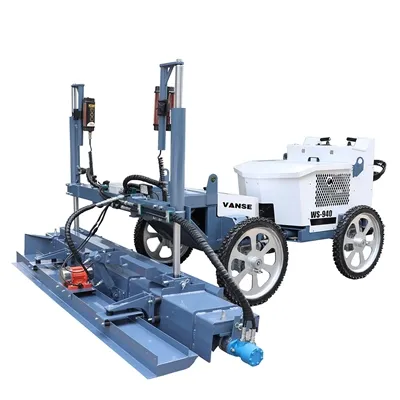
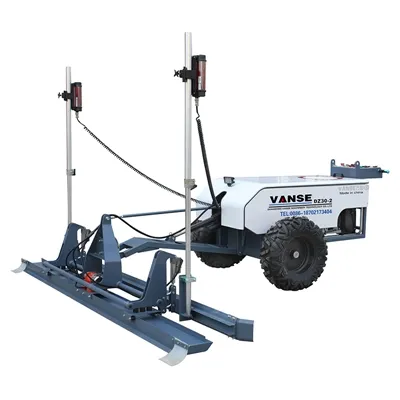
The principle of the infrared laser concrete leveler is mainly a special floor equipment that uses laser guidance to pave, level and vibrate concrete. Here's how it works: Set the laser transmitter to the required height, then place the handheld receiver pole on the elevation reference, adjust the height of the pole according to the laser emitted by the transmitter, and lock the corresponding height. Transfer height measurements from the handheld receiver pole directly to the laser leveling handpiece laser receiver pole. It relies on a hydraulic (electric) driven leveling head, working with the laser system and computer control system to complete the leveling work while automatically leveling. The leveling head is equipped with an integrated scraper, vibrator and leveling plate, which integrates all leveling, leveling, vibrating, compacting and paddle lifting work into one and completes it at one time. The computer control system automatically adjusts the height 10 times per second in real time, and the balanced designed vibrator has a vibration frequency of 4,000 times per minute. Infrared laser concrete leveling machine can greatly reduce unnecessary construction joints, speed up construction, save labor, and improve construction quality.How to ensure the construction effect and ground flatness of concrete laser leveling machine?
Ensuring the construction effect of the concrete laser leveling machine and the smoothness of the ground are key. Here are some suggestions and measures: 1. Choose the right equipment: Choose a concrete laser leveler with advanced technology and good reputation, which can better cope with various construction conditions and ensure smoothness. 2. Operator training: Provide professional training to operators to ensure that they are familiar with the performance, operating skills and safety procedures of the equipment. Trained operators can control equipment more accurately, improving construction results and smoothness. 3. Preparation work before construction: Before construction, the ground should be cleaned and leveled, foreign objects should be removed, potholes should be filled, and the ground should be smooth. In addition, checking the mix proportion and quality of concrete materials is also key to ensure that the performance of the concrete meets the construction requirements. 4. Adjust equipment parameters: According to construction conditions and requirements, reasonably adjust various parameters of the concrete laser leveling, such as working height, vibration frequency, paving speed, etc. Appropriate parameter settings can better control the paving and leveling of concrete, thereby improving smoothness. 5. Real-time monitoring and control: Use advanced sensors and control systems to monitor the flatness and height of the ground in real time, and adjust the equipment automatically or manually to ensure that the laying of concrete meets the design requirements. Real-time data feedback and analysis can help operators find and solve flatness problems in time. 6. Repeated leveling: For some special or demanding floors, repeated leveling can be carried out multiple times to further improve the flatness of the ground. After each leveling, quality inspection should be carried out and parts that do not meet the requirements should be re-leveled. 7. Strengthen quality control and acceptance: During the construction process, quality inspections should be carried out regularly, including the density, thickness and flatness of the concrete. After the construction is completed, strict acceptance procedures are carried out to ensure that the design requirements and flatness standards are met. If necessary, a third party can be entrusted to conduct quality testing and evaluation. 8. Maintenance and maintenance: Carry out regular maintenance and upkeep on the concrete laser leveling to ensure the normal operation and use of the equipment. Timely replacement of worn parts, inspection of key parts, and lubrication of key parts can extend the service life of equipment and improve construction results. 9. Technological innovation and application: Pay attention to industry trends and technological innovation results, and continuously introduce advanced processes and technologies. New concrete laser leveling machines and technologies can better improve construction efficiency and smoothness. 10. Experience summary and feedback: During the actual construction process, experience and lessons are constantly summarized and feedback is given to relevant departments or teams in a timely manner. Through experience sharing and improvement measures, we will continue to optimize construction processes and methods to improve flatness and construction effects. To sum up, ensuring the construction effect and ground flatness of the concrete laser leveling requires comprehensive consideration of many aspects. From equipment selection, personnel training to pre-construction preparation, real-time monitoring and control of parameter adjustment, quality control and acceptance, management needs to be strengthened. At the same time, measures such as technological innovation and application, experience summary and feedback are constantly optimized and improved to improve construction effects and flatness. Through these comprehensive measures, the construction quality and efficiency of concrete laser levelings can be effectively improved.Optimization of the collaborative workflow between power trowel and concrete laser leveling machine
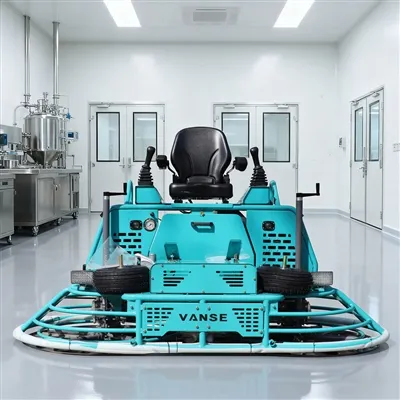
The collaborative operation of laser Leveling and power trowels is key to achieving "ultra-flat surfaces." The laser Leveling is responsible for initial geometric accuracy (elevation and overall flatness), while the power trowel is responsible for subsequent physical compaction and surface finish. To optimize the collaborative workflow, the following four key stages can be addressed: Manual Pre-partitioning: Before the laser Leveling arrives, workers should pre-spread the concrete according to the elevation points. The material pile height should be slightly higher than the design elevation by 1-2cm to ensure the Leveling head has sufficient material for cutting and to avoid depressions caused by insufficient material. One-Way Operation Path: The laser Leveling should operate in a one-way backward motion. Real-Time Elevation Verification: The construction worker must use a handheld laser receiver to closely follow the Leveling head and conduct real-time inspections of edges, column bases, and other blind spots, and manually replenish material to ensure that the reference surface deviation is controlled within ±3mm before the power trowel enters the site. Moisture Management: After laser Leveling, a layer of slurry (bleeding water) will appear on the concrete surface. Direct operation is strictly prohibited at this time. Collaborative Observation: The laser Leveling operator should maintain communication with the power trowel operator. When the concrete hardens to the point where "a person's footprint is approximately 3-5mm deep," the power trowel must immediately begin operation. Optimization Suggestion: In summer or dry environments, a "production line" operation can be implemented in sections-after the laser Leveling completes 10-15 meters, the first rotary power trowel can be ready to be positioned at the rear. Float Pans First: The slurry machine must be equipped with float pans during this stage. The vibration and pressure of the float pans further eliminate the minute machine head marks left by the laser Leveling. Cross-cut Coverage: The slurry machine path should be perpendicular to (or intersect at 45°) the direction of travel of the laser Leveling. Overlap Requirement: Each slurry path should overlap by 50%, using high-frequency float pan smoothing to eliminate short peaks in large-area smoothness (FF). Angle and Speed Optimization: As the concrete hardens, the disc is removed, and blade trowels are used. By adjusting the blade angle (from flat to steep) and increasing the speed, the "smoothness" achieved after laser Leveling is converted into "density." Edge Closure: For construction joints and wall edges that are difficult for laser Leveling to handle, the power trowel unit needs to be used in conjunction with a hand trowel for final finishing. Stages Core Equipment Optimization Objectives: Key Parameters/Actions: Spreading Laser Leveling Overall Elevation $FL$ Pre-lay 1-2cm of extra height to ensure cutting pressure. Initial application Ride-on Power Trowel (with mounting plate) Smoothness $FF$ Operate in a cross pattern, overlapping 50%. Middle application Power Trowel (blades) Eliminate Sand Holes and Air Pit Maintain a small to medium angle and move at a constant speed. Final finishing High-Speed Power Trowel Surface Hardening and Gloss Increase the blade angle to perform "polishing". Regarding the collaborative work you mentioned, what is the current construction area? If it is a large venue with a daily construction volume of over 1000 square meters, I would suggest that you introduce a "ride-on double-disc power trowel" to match the high efficiency of the laser leveling machine, and provide you with an equipment matching plan. Note: The parameters provided in this document are for reference only and are not mandatory. Due to differences in technical characteristics between different brands and models of laser levelers, please consult the manufacturer for a suitable solution before actual operation. This reference document assumes no responsibility for any issues arising from failure to follow the manufacturer's instructions.