Technical Knowledge
Safety & environmental protection measures for fine stone concrete floor construction
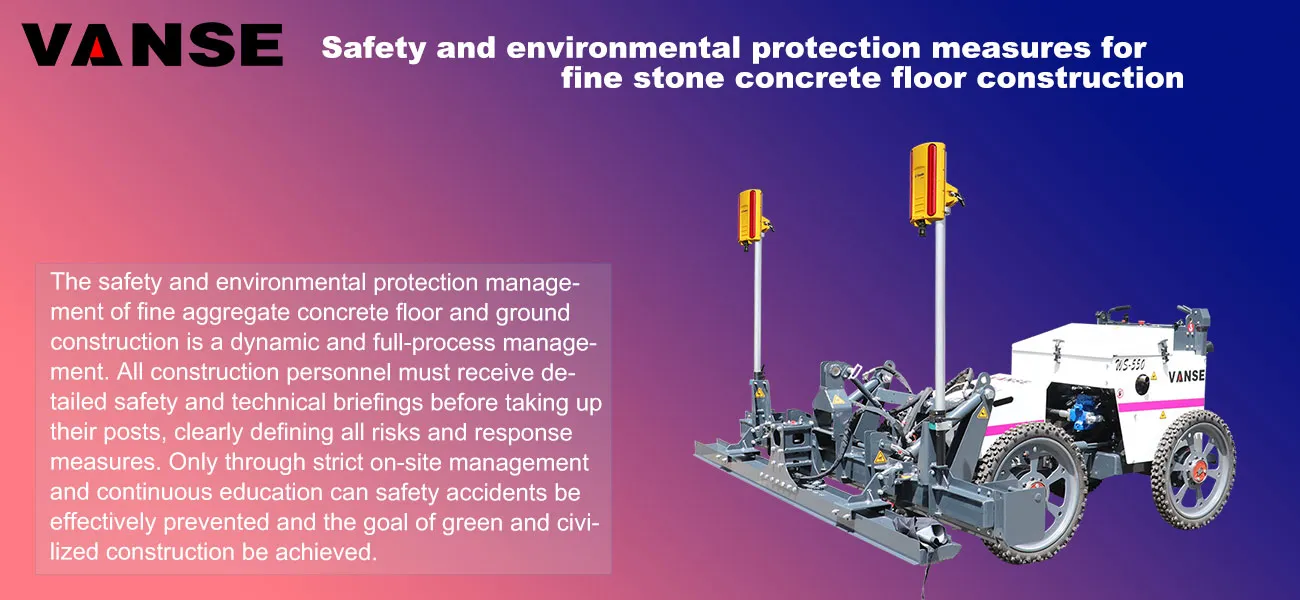
Construction of fine aggregate concrete floor: Safety protection and environmental protection measures
To ensure the smooth progress of the fine aggregate concrete floor construction process, safeguard the safety and health of the workers, and minimize the negative impact on the environment, the following measures are specially formulated.
I. Safety Protection Measures
Safe construction should follow the principle of "safety first, prevention foremost, and comprehensive governance".
1. Personal safety protection
Head protection:
All personnel entering the construction site must wear qualified safety helmets correctly.
Foot protection:
Construction workers should wear safety shoes that are resistant to impact, puncture and slip. Concrete operators are advised to wear rubber boots to prevent cement slurry corrosion.
Respiratory protection:
When handling, mixing and dry spreading cement and sand and gravel, especially in poorly ventilated environments, dust masks must be worn to prevent inhalation of cement dust.
Hand protection:
Operators should wear rubber or plastic gloves to prevent skin burns from cement and alkaline substances.
Eye protection
: When mixing, pumping or using power tools for cutting and grinding, protective glasses should be worn to prevent concrete slurry or debris from splashing into the eyes.
High-altitude work protection:
When working near edges or openings, safety belts must be fastened.
2. Safety of construction machinery
Mixer safety
Before use, check the electrical circuits, insulation conditions and whether the protective covers are in good condition.
When in operation, it is strictly forbidden to insert hands or tools into the mixing drum.
When cleaning or conducting maintenance, the power supply must be cut off, and a dedicated person should be assigned for supervision. A warning sign reading "Do Not Close the Switch" should be hung.
Safety of trowels and grinders
Before operation, check whether the cable, switch, blade/grinding disc are in good condition and securely fastened.
Operators need to be familiar with the equipment operation procedures, hold the control lever tightly with both hands to prevent the machine from getting out of control.
The cable should be suspended to prevent it from being caught or dragged by the machine.
Safety of pumping equipment
The support of the pump pipe must be firm, especially at the elbows and joints.
When pumping, it is strictly prohibited for anyone to stand at the outlet of the pump pipe. When cleaning the pipeline, there must be no personnel in front of the outlet.
Electrical safety
All electric tools must be powered by a power supply equipped with a leakage protection device.
Cables must not be dragged on the ground, rolled over or immersed in water. They should be installed overhead or buried underground.
Non-professional electricians are strictly prohibited from privately connecting wires or repairing electrical equipment.
3. On-site construction safety
Openings and edge protection:
The reserved openings on the floor, staircase entrances, and elevator shaft openings must be covered with solid covers or guardrails, and safety warning signs must be hung.
Material stacking safety:
Materials such as cement and sand and gravel should be stacked neatly, and the height should not be too high to prevent collapse. The stacking area should be kept away from slopes and pits.
Safety of cross-operation:
Arrange the construction sequence reasonably and reduce vertical cross-operation. When it is unavoidable, a safety isolation layer should be set up, and a dedicated person should be assigned to direct and communicate between the upper and lower floors.
Fire prevention measures:
Smoking is strictly prohibited at the construction site, and sufficient fire-fighting equipment (such as fire extinguishers) should be provided as required. When conducting thermal construction (such as using a furnace for heating in winter construction), there must be a dedicated person to supervise and keep away from flammable materials.
Lighting and ventilation:
When conducting construction in the basement or at night, there must be sufficient lighting. When working in a closed space, good ventilation should be ensured.
Ⅱ. Environmental Protection Measures
Environmental protection should follow the principle of "source control, process management and end-of-pipe treatment".
1. Dust control
Cement and sand:
Cement should be stored in a dedicated warehouse or tightly covered with tarpaulin. Sand and gravel storage sites should be appropriately watered to reduce dust or covered.
Mixing operation:
Pre-mixed commercial fine aggregate concrete is preferred. If on-site stirring is carried out, it should be set up in a closed or semi-closed stirring shed and equipped with dust suppression devices.
Transportation and paving:
Transport vehicles should be protected from spillage. When laying manually, avoid raising dust.
Cutting and grinding:
When performing ground cutting and grinding, it is necessary to use dedicated equipment with dust collection devices or carry out wet water spraying operations to effectively suppress dust.
2. Noise control
Equipment selection:
Give priority to using construction machinery with low noise and high efficiency.
Work time:
Reasonably arrange the time for high-noise operations (such as cutting and grinding), and try to avoid construction at night or during lunch breaks. If continuous operation is required, it should be reported to the environmental protection department in advance and the surrounding residents should be informed.
Sound insulation measures:
For fixed high-noise equipment (such as fixed mixers), sound insulation sheds can be set up. Mobile device operators should wear earplugs.
3. Waste Management
Solid waste
Classified collection:
Separate construction waste from household waste. Discarded concrete blocks, mortar, packaging bags, etc. should be sorted and stacked.
Recycling:
Discarded concrete blocks, bricks, etc. can be crushed and used as backfill materials or roadbed materials.
Timely removal:
Assign dedicated personnel to be responsible for transporting the waste to the designated construction waste storage area in a centralized manner. It is strictly prohibited to dump or landfill it at will.
Wastewater management
Cleaning of mixing equipment:
The wastewater from cleaning mixers and transport vehicles should be discharged into a dedicated sedimentation tank. After sedimentation treatment, the supernatant can be recycled for water spraying and dust suppression. It is strictly prohibited to directly discharge it into the municipal water network or natural water bodies.
Curing wastewater:
The wastewater generated during the curing stage (such as watering and covering with a wet cloth) is basically clean water, but the flow rate should be controlled to avoid surface runoff, which could lead to water resource waste and site mud.
4. Resource and energy conservation
Material conservation:
Accurately calculate the amount of concrete used, adopt advanced construction techniques, and reduce unnecessary waste and loss.
Water conservation:
It is recommended to use spray moisture retention during maintenance and avoid flooding with water. Promote the use of water-saving curing agents (film curing liquid) to replace traditional watering curing.
Energy conservation:
Select construction equipment with high energy efficiency, rationally arrange the process, and reduce the idling time of equipment.
Summary
The safety and environmental protection management of fine aggregate concrete floor and ground construction is a dynamic and full-process management. All construction personnel must receive detailed safety and technical briefings before taking up their posts, clearly defining all risks and response measures. Only through strict on-site management and continuous education can safety accidents be effectively prevented and the goal of green and civilized construction be achieved.
Note:
The parameters provided in this document are for reference only and are not mandatory. Due to differences in technical characteristics between different brands and models of laser levelers, please consult the manufacturer for a suitable solution before actual operation. This reference document assumes no responsibility for any issues arising from failure to follow the manufacturer's instructions.
Thanks to All the Friends Who Support and Trust Shandong Vanse Machinery Technology Co., Ltd.
If you want to know more about Shandong Vanse Machinery Technology Co., Ltd. or have any questions, please feel free to contact us:
Our Factory
Shandong Vanse Machinery Technology Co., Ltd.








Share this article

About the Author: Shandong Vanse Machinery Technology Co., Ltd.
Shandong Vanse Machinery Technology Co., Ltd. is a high-tech manufacturer specializing in concrete construction machinery, including laser screeds and related equipment. The company integrates R&D, production, and global sales, with products exported to over 60 countries and widely used in infrastructure projects worldwide.
Previous Post
Next Post
Related Articles
You Might Also Like
What is the market prospect of concrete trowel machine?
1. Market demand analysis With the rapid development of the construction industry, the market demand for concrete trowels is also increasing. At present, concrete trowelling machines are mainly used in construction processes such as smoothing, compacting and polishing concrete surfaces such as floors, walls, and ceilings of buildings. With the acceleration of urbanization and the continuous advancement of infrastructure construction, the market demand for concrete trowels will continue to grow. At the same time, as people's requirements for the living environment continue to increase, the requirements for the appearance and internal quality of buildings are also getting higher and higher. Therefore, the market demand for concrete trowels will become more diversified, and they need to meet the needs of different customers and provide more personalized and high-quality construction services. 2. Technology development trends With the continuous development of science and technology, the technology of concrete trowels is also constantly improving. In the future, concrete trowels will be more efficient and intelligent to adapt to higher quality and higher efficiency construction requirements. 1. Efficiency: Future concrete trowel machines will adopt more advanced drive systems and transmission systems to improve the operating speed and stability of the equipment. At the same time, advanced control technology is used to realize automated and intelligent operation of equipment and improve construction efficiency and quality. 2. Intelligentization: With the continuous development of artificial intelligence, Internet of Things and other technologies, future concrete trowels will be more intelligent. By introducing sensors, cameras and other equipment, real-time monitoring and feedback of equipment operating status and construction quality can be achieved, the self-diagnosis and repair capabilities of equipment can be improved, downtime can be reduced, and equipment utilization and construction efficiency can be improved. 3. Greening: With the continuous improvement of environmental awareness, the environmental protection requirements for concrete trowels are also increasing. Future concrete trowels will be made of environmentally friendly materials to reduce environmental pollution. At the same time, the equipment will have the characteristics of low noise and low energy consumption to reduce energy consumption and operating costs. In addition, the equipment will be driven by renewable energy sources, such as solar energy, wind energy, etc., to reduce dependence on traditional energy sources. 4. Modularization: Future conc rete trowel machines will adopt modular design to facilitate equipment maintenance and replacement. At the same time, the equipment will have multiple working modes and parameter adjustment functions to adapt to different construction environments and requirements. 3. Industry competition landscape Currently, there are multiple brands and models of concrete trowel machines on the market, and competition is fierce. The main competitors include well-known domestic brands and foreign brands. Domestic brands have advantages in price and market share, while foreign brands have advantages in technical level and product quality. In the future, as market competition intensifies and technology levels continue to improve, the concrete trowel market will see more intense competition. Enterprises need to continuously improve product quality and technical level, strengthen brand building and marketing, in order to win more market share. 4. Impact of policies and regulations Policies and regulations also have a greater impact on the concrete trowel market. The government's regulation and management of the construction industry will promote the healthy development of the concrete trowel market. At the same time, the government's increased environmental protection requirements will promote the development of concrete trowels in a green and environmentally friendly direction. In addition, the government's support and promotion of new technologies and products will also have a positive impact on the concrete trowel market. 5. Forecast of future development trends According to the analysis of market demand and technology development trends, the compact soil trowel market will show the following development trends in the future: 1. Efficiency and intelligence have become mainstream: In the future, concrete trowel machines will be more efficient and intelligent, meeting the construction requirements of higher quality and higher efficiency. 2. Greening and environmental protection have become a trend: With the improvement of environmental awareness, concrete trowels will pay more attention to the improvement of environmental performance in the future and promote the market to develop in the direction of green and environmental protection. 3. Increased demand for personalized customization: In the future, consumers will have higher and higher demands for personalization. Concrete trowel machines will pay more attention to personalized customization services to meet the needs of different customers. 4. Brand competition will become more intense: As market competition intensifies and technology levels continue to improve, brand competition will become more intense, and companies need to strengthen brand building and marketing to win market share.The use of concrete edge power trowel to maintain flatness at the corners of laser-leveled floors
In the construction on laser-levitated ground, maintaining the flatness of the corner areas is a complex system project that requires the close cooperation of specialized equipment (edge power trowel) and manual assistance. The laser levitation machine is responsible for the large-scale high-precision paving, while the corner areas require specialized equipment and techniques for meticulous treatment. For areas along the walls or at the base of columns that the laser leveling machine cannot reach, the edge power trowel (also known as the corner smoothing machine) is the core tool for maintaining the levelness. It is compact in size and can penetrate into narrow areas, extending the flatness of the large surface to every corner. Process stage Core equipment/tools Key operation points: Functions and Objectives 1. Laser leveling and rough leveling Laser leveling machine After the concrete is poured, the laser leveling machine conducts large-scale vibration and leveling, setting the overall ground elevation benchmark. Establish an initial flatness of ±3mm/3m for the entire floor, which serves as the foundation for corner treatment. 2. Initial treatment of corner areas Manual trowel, iron trowel After the laser leveling machine operation, immediately use the manual trowel to level the concrete at the corners, making it consistent with the leveled large surface elevation. Eliminate local height differences caused by the machine's inability to operate, and incorporate the overall flatness into the corners. 3. Edge power trowel for slurry application and compaction Edge power trowel (requires installation of a disc) Before and after the initial setting of the concrete (when footprints are about 3-5mm deep when stepped on), install the circular disc of the edge trowel and compact and smooth the corner area. Completely compact the concrete, remove the marks left by the trowel, and make the surface structure consistent with the large area. 4. Edge power trowel for finishing Edge power trowel (requires replacement with a blade) As the concrete further hardens, replace the circular disc with a blade, adjust the blade angle, and perform fine polishing to make the corner surface reach the same density and glossiness as the large surface. Complete the final surface effect, ensuring uniform color and density of the corners and the entire floor. 5. Manual detail adjustment Handmade steel trowel For the extremely small areas that the edge trowel cannot reach (such as the corner dead space of columns), finally use the manual steel trowel for final polishing. Ensure there are no missed areas and achieve a perfect overall effect. To ensure the best performance of the corner smoothing machine, effective coordination during the construction process is crucial: Timing accuracy: The operation of the edge power trowel must be synchronized with that of the large surface smoothing machine. When the large surface is performing the first round disc finishing, the corner must also start immediately without waiting. If the window for concrete hardening is missed, the corner will be difficult to compact and may even crack. Flow consistency: During the first round disc operation, the walking path of the edge power trowel should ideally be perpendicular or at a 45-degree angle to that of the large surface smoothing machine. This helps eliminate the fine scratches left by the machine and makes the transition smoother. Height linkage: During the laser leveling operation, workers should use handheld laser receivers to check the height of the corner area in real time. If there is a shortage of material, it should be manually filled immediately. This step is a key preventive measure to ensure that the flatness of the corner does not deviate. Handling the corner area cannot rely solely on a single tool; instead, a complete process chain of "laser leveling establishes the benchmark → manual scraper introduces → edge power trowel forms → manual trowel finishes" should be formed. Among them, the edge power trowel is the core guarantee for extending the high precision of the large surface to every corner. Is your project's corner area complex? For example, are there particularly dense columns or irregular shapes? Please tell me the specific situation, and I can help you further analyze whether additional equipment or adjustment of the construction sequence is needed. Contact us NOW Note: The parameters provided in this document are for reference only and are not mandatory. Due to differences in technical characteristics between different brands and models of laser levelers, please consult the manufacturer for a suitable solution before actual operation. This reference document assumes no responsibility for any issues arising from failure to follow the manufacturer's instructions.Revolutionizing Floor Construction:The Power of Automatic Concrete Laser Leveling Machines
In modern construction, achieving a flawlessly flat and durable concrete floor is no longer a labor-intensive challenge, thanks to advanced technologies like automatic concrete leveling machines. Among industry leaders, Shandong Vanse Machinery Technology Co., Ltd. has emerged as a pioneer, offering innovative solutions such as their concrete laser floor leveling machine series. This article explores how these cutting-edge machines enhance construction efficiency, precision, and quality while redefining traditional floor-leveling practices. — Traditional concrete floor leveling methods rely heavily on manual labor, leading to inconsistencies, time delays, and higher costs. In contrast, automatic laser concrete leveling machines integrate laser technology with automated controls to deliver unmatched accuracy. Shandong Vanse's concrete laser leveling machine uses a concrete floor leveling laser system to create a reference plane, ensuring millimeter-level flatness across large surfaces. This eliminates human error and significantly reduces rework. — Shandong Vanse's product line, including the concrete laser level machine and concrete laser leveling floors machine, is designed for versatility and performance. Key features include: 1. Automated Operation: The automatic concrete leveling machine operates with minimal human intervention. Its self-propelled system adjusts in real time based on laser guidance, ensuring uniform concrete distribution. 2. High-Speed Efficiency: Capable of covering up to 1,000 square meters per hour, these machines accelerate project timelines by 300% compared to manual methods. 3. Precision Engineering: The concrete laser floor leveling machine achieves a flatness tolerance of ±2mm/3m and a levelness of ±3mm/10m, meeting international standards for industrial and commercial floors. 4. Durability: Built for heavy-duty use, Vanse's machines excel in challenging environments, from warehouses to airport runways. — The integration of a concrete floor leveling laser into Shandong Vanse's equipment optimizes the entire construction process: 1. Preparation: Set up the laser transmitter to establish the reference plane. 2. Pouring & Spreading: The automatic laser concrete leveling machine evenly distributes concrete while adjusting blade height based on real-time laser feedback. 3. Compaction & Finishing: Simultaneous vibration and leveling eliminate air pockets, resulting in a dense, crack-resistant surface. This seamless workflow minimizes labor requirements and ensures consistent results, even for complex layouts. — 1. Cost Savings: Reduced labor and faster completion times lower overall project costs. 2. Sustainability: Precise material usage reduces waste, aligning with eco-friendly construction practices. 3. Versatility: Compatible with fiber-reinforced, epoxy-coated, and polished concrete applications. 4. After-Sales Support: Vanse provides comprehensive training and maintenance services, ensuring long-term machine reliability. — Shandong Vanse Machinery Technology Co., Ltd. has set a new benchmark in floor construction with its concrete laser leveling machine series. By combining automatic concrete leveling machine efficiency with laser-guided accuracy, these tools empower contractors to deliver superior-quality floors in record time. Whether for industrial facilities, retail spaces, or infrastructure projects, investing in a concrete laser leveling floors machine is a strategic move toward smarter, faster, and more sustainable construction. For more details on Shandong Vanse's automatic laser concrete leveling machine solutions, visit their official website or contact their expert team today. — Keywords: #Automatic concrete leveling machine, #automatic laser concrete leveling machine, #concrete floor leveling laser, #concrete laser floor leveling machine, #concrete laser level machine, #concrete laser leveling floors machine, #concrete laser leveling machine.