Technical Knowledge
Optimization of the collaborative workflow between power trowel and concrete laser leveling machine
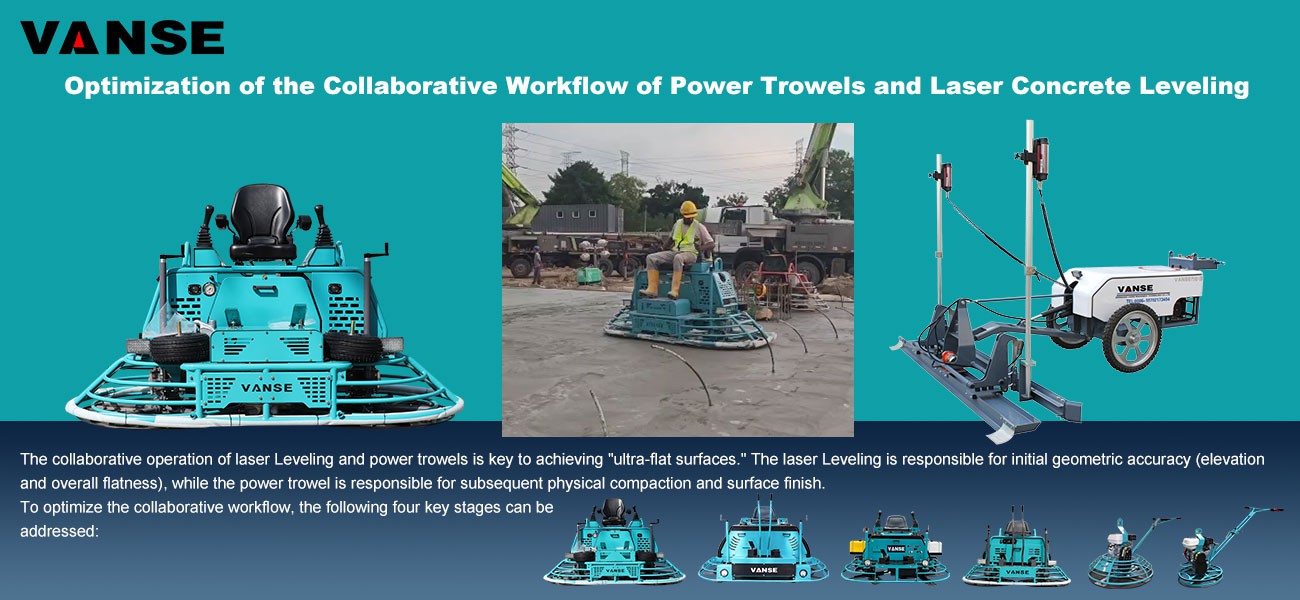
The collaborative operation of laser Leveling and power trowels is key to achieving "ultra-flat surfaces." The laser Leveling is responsible for initial geometric accuracy (elevation and overall flatness), while the power trowel is responsible for subsequent physical compaction and surface finish.
To optimize the collaborative workflow, the following four key stages can be addressed:
1. Paving and Preliminary Leveling Stage (Laser Leveling as the Main Tool)
Manual Pre-partitioning: Before the laser Leveling arrives, workers should pre-spread the concrete according to the elevation points. The material pile height should be slightly higher than the design elevation by 1-2cm to ensure the Leveling head has sufficient material for cutting and to avoid depressions caused by insufficient material.
One-Way Operation Path: The laser Leveling should operate in a one-way backward motion.
Real-Time Elevation Verification: The construction worker must use a handheld laser receiver to closely follow the Leveling head and conduct real-time inspections of edges, column bases, and other blind spots, and manually replenish material to ensure that the reference surface deviation is controlled within ±3mm before the power trowel enters the site.
2. Connection and Waiting Phase (Timing Transition)
Moisture Management: After laser Leveling, a layer of slurry (bleeding water) will appear on the concrete surface. Direct operation is strictly prohibited at this time.
Collaborative Observation: The laser Leveling operator should maintain communication with the power trowel operator. When the concrete hardens to the point where "a person's footprint is approximately 3-5mm deep," the power trowel must immediately begin operation.
Optimization Suggestion: In summer or dry environments, a "production line" operation can be implemented in sections-after the laser Leveling completes 10-15 meters, the first rotary power trowel can be ready to be positioned at the rear.
3. Leveling and Slurry Preparation Stage (with Float Pans)
Float Pans First: The slurry machine must be equipped with float pans during this stage. The vibration and pressure of the float pans further eliminate the minute machine head marks left by the laser Leveling.
Cross-cut Coverage: The slurry machine path should be perpendicular to (or intersect at 45°) the direction of travel of the laser Leveling.
Overlap Requirement: Each slurry path should overlap by 50%, using high-frequency float pan smoothing to eliminate short peaks in large-area smoothness (FF).
4. Finishing Stage (Dominated by Blade Power Pulverizer)
Angle and Speed Optimization: As the concrete hardens, the disc is removed, and blade trowels are used. By adjusting the blade angle (from flat to steep) and increasing the speed, the "smoothness" achieved after laser Leveling is converted into "density."
Edge Closure: For construction joints and wall edges that are difficult for laser Leveling to handle, the power trowel unit needs to be used in conjunction with a hand trowel for final finishing.
Collaborative Work Suggestion Form
| Stages | Core Equipment | Optimization Objectives: | Key Parameters/Actions: |
| Spreading | Laser Leveling | Overall Elevation $FL$ | Pre-lay 1-2cm of extra height to ensure cutting pressure. |
| Initial application | Ride-on Power Trowel (with mounting plate) | Smoothness $FF$ | Operate in a cross pattern, overlapping 50%. |
| Middle application | Power Trowel (blades) | Eliminate Sand Holes and Air Pit | Maintain a small to medium angle and move at a constant speed. |
| Final finishing | High-Speed Power Trowel | Surface Hardening and Gloss | Increase the blade angle to perform "polishing". |
Next steps recommended:
Regarding the collaborative work you mentioned, what is the current construction area? If it is a large venue with a daily construction volume of over 1000 square meters, I would suggest that you introduce a "ride-on double-disc power trowel" to match the high efficiency of the laser leveling machine, and provide you with an equipment matching plan.
Note: The parameters provided in this document are for reference only and are not mandatory. Due to differences in technical characteristics between different brands and models of laser levelers, please consult the manufacturer for a suitable solution before actual operation. This reference document assumes no responsibility for any issues arising from failure to follow the manufacturer's instructions.
Thanks to All the Friends Who Support and Trust Shandong Vanse Machinery Technology Co., Ltd.
If you want to know more about Shandong Vanse Machinery Technology Co., Ltd. or have any questions, please feel free to contact us:
Our Factory
Shandong Vanse Machinery Technology Co., Ltd.








Share this article

About the Author: Shandong Vanse Machinery Technology Co., Ltd.
Shandong Vanse Machinery Technology Co., Ltd. is a high-tech manufacturer specializing in concrete construction machinery, including laser screeds and related equipment. The company integrates R&D, production, and global sales, with products exported to over 60 countries and widely used in infrastructure projects worldwide.
Previous Post
Next Post
Related Articles
You Might Also Like
Concrete Laser Leveling Machine Summer Maintenance Tips
CONCRETE LASER LEVELING MACHINE SUMMER MAINTENANCE TIPS In the hot summer, the construction of concrete laser leveling machines has not stopped. The high temperature construction environment in summer is a relatively heavy test for construction machinery and equipment such as concrete laser leveling machines. Therefore, laser leveling machines should be prepared in summer The daily maintenance of the concrete laser leveler has also become very important. Today, the editor of Shandong VANSE will explain to you some construction precautions of the concrete laser leveling machine in summer, for your reference. 1. During construction in summer, the engine must first be prevented from overheating. Generally, the temperature of the engine should not exceed 95°. If the temperature is too high, you should choose a relatively shady location to stop and cool down. The engine hood can be lifted to ventilate and dissipate heat while stopping. 2. Check the amount of cooling water in time. When the water radiator reaches 100°, do not rush to add cooling water. Instead, stop the engine immediately to cool down the engine at idle speed, and then add coolant. 3. The construction temperature is high in summer, and the air pressure and temperature of the tire should be checked frequently. If the tire temperature is too high, it should be stopped in time and placed in a cool place to cool down. Remember to use the wrong method of deflation or pouring cold water to cool down. 4. Frequently check the liquid level of the battery, add distilled water in time, and dredge the vent holes, pay attention to the density of the electrolyte, and maintain a good charging state. 5. Prevent engine deflagration. Before entering the summer, the carbon deposits in the combustion chamber, valve top and other parts should be completely removed to maintain good heat dissipation and normal compression ratio; and the fuel supply advance angle should be checked and adjusted to prevent engine deflagration. 6. Check the temperature of hydraulic oil and hydraulic transmission oil frequently. If the temperature is too high, stop the machine and rest, and do not work at higher temperatures. In short, construction machinery such as concrete laser leveling machines are subjected to the test of long-term continuous operation and are also affected by high-temperature environments during summer construction. Therefore, summer construction must pay attention to the above conditions, and it must be carried out regularly. Routine inspection and maintenance work, which is not only related to the service life of the concrete machine leveler, but also related to the hidden dangers of construction and the smoothness of the concrete laser leveler in work.Timing Control of Concrete Spreader & Power Trowel Machine Collaboration
In concrete floor construction, the coordinated operation of concrete spreaders and power trowels is like a relay race against time. Because anti-corrosion flooring (such as acid-resistant and oil-resistant flooring) requires extremely high density, poor timing control can lead to peeling, cracking, or failure of anti-corrosion performance. The following are the key timing points and collaborative logic in the standard construction process: Judgment Criteria: After concrete paving and leveling, when construction workers step on the concrete surface, the footprint depth is approximately 3mm-5mm. Collaborative Operation: At this point, most of the moisture on the concrete surface has evaporated, but it can still moisten the aggregate. The spreader begins spreading the first layer of material (usually 2/3 of the total). Note: Spreading material on a surface with standing water is strictly prohibited, as it will dilute the thickness of the anti-corrosion coating. Judgment Criteria: After material spreading, wait for the aggregate to absorb moisture from the concrete and darken (approximately 5-15 minutes). Coordinated Operation: The power trowel, equipped with a "disc," performs the initial grouting. Objective: Through the kneading action of the disc, the anti-corrosion aggregate is pressed into the concrete surface, integrating it with the base grout. Timing: Immediately after the initial slurry application. Coo rdinated Operation: The material application machine applies the remaining 1/3 of the material (to reinforce areas unevenly applied in the first round). The power trowel then applies the slurry again in a crisscrossing pattern. Judgment Criteria: The concrete begins to harden; footprints are barely visible when stepped on. Coordinated Operation: The power trowel removes its disc and uses a blade for finishing. Key to Corrosion Prevention: 3-4 repeated finishing passes are required. As the concrete hardens, continuously increase the blade angle until a mirror-like surface is achieved. Construction joints are not fixed; the coordination speed of the spreading machine and the power trowel must be adjusted according to environmental changes. Environmental factors Impact on timing Coordinated Adjustment Strategies High temperature/strong wind Concrete dehydrates extremely quickly, shortening the window period. The spreading machine should closely follow the leveling machine, and the number of power trowels should be increased to operate synchronously. Low temperature/high humidity Slow setting; premature construction may bury materials. Extend the waiting time to prevent aggregate from settling to the bottom of the concrete. Indoor/underfloor heating The bottom heats up quickly, causing a skin to form on the surface. The power trowel should apply slurry as early as possible to prevent "false drying" that can lead to hollow areas. For special functional flooring such as acid-resistant and oil-resistant flooring, extra attention needs to be paid during collaborative construction: Prioritize Density: The power trowel should apply 1-2 more passes than for ordinary flooring to seal all micropores and prevent acid/oil penetration. Joint Treatment: When the spreader is moving, ensure that the overlap area between two applications is approximately 10cm. The power trowel should then focus on strengthening the grinding at the overlap area. Finished Product Protection: After the final pass, a curing agent or anti-corrosion sealant should typically be sprayed within 4-6 hours. If your construction area is large (over 1000㎡ per day), we recommend using a combined operation mode of laser leveling machine + automatic material spreader + ride-on power trowel to ensure that the corrosion resistance of the entire floor is at a consistent level. Is your current construction environment indoors or outdoors? Depending on the ventilation conditions, I can provide you with detailed parameters for controlling the material spread thickness. Note: The parameters provided in this document are for reference only and are not mandatory. Due to differences in technical characteristics between different brands and models of laser levelers, please consult the manufacturer for a suitable solution before actual operation. This reference document assumes no responsibility for any issues arising from failure to follow the manufacturer's instructions.With the advent of laser leveling machines, are you still using the old vibrating leveler to vibrate the beam?
With the advent of laser leveling machines, are you still using the old vibrating leveler to vibrate the beam? When it comes to construction, everyone knows that only with a short construction period and high quality can we save costs, improve efficiency and increase profits. If you want to save costs quickly during construction, construction tools are a very important choice. An efficient, convenient and fast tool will make construction work more effective with half the effort! On the contrary, choosing inappropriate tools will extend the construction period, increase costs, and reduce profits. Take the floor construction under construction as an example! The flatness of the floor is more difficult to grasp. Leveling is usually done manually. Even if you use an old-fashioned floor machine, the effect and cost are not particularly ideal. The emergence of a laser leveling machine has greatly solved many problems that arise during construction. During the construction process, it can solve the problems of hollowing, shelling, cracking, and uneven ground after general construction. It can make the final effect exceed Party A's floor quality requirements, reduce costs, and Improved work efficiency. Many industries require factories, as well as shopping malls, large warehouses and other construction sites that require large areas of ground, to have much higher standards. Attention has been greatly increased to the strength, flatness and level of the ground quality. It is difficult to meet the requirements using old-fashioned flooring methods, and labor costs will increase exponentially. The construction principle of the laser leveler is very simple and clear. It can perform several construction processes such as leveling and vibration at the same time, further ensuring the quality of the construction and completely saving labor costs. The advantage of construction is that the construction speed is fast and the quality is high, ensuring that the overall integrity of the ground is good and cracks are not prone to occur. The amount of support and disassembly is reduced compared with the traditional method. Moreover, the reduction in the number of workers ensures an increase in final profits.