Technical Knowledge
Just a few steps to teach you how to operate a ride-on trowel
The car-mounted trowel, which plays a dominant role in pavement engineering, has a wide range of applications and can be applied to many construction sites such as squares,
airports, workshops, factories, parking lots, etc., and is deeply loved and welcomed by users.
Using this equipment Finishing and smoothing the concrete floor can greatly reduce the labor intensity of workers,
and the construction work becomes easier and more efficient.
The road surface constructed by the ride-on trowel is smooth and flat,
and the concrete surface has good compactness and wear resistance.
Car trowel
1. Start the troweling machine and operate the handle;
2. Hold the joystick tightly to keep the body balanced;
3. When the troweling machine is working, be sure to hold the troweling machine steady, and adjust the direction in time when working on the floor. To prevent the machine from losing control;
4. First coarse grinding, then fine grinding. After the bottom grinding disc is roughly ground, remove the grinding disc when the ground is suitable for fine grinding, and finely grind with a spatula.
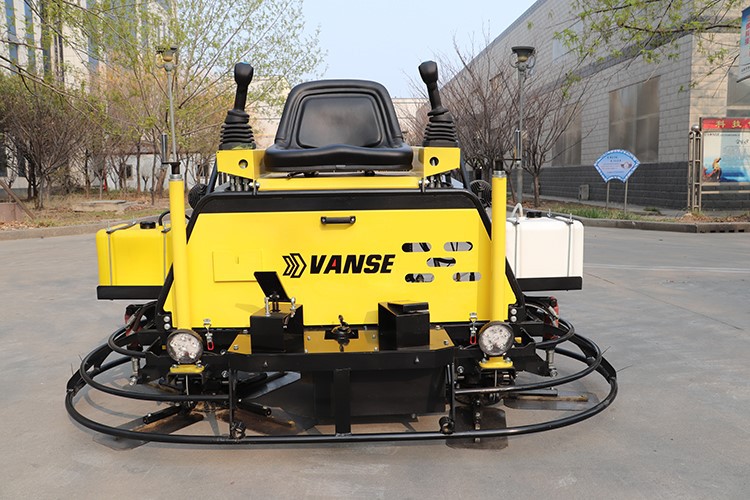
Driving trowel
The ride-on troweling machine has high working efficiency and good finishing effect, and can easily meet the engineering construction standards.
This car troweling machine is easy to operate and calmly cope with different harsh working conditions.
It is an indispensable good equipment in concrete troweling construction!
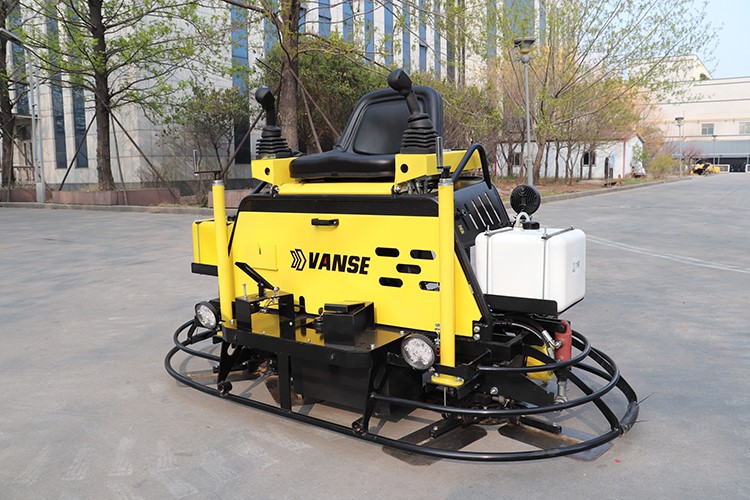
Full hydraulic troweling machine
Thanks to All the Friends Who Support and Trust Shandong Vanse Machinery Technology Co., Ltd.
If you want to know more about Shandong Vanse Machinery Technology Co., Ltd. or have any questions, please feel free to contact us:
Our Factory
Shandong Vanse Machinery Technology Co., Ltd.








Share this article

About the Author: Shandong Vanse Machinery Technology Co., Ltd.
Shandong Vanse Machinery Technology Co., Ltd. is a high-tech manufacturer specializing in concrete construction machinery, including laser screeds and related equipment. The company integrates R&D, production, and global sales, with products exported to over 60 countries and widely used in infrastructure projects worldwide.
Previous Post
Next Post
Related Articles
You Might Also Like
Quality Control Methods for Ensuring Uniform Distribution of Wear-Resistant Aggregates
Ensuring the uniform distribution of wear-resistant aggregates (such as corundum and alloy aggregates) is crucial to preventing color differences, peeling, and uneven wear resistance in floor coatings. Quality control should be implemented throughout the entire process, from "base layer treatment" to "mechanical finishing." The following are the core control methods for achieving uniformity: Do not rely solely on experience for random spreading; instead, adopt **"grid management."** Grid division: Based on the total amount used (e.g., 5 kg/m²), divide the construction surface into several equal areas. Quota placement: Pre-place the corresponding weight of aggregate in the center of each area to ensure consistent consumption in each grid cell. The "two-stage application method" effectively re pairs gaps left after the first application. First application (2/3 of the total amount): Applied when the concrete is initially setting (footprint indentation of approximately 5mm), utilizing the bleed water from the base layer to moisten the aggregate. Second application (1/3 of the total amount): After the first application is finished and smoothed, a reinforcing application is performed in a perpendicular direction, focusing on areas with lighter color or sparser aggregate. Mechanical Spreading Machines: For large-area construction, the use of automatic spreading machines is recommended. Compared to manual application, mechanical spreaders can precisely control the amount of material applied per square meter through rotational speed and travel speed, greatly improving consistency. Manual Assistance: When spreading manually, use a "scattering" motion rather than "pouring," and ensure the material is distributed evenly. Edge Prioritization: In areas difficult for large machinery to cover, such as column edges and wall corners, manual application of extra material and manual compaction should be performed first. Joint Treatment: At construction joints, the application amount should slightly overlap to ensure that the hardness and flatness of the joint area are consistent with the main surface. Avoid strong winds: During indoor construction, doors and windows should be closed to prevent drafts that could cause fine aggregates to deviate during placement, resulting in localized areas with insufficient material. Strictly prohibit adding extra water: If the aggregate is locally too dry, direct watering is strictly prohibited. The slurry generated by the power trowel should be used for wetting; otherwise, it will lead to reduced surface strength and color differences. Quality inspection tips: After spreading, assess the consistency of the color (checking for light or dark patches) and the balance of moisture content by visual inspection. If localized areas appear lighter in color, it usually indicates an excess of aggregate or insufficient moisture in that area. Mechanical troweling to bring the mortar to the surface should be performed immediately. Note: The parameters provided in this document are for reference only and are not mandatory. Due to differences in technical characteristics between different brands and models of laser levelers, please consult the manufacturer for a suitable solution before actual operation. This reference document assumes no responsibility for any issues arising from failure to follow the manufacturer's instructions.What Fuel-Saving Measures Should Be Taken When Operating A Concrete Laser Leveling?
Nowadays, the amount of work is increasing. When operating the concrete laser leveling, you will feel that the fuel consumption of the machine is a bit high. This is because the workload itself is relatively large, and the construction time is also relatively long, so the fuel consumption is It is also a relatively common phenomenon, but in order to further save costs, we still need to take some measures, which can actually reasonably reduce the fuel consumption of concrete laser leveling machines. 1. Be proficient in the operation method of concrete laser leveling machine In order to reduce the unnecessary increase in fuel consumption in the concrete laser leveling machine, you must first understand the basic operations of the concrete laser leveling machine and master the correct operations of loading, walking, turning, leveling, slope repair and other operations. If the foundation is not good, it will increase the fuel consumption of the concrete laser leveling machine. I would like to remind novices who have just entered the industry to listen to the advice of the master and master the leveling operation. 2. Reduce unnecessary idling If you want to save fuel, you need to reduce the necessary idling speed of the engine. You should know that when the concrete laser leveling is idling, it is also using a hydraulic pump to circulate hydraulic oil. The longer the idling time, the more fuel is wasted. In fact, the correct way to save fuel is to try not to idle the concrete laser leveler during standby and rest periods. This is one of the secrets to saving fuel. 3. Reduce engine speed When performing excavation operations, when the engine speed is at a higher speed, the operating speed is fast, but the fuel consumption is high. When operating at non-full throttle, appropriately reduce the engine speed. Although the operating speed is reduced, fuel consumption can be reduced. Improve fuel efficiency. 4. Walking without full throttle When walking with the engine not at full throttle, everyone should know that the higher the engine speed, the faster the walking speed, and the higher the fuel consumption. Reducing the engine speed during operation can improve fuel consumption efficiency while walking.The promotion and application of concrete laser leveling in agricultural modernization
The promotion and application of concrete laser leveling in agricultural modernization is a highly forward-looking and valuable topic. It is not merely an upgrade of construction tools, but a crucial link in promoting the advancement of agricultural production infrastructure towards high standards and intelligence. The following will be elaborated from several aspects, including promotion value, specific application scenarios, challenges faced, and countermeasures and suggestions. Ultra-high flatness: The leveling accuracy under laser control can reach the millimeter level, providing an absolutely flat foundation for subsequent high-standard farmland construction and large-scale precise irrigation (such as drip irrigation and sprinkler irrigation). It avoids the common problem of "unevenness" after traditional land leveling, which leads to water accumulation or uneven irrigation. Extremely high density and strength: The combination of high-frequency machine vibration and hydraulic leveling makes the concrete dense and uniform, greatly reducing problems such as ground dusting, sanding and cracking, and its durability far exceeds that of manual construction. Supporting intelligent agricultural machinery operations: It provides an ideal working surface like a "highway" for unmanned tractors, intelligent harvesters, automated seeders, etc., reducing bumps and path correction, and improving operation accuracy, speed and equipment lifespan. Adapting to large-scale breeding: In the ground construction of modern breeding farms (dairy farms, pig farms, etc.), a smooth, seamless, easy-to-clean and disinfect, and durable concrete ground is a prerequisite for biosecurity and efficient collection and treatment of manure and sewage. The laser leveling is the best tool to achieve this goal. Water conservation: Combined with precise irrigation systems, it completely eliminates the waste of water resources caused by uneven ground. Material conservation: Through precise elevation control, unnecessary waste of concrete raw materials can be reduced. Energy conservation: Leveling the ground reduces the resistance of agricultural machinery during operation and lowers fuel/electricity consumption. Environmental protection: Hardened and sealed ground effectively prevents soil dust from flying and reduces the pollution of soil and groundwater caused by the seepage of manure and sewage from livestock farms. Although the initial investment is relatively high, the ground it builds has a long service life and extremely low maintenance requirements. It avoids the long-term costs and agricultural interruption losses that require repeated leveling and repair of traditional land or low-quality ground, and has significant economic benefits throughout the entire life cycle. Large-scale drying ground/grain drying center floor: Achieve rapid and uniform drying, facilitating mechanical collection. The ground of the agricultural machinery warehouse and the warehousing and logistics center: meets the storage and transfer requirements of heavy machinery. Hardening of field roads and ditches: Enhancing transportation efficiency and irrigation/drainage accuracy. The ground inside large multi-span greenhouses and glass greenhouses: It provides a foundation for automated seedling raising, transportation robots, and soilless cultivation systems. The floor of the agricultural product grading, packaging and processing workshop: meets the requirements of food-grade cleanliness and efficient logistics. Cattle sheds, milking parlors and passageways in dairy and beef cattle farms: conducive to the scraping and sweeping of manure, animal welfare and hoof health. The floors of modern pigsties and poultry houses: easy to clean, dry and control diseases. Processing sites for special crops such as Chinese medicinal materials and edible fungi. The floor of the industrialized recirculating aquaculture (RAS) workshop and the seedling workshop must be absolutely flat to match the installation of the water pool and the drainage design. High initial investment cost: The cost of purchasing and leasing equipment is relatively high, and the threshold for individual farmers or small cooperatives is high. Shortage of technology and talent: Operating and maintaining laser screeners requires certain professional skills, and there is a lack of corresponding technical talents in rural areas. Application scenario cognitive limitations: Many agricultural operators still regard it as a "large construction tool" and have not fully recognized its huge value in the agricultural production end. The particularity of agricultural projects: Agricultural ground construction may encounter challenges such as scattered operation areas, small single area, and complex terrain, which require flexible equipment scheduling and construction plans. Lack of policies and standards: In the agricultural sector, there is a lack of specialized subsidy policies and clear design and construction standards for such high-standard ground construction. Incorporate high-performance concrete laser leveling construction into the subsidy or recommendation standards for projects such as high-standard farmland construction, modern agricultural industrial parks, and resource utilization of livestock and poultry manure. Encourage the reduction of the initial usage cost for users through measures such as government procurement of services, setting up special subsidies for agricultural machinery, and providing loan interest subsidies. Vigorously develop "professional construction service teams" or equipment rental companies to enable small and medium-sized agricultural business entities to enjoy high-quality services without purchasing equipment. Promote the contract model of "charging by area". Equipment manufacturers can develop more flexible and suitable small and medium-sized models for agricultural scenarios. Strengthen technical training and demonstration guidance Add relevant courses in agricultural colleges and universities and the agricultural machinery extension system. Build a number of high-quality application demonstration zones (such as super farms and national-level industrial parks), and through on-site meetings, effect comparisons and other means, visually display their long-term benefits and change concepts. Promote the in-depth integration of "agricultural machinery and agronomy" with "engineering construction". Agricultural experts, agricultural machinery engineers and the construction party jointly designed to ensure that the ground standards truly meet the needs of future agricultural production. Encourage laser levelings to be integrated with concrete mixer trucks, trowels, etc. to form an integrated construction solution to enhance overall efficiency. Industry associations or government departments should take the lead in formulating the "Technical Specifications for Laser Leveling of Concrete Floors for Agricultural Use", which should put forward clear requirements for the flatness, strength, wear resistance and anti-slip properties of floors for different uses (such as breeding, storage, greenhouses, etc.), and regulate the market. The promotion of concrete laser leveling machines in agricultural modernization essentially involves introducing industrial-grade precision construction technology into agriculture, providing a solid and accurate physical load-bearing foundation for digital agriculture and smart agriculture. It is not only a "revolution of tools", but also a "revolution of production thinking". With the in-depth transformation of China's agriculture towards intensification, intelligence and greenness, its application prospects are bound to become increasingly broad. By breaking through the initial cost and cognitive barriers and taking a three-pronged approach of policy, model and innovation, this technology will become a powerful "infrastructure shaper" that helps build a strong agricultural country. Note: The parameters provided in this document are for reference only and are not mandatory. Due to differences in technical characteristics between different brands and models of laser levelers, please consult the manufacturer for a suitable solution before actual operation. This reference document assumes no responsibility for any issues arising from failure to follow the manufacturer's instructions.