Technical Knowledge
Safety tips for ride-on power trowels in tight indoor spaces
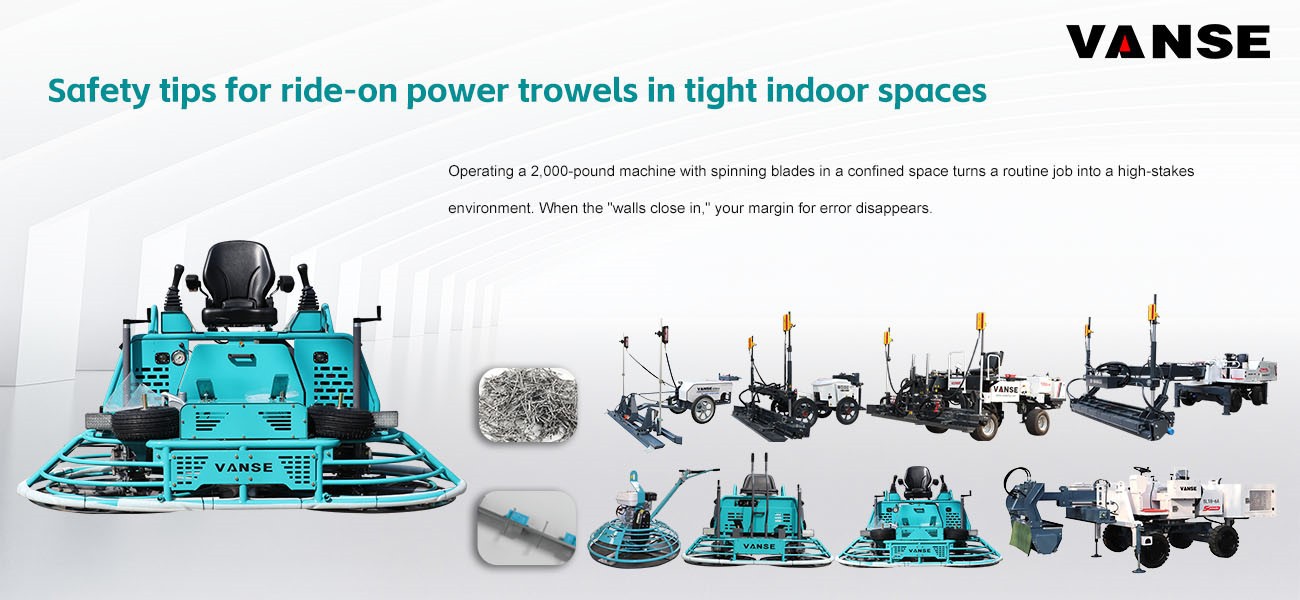
Operating a 2,000-pound machine with spinning blades in a confined space turns a routine job into a high-stakes environment. When the "walls close in," your margin for error disappears.
Here is the safety protocol for maneuvering ride-on trowels in tight indoor quarters.
1. Exhaust Gas: The Silent Killer
This is the #1 danger for indoor ride-on use. Standard gas or diesel engines produce Carbon Monoxide (CO), which can reach lethal levels in minutes in a closed room.
Active Ventilation: Do not rely on "open doors." You need high-volume axial fans (blowers) to create a "push-pull" airflow system.
CO Monitors: The operator must wear a personal CO monitor clip. If it beeps, the site is evacuated immediately.
Catalytic Converters: Ensure your machine is fitted with a "scrubber" (catalytic muffler) to reduce emissions, or better yet, use Propane-powered or Electric trowels for indoor work.
2. The "Crush Zone" Awareness
In tight spaces, the machine’s "tail swing" is your biggest enemy.
No-Go Zones: Establish a rule that no ground crew (manual finishers) can be within 10 feet of the machine when it is near a wall or pillar.
Pillar Strategy: When circling columns, always keep the machine moving in a direction where the operator has a clear line of sight to the gap between the machine and the obstruction.
Avoid "Backing Into" Corners: Always try to nose into tight corners so you have the best visibility to back out into the open.
3. Blade Strike and "Kickback"
If a spinning blade hits a protruding pipe, drain, or a structural steel column, the machine can jerk or spin violently.
Mark Obstructions: Use bright spray paint or "flags" on any floor penetrations (pipes/conduit) that are shorter than the operator's seated eye level.
Low Speed Near Edges: Reduce RPM when working within 2 feet of a wall. This gives you more reaction time if the machine "catches" an edge.
4. Fire Safety: The "Hot Refuel" Risk
Indoor spaces often have poor airflow for flammable vapors.
Cool Down Before Fueling: Never refuel a hot engine inside. The "flash point" of spilled gas on a hot manifold in a room with no wind is a recipe for a fireball.
Spill Kits: Keep a spill kit nearby. A hydraulic hose burst on fresh concrete is a slip hazard and a nightmare to clean.
Essential Safety Checklist
| Danger | Preventive Action |
| CO Poisoning | Use CO monitors + High-velocity fans |
| Wall Impact | Maintain "Slow-Zone" within 3ft of walls |
| Tip-Over | Watch for floor "drop-offs" or open elevator shafts |
| Communication | Use hand signals (it's too loud for shouting) |
| Lighting | Ensure 2,000+ lumens of temporary work lighting |
Pro-Tip: The "Dead Man" Switch
Before starting, test the kill switch. In a tight space, if you lose control or the throttle sticks, you have a fraction of a second to shut down before hitting a structural wall. If the seat-activated safety switch is bypassed or broken, do not operate the machine.
Would you like me to look up the OSHA (or local) requirements for CFM airflow based on the square footage of your indoor project? Contact us NOW
Note: The parameters provided in this document are for reference only and are not mandatory. Due to differences in technical characteristics between different brands and models of laser levelers, please consult the manufacturer for a suitable solution before actual operation. This reference document assumes no responsibility for any issues arising from failure to follow the manufacturer's instructions.
Thanks to All the Friends Who Support and Trust Shandong Vanse Machinery Technology Co., Ltd.
If you want to know more about Shandong Vanse Machinery Technology Co., Ltd. or have any questions, please feel free to contact us:
Our Factory
Shandong Vanse Machinery Technology Co., Ltd.








Share this article

About the Author: Shandong Vanse Machinery Technology Co., Ltd.
Shandong Vanse Machinery Technology Co., Ltd. is a high-tech manufacturer specializing in concrete construction machinery, including laser screeds and related equipment. The company integrates R&D, production, and global sales, with products exported to over 60 countries and widely used in infrastructure projects worldwide.
Previous Post
Next Post
Related Articles
You Might Also Like
Establish standard operating procedures for the daily cleaning and regular deep maintenance of concrete laser leveling
Standardize the daily cleaning and regular maintenance of concrete laser leveling machines to ensure that the equipment is in the best technical condition, prevent abnormal wear and failure, improve equipment utilization and economic benefits, and eliminate potential safety hazards. This program is applicable to all operators, maintenance personnel and equipment managers of concrete laser leveling machines. All cleaning and maintenance work must be carried out after the equipment has completely stopped, the engine has been turned off, and the key has been removed. For the operation of hydraulic and electrical systems, it must be confirmed that the system has been completely depressinized. Wear appropriate personal protective equipment, including but not limited to: protective gloves, safety glasses, and anti-crush work shoes. When working under the equipment, it is essential to use safety brackets or jack brackets for reliable support to prevent the equipment from accidentally falling. A warning sign reading "Under maintenance, Do not start" must be placed on site. Objective: Remove the dirt accumulated on the day, inspect the basic condition, and get ready for the next day's work. Serial number Assignment project Standards and Requirements 1 Preliminary cleaning of the entire machine Use high-pressure water guns or manual tools (scrapers, brushes) to remove large blocks of concrete and mud adhering to the chassis, scrapers, vibrators, walking tracks/wheels. Note: Avoid directly flushing the engine air intake, radiator, bearing housing, electrical interfaces and laser receiver with high-pressure water. 2 Fine cleaning of key areas Under the scraper and vibrator: They must be thoroughly cleaned to ensure there is no hard concrete buildup, guaranteeing no resistance during the next start-up. • Laser receiver sensor: Wipe it clean with a soft cloth to ensure there is no dirt blocking it. • Piston rods of each cylinder: Before retracting, wipe their surfaces clean with a soft cloth to prevent cement particles from scratching the seals. 3 Cleaning of the walking system • Crawler type: Clean the crushed stones and mud blocks in the crawler chain links, drive wheels and guide wheels. • Wheel type: Remove debris from the tire treads. 4 Post-operation inspection • Leakage inspection: Visually inspect the hydraulic pipelines, joints, and cylinders for any oil leakage. • Loosening check: Inspect whether the main connecting bolts (such as scraper and vibrator mounting seats) are loose. • Visual inspection: Check for obvious cracks or deformations in structural components. 5 Park Park the equipment on a flat and solid ground. Retract the cylinder to lift the scraper off the ground. Disconnect the power supply (if any). Objective: Conduct systematic inspection, adjustment, lubrication and component replacement to fundamentally maintain equipment performance. Note: The following cycles are general recommendations. Please be sure to refer to the final regulations in the equipment manufacturer's manual. The maintenance cycle should be shortened under harsh working conditions. Maintenance cycle Maintenance items Standards and Requirements 50 working hours per week 1. Lubrication and maintenance Apply the specified lithium-based grease to all lubrication nozzles (grease nozzles) until the new grease is squeezed out from the seal. Key points include: All bearing housings (vibrator bearings, walking wheel bearings). All pins and joint joints (lifting connecting rods, adjusting mechanisms). • Clean up any spilled old butter and keep it clean. 2. Fastening inspection Use a torque wrench to check and tighten the key bolt connections according to the specified torque value. 3. Hydraulic system inspection Check the oil level in the hydraulic oil tank. If it is insufficient, add hydraulic oil of the same grade. Check whether the color and smell of the hydraulic oil are normal. 250 working hours per month 1. Hydraulic oil breathing filter Clean or replace the air breather filter element on the top of the fuel tank. 2. Electrical system inspection Check whether the battery terminals are corroded or loose and clean them. Check whether the joints of each line are firm and whether the wire harnesses are worn or aged. Check whether all control switches and sensors are working properly. 3. Laser system calibration Check the consistency between the laser emitter and the control system of the leveling machine, and calibrate it if necessary. Every six months / 1,000 working hours 1. Replacement of hydraulic oil and filter elements Completely replace all the hydraulic oil. All hydraulic filter elements (suction oil filter, return oil filter, pressure oil filter) should be replaced simultaneously. • Clean the interior of the hydraulic oil tank (a special cleaner and dough can be used for adhesion). 2. Engine maintenance • Replace the engine oil, oil filter, fuel filter and air filter. Check and adjust the tension of the fan belt. 3. Inspection of the walking system Check the wear of the tracks/tires and adjust the tension of the tracks. • Check the drive motor and reducer. 4. In-depth inspection Check the installation and tightness of major components such as hydraulic pumps, motors, and multi-way valves. Check whether there are any scratches or rust on the surface of the piston rods of each cylinder and whether the seals are intact. 2,000 working hours per year Comprehensive and systematic inspection and calibration It is recommended to be carried out by professional service engineers, including: Check whether the pressure and flow rate of the hydraulic system meet the standards. • Conduct a comprehensive inspection of the electrical control system and sensors. • Conduct flaw detection on structural components (if necessary). Thorough cleaning: Wash thoroughly according to the daily procedure and dry completely. Rust prevention treatment: Apply rust prevention grease to all exposed metal surfaces (such as cylinder piston rods, guide rails, bolt threads). Oil protection: Add hydraulic oil to the upper limit and carry out anti-rust treatment on the engine crankcase and fuel system. Tires/Tracks: Lift the equipment up to lift the tires/tracks off the ground. Battery: Disconnect the negative terminal of the battery, take it out and store it in a dry and well-ventilated place, and charge it regularly. Parking environment: Store in a dry and well-ventilated indoor area and cover with tarpaulin to prevent dust. After each cleaning and maintenance is completed, the date, working hours, maintenance content, replaced parts and the person who performed the task must be recorded in detail on the "Equipment Maintenance Record Form". The operator is responsible for daily cleaning and inspection, while the mechanic or equipment administrator is responsible for regular deep maintenance. Managers should regularly check the completeness and authenticity of maintenance records. Establishing and strictly implementing this standard operating procedure can transform the management of concrete laser leveling machines from "passive maintenance" to "active prevention", which is the core link to achieve refined equipment management and cost reduction and efficiency improvement. Please combine this program with the manufacturer's manual of your specific device model for the best results. Note: The parameters provided in this document are for reference only and are not mandatory. Due to differences in technical characteristics between different brands and models of laser levelers, please consult the manufacturer for a suitable solution before actual operation. This reference document assumes no responsibility for any issues arising from failure to follow the manufacturer's instructions.Concrete Laser Levelings Machine User Manual And Operating Guide
♢ • ♢ • ♢ • ☆ Equipment Overview ☆ • ♢ • ♢ • ♢ The concrete laser leveling machine is an efficient and accurate ground leveling equipment that is widely used in various construction projects. It combines modern laser technology and mechanical engineering technology, captures the signal from the laser transmitter through the laser receiver, controls the scraper height of the leveling machine, and realizes automatic leveling of newly poured concrete, greatly improving work efficiency and leveling quality. . This equipment is suitable for large-area, high-precision concrete ground construction, such as commercial complexes, parking lots, warehouses and other places. ♢ • ♢ • ♢ • ☆ Equipment composition ☆ • ♢ • ♢ • ♢ The concrete laser leveling machine mainly consists of the following parts: 1. Main machine: including core components such as engine, traveling system, leveling system, control system, etc., it is the main working mechanism of the leveling machine. 2. Laser transmitter: used to emit laser signals to provide a reference plane for the leveling machine. 3. Laser receiver: installed on the leveling machine, used to capture laser signals and convert them into mechanical control signals. 4. Water source and water spray system: Provide an appropriate amount of moisture to the concrete during the leveling process to ensure that the concrete surface is flat and smooth. 5. Accessories: including various to ols, measuring tools, etc., used to assist the use and maintenance of the leveling machine ♢ • ♢ • ♢ • ☆ Safety Instructions ☆ • ♢ • ♢ • ♢ When operating a concrete laser leveling, the following safety regulations must be strictly observed: 1. Operators must receive professional training, be familiar with the equipment structure and operating points, and must obtain operating qualifications before taking up their posts. 2. Before starting the equipment, you must check whe ther all components are intact and whether the fasteners are firm and reliable to ensure that the equipment is in good working condition. 3. During operation, overloading, overspeeding, and over-range use are strictly prohibited to avoid equipment damage due to overload. 4. At the construction site, obvious safety war ning signs must be set up to ensure that non-workers stay away from the work area. 5. When the equipment has a fault or abnormality, it should be stopped immediately for inspection and the fault can be eliminated before continued use. 6. Operators must wear complete safety protective equipment, such as hard hats, protective glasses, gloves, etc., to ensure personal safety. ♢ • ♢ • ♢ • ☆ Preparation ☆ • ♢ • ♢ • ♢ Before operating the concrete laser leveling machine, you need to make the following preparations: 1. Check whether the appearance of the equipment is intact and whether there is any obvious damage or deformation. 2. Check whether the engine oil, water tank water level, etc. are within the specified range to ensure that the equipment lubrication and cooling systems are working properly. 3. Check whether each connection part is fastened reliably to prevent the equipment from loosening or falling off during work. 4. Check whether the laser transmitter and receiver are installed correctly to ensure that the laser signal can be transmitted and received normally. 5. According to the conditions of the construction site, reasonably arrange the position of the laser transmitter to ensure that the leveler can receive stable laser signals. 6. Prepare the water source and water spray system to ensure that the concrete surface can be fully moistened during the leveling process. ♢ • ♢ • ♢ • ☆ Operational procedures ☆ • ♢ • ♢ • ♢ The operation process of the concrete laser leveling is as follows: 1. Start the engine, preheat the equipment, and check whether each system is working properly. 2. Set the parameters of the laser transmitter according to the construction drawings and site conditions to ensure that the laser signal emitted meets the leveling requirements. 3. Connect the laser receiver to the leveling machine to ensure stable and reliable signal transmission. 4. Adjust the height and angle of the scraper of the leveling machine to maintain an appropriate distance and angle from the laser signal. 5. Turn on the water spray system to provide the appropriate amount of moisture to the concrete surface. 6. Start the leveling operation. According to the construction progress and the initial setting time of the concrete, reasonably control the walking speed of the leveling machine and the lifting frequency of the scraper. 7. During the leveling process, always observe the flatness and wetness of the concrete surface, and adjust the scraper height and water spray volume in a timely manner. 8. After the leveling operation is completed, turn off the engine and water spray system, and disconnect the laser receiver from the leveling machine. 9. Clean the equipment surface and construction site to ensure that the equipment is tidy and the environment is clean. ♢ • ♢ • ♢ • ☆ Care and Maintenance ☆ • ♢ • ♢ • ♢ In order to ensure the long-term stable operation of the concrete laser leveling machine, regular maintenance and upkeep work must be performed, including: 1. Regularly replace the engine oil and clean the oil filter to ensure that the engine lubrication system is clean and effective. 2. Check whether the cooling system components such as water tanks and water pipes are leaking or blocked, and keep the cooling system unimpeded. 3. Check the wear of scrapers, running wheels and other wearing parts, and replace damaged parts in time to ensure stable equipment performance. 4. Clean dust, oil and other debris on the surface and inside of the equipment to keep the equipment clean and tidy. 5. Regularly check the working status of key components such as electrical systems, laser transmitters and receivers to ensure their normal operation. 6. In accordance with the requirements of the equipment instruction manual, conduct regular comprehensive inspections and maintenance of the equipment to ensure long-term stable operation of the equipment. ♢ • ♢ • ♢ • ☆ Troubleshooting ☆ • ♢ • ♢ • ♢ During use, the concrete laser leveling may encounter some malfunctions or abnormal situations. To solve these problems, we can take the following measures to eliminate them: 1. Difficulty starting the engine: Check whether the battery power is sufficient, whether the starter motor is working normally, whether the fuel supply is smooth, etc. If there is any problem, replace the battery, start the motor or clean the fuel system in time. 2. Poor leveling effect: Check whether the laser transmitter and receiver are installed correctly and whether the signal is stable and reliable; check whether the height and angle of the scraper are adjusted appropriately; check whether the concrete surface is even and moist. If there is any problem, adjust or replace relevant parts in time. 3. The equipment is running abnormally: check whether the running wheels are seriously worn, whether the bearings are damaged, whether the transmission chain is loose, etc. If there is any problem, replace the running wheel, bearing or adjust the transmission chain in time. 4. The laser signal is unstable: Check whether the laser transmitter and receiver are interfered, whether the reflective surface is clean, whether the lens is damaged, etc. If there is any problem, promptly eliminate the interference, clean the reflective surface or replace the lens. 5. Electrical system failure: Check whether the cables are damaged, whether the wiring is loose, whether the components are damaged, etc. If there is a problem, repair the cable, tighten the wiring or replace the components in time. When troubleshooting, operators should strictly follow the requirements of the equipment instruction manual and are strictly prohibited from dismantling or repairing the equipment at will. If you encounter a fault that cannot be solved, you should contact professional maintenance personnel in time to handle it. ♢ • ♢ • ♢ • ☆ Transportation and Storage ☆ • ♢ • ♢ • ♢ When transporting and storing the concrete laser leveling, you need to pay attention to the following points: 1. Before transportation, make sure the device is turned off and disconnect the power supply and cables to prevent accidental startup during transportation. 2. During transportation, the equipment should be fixed and protected to prevent the equipment from being collided or damaged during transportation. 3. After arriving at the destination, the equipment should be fully inspected to ensure that the equipment has not been damaged or deformed during transportation. 4. When storing equipment, you should choose a dry, ventilated, and dark place to prevent the equipment from moisture, rust, or other damage. 5. During the storage period, the equipment should be maintained and maintained regularly to ensure that the equipment can work normally the next time it is used. In short, the warm concrete laser leveling machine is an efficient and accurate ground leveling equipment, but during use it needs to strictly abide by safety regulations, make preparations, follow operating procedures, perform regular maintenance and troubleshooting, and troubleshoot in a timely manner , and take necessary protective measures during transportation and storage. Only in this way can the long-term stable operation and service life of the equipment be ensured.Where are the energy-saving & environmental protection performance of concrete laser leveling machine specifically reflected?
The energy-saving and environmental protection performance of concrete laser leveling machines is mainly reflected in multiple dimensions such as energy utilization efficiency, material loss control, pollutant emission optimization and sustainable design. The following are specific manifestations: – The use of high-efficiency and energy-saving engines improves fuel efficiency by 10%-20% compared with traditional models, reducing fossil energy consumption. For example, some electric laser leveling machines rely on lithium batteries for power supply, and have zero fuel consumption during operation, reducing energy consumption costs by more than 30%. – Equipped with an intelligent idling system, the equipment automatically reduces the engine speed when not in operation, avoiding idling energy waste and further reducing fuel consumption. – The use of load-sensitive hydraulic technology automatically adjusts the hydraulic oil flow and pressure according to the operating load to reduce energy loss. For example, during leveling operations, the system only provides the required power to avoid the conversion of excess hydraulic energy into heat energy loss. – The laser positioning system achieves millimeter-level leveling accuracy (error ≤3mm), avoiding repeated concrete repairs or over-thick paving due to insufficient flatness in traditional manual construction, and can reduce the amount of concrete used by 5%-10%. Taking a 10,000㎡ site as an example, it can save about 50-100m³ of concrete, reduce material costs and reduce carbon emissions from cement production (about 0.9 tons of CO₂ per ton of cement production). – Mechanized operations are 3-5 times more efficient than manual construction, shortening the construction period while reducing the energy consumption of on-site machinery and personnel. For example, traditional manual leveling requires multiple rounds of operations, while the laser leveling machine is formed in one go, reducing the energy consumption of repeated construction. – Some models are equipped with engines that meet the emission standards of National VI, Euro V, and US EPA (or Euro V, Tier 4 Final), reducing nitrogen oxide (NOx) and particulate matter (PM) emissions by more than 50%, reducing air pollution. Electric models have completely zero tail gas emissions and are suitable for construction indoors or in environmentally sensitive areas. – Through the engine soundproof cover and hydraulic system noise reduction design, the operating noise can be controlled below 85 decibels (traditional models are about 95 decibels), reducing the noise pollution of the surrounding environment caused by construction, and meeting the environmental protection standards of urban construction. – Key components (such as hydraulic pumps and motors) adopt modular design, which can be replaced separately in case of failure, avoiding the scrapping of the entire machine and extending the service life of the equipment. According to statistics, modular design can reduce the equipment maintenance cost by 20% and extend the replacement cycle of parts by 3-5 years. – Equipped with energy consumption monitoring display screen, real-time display of fuel consumption and power consumption data, to help operators optimize the operation mode. For example, by adjusting the construction speed through data feedback, the energy consumption per unit area can be reduced by 5%-8%. Some models have passed ISO 14001 environmental management system certification or LEED green building certification, suitable for green construction projects, helping Party A to obtain environmental rating bonus points. Summary: The core value of energy saving and environmental protection The concrete laser leveling machine combines "high-efficiency power + precise construction + low-consumption design" to not only reduce the energy consumption and pollutant emissions of a single device, but also reduce the environmental load of construction projects from the perspective of the entire life cycle through material saving and construction efficiency improvement, which is in line with the current trend of green construction under the "dual carbon" goal.