Technical Knowledge
How can the concrete laser leveling machine process be coordinated with the design of concrete construction to achieve the best level effect?
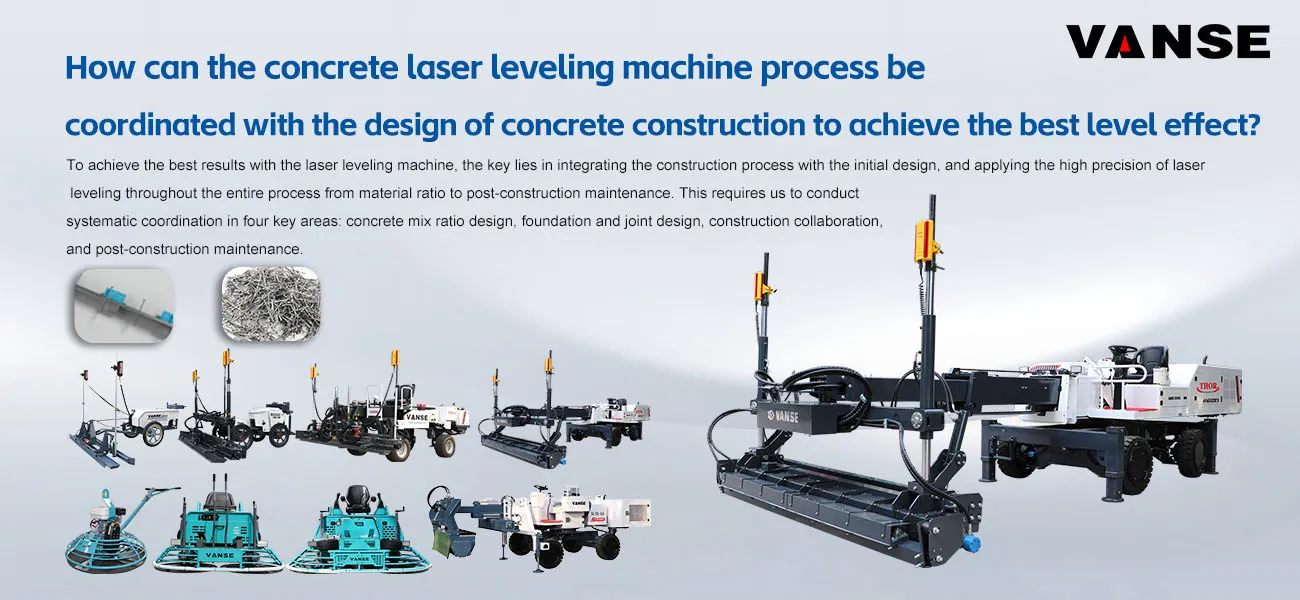
To achieve the best results with the laser leveling machine, the key lies in integrating the construction process with the initial design, and applying the high precision of laser leveling throughout the entire process from material ratio to post-construction maintenance. This requires us to conduct systematic coordination in four key areas: concrete mix ratio design, foundation and joint design, construction collaboration, and post-construction maintenance.
🏗 1. Concrete mix ratio design: Providing an ideal medium for laser leveling
Objective: To prevent problems before they occur and promptly identify potential issues through daily observation.
The high-frequency vibration and precise leveling of the laser leveling machine require that the concrete itself have good and stable working performance. Mix ratio design is the foundation.
| Design parameters | Recommendation requirements: | The influence on the laser leveling effect |
| Water-cement ratio | Not more than 0.5, no water addition allowed on site | Controlling the water-cement ratio can ensure the strength and volume stability of the hardened concrete, preventing shrinkage cracks or insufficient strength due to excessive moisture. Adding water on-site will disrupt the mix ratio, causing segregation and bleeding, which seriously affects the leveling accuracy. |
| Consistency | 14 ± 2 cm (maximum 16 cm) | This slump range can ensure that the concrete has good fluidity, facilitating the leveling by the laser leveling machine, while not being too thin to maintain the shape after leveling, which is the key to ensuring the stability of the leveling accuracy. |
| Setting time | Initial setting time controlled within 3-5 hours | It provides sufficient operation windows for the spreading, vibrating and repeated leveling of the laser leveling machine, ensuring the continuity of large-scale construction and avoiding cold joints. |
| Aggregate gradation | Maximum particle size of coarse aggregate ≤ 25 mm; sand ratio controlled within 35% – 40% | Good gradation can ensure the concrete is dense and uniform, avoiding surface defects (such as cracking and sanding) caused by aggregate segregation, creating a uniform working surface for laser leveling. |
📐 2. Foundation and Joint Design: Establishing the foundation for high-precision molding
Without a solid foundation and scientific joint design, the accuracy of laser leveling will be impossible to achieve.
Foundation preparation: Before concrete pouring, it is necessary to ensure that the base has been leveled, compacted, and precisely controlled in terms of elevation. This is the fundamental measure to prevent ground settlement and deformation after completion, thereby ensuring the final levelness.
Joint design:
Construction joints: In design, efforts should be made to minimize the occurrence of construction joints. When they cannot be avoided, a force transmission system should be set up. This can effectively transfer the load between the slabs and prevent misalignment at the joint, thus avoiding damage to the overall flatness of the ground.
Expansion joints/cutting joints: The design should clearly define the time and method for cutting the joints. To overcome concrete shrinkage and temperature stress, the cutting should be carried out as early as possible (usually within 24 hours), and the quality of the cutting should be strictly controlled to prevent the edges from cracking or the formation of irregular cracks.
🤝 3. Construction process collaboration: The perfect coordination of humans, machines and environment
The laser leveling machine is the core, but it cannot function without the close collaboration between humans and the environment.
Human-machine collaboration: The equipment operator is responsible for precise leveling, while 3-4 workers are needed to assist, responsible for quickly leveling the concrete, handling the formwork, the edges of columns, and the corner areas that the machine cannot cover. This "machine operator with human assistance" model is the key to ensuring overall flatness without any blind spots.
Process control:
Material supply stability: It is necessary to ensure continuous concrete supply (speed ≥ 40m³/h), and the slump and initial setting time of each truckload of concrete should be highly consistent to avoid affecting the construction quality and progress due to material fluctuations.
Leveling verification: During the leveling process, the ground elevation should be regularly rechecked to ensure that the laser emitter is working properly. Once any problems are identified, they should be immediately adjusted to prevent large-scale rework.
Environmental protection: The ground that has just been leveled must not be exposed to direct sunlight, strong winds, or rainwater. At the same time, the construction site should avoid electric welding operations and reflective objects to prevent interference with the reception of the laser signal.
🛡️ 4. Post-closure maintenance and treatment: Lock in and enhance the final effect
The later maintenance and surface treatment are the final procedures for protecting and enhancing the laser-levelled finished products.Timely maintenance: Use the maintenance agent compatible with the floor material for maintenance. This can form a high-density crystalline film, effectively locking in moisture and preventing concrete from developing dry shrinkage cracks or surface dusting due to rapid water loss, ensuring strength and flatness.
Wear resistance and joint sealing: For floors with wear resistance requirements, apply high-performance floor hardener at the appropriate time (determined by the concrete setting time). After cutting the joints, use polyurethane joint sealing adhesive of the same color as the floor to handle the joints, to ensure the tear resistance, aging resistance and aesthetic performance of the joints.
Summary
To achieve the best results with the laser leveler, it must be regarded as a systematic project. From the design stage, create the best conditions for this efficient and high-precision process, and strictly control the entire construction process.
If you can provide more information about your project, such as whether it is a logistics warehouse with super-leveling or a basement with decoration requirements, I can provide you with more targeted design suggestions. Contact us NOW
Note: The parameters provided in this document are for reference only and are not mandatory. Due to differences in technical characteristics between different brands and models of laser levelers, please consult the manufacturer for a suitable solution before actual operation. This reference document assumes no responsibility for any issues arising from failure to follow the manufacturer's instructions.
Thanks to All the Friends Who Support and Trust Shandong Vanse Machinery Technology Co., Ltd.
If you want to know more about Shandong Vanse Machinery Technology Co., Ltd. or have any questions, please feel free to contact us:
Our Factory
Shandong Vanse Machinery Technology Co., Ltd.








Share this article

About the Author: Shandong Vanse Machinery Technology Co., Ltd.
Shandong Vanse Machinery Technology Co., Ltd. is a high-tech manufacturer specializing in concrete construction machinery, including laser screeds and related equipment. The company integrates R&D, production, and global sales, with products exported to over 60 countries and widely used in infrastructure projects worldwide.
Previous Post
Next Post
Related Articles
You Might Also Like
What is the working principle of concrete laser leveling machine?
Concrete laser leveling machine is a kind of equipment used for concrete construction. Its working principle mainly involves laser technology and automatic control technology. The following is the working principle of concrete laser leveling machine 1. The laser transmitter emits a laser beam, which is projected onto the concrete surface. 2. The laser receiver receives the laser beam and detects the distance between the concrete surface and the laser beam. 3. After receiving the signal, the controller adjusts the horizontal movement mechanism and height adjustment mechanism of the leveler according to the received signal, so that the concrete surface and the laser beam are kept at a certain distance. 4. By constantly adjusting the position and height of the leveler, the concrete surface reaches the preset flatness requirements. Through this working principle, the concrete laser leveler can quickly and accurately complete the leveling work of the concrete surface, improving construction efficiency and quality.YZ28-4S Concrete Level Machine Summer Construction Considerations
The laser leveling machine plays a vital role as the main equipment for floor construction. When the summer comes, the floor construction will gradually enter the peak season, and it is very important to ensure the working condition of the equipment. High temperature construction in summer is also a test for concrete and concrete laser levelers. Do a good job in equipment maintenance and work to maximize the efficiency of the equipment. Learning equipment maintenance is not only related to the construction quality of the floor, but also related to the service life of the concrete laser leveling machine and construction safety. Do a good job in machine maintenance and guarantee your investment. This issue brings you the summer maintenance micro-classroom of the YZ28-4S/ YZ28-4. These two equipments are two four-wheel drive YZ28-4S that been developmented by VANSE or many years. YZ28-4S concrete leveling machine. two devices follow the excellent quality of the Hummer model, and the product development habits and requirements of domestic customers are fully considered in the product development process. Therefore, in addition to the performance guarantees of these two new products, the customer operating experience has also been significantly improved. Precautions: * Avoiding the engine too hot. Under normal circumstances, the temperature of the engine should not exceed 95°. If the temperature is too high, you should choose a cooler position to stop the cooling. When the machine is stopped, the hood can be ventilated and cooled. * To detect the amount of cooling water in time. When the water radiator reaches 100°, do not rush to add cooling water. Instead, stop the engine immediately after idling and then add coolant. * Clean the radiator timely. Includes coolant radiator / oil radiator / hydraulic oil radiator to prevent poor heat dissipation. * The construction temperature in summer is very hot, so it's better to check the wheels air pressure and temperature. If the temperature of the wheels too hot, . If the temperature of the tire is too high, stop it in time and place it in a cool place to cool down. Avoiding use the wrong method of deflation or cold water to cool down. * Maintenance-free batteries need to be checked frequently for their working conditions. The observation hole shows that green represents normal. * Prevent engine knocking .Before entering the summer, the carbon deposits in the combustion chamber, valve top and other parts should be completely removed to maintain good heat dissipation and normal compression ratio; it is necessary to check and adjust the fuel supply advance angle to prevent engine deflagration. * Always check the temperature of the hydraulic oil and hydraulic transmission oil . If the temperature is too high, stop it and stop it. Do not operate at high temperatures. * In summer, the concrete solidifies at a faster speed, so it is necessary to clean the equipment in time, otherwise it will cause damage to the machine. If yoour machine happen somethings wrong, do not worry! When choose VANSE, also choose the 100% perfect after-sales system, "zero-distance" of VANSE and our equipment, We offer 24 hours and 365 days safty after-sales, if your machine had something wrong on the working, welcome to contact us at anywhere and anytime! Our after- sales engineer will get in touch with you at first.How operable is the concrete laser leveling machine?
The operability of a concrete laser leveling depends largely on the skill and experience of the operator, as well as the model and capabilities of the machine. The following is a detailed analysis of the operability of concrete laser leveling machines: ☛Ease of operation: The concrete laser leveling machine should have a simple design and a friendly operating interface for easy understanding and use. Some advanced machines may be equipped with automated functions, such as automatic navigation, automatic leveling, etc., which can greatly simplify the operation process. ☛Safety: Since the concrete laser leveling is a heavy machine, its operation should focus on safety. Operators should receive appropriate training and understand the machine's capabilities, limitations, and operating procedures. During operation, safety regulations should be followed and attention should be paid to protecting the safety of yourself and others. ☛Accuracy: The concrete laser leveler should have high-precision leveling capabilities. Using laser technology, the flatness and precision of the plane can be ensured. In addition, some advanced machines may be equipped with sensors and feedback systems to monitor and adjust the smoothing process in real time. ☛Adaptability: The concrete laser leveling machine should have good adaptability and be able to cope with different construction environments and requirements. For example, the machine should be able to operate on various types of concrete floors, while also being able to adapt to different construction processes and specifications. ☛Maintenance: The maintenance of the concrete laser leveling is crucial to ensure its operability. Operators should understand the maintenance requirements of the machine and perform regular maintenance. At the same time, any faults or problems should be repaired promptly or professional help should be sought. ☛Cost-Effectiveness: The cost-effectiveness of a concrete laser leveling is an important factor considering its operability. Although the one-time investment of such a machine may be higher, its long-term operating costs may be lower because construction efficiency can be improved and labor costs and material waste reduced. In addition, the reliability and durability of the machine are also important factors in assessing its cost-effectiveness. ☛Sustainability: Sustainability is also an important consideration when choosing a concrete laser leveling. Machines that use environmentally friendly energy sources, such as electricity or solar energy, should be chosen to reduce carbon emissions and impact on the environment. In addition, it is crucial to choose machine parts that can be recycled and reused. ☛Training and support: After purchasing a concrete laser leveling machine, the operator may need to receive relevant training to understand the machine's performance, operation and maintenance. The supplier or manufacturer should provide the necessary training and support to ensure that operators can take full advantage of the machine's capabilities. ☛After-sales service: Choosing a manufacturer that provides comprehensive after-sales service can ensure timely help when problems arise with the machine. This will help reduce downtime and increase productivity. ☛Future development: As technology continues to advance, concrete laser levelings may become more advanced and intelligent. Considering the needs of future development, you can choose machines with upgrade potential and adaptability to future construction requirements. In summary, the operability of a concrete laser leveling depends on the combined influence of several factors. When selecting and using such machinery, factors such as its design, performance, adaptability and support should be fully considered to ensure efficient, safe and sustainable construction results.