Technical Knowledge
Routine inspection of the power trowel’s hydraulic system
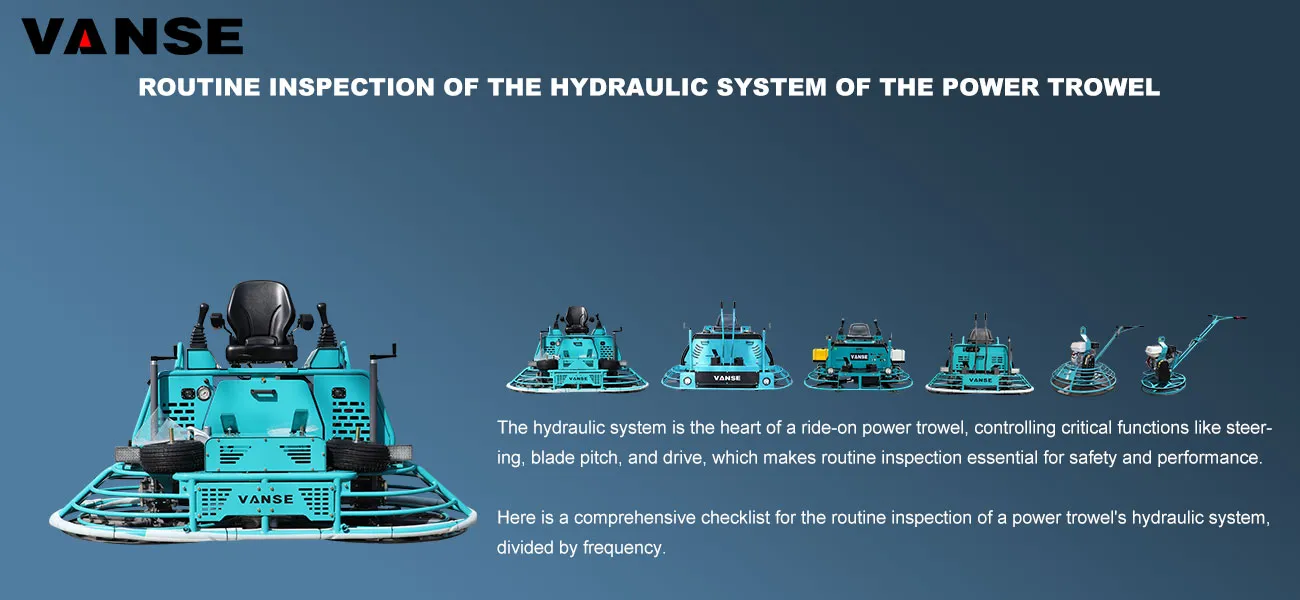
The hydraulic system is the heart of a ride-on power trowel, controlling critical functions like steering, blade pitch, and drive, which makes routine inspection essential for safety and performance.
Here is a comprehensive checklist for the routine inspection of a power trowel's hydraulic system, divided by frequency.
📅 Routine Hydraulic System Inspection Checklist
The manufacturer's manual always provides the definitive schedule and procedures. The following is a general guide.
1. 🔍 Daily Pre-Operation Checks (Visual and Auditory)
These checks are performed before starting the machine for the day.
| Component | Inspection Focus | Action/Symptom to Look For |
| Hydraulic Fluid Level | Reservoir | Check the sight glass or dipstick for the correct level. Low fluid can cause the pump to draw in air (aeration). |
| Fluid Condition | Fluid Sample | Visually check the fluid color. Look for milky/cloudy fluid (water contamination) or black/burnt fluid (overheating/oxidation). |
| Hoses, Lines, and Fittings | Entire System | Inspect all hoses, tubes, and connections. Look for leaks (oil seepage or drips), bulges, cracks, abrasions, or chafing where lines rub against the frame. |
| Pump and Motor | Pump Casing | Check the pump and connections for signs of oil seepage or external leaks. |
| Hydraulic Cylinders | Rod Surfaces | Inspect the exposed cylinder rods for pitting, scoring, or corrosion. A film of oil around the rod seals indicates a potential leak. |
| Initial Operation | Auditory Check | Start the engine and listen to the pump. Listen for unusual noises like a loud whining/gurgling (aeration/cavitation), knocking, or vibration. |
2. ⚙️ Weekly/Monthly Detailed Checks
These checks often require the machine to be running or a closer look at specific components.
| Component | Inspection Focus | Action/Symptom to Look For |
| System Performance | Controls | Test the pitch control, steering, and any hydraulic drive functions. Movement should be smooth and responsive. Slow, erratic, or jerky operation suggests low pressure or air in the system. |
| System Temperature | Reservoir/Hoses | After running the machine, check the temperature of the reservoir (using an infrared thermometer, if available). Excessive heat ($>180^\circ$F or per manual) indicates an issue with the cooler or internal leakage. |
| Filter Indicator | Pressure Gauge/Button | Check the filter's differential pressure indicator (if equipped) for a "pop-out" button or high reading, which signals a clogged filter that needs immediate replacement. |
| Breathers and Vents | Reservoir | Inspect the breather caps and fill screens. Ensure they are clean and not allowing dirt or contaminants to enter the reservoir. |
| Pressure Relief Valve (PRV) | Under Load | (Advanced/Technician) Verify the set pressure using a calibrated gauge and listen for chattering noise under load, which suggests a possible malfunction. |
3. 🗓️ Scheduled Maintenance (Based on Hours/Time)
These tasks are crucial for preventing long-term damage caused by contamination and fluid breakdown. Always consult the manufacturer's maintenance hour guide.
| Service Task | Typical Interval | Rationale |
| Hydraulic Fluid Change | Annually or Every 1,000–2,000 Hours | Old oil loses its viscosity, anti-wear properties, and thermal stability, leading to excessive wear and heat. |
| Hydraulic Filter Replacement | First Change: 50–100 Hours (Break-In) | Removes contaminants generated during the initial break-in period. |
| Hydraulic Filter Replacement | Every 250–500 Hours (or with oil change) | Filters are essential for removing abrasive particulate contamination which is the #1 cause of component wear. |
| Reservoir Cleaning | With every major oil change | Cleaning the reservoir removes settled sludge and debris, including cleaning the suction strainer. |
| Fluid Sampling (Oil Analysis) | Every 500–1,000 Hours | A lab analysis provides the most accurate measure of contamination (particulate count, water, metal) and fluid health, allowing you to safely extend change intervals. |
Common Hydraulic System Problems in Power Trowels
| Symptom | Probable Cause | Immediate Action |
| Erratic or Slow Operation | Air in the system (aeration), low fluid level, or worn pump/valve. | Bleed the system to remove air; check fluid level and top off. |
| Excessive Noise (Whining/Gurgling) | Air ingestion (leak in the suction line) or low fluid level causing cavitation. | Find and seal the air leak (often a loose fitting); check and fill the fluid. |
| Overheating Fluid | Low fluid level, clogged oil cooler/fins, or internal component leakage (e.g., in a cylinder or valve). | Clean cooler fins; check fluid level; inspect for internal leaks. |
| Blade Pitch Drift/Will Not Hold Angle | Internal leakage within the hydraulic cylinder seals or the pitch control valve. | Consult a technician for seal replacement or valve repair. |
Would you like to review the engine maintenance checklist for a ride-on power trowel, as it is closely tied to hydraulic pump performance?
Note: The parameters provided in this document are for reference only and are not mandatory. Due to differences in technical characteristics between different brands and models of laser levelers, please consult the manufacturer for a suitable solution before actual operation. This reference document assumes no responsibility for any issues arising from failure to follow the manufacturer's instructions.
Thanks to All the Friends Who Support and Trust Shandong Vanse Machinery Technology Co., Ltd.
If you want to know more about Shandong Vanse Machinery Technology Co., Ltd. or have any questions, please feel free to contact us:
Our Factory
Shandong Vanse Machinery Technology Co., Ltd.








Share this article

About the Author: Shandong Vanse Machinery Technology Co., Ltd.
Shandong Vanse Machinery Technology Co., Ltd. is a high-tech manufacturer specializing in concrete construction machinery, including laser screeds and related equipment. The company integrates R&D, production, and global sales, with products exported to over 60 countries and widely used in infrastructure projects worldwide.
Previous Post
Next Post
Related Articles
You Might Also Like
What Kind Of Consumables Do Concrete Laser Leveling Need?
Concrete laser leveling machine is a kind of equipment used in concrete construction. Its function is to achieve flatness and smoothness of the concrete surface. In the process of using the concrete laser leveling machine, some consumables are needed to ensure the normal operation and construction effect of the equipment. Here are some supplies you may need for your concrete laser leveling: 1. Laser: One of the main components of the concrete laser leveling machine is the laser, which is used to emit laser beams to control the flatness and height of the concrete surface. Therefore, the quality and performance of the laser have an important impact on the effectiveness and service life of the leveler. 2. Laser head: The laser head is the key component of the laser. It is responsible for focusing and projecting the laser beam onto the concrete surface. The quality and performance of the laser head will also affect the effectiveness and service life of the leveler. 3. Mixer: Concrete laser leveling machines are usually equipped with a mixer, which is used to mix the concrete evenly to ensure the construction effect. The quality and performance of the agitator also affects the effectiveness and service life of the leveler. 4. Filter element: The concrete laser leveling machine will inhale a large amount of dust and debris during operation, so a filter element is needed to filter the air to ensure the normal operation of the equipment and construction results. 5. Lubricant: The concrete laser leveling needs regular lubrication to reduce wear and failure. Therefore, lubricating oil is needed to lubricate various parts of the equipment. 6. Cleaning agent: During the operation of the concrete laser leveling machine, it will be affected by dust, debris and other dirt, so cleaning agents need to be used to clean the equipment. In addition, the concrete laser leveling machine also needs some other accessories and tools to clean the equipment. Auxiliary construction, such as scrapers, trowels, measuring rulers, etc. The quality and performance of these accessories and tools will also affect the effectiveness and service life of the leveler In short, the consumables of the concrete laser leveling need to be determined according to the specific model and usage of the equipment. When choosing consumables, you need to choose brands and models with reliable quality and stable performance to ensure the normal operation of the equipment and construction results. At the same time, it is also necessary to regularly inspect and maintain the equipment, promptly replace damaged parts and replenish consumables to ensure the long-term stable operation and service life of the equipment.The role of concrete floor grinders in refining the flatness of laser-leveled surfaces
While a laser Leveling is a marvel of engineering for placing high-volume, high-tolerance floors, it is essentially a "macro" tool. It sets the stage, but when specifications demand Superflat tolerances (like Category 1 or VNA-Very Narrow Aisle warehouses), the concrete floor grinder steps in as the "micro" refinement tool. Here is how grinding bridges the gap between a good pour and a perfect surface. Even the best laser Leveling can leave behind subtle periodic waves caused by the vibration frequency of the Leveling head or slight settling of the concrete. The Problem: These waves might only be 1–2 mm high, but at high speeds, a forklift will feel them as significant vibrations. The Solution: Heavy-duty planetary grinders equipped with coarse metal-bond diamonds act as a "plane." Because the machine has a large, rigid footprint, it bridges the valleys and shaves off the peaks (high spots), effectively flattening the Waviness Index. One of the biggest enemies of laser-leveled floors is drying shrinkage, which causes the edges of the concrete slabs to "curl" upward at the saw-cut joints. The Impact: A floor that was perfectly level on day 1 may have "steps" at the joints by day 28. The Refinement: Grinders are used to "chase" these joints. By grinding across the joint, the machine transitions the height difference into a long, imperceptible slope, ensuring smooth wheel transitions for equipment. In the world of floor tolerances, we use F-numbers to measure quality: FF (Flatness): Relates to the bumpiness of the surface. FL (Levelness): Relates to the tilt of the slab. Laser leveling is excellent at achieving high FF (Levelness) because it follows a laser plane. However, achieving an FF (Flatness) above 60 or 80 usually requires mechanical grinding. The grinder removes the "noise" in the data, smoothing out the micro-texture that a Leveling simply cannot address. Feature Laser Leveling (Placement) Floor Grinder (Refinement) Primary Goal Bulk leveling and consolidation. Precision flattening and smoothing. Tolerance Range Good to Great (FF 25–45). Exceptional (Up to FF 100+). Material State Wet/Plastic concrete. Cured/Hardened concrete. Surface Profile Closed-face (cream) finish. Refined, open, or polished finish. For high-spec projects, contractors use a "Measure-Grind-Measure" loop: Initial Measurement: Use a floor profiler (like a Dipstick) to map the high and low spots of the laser-leveled floor. Targeted Grinding: The grinder is used specifically on the "red zones" (high spots) identified by the software. Verification: The floor is re-measured to ensure it meets the Narrow Aisle (VNA) specification. Note: Grinding to refine flatness is different from grinding for aesthetics. In flatness refinement, the goal is stock removal (shaving the concrete), which often exposes the aggregate. If the client wants a uniform look, the entire floor must be ground to the same depth. Would you like me to explain the different types of diamond grit sequences used for stock removal versus final polishing? Contact us NOW Note: The parameters provided in this document are for reference only and are not mandatory. Due to differences in technical characteristics between different brands and models of laser levelers, please consult the manufacturer for a suitable solution before actual operation. This reference document assumes no responsibility for any issues arising from failure to follow the manufacturer's instructions.Does the operating skills of power trowel machine have a big impact on the trowel effect?
– Correct starting position: When starting the trowel, it is important to place it in an area where the concrete surface is flat and has been preliminarily processed (such as vibrated and scraped). If it is started in an uneven place or with debris, the trowel will be subject to uneven resistance at the beginning, which may cause the trowel blade to jump, thereby affecting the trowel effect. For example, on the newly poured concrete floor, if there are protruding stones or uncompacted parts, after starting the trowel, the trowel blade is likely to vibrate here, causing wavy patterns on the surrounding ground. – Stable starting speed: Starting the trowel smoothly can avoid the trowel blade suddenly accelerating and causing impact on the ground. For electric trowels, avoid quickly connecting the power supply to cause the motor to run at a high speed instantly; for gasoline trowels, when starting, you should follow the operating procedures and slowly pull the starting rope to allow the engine to gradually reach the working speed. If the starting speed is too fast, the impact force between the trowel and the ground is too large, which may leave scratches on the ground or cause partial peeling of the mortar layer on the concrete surface. – Travel speed control: The travel speed of the trowel directly affects the quality and efficiency of the trowel. If the speed is too fast, the trowel will stay in each area for too short a time, and the concrete surface cannot be fully compacted and smoothed, which can easily cause the ground to be rough and uneven. If the speed is too slow, although the trowel effect can be more refined, it will reduce work efficiency. For example, when troweling a large area of industrial plant floor, it is generally more appropriate to keep the travel speed at 3-5 meters per minute, which can not only ensure the quality of troweling, but also improve work efficiency to a certain extent. – Travel track planning: A reasonable travel track can make the trowel effect more uniform. Usually, a zigzag, circular or spiral travel track is used. The zigzag track is suitable for narrow and long areas, so that the trowel can fully cover every corner; the circular and spiral tracks are suitable for large circular or square areas, which can ensure that the trowel can evenly trowel from the center to the periphery or from the periphery to the center. If the walking track is chaotic, such as turning randomly or repeatedly over-troweling in certain areas, it will cause uneven troweling of the ground, high and low differences or local over-troweling. – Adjust pressure according to stage: Different pressures need to be applied at different stages during the troweling process. In the rough grinding stage after the initial setting of concrete, a larger pressure can be appropriately applied to compact the concrete surface and eliminate bubbles and pores. In the fine grinding stage, the pressure should be reduced so that the trowel slides gently on the ground, mainly used to improve the finish of the ground. For example, during rough grinding, the hand-held trowel can increase the pressure by pressing the operating handle appropriately; during fine grinding, the handle is relaxed to let the trowel contact the ground naturally. If the pressure is not properly controlled, excessive pressure during the fine grinding stage may damage the ground that has been initially leveled, resulting in new scratches and unevenness. – Importance of even pressure: Ensure that pressure is evenly distributed on the trowel blade, whether in the rough or fine grinding stage. Uneven pressure can cause some parts of the trowel blade to exert too much force on the ground, while other parts exert insufficient force, resulting in local unevenness and inconsistent gloss on the ground. Operators need to achieve even pressure through skilled operation and good control of the trowel. – Special tools or techniques for corners: For areas such as corners and edges that are difficult for the trowel to cover directly, operating skills are particularly critical. You can use a small handheld trowel or a special corner trowel tool for processing. When using a handheld trowel, keep it perpendicular to the corner or edge and rotate it slowly with a small radius to ensure that the concrete in the corner can be fully compacted and smoothed. Without the correct corner treatment skills, these areas can easily be overlooked, resulting in uneven and rough corners, affecting the finishing quality of the entire floor.