Technical Knowledge
How can ride-on concrete laser leveling machines be designed to reduce operator fatigue?
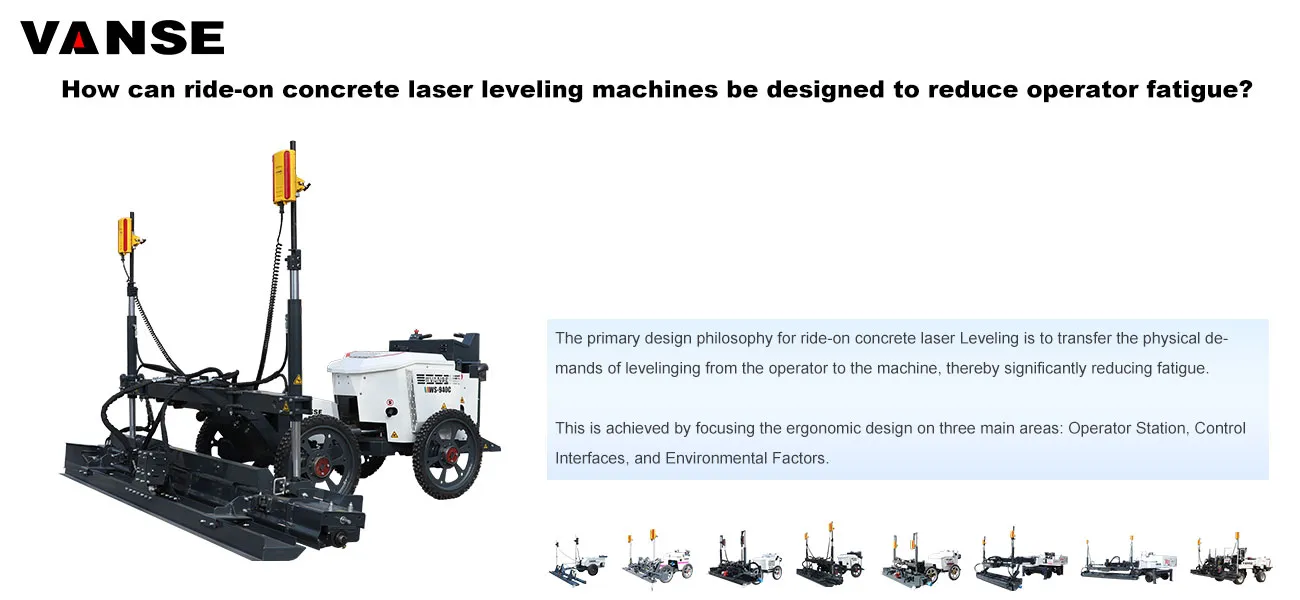
The primary design philosophy for ride-on concrete laser Leveling is to transfer the physical demands of levelinging from the operator to the machine, thereby significantly reducing fatigue.
This is achieved by focusing the ergonomic design on three main areas: Operator Station, Control Interfaces, and Environmental Factors.
Here are the specific ways ride-on laser leveling machines can be designed to reduce operator fatigue:
1. Ergonomic Design of the Operator Station
The goal is to provide a comfortable, supportive, and variable working posture, minimizing static load and awkward positions.
Advanced Seating Systems:
Air-Ride/Suspension Seats: These seats absorb shock and whole-body vibration transmitted through the machine's frame, which is a major contributor to back pain and fatigue in heavy equipment. The suspension should be adjustable based on the operator's weight.
Full Adjustability: The seat must offer multi-way adjustments (height, depth, recline, lumbar support, and armrests) to ensure the operator can maintain a neutral posture with elbows close to the body and feet resting comfortably on the pedals/platform.
Heated/Ventilated Options: In extreme climates (hot or cold), temperature regulation prevents fatigue caused by thermal stress.
Postural Variety:
Seated and Standing Platforms: Offering an option to switch between a seated position and a padded standing platform allows the operator to vary their posture throughout a long shift, preventing fatigue from holding a single, static position (a key risk factor for WMSDs).
Optimized Visibility:
Improved Sightlines: The cabin design, including large windows and strategic mirror/camera placement, should provide a clear, unobstructed view of the leveling head, the laser receivers, and the concrete surface. This minimizes the need for the operator to twist or strain their neck and torso.
2. Intuitive and Low-Effort Control Interfaces
Fatigue is accelerated by high-force, repetitive, or complex control inputs.
Low-Force Joysticks and Proportional Controls:
Heavy mechanical levers are replaced with low-force, electronic joysticks for steering, boom extension, and leveling head articulation. The force required to operate controls should be minimal (less than 10% of maximum grip strength).
Proportional Hydraulics allow for smooth, predictable, and precise machine movement, reducing the micro-corrections and physical effort needed to maintain accuracy.
Centralized and Reach-Optimized Panels:
Frequently used buttons, dials, and emergency stops should be positioned within the operator's "primary reach zone" (the arc swept by a relaxed arm), eliminating awkward stretching or leaning.
Clear Display Interfaces:
Anti-glare, high-resolution display screens (like anti-glare LCDs) placed at or just below eye level provide essential data (levelness, diagnostics) without forcing the operator to repeatedly look down or strain their eyes.
3. Environmental and Operational Mitigation
External factors like noise and vibration are directly linked to decreased alertness and increased fatigue.
Vibration Dampening:
Isolation Mounts: Utilizing advanced suspension and dampening mounts between the engine, hydraulic components, and the operator's platform/cab to minimize the transmission of vibrations.
Noise Reduction:
Acoustic Insulation: Insulated engine compartments and the use of quieter, modern engines or electric power options reduce noise levels in the operator's environment, preserving concentration and reducing fatigue-inducing stress.
Air Quality and Climate Control:
HVAC Systems: Climate-controlled cabs (if enclosed) or strategic airflow management (like "air curtains" on open models) maintain a comfortable temperature and humidity.
Fume Extraction/Filtration: For indoor pours, proper ventilation and filtration (or fully electric models) remove harmful exhaust fumes, which can cause headaches and fatigue.
Automated and Smart Features:
Soft-Landing Feature: Advanced control systems that automatically slow the leveling head as it approaches the concrete surface ensure a smooth, precise landing, eliminating the jarring shock and mental effort required for a manual "perfect land."
360° Rotation and Multiple Steering Modes: Features like crab-steer and full frame rotation (on boomed models) simplify repositioning, allowing the operator to maneuver the machine with less mental and physical effort.
By incorporating these ergonomic features, manufacturers ensure the operator remains productive, focused, and comfortable for the duration of long concrete placement jobs.
Would you like to explore the specific technical challenges involved in implementing air-ride seats in construction equipment?
Note: The parameters provided in this document are for reference only and are not mandatory. Due to differences in technical characteristics between different brands and models of laser levelers, please consult the manufacturer for a suitable solution before actual operation. This reference document assumes no responsibility for any issues arising from failure to follow the manufacturer's instructions.
Thanks to All the Friends Who Support and Trust Shandong Vanse Machinery Technology Co., Ltd.
If you want to know more about Shandong Vanse Machinery Technology Co., Ltd. or have any questions, please feel free to contact us:
Our Factory
Shandong Vanse Machinery Technology Co., Ltd.








Share this article

About the Author: Shandong Vanse Machinery Technology Co., Ltd.
Shandong Vanse Machinery Technology Co., Ltd. is a high-tech manufacturer specializing in concrete construction machinery, including laser screeds and related equipment. The company integrates R&D, production, and global sales, with products exported to over 60 countries and widely used in infrastructure projects worldwide.
Previous Post
Next Post
Related Articles
You Might Also Like
How does a concrete laser leveling machine work?
How does a laser leveling work? Do you know the leveling process of laser leveling machine? For how to do a good job in floor engineering, the selection of materials and construction technology are equally important. Laser leveling machine is also the key point that needs to be grasped in the construction process. Industrial plants have high requirements on the flatness of the ground level and surface resistance. Manual construction is difficult to grasp and control, and it is difficult to achieve standardized construction. The following articles are how to construct laser leveling machines and precautions, and how to avoid construction errors. 1 The construction of the floor project needs to be fully prepared. From laying the base and steel mesh – setting the dowel bar – placing the buffer zone – concrete mixing, every step is carefully grasped the details. (1) After the base layer is processed, the equipment of the laser paver is debugged, and the original benchmark point is used as the fixed reference level point; the non-woven fabric is laid, the side formwork is supported, the laser transmitter is erected, and the ground level is introduced into the laser leveling machine according to the original benchmark point. (2) Commercial concrete is used for transporting concrete, and the commercial concrete is transported to the entrance and exit of the garage by tank truck, and then transported to the construction site by a three-wheel dump truck. (3) Scale calibration Use a hand-held laser receiver to check the floor elevation, introduce the elevation into the laser paver, and adjust the reference point (±0.00) on the leveling machine. 2 The concrete mixed in the mixing station is pumped and paved on the gravel base. The paving speed of the laser leveling machine should be appropriate, and the paving can be quickly assisted by manual paving. 3 About 3-4 hours after the concrete is paved by the laser leveler, the best time is when there are no clear footprints after the master. Use a single-disc or double-disc trowel, install a rubbing disc, and rub it repeatedly during the initial setting of the concrete until the concrete slurry is released. Use a single-disc and double-disc trowel, install a smoothing disc, and rub it repeatedly when the concrete bleeds and initially sets until the concrete slurry is released. 4 It is recommended to throw the specified amount of wear-resistant material evenly on the concrete surface just after the grout is broken, and the places that lose water quickly near the formwork, columns, doorways, walls, and pits should be thrown first. Depending on the specific conditions, special materials can be thrown in more than two times. 2/3 of the amount of the first throwing; the remaining 1/3 of the second throwing; the time interval between the two spreading of aggregate should not be too long. 5 After the aggregate is sprinkled once, after the aggregate absorbs the coagulated water, the aggregate is polished and compacted with a trowel, and then the aggregate is sprinkled for the second time, and the compacted aggregate is polished with a trowel. The amount of wear-resistant aggregate is not less than 5kg/㎡. During the grinding and compacting process, a ruler can be used to assist scraping. If it is not smooth, adjust the distribution of aggregates and grind again. The number of grinding times of the laser leveling machine can be operated by construction personnel according to specific conditions. The corners are scraped manually. The front and back grinding directions are criss-crossed, and the flatness is checked with a ruler after the grinding is completed. 6 Depending on the hardening of the concrete, perform at least three trowel operations without discs after the surface has faded. The operation speed and angle of the trowel should be adjusted according to the hardening of the concrete. It is recommended to adjust the angle of the blade at the beginning of each finishing to avoid damage to the floor. 7 After scientifically completing the laser leveling machine construction process, it takes more than 28 days to maintain the floor. After the construction is completed, sprinkle water for maintenance, and lay geotextiles to reduce water evaporation and keep the wear-resistant floor after construction in water. 8 Cut the expansion joints after the concrete has been watered and cured for 24 hours. Because the interval between the wall pillars is about 7 meters, which meets the requirements of the expansion joint gap, the expansion joints are mainly distributed according to the structure of the wall pillars, forming a layout of 7m*7m; the depth is about 6-7cm, and the gap is about 5mm.What are the maintenance methods for laser concrete leveling machines?
The maintenance method of concrete laser leveling machine is crucial to the normal operation and service life of the equipment. The following will introduce the maintenance methods of concrete laser leveling machine. 1. Daily maintenance After daily use, routine maintenance should be performed to ensure the normal operation of the equipment and extend its service life. Routine maintenance mainly includes the following aspects: ▼Clean the dust and debris on the surface of the equipment and keep the surface of the equipment clean. ▼Check whether the various connection parts of the equipment are loose or falling off, and tighten them in time. ▼Check whether the running parts of each part are flexible and reliable, and apply grease regularly to prevent parts from wearing out. ▼Check whether the photoelectric sensor is clean and sensitive, and remove dust and debris in time to prevent photoelectric sensor failure. ▼Check whether the power supply, control circuit and other components are normal, and repair them in time if there are any abnormalities. 2. Regular inspection and maintenance Regular inspection and maintenance are important measures to ensure the long-term normal operation of the concrete laser leveling machine. Regular inspection and maintenance mainly include the following aspects: ▼Regularly check whether the power cords, control lines and other lines are damaged or aged, and repair or replace them in time if necessary. ▼Regularly check the wear of various components, such as bearings, gears and other components, and replace seriously worn components in a timely manner. ▼Regularly check the accuracy and stability of equipment, such as laser heads, sensors and other components, and adjust or replace components in a timely manner. ▼Regularly check whether the electrical components of the equipment are working properly, such as electrical control boxes, motors and other electrical components, and replace damaged electrical components in a timely manner. ▼Perform regular comprehensive inspections and maintenance of equipment to ensure normal operation and extend service life of the equipment. 3.Special maintenance Special maintenance is a deeper maintenance based on daily maintenance and regular inspection and maintenance. Special maintenance mainly includes the following aspects: ▼Carry out comprehensive cleaning and maintenance of the equipment to remove dirt and debris on the surface of the equipment to ensure the normal operation of the equipment. ▼Disassemble and clean the equipment, remove debris and dust inside the equipment, and ensure the normal operation of the equipment. ▼Carry out comprehensive inspection and maintenance of the electrical components of the equipment, remove dust and debris on the surface of the electrical components to ensure the normal operation of the electrical components. ▼Inspect and maintain the hydraulic system of the equipment, remove debris and dust inside the hydraulic system to ensure the normal operation of the hydraulic system. ▼Inspect and maintain the laser head of the equipment, remove dirt and debris on the surface of the laser head, and ensure the normal operation of the laser head. To sum up, the maintenance methods of concrete laser leveling mainly include daily maintenance, regular inspection and maintenance and special maintenance. In order to ensure the normal operation of the equipment and extend its service life, operators should be proficient in maintenance methods and perform maintenance in strict accordance with the requirements. At the same time, the daily use and storage of equipment should be strengthened to avoid unnecessary damage and waste.The correct way to store power trowels for a long time
The long-term storage of the power trowel machine during the off-season of construction or during project intervals (usually referring to more than one month) is of vital importance. Proper storage and maintenance can greatly prevent equipment from rusting, aging and being damaged, ensuring that its performance remains as good as new when it is used again and extending its service life. The following is the standard "seven-step method" for the long-term storage of a power trowel. Please be sure to follow the sequence. This is the foundation of all steps and must never be stored with cement slurry on the machine. High-pressure flushing: Use a high-pressure water gun or a large amount of clean water to thoroughly rinse all parts of the machine body, blades, chassis, walking wheels, etc., and remove all cement, mortar, and mud lumps. Pay special attention to cleaning the connection area of the blade, the lifting screw and the area around the bearing sealing ring. Detail cleaning: Use tools such as scrapers and wire brushes to remove stubborn lumps. Comprehensive inspection: During the cleaning process, check whether the blades are worn or deformed, whether the screws and nuts are loose, whether the machine body is cracked, and whether the cables/oil pipes are damaged. Record the problems to facilitate subsequent maintenance. Move the machine to a well-ventilated, dry and rain-free indoor storage point. Dry/blow dry all surface moisture with a dry cloth or compressed air, especially: Exposed metal parts (lifting screw, adjusting rod). Blade. Engine surface. All oil injectors and gaps. Make sure that the inside and outside of the machine are completely dry, with no signs of dampness at all. Drain the old grease and add new grease: Use a grease gun to inject an adequate amount of new grease into all grease nozzles (spindle of the cutter head, bearings of the traveling wheels, steering mechanism, etc.) until all the old grease that may contain water is completely squeezed out. This can expel moisture and form a protective film inside. Apply anti-rust oil to key areas: Apply a layer of anti-rust oil or grease to all exposed metal surfaces prone to rust (non-friction contact surfaces). Key points include: Lifting screw and thread: Thickly coated with grease. Blade: Apply a thin layer of anti-rust oil to both sides (wipe it off before reuse). Chassis metal frame. Exposed bolts and nuts. Engine maintenance (for gasoline/diesel engines) : Change the engine oil: Drain the old oil when the engine is hot and add new oil to the specified mark. Fuel system treatment (crucial!)" : Option A (Recommended) : Completely drain the fuel from the fuel tank. Then start the engine and let it shut down naturally to deplete the residual fuel in the carburetor or fuel lines. Option B: If it is impossible to empty the fuel tank, fill it up with fuel and add fuel stabilizer. Then run the engine for 5 to 10 minutes to allow the stabilizer to circulate throughout the fuel line. This can prevent the fuel from gelatinizing and clogging the carburetor and fuel injector. Spark plug/fuel injector: Remove the spark plug, inject a small amount (about 10-15ml) of engine oil into the cylinder, manually and slowly pull the start rope several times to coat the cylinder wall with the engine oil, and then reinstall the spark plug (without connecting the high-voltage wire). Disconnect the battery: If the machine has power to start the battery, the negative cable should be disconnected. Remove the battery, store it in a cool and dry place, and perform a charge maintenance every 1 to 2 months. Protect the circuit: Wrap the exposed circuit joints with waterproof tape. Air filter: Remove the air filter, clean or replace it. Stuff a clean cloth into the air intake to prevent dust from entering. Tire: Lift the machine up to lift the tire off the ground to prevent the tread from being deformed and aged due to long-term single-point pressure. If it cannot be lifted, make sure the tire pressure is sufficient and move the position regularly. Blade: The blade can be removed. After cleaning, apply anti-rust oil separately and store it. Or at least ensure that rust prevention measures have been taken on the machine. Ideal environment: In a dry, cool and well-ventilated warehouse or shed. Avoid outdoor storage. Stay away from corrosion: Keep away from fertilizers, chemicals and damp ground. Stable placement: Place the machine on a flat ground and level it with wooden blocks if necessary. Cover: Use a breathable dust cover (such as a canvas cover) to cover the entire machine. It is strictly prohibited to directly wrap with completely impermeable plastic sheeting, otherwise water vapor will condense inside, causing severe rust. Marking: Hang a label that reads "Maintained and ready for storage" in a prominent position, and indicate the storage date and the date when the next inspection is required. Storage period: Every 1-2 months, check the machine for any abnormalities (such as tire pressure, the integrity of the covering, and whether there is any rat damage or wire biting), and recharge the battery. Before reactivation (very important!)" : Remove the coverings and check the overall condition. Check whether the grease in all parts has hardened and replenish or replace it if necessary. Reinstall the battery (if it has been removed) and connect it firmly. Remove the blockage at the air intake and reinstall the air filter. Wipe off the excess anti-rust oil from the key friction areas (such as the contact surface between the blade and the ground). Check the fuel and engine oil according to the normal start-up procedure, and then start the machine. First, run it at low speed without load for a few minutes to allow all components to lubricate and circulate. Only after there are no abnormal sounds can it be put into construction. Cleanliness is the prerequisite: no cement residue. Drying is fundamental: eliminate moisture. Lubrication and rust prevention are key: putting on a "protective suit" for metals. The fuel system needs to be properly handled: to prevent clogging. It's better to store off the ground: protect the tires. Regular inspections are indispensable: dynamic management. By following the above methods, your power trowel machine can quickly regain its "combat effectiveness" even after being idle for several months, effectively avoiding problems such as difficult startup, component jamming, and rust damage, truly achieving "always on standby, reliable and durable". Note: The parameters provided in this document are for reference only and are not mandatory. Due to differences in technical characteristics between different brands and models of laser levelers, please consult the manufacturer for a suitable solution before actual operation. This reference document assumes no responsibility for any issues arising from failure to follow the manufacturer's instructions.