Technical Knowledge
Precision Control Principle of Laser Leveling Machine in Superflat Floor Construction
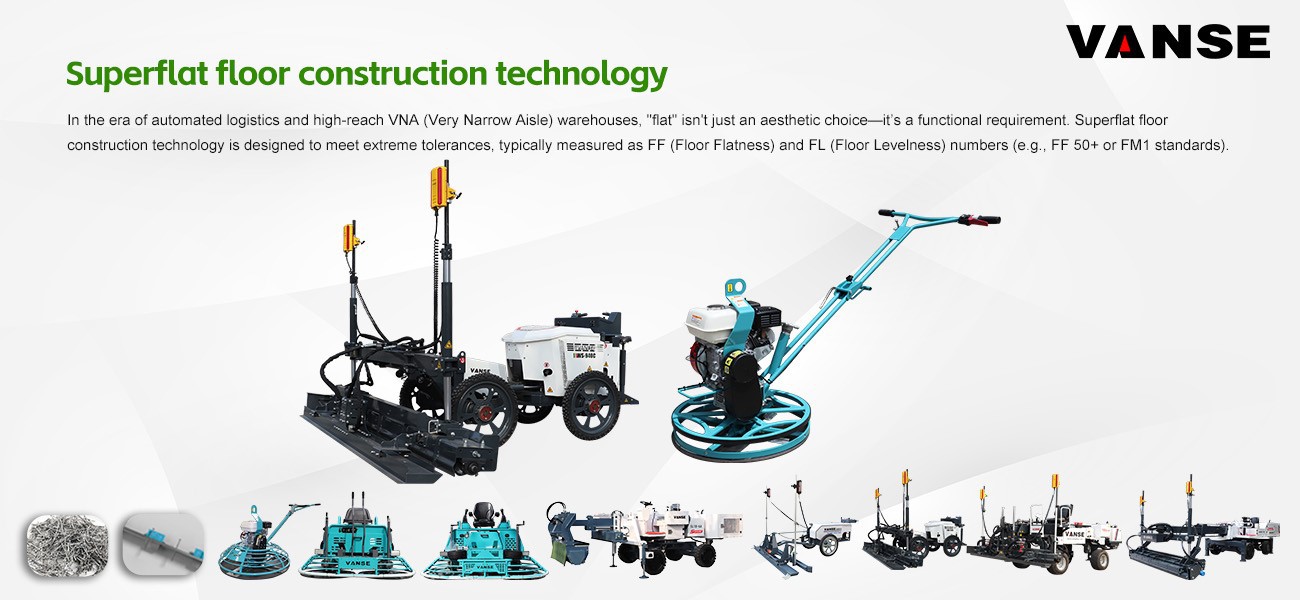
Achieving a Superflat floor (FM1/FM2 or FF 50+) isn't just about having a steady hand; it’s about high-speed physics and real-time data. If you’re a contractor looking to bid on high-spec logistics hubs or robotic warehouses, you need to understand the Precision Control Principle that makes a Concrete Laser Leveling Machine the undisputed king of the job site.
Here is the "under-the-hood" breakdown of how this technology works, and how the Vanse professional fleet turns these principles into flawless results.
1. The "Benchmark": Constant Laser Reference
The heart of the system is the Laser Transmitter. It sends out a 360-degree rotating beam that creates a perfectly horizontal (or sloped) reference plane over the entire work area.
The Vanse Advantage: Most Vanse machines, are designed to work with world-class laser systems (Leica/Trimble). This transmitter stays stationary, ensuring that the "zero point" never shifts, regardless of the terrain or machine movement.
2. The "Eyes": High-Frequency Receivers
Mounted on both sides of the machine's leveling head are the Laser Receivers.
The Principle: These receivers detect the laser beam and send height data to the on-board computer 10 times every second. This is far faster and more accurate than any human eye could ever hope to be.
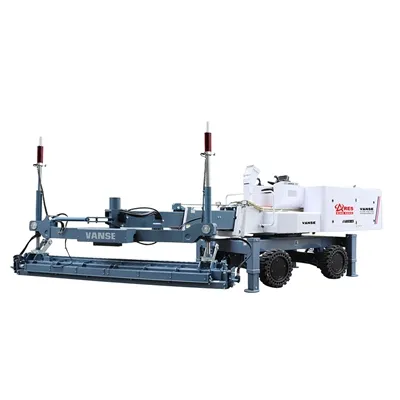
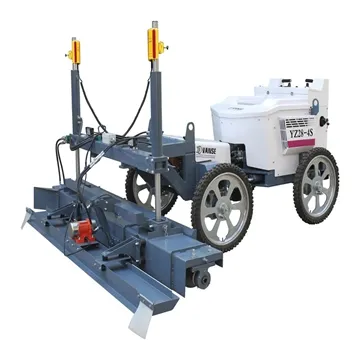
The Vanse Workflow: Because the Vanse YZ30-4E Telescopic Boomed Laser leveling has such a long reach (6 meters), the receivers can maintain a "clean" signal without the interference of moving wheels on wet concrete, which is a major factor in hitting those ultra-high FL (Levelness) numbers.
3. The "Muscle": Instant Hydraulic Feedback
This is where the magic happens. The computer compares the data from the receivers to the benchmark. If the head is even 1mm too high or low, it sends an immediate command to the Hydraulic System.
The Principle: The hydraulic actuators make micro-adjustments to the leveling head's elevation in real-time. This ensures that the auger (which removes excess concrete) and the vibrator (which consolidates the slab) are always at the exact elevation required.
Vanse Integration: To make this process smoother, it helps if the concrete is placed evenly first. Using a Vanse Concrete Distributor or a Mini Dumper to place the mix prevents the laser leveling from "fighting" massive piles of concrete, allowing the hydraulic system to focus on precision rather than heavy lifting.
4. Consolidated Finishing: Preserving the Level
The precision control doesn't stop once the leveling passes. The surface must be finished without losing that laser-perfect flatness.
The Principle: You need to densify the slab without creating new "waves."
The Vanse Workflow:
Use a Vanse Automatic Topping Spreader to apply hardener uniformly. Manual throwing creates "hills" that ruin FF scores.
Follow up with a Vanse Ride-on Power Trowel. With its high-torque engine and precision pitch control, it burnishes the floor to a mirror finish while maintaining the flatness established by the laser leveling.
Finally, use a Vanse Concrete Cutting Machine (Floor Saw) for crisp contraction joints that won't spall or lift, preserving the floor's long-term FF/FL integrity.
Why "The Vanse System" Wins the FF/FL Game
Foreign buyers and engineers don't just look for a "smoothing tool"; they look for a System of Precision. Here is the ROI for your business:
| Control Element | Traditional Manual Result | Vanse Laser Control Result |
| Reaction Speed | Slow (Human observation) | Instant (10x per second) |
| Leveling Accuracy | ±5-10mm over 3m | ±1mm over 3m (Superflat) |
| Surface Density | Uneven (Manual vibration) | Uniform (High-frequency vibration) |
| Joint Quality | Ragged (Hand-tooling) | Clean & Straight (Floor Saw) |
| Labor Cost | High (12+ man crew) | Low (4-6 man crew) |
Final Thought
Precision control isn't a "feature"-it’s a requirement. If you are bidding on modern industrial projects, you aren't just competing on price; you are competing on accuracy. By utilizing a complete fleet from Vanse Machinery (www.vansemac.com), you are guaranteeing that every square meter of your floor meets the highest international standards.
Ready to hit those FM1 numbers? Explore the full technical breakdown at Vanse and see how our laser leveling technology can revolutionize your business.
Note: The parameters provided in this document are for reference only and are not mandatory. Due to differences in technical characteristics between different brands and models of laser levelers, please consult the manufacturer for a suitable solution before actual operation. This reference document assumes no responsibility for any issues arising from failure to follow the manufacturer's instructions.
Thanks to All the Friends Who Support and Trust Shandong Vanse Machinery Technology Co., Ltd.
If you want to know more about Shandong Vanse Machinery Technology Co., Ltd. or have any questions, please feel free to contact us:
Our Factory
Shandong Vanse Machinery Technology Co., Ltd.








Share this article

About the Author: Shandong Vanse Machinery Technology Co., Ltd.
Shandong Vanse Machinery Technology Co., Ltd. is a high-tech manufacturer specializing in concrete construction machinery, including laser screeds and related equipment. The company integrates R&D, production, and global sales, with products exported to over 60 countries and widely used in infrastructure projects worldwide.
Previous Post
Next Post
Related Articles
You Might Also Like
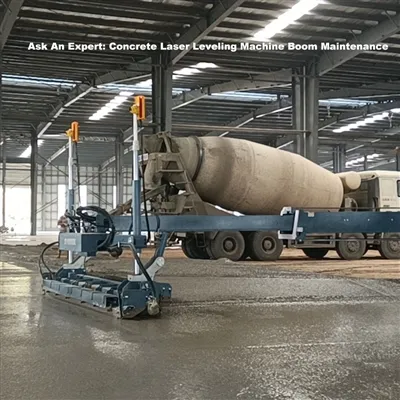
Ask An Expert: Concrete Laser Leveling Machine Boom Maintenance
This is an excellent, specific question. Vanse offers a range of concrete laser leveling machines with telescopic booms (like the YZ40-4E), and their maintenance philosophy is critical for machine longevity and leveling accuracy.1 Based on the general requirements for all laser levelings and the guidelines provided by Vanse, here is an expert summary focusing specifically on the telescopic boom. Vanse emphasizes comprehensive maintenance, including regular checks on lubrication points and the overall integrity of the machine.2 The key to maintaining a Vanse telescopic boom is managing friction, eliminating "slop," and aggressively fighting concrete abrasion. While some specialized brands (like Ligchine) advise strictly against grease on the boom tubes, Vanse machines often follow a more traditional heavy-duty equipment approach for their structural moving parts, requiring you to locate and service specific grease points. Zerk Fittings: Vanse machines have designated lubrication points (zerk fittings) on structural pivots, the leveling head, and potentially internal boom components like rollers or cylinders. You must consult your specific Vanse operation or maintenance manual for the location and frequency of these points. Expert Tip: When greasing any part on the boom near the telescoping tubes, be extremely careful not to over-grease. Wipe away all excess grease immediately, as it will attract concrete dust, forming an abrasive paste that damages the boom wear pads.Cylinder piston rod: Check for any scratches, bends or continuous leakage. Chain Lubrication: If your model uses an internal chain drive for boom extension, ensure the chain is regularly lubricated with the specified chain oil or Open Gear Lubricant (OGL) and that the tension is checked often. The most critical maintenance for your FF/FL numbers is ensuring the telescopic boom sections are supported properly to prevent lateral or vertical movement ("slop"). The Check: Fully extend the boom and manually attempt to wiggle the end section up/down and side-to-side. There should be almost zero discernible play. Any movement compromises the accuracy of your leveling head. The Process: Wear pads (shims) and rollers guide the boom. As they wear, the clearance increases. Regularly inspect the pads for deep scoring or embedding of concrete grit. Grit requires immediate cleaning or pad replacement. Refer to your Vanse manual for the specific procedure to add shims or adjust the tensioners/rollers. Maintaining the correct clearance is essential. Vanse guidelines stress the importance of cleaning, and for the boom, this is the most effective preventative maintenance. Concrete Slurry: Use a power washer to clean off all concrete slu rry and dust immediately after the pour. Hardened concrete on the boom tubes and the leveling head acts as abrasive sandpaper on the wear pads every time the boom moves. Hydraulic Rods: Pay special attention to the hydraulic cylinder rods that move the boom and leveling head. Ensure they are clean before retraction. Dust or concrete on the rod will damage the seals inside the cylinder, leading to premature hydraulic failure. Pressure maintenance: For the lifting cylinder, observe whether there is obvious "sinking" (i.e., internal leakage) after it is lifted. Maintenance Task Frequency Purpose Clean Boom Tubes After Every Use Prevent abrasive wear (scoring) and remove weight buildup. Grease Bearings/Pivots After Every Use / Daily Purge concrete slurry from high-speed bearings (e.g., auger, vibrator) and lubricate structural pins. Inspect Wear Pads/Rollers Weekly / Monthly Check for slop/wobble. Adjust clearance to maintain optimal tightness. Check Hydraulic Hoses Daily Inspect for rubbing, chafing, or kinks, especially where they track inside the boom. Note: The parameters provided in this document are for reference only and are not mandatory. Due to differences in technical characteristics between different brands and models of laser levelers, please consult the manufacturer for a suitable solution before actual operation. This reference document assumes no responsibility for any issues arising from failure to follow the manufacturer's instructions.The maintenance and maintenance of the laser leveling machine that comes during the rainy season cannot be ignored
Recently lying storms throughout our country, the rainy season comes laser screed machine maintenance has become very important, the rainy season concrete ground outside can not be constructed, in the concrete laser flatflating machine idle, should be placed in a dry place, to avoid the air humidity and affect the engine start. In addition, the construction environment of the concrete laser flattening machine is not very good, after the rain will have a lot of potholes and puddles of mud accumulation, the first thing to pay attention to after the rainy season is the cleaning of the laser flatflater, of course, not only the rainy season, usually after the use of laser flatflating machine should also be cleaned in time, Failure to do so can lead to the laser leveling machine walking track under the gap in the accumulation of sludge, is a place where moisture is hidden, but also most likely to cause the track rust. The acidic composition in the rainhast water has a strong corrosive effect on the paint surface of the laser screed machine, and over time it will cause damage to the paint surface of the laser flattener, so in the season with more rain, it is best to give the laser leveling machine a paint finish. The simplest is waxing, the longer and more effective is to seal the glaze. No matter what method, All to the laser leveling machine put on a protective coat, to prevent the paint surface fade aging. The chassis of the laser screed is the closest to the ground, especially affected by road conditions, this part is most prone to rust spots, the wheel shell may even loosen perforation. Therefore, we must pay attention to the laser leveling machine chassis clean rust treatment. Rainy days, such as encountering indoor construction, laser screed machine engine is not easy to start the problem, sometimes even if forced to start up, but also has air power. The most likely is a leakage due to moisture in the ignition system, which loses its normal ignition function. Once found that because of the moisture of the ignition system caused bad ignition, engine performance, it is best to use dry paper towels or dry cloth to the inside and outside of the cable and wire drying, and then use a special desiccant spray can to spray the dryer in the split disk cap, battery connector, line connector, high-voltage line, etc. , and so on after a while can start the engineTell you how effective the concrete laser leveling machine is!
Tell you how effective the concrete laser leveling machine is! Many consumers are still hesitating whether they should buy a concrete laser leveling machine, because they have no concept of the construction effect of the equipment. Today we will introduce the use effect of the equipment. First of all, the biggest feature of this equipment is that it is fast, and the time-consuming is 1/10 of manual work, which is enough to make many construction teams excited; secondly, it is flat, and the ground level error after paving is small , is almost negligible. 1. Requirements for concrete and formwork ① Concrete: Concrete must be produced, conveyed or pumped to the flooring site by a commercial concrete production plant. ② Concrete specifications: C25~C30 concrete, the strength of which is not less than 25MPa in 28 days, according to the design requirements. ③ Water-cement ratio: N o more than 0.5, no water can be added during the feeding process. ④ Cement: Use ordinary Portland cement with a grade of not less than 42.5. ⑤ Aggregate: Well-graded aggregate should be used. Crushed granite or pebbles are used as coarse aggregate, and the maximum diameter is not more than 25mm. The fine aggregate is clean river sand with a fineness modulus of 2.4-2.7. ⑥ Concrete mix ratio: The amount of cement is not less than 350Kg/m3. In order to avoid surface quality problems, the sand rate should be controlled at 35% to 40%. ⑦ Concrete slump: 14±2cm, maximum 16cm. ⑧ Setting time: The initial setting time should be controlled within 3-5 hours. In order to avoid the excessive deviation of the surface elevation affecting the joints, the formwork should be steel formwork. The height of the formwork should be controlled within +0 and -2mm, and the steel formwork should be within 1-1.2 meters from the surrounding walls. 2. Construction cooperation requirements ① The concrete feeding speed should be determined according to the ground thickness and pouring area to determine the minimum hourly feeding speed. For a floor with a thickness of 200 mm, if the width of one-time pouring reaches 40 meters, the minimum feeding speed should reach 40 cubic meters per hour, otherwise there will be cold joint problems, which will affect the quality of ground construction. ② Manually coordinate the concrete sent to the platform, and workers need to remove it as soon as possible and roughly level it. In addition, the areas around the formwork, walls, columns, trenches, equipment foundations, floor drains or around pipelines that cannot be leveled require manual cooperation for local leveling. Generally, 3-4 workers are required to cooperate with the construction (provided by Party A). ③ Other precautions In order to ensure the flatness of the ground, attention should be paid to: 1) The slump of concrete sent to the platform must be consistent each time. 2) Ensure that the concrete feeding speed reaches 40 cubic meters per hour or above, and the initial setting time of each batch of concrete must be consistent. 3) Ensure that the formwork elevation is accurate and cannot be disturbed during construction. 4) Environmental cooperation. The concrete floor that has just been constructed cannot be exposed to sunlight, wind, rain, etc. that are unfavorable to concrete health. ④ Other requirements: A. In order to avoid random cracks in the floor, the cutting time of shrinkage joints should be carried out as early as possible (within 24 hours). B. At the same time as the construction of the laser leveling machine, there should be no electric welding machines on site, and no reflective objects (such as glass windows). C. The foundation must reach a certain hardness to ensure that the laser leveling machine does not collapse when working on the ground. D. The height of the ground in the factory building shall be calibrated by Party A, and the points must be evenly distributed, and there must be no error in the levelness. E. Pouring concrete must be operated according to the requirements of Party B's technicians.