Technical Knowledge
Compaction Degree of Sub-base in Superflat Floors and Its Impact on Final Flatness
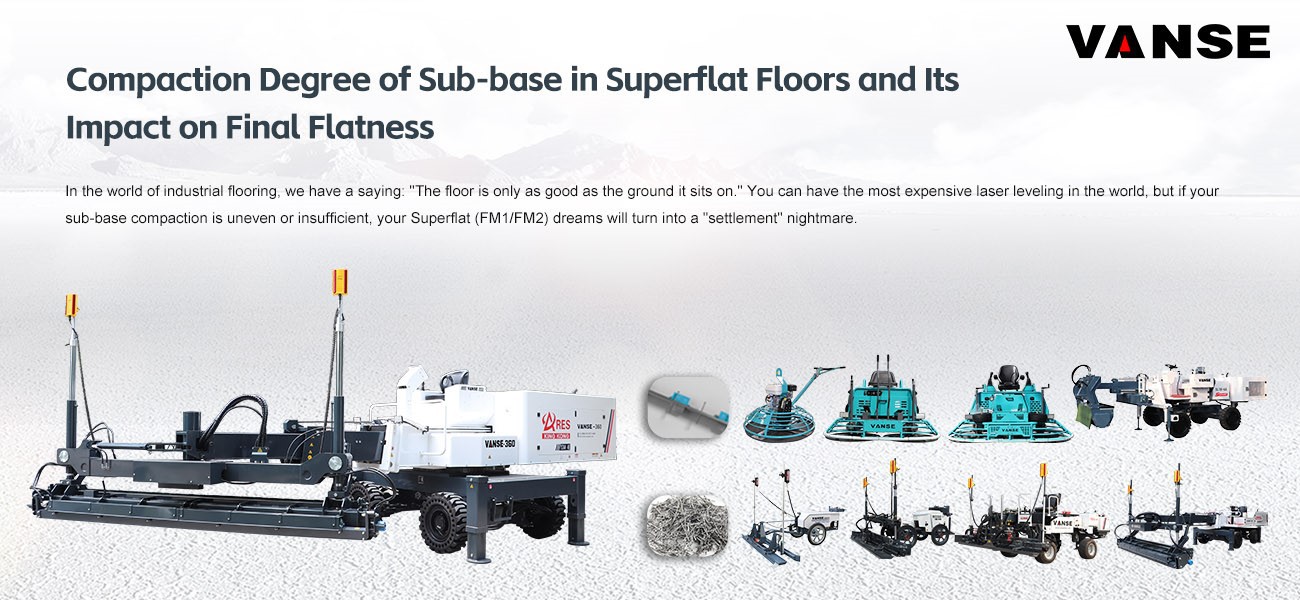
In the world of industrial flooring, we have a saying: "The floor is only as good as the ground it sits on." You can have the most expensive laser leveling in the world, but if your sub-base compaction is uneven or insufficient, your Superflat (FM1/FM2) dreams will turn into a "settlement" nightmare.
If you’re a contractor or facility owner, understanding the link between sub-base compaction degree and final flatness (FF/FL numbers) is critical. Here’s a professional breakdown of how to get the foundation right, featuring the technical workflow from Vanse Machinery.
1. The "Anvil Effect": Why Compaction is the Starting Line
Think of the sub-base as an anvil. When you use a Power Trowel to densify the concrete, the concrete is being compressed between the blades and the sub-base. If the sub-base has "soft spots" (low compaction degree), the slab will deflect under the weight of the machines and the concrete itself.
The Impact: Even a 2mm settlement in the sub-base during the pour can tank your FL (Levelness) scores. This is why a compaction degree of at least 95% to 98% Proctor density is usually the standard for high-spec warehouses.
2. Moving Material Without Creating "Ruts"
A common mistake is compacting the sub-base perfectly, then driving heavy concrete trucks over it, creating deep ruts that ruin the uniformity.
The Vanse Solution: Instead of heavy trucks, pro contractors use a Vanse Concrete Distributor or the Vanse Mini Dumper. These machines are designed to be agile. The Vanse Mini Dumper (available in electric or gasoline) allows you to move concrete to the exact spot without the massive point-load of a transit mixer, preserving the integrity of your compacted sub-grade.
3. Laser leveling on "Sensitive" Ground
Even with good compaction, the weight of a leveling machine can sometimes cause micro-movements in the sub-base.
The Vanse Solution: This is where the Vanse YZ30-4E Telescopic Boomed Laser leveling is a game-changer. Unlike traditional "drive-in" leveling, the telescopic boom allows the leveling head to reach out 6 meters while the machine stays stationary. This minimizes the "footprint" on the compacted sub-base, ensuring that the laser-accurate strike-off is based on a stable reference point, not a moving one.
4. Surface Density & Long-term Flatness
If the sub-base isn't uniform, the concrete will cure at different rates, leading to "curling" at the joints-the #1 enemy of long-term flatness.
The Vanse Solution:
Use a Vanse Automatic Topping Spreader to apply hardener uniformly. This ensures the "skin" of the concrete is as tough as the base.
Follow up with a Vanse VS1046H Ride-on Power Trowel. The high-torque 35HP BRIGGS & STRATTON engine provides the force needed to "burnish" the floor. If your sub-base is solid, this troweling process creates a rock-hard, Superflat surface that won't shift over time.
Finally, protect those joints with a precision Vanse Concrete Cutting Machine (Floor Saw) to ensure stress is relieved exactly where it should be.
Summary: The ROI of Proper Sub-base Prep
| Factor | Poor Compaction Result | Vanse-Enabled Professional Result |
| FF/FL Scores | Fails due to micro-settlement. | Hits FM1/FM2 consistently. |
| Joint Health | Spalling and curling. | Clean, stable transitions with Floor Saws. |
| Labor Cost | High (due to rework/grinding). | Low (Get it right the first time). |
| Equipment Performance | Machines "sink" or vibrate poorly. | Maximum precision with Telescopic leveling. |
Final Word
You can’t cheat the physics of a Superflat floor. Hitting ±1mm over 3 meters requires a solid sub-base and the world's most precise machinery. By combining the placement agility of the Mini Dumper with the telescopic reach of the Vanse Laser leveling (www.vansemac.com), you ensure that your floor stays flat from the day of the pour until decades of forklift traffic later.
Don't build on a weak foundation. Explore the full Vanse fleet today and see how our technology supports your highest-spec projects.
Note: The parameters provided in this document are for reference only and are not mandatory. Due to differences in technical characteristics between different brands and models of laser levelers, please consult the manufacturer for a suitable solution before actual operation. This reference document assumes no responsibility for any issues arising from failure to follow the manufacturer's instructions.
Thanks to All the Friends Who Support and Trust Shandong Vanse Machinery Technology Co., Ltd.
If you want to know more about Shandong Vanse Machinery Technology Co., Ltd. or have any questions, please feel free to contact us:
Our Factory
Shandong Vanse Machinery Technology Co., Ltd.








Share this article

About the Author: Shandong Vanse Machinery Technology Co., Ltd.
Shandong Vanse Machinery Technology Co., Ltd. is a high-tech manufacturer specializing in concrete construction machinery, including laser screeds and related equipment. The company integrates R&D, production, and global sales, with products exported to over 60 countries and widely used in infrastructure projects worldwide.
Previous Post
Next Post
Related Articles
You Might Also Like
How to optimize the construction effect of concrete laser leveling machine by adjusting the laser receiver?
To optimize the construction effect of the concrete laser leveling machine, the laser receiver can be adjusted by the following methods: 1. Calibrate the laser receiver: Before construction, calibrate the laser receiver to ensure it is in the correct position and angle. Through calibration, the initial error of the laser receiver can be eliminated and the accuracy and stability of construction can be improved. 2. Adjust the sensitivity of the laser receiver: According to the construction environment and conditions, appropriately adjust the sensitivity of the laser receiver. In an environment with more interference factors, you can choose to increase the sensitivity of the laser receiver to better capture the laser signal. In a quieter environment, the sensitivity can be appropriately reduced to reduce false triggering. 3. Adjust the receiving range of the laser receiver: According to the construction scope and speed, appropriately adjust the receiving range of the laser receiver. In situations where rapid construction is required, there is an option to expand the laser receiver's reception range to cover a wider area. In situations where refined construction is required, the receiving range can be appropriately narrowed to improve the accuracy and stability of construction. 4. Regularly clean and maintain the laser receiver: Keeping the laser receiver clean and in good condition is crucial to optimizing construction results. Clean optics and housings regularly and check for damage or contamination. Use appropriate cleaners and tools for cleaning, and ensure that maintenance and upkeep is performed in accordance with the manufacturer's instructions. 5. Adjustment with other equipment: Ensure good cooperation and synchronization between the laser receiver and other related equipment (such as control systems, sensors, etc.). Learn how to adjust the parameters and settings of relevant equipment to achieve the best construction results by communicating with the supplier or manufacturer's technical support team. 6. Record and monitor the adjustment process: During the process of adjusting the laser receiver, it is recommended to record the detailed steps and parameters of each adjustment. This helps track the effects of adjustments and ensures you can quickly return to optimal performance when needed. At the same time, the construction effect is continuously monitored, and the performance and status of the laser receiver are regularly checked to ensure that it continues to provide accurate signals and stable output. In short, through proper calibration, sensitivity adjustment, reception range setting, maintenance and coordination with other equipment, the construction effect of the concrete laser leveling can be significantly optimized. It is recommended to work with an experienced technician or supplier on the actual application to ensure proper adjustment and optimal performance.Automatic obstacle avoidance capability of concrete laser leveling machines
The term "automatic obstacle avoidance" for concrete laser leveling machines, including those from Vanse Machinery, generally refers to operator-aided maneuverability enabled by advanced machine design, rather than fully autonomous sensing and navigation technology. Vanse machinery utilizes several design features, particularly in their advanced telescopic boom models (like the YZ40-4E), that significantly help the operator avoid obstacles and work in complex environments: The primary method for "obstacle avoidance" with Vanse machines relies on operator control enhanced by the machine's flexible design. Feature: Vanse's boom-type machines (e.g., YZ40-4E, YZ30-4E) feature a body that can rotate infinitely (360 degrees). Benefit for Obstacle Avoidance: This high degree of agility means the operator can easily reposition the leveling head and boom around columns, existing walls, or complex boundaries without needing to move the entire chassis. This greatly reduces the non-levelinged area that must be finished manually. Feature: Larger ride-on models often include Two-wheel, Four-wheel, and Crab Steering modes. Benefit for Obstacle Avoidance: These multiple steering modes allow the operator to navigate the chassis in tight spaces and around perimeter forms with greater precision than a traditional fixed-steering vehicle. Crab steering, for instance, allows for lateral movement, which is helpful when parallel-parking next to a wall. Primary Reliance: Like most laser leveling, the ultimate obstacle avoidance is performed by the trained operator. Vanse's documentation emphasizes preliminary survey and path optimization using 3D modeling to mark obstacle locations (rebar, pipes, etc.). Procedure: The operator is trained to deliberately circumvent obstacles by 10-15 cm and then manually compensate and level the blocked-out area using small vibrators and a straightedge to ensure a smooth connection to the machine-levelinged area. It's important to clarify that the "automatic" functions on Vanse machines focus on: Automatic Leveling: Using the laser receiver and microcomputer control system to automatically adjust the leveling head height to a precision of ±1.5mm (or better) across the pour. Automatic Body Leveling: Some models offer "One-click leveling of the body" to handle various complex road surfaces before leveling begins. Vanse laser leveling machines do not currently advertise a system of autonomous obstacle sensing (using sensors or radar) that automatically stops or steers the machine away from an object. Instead, they provide superior mechanical flexibility (360° boom, multi-mode steering) to empower the human operator to efficiently navigate around complex obstacles. Would you like to know more about the different types of Vanse laser leveling machines (Walk-behind, Four-wheel ride-on, Boom) and which are best suited for areas with many obstacles? Note: The parameters provided in this document are for reference only and are not mandatory. Due to differences in technical characteristics between different brands and models of laser levelers, please consult the manufacturer for a suitable solution before actual operation. This reference document assumes no responsibility for any issues arising from failure to follow the manufacturer's instructions.What special measures or methods need to be taken to deal with special ground conditions?
For special ground conditions, in order to ensure the construction effect and flatness of the concrete laser leveling, some special measures or methods need to be taken. The following are some common special ground conditions and how to deal with them: 1. Soft soil foundation: For soft soil foundations, foundation reinforcement measures can be taken, such as using geotextiles, drainage materials, etc. to improve the bearing capacity and stability of the ground. In addition, an appropriate amount of early strength agent can be added to the concrete to shorten the initial strength. Set time and improve construction efficiency. 2. Uneven ground: For seriously uneven ground, it can be filled first. Use sand, gravel, filler and other materials to fill potholes and make the ground roughly flat. Then, when the leveler is operating, the pressure and angle of the scraper can be appropriately adjusted to adapt to changes in the ground. 3. Smooth floors: For smooth floors, thickeners, scrubs, etc. can be used to increase the friction coefficient of the concrete to make it better adhere to the ground. At the same time, it is necessary to appropriately adjust the pressure and angle of the scraper and control the slump of the concrete to ensure that the concrete can be spread evenly and reduce slippage. 4. Cross construction: In cross construction sites, the construction work of different professional teams may have a certain impact on the ground. In order to ensure the smoothness of the ground, appropriate plastering and calendering treatments can be carried out before the initial setting of the concrete to eliminate surface marks and uneven areas. 5. Temperature influence: When constructing in high or low temperature environments, attention needs to be paid to controlling the temperature and setting time of concrete. At high temperatures, measures such as sprinkling water to cool down and using retarders can be taken; at low temperatures, measures such as insulation and antifreeze can be taken to ensure the normal hardening of the concrete and the smoothness of the ground. 6. Drainage issues: For floors that are prone to water accumulation, special attention needs to be paid to drainage issues. Drainage materials and drainage ditches can be laid under the concrete cushion to prevent water accumulation from causing adverse effects on the ground. 7. Strengthen edge processing: In the edges or detailed areas, because the leveling machine is difficult to reach or it is difficult to scrape, manual auxiliary processing needs to be strengthened. Manual adjustments can be made using tools such as scrapers and knives to ensure smoothness of edges and detailed areas. To sum up, for special ground conditions, corresponding special measures or methods need to be taken. These methods can be selected and applied according to the actual situation to achieve the best construction effect and smoothness. It should be noted that in actual stinging, it is necessary to flexibly apply it according to specific conditions, comprehensively consider multiple factors, and formulate reasonable construction plans and quality control measures.