Technical Knowledge
Pouring Sequence and Equipment Scheduling Strategies for Large-Area Super-Flat Concrete Floors
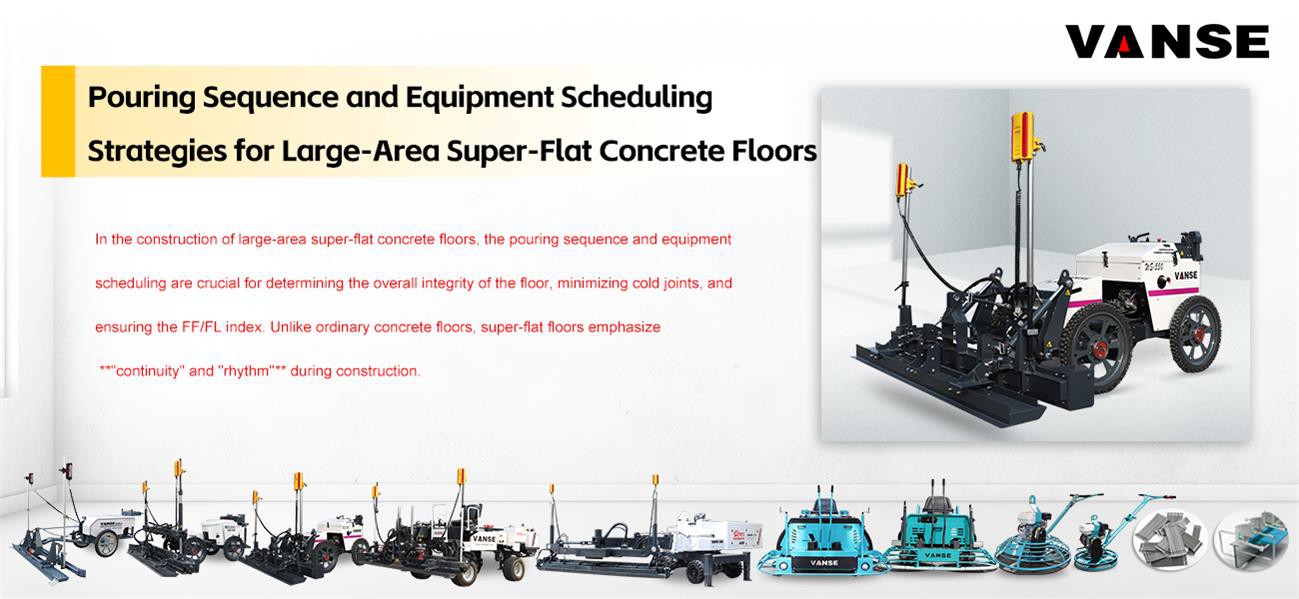
In the construction of large-area super-flat concrete floors, the pouring sequence and equipment scheduling are crucial for determining the overall integrity of the floor, minimizing cold joints, and ensuring the FF/FL index. Unlike ordinary concrete floors, super-flat floors emphasize **"continuity" and "rhythm"** during construction.
I. Pouring Sequence: Skip Pouring and Long-Strip Pouring
Large-area construction typically employs the following two strategies, with the core logic being to control shrinkage stress:
1. Long-Strip Pouring – Recommended Option
For VNA (Very Narrow Aisle) warehouses, long-strip pouring is usually adopted.
Sequence: Long-distance longitudinal pouring along the aisle direction. For example, a 100m x 50m area would be divided into several strips 4m to 6m wide and 100 meters long.
Advantages: Laser Leveling can maintain continuous operation over long distances, reducing transverse construction joints and significantly improving the FL (levelness) value.
2. Skip Pouring (Checkerboard Pouring)
Sequence: The area is divided into blocks. Blocks 1, 3, and 5 are poured first, and after they have stabilized from shrinkage (usually after 7 days), blocks 2, 4, and 6 are poured.
Applicability: Suitable for sites with limited space or where structural design requires strict control of cracks
II. Equipment Scheduling Strategy: Ensuring "Dynamic Balance"
Super-flat floor construction must achieve a balance where concrete supply speed = paving speed = finishing speed.
1. Batching Plant and Transport Vehicle Scheduling
Uniform Supply: The batching plant must dedicate specific tanks for continuous supply. The calculation formula is:
V = W × H × v
(Where V is the required material supply per hour, $W$ is the paving width, H is the slab thickness, and v is the forward speed of the leveling machine).
Vehicle Spacing: The site must maintain a rolling pattern of "one truck unloading, one truck waiting, and one truck on the way," strictly prohibiting supply interruptions exceeding 15 minutes, otherwise visible leveling marks will occur.
2. Laser Leveling Machine Path Planning
Starting and Finishing: The laser leveling machine should start from the short side. When approaching the edge of the formwork, manual material replenishment should be used.
Overlap Control: Each paving pass should overlap the previous pass by 20-30 cm to eliminate elevation differences at the overlap.
3. Power Trowel Teamwork
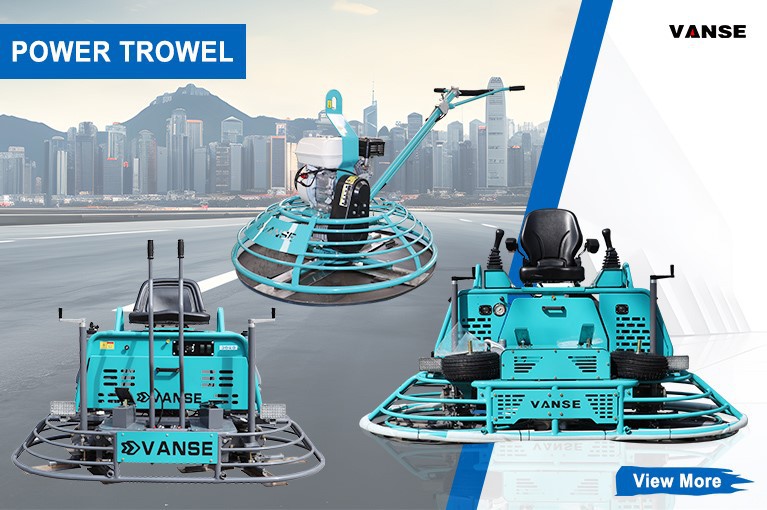
Finishing is a relay race, usually requiring 3-4 ride-on power trowels working together:
First Team (Slurry Application): Following closely behind the leveling machine, they enter the site when a person's footprint leaves an approximately 5 mm deep impression, using a pan to apply the slurry.
Second Team (Leveling): Using a highway straightedge, they perform reciprocating adjustments in both longitudinal and transverse directions.
Third Team (Fine Finishing): When the concrete surface begins to shine and the footprint depth is reduced to 2 mm, the blades are changed for high-speed finishing.
III. Suggested Construction Layout (Taking strip paving as an example)
| Time points | Construction Locations | Equipment Status |
| 6:00 | Beginning of the first tunnel section | The laser Leveling has started operation, and the first two concrete trucks have arrived. |
| 9:00 | Middle of the first tunnel section | The power trowel team is entering the site; the long-handled Leveling is beginning initial leveling. |
| 12:00 | End of the first tunnel section | The laser Leveling is moving to the second lane for preparation; the first lane is entering the final finishing stage. |
| 15:00 | Overall site maintenance | Cover with plastic film or spray curing agent; personnel are strictly prohibited from stepping on the finished area. |
IV. Key Emergency Response Plans
Equipment Failure: A backup laser Leveling or manual vibrating beam must be available on site. If the main Leveling breaks down and the work is stopped for more than 30 minutes, the floor's flatness will not meet the super-flat grade.
Sudden Weather Changes: Sufficient rainproof tarpaulins must be prepared for large-area construction. Because super-flat floors are extremely sensitive to the surface water-cement ratio, finishing work is strictly prohibited in the rain.
Note: The parameters provided in this document are for reference only and are not mandatory. Due to differences in technical characteristics between different brands and models of laser levelers, please consult the manufacturer for a suitable solution before actual operation. This reference document assumes no responsibility for any issues arising from failure to follow the manufacturer's instructions.
Thanks to All the Friends Who Support and Trust Shandong Vanse Machinery Technology Co., Ltd.
If you want to know more about Shandong Vanse Machinery Technology Co., Ltd. or have any questions, please feel free to contact us:
Our Factory
Shandong Vanse Machinery Technology Co., Ltd.
Share this article

About the Author: Shandong Vanse Machinery Technology Co., Ltd.
Shandong Vanse Machinery Technology Co., Ltd. is a high-tech manufacturer specializing in concrete construction machinery, including laser screeds and related equipment. The company integrates R&D, production, and global sales, with products exported to over 60 countries and widely used in infrastructure projects worldwide.
Previous Post
Next Post
Related Articles
You Might Also Like
Shandong Vanse Machinery’s laser leveling machine leads the market with four major advantages
The construction machinery industry is becoming more and more mature, and various types of construction machinery are increasingly used in my country's consumer market, especially this year, concrete laser leveling machines are increasingly recognized by customers. As the leader of concrete laser leveling machines, the concrete laser leveling machines produced by Shandong Vanse Machinery can achieve large-scale construction. By solving the concrete surface layer at one time, all the "quality problems" brought by the secondary approach are completely eliminated. It truly realizes the "three super" floor of flatness, smoothness, density, high strength, one layer as a whole, reduced costs, shortened construction period, and absolutely durable. Shandong Vanse Machinery Concrete Laser Leveling Machine has several advantages over traditional laser leveling machines: Traditional leveling technology requires template support to control the elevation of the ground and pull the control line. The elevation error is large. The horizontality and flatness of the entire floor cannot be guaranteed. The laser point-to-point transmitter is used, which is suitable for large-area one-time paving. There is a laser measurement and control system to control the elevation in real time. There is no need to pull the line for leveling, and there is no need to support the side plate in the middle to control the ground elevation. Thus, the elevation error caused by the vibration of the formwork (channel steel) during the construction process is avoided, and the elevation error caused by the traditional manual block formwork is also reduced. The traditional process has a large number of construction workers, and it is necessary to support the formwork (channel steel), dot, and spread. It requires about 20 people. The construction area is 700 square meters per day. The total number of people using the concrete laser leveling machine is more than half less than that of the traditional process. It can be operated by one person. The construction area is 2500-3500 square meters per day, which greatly reduces the labor cost. Traditional construction technology, one day of formwork, one day of pouring, can only be skipped one by one, which has great limitations, cannot be operated continuously, and has poor integrity, which is easy to cause cumulative errors in construction joints. The concrete laser leveling machine is more efficient and integrated for a large area of floor paving at one time. The completion of the entire floor makes the ground integrity better, which is completely impossible for traditional construction. The high-frequency vibrator of 4000 times per minute allows the leveling head vibrator to produce uniform high-frequency vibration, making the concrete floor more compact and uniform. Combining the above detailed comparison between ordinary leveling machines and Shandong Vanse Machinery's laser leveling machines, we can know why laser leveling machines are so popular now. In order to better and more effectively serve our customers, Shandong Vanse Machinery will continue to provide customers with safe and reliable products and more complete after-sales services.How to avoid over-vibration with laser leveling on fiber concrete?
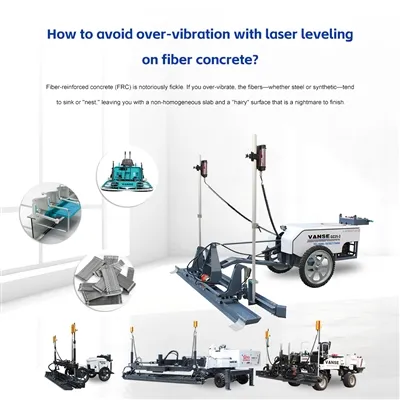
Fiber-reinforced concrete (FRC) is notoriously fickle. If you over-vibrate, the fibers-whether steel or synthetic-tend to sink or "nest," leaving you with a non-homogeneous slab and a "hairy" surface that is a nightmare to finish. With a laser leveling, the goal is to keep the fibers suspended in the paste while achieving your ±3mm tolerance. Here is how to dial in your machine: Over-vibration usually happens when the centrifugal force is too high for the concrete's consistency. The Rule of Thumb: For high-fiber mixes, you generally want high frequency but low amplitude. Adjustment: Most laser leveling (like Vanse) allow you to adjust the hydraulic flow to the vibrator motor. If you see "fat" (excessive cream/paste) rising more than 2mm–3mm above the fibers, slow the vibrator RPM down immediately. If the machine moves too slowly while the vibrator is screaming, you are effectively "drilling" the fibers down into the subgrade. The Sweet Spot: Maintain a consistent forward (or pulling) speed. If you have to stop the machine for any reason, shut off the vibrator immediately. Leaving a vibrating leveling head stationary for even 5 seconds will create a permanent "soft spot" or depression in a fiber floor. The vibrator should not be buried in the concrete. Positioning: The vibrator plate should just "kiss" the surface of the concrete as the auger levels it. The Sink Effect: If the vibrator is set too low, it pushes the larger aggregate and fibers down, leaving only weak laitance on top. This leads to surface scaling later in the floor's life. Fibers can sometimes clump (balling) before they even hit the leveling. Auger Interaction: Ensure your auger is set to the correct height (3mm to 5mm above finished grade). The auger's job is to "cut" the excess; if it's too low, it will snag fibers and drag them, creating tears in the surface. Avoid "Double-leveling": With fiber, try to get it right in one pass. Re-vibrating the same area almost guarantees the fibers will settle too deep. Because fibers can make the mix "stiffer," the leveling head might "ride up" on the material. The Fix: Don't increase vibration to force it down. Instead, adjust your Laser Offset. If the machine is riding high, lower the laser receivers by 1MM or 2MM to compensate for the material's resistance without over-working the paste. Variable Adjustment for Fiber Goal Vibrator RPM Reduce by 15-20% Prevent fiber sinking Travel Speed Faster / Consistent Prevent "hot spots" Auger Height Slightly Higher Avoid snagging/tearing Slump Maintain 100mm – 125mm Ensure flow without segregation Pro Tip: Have a "muck man" with a come-along tool standing by to watch the auger. If he sees a "beard" of fibers building up on the plow, you need to stop and clean the head, or it will ruin your FF numbers. Would you like a guide on how to properly "dry-shake" hardener over a fiber-reinforced floor without creating delamination? Contact us NOW Note: The parameters provided in this document are for reference only and are not mandatory. Due to differences in technical characteristics between different brands and models of laser levelers, please consult the manufacturer for a suitable solution before actual operation. This reference document assumes no responsibility for any issues arising from failure to follow the manufacturer's instructions.What are the advantages of using laser leveling machines in building floor construction?
The construction industry of building floor is developing rapidly at present, and the use of construction machinery such as laser leveling machine is becoming more and more frequent. So, why do we have to recommend this equipment to everyone among many engineering machinery? In fact, there are certain reasons. Next, let's take a look at the introduction of the following article! The traditional process has a large number of construction workers, and requires templates (channel steel), dotting, and paving. It requires about 20 people. The construction area is 700 square meters per day. The total number of people using concrete laser leveling machine is more than half of that of traditional processes. It can be operated by one person. The construction area is 2500 square meters-3500 square meters per day, which greatly reduces labor costs. The traditional process leveling requires templates to control the elevation of the ground and pull the control line. The elevation error is large. The levelness and flatness of the entire floor cannot be guaranteed. The laser point transmitter is used, which is suitable for one-time paving of large areas. There is a laser measurement and control system to control the elevation in real time. There is no need to pull the wire for leveling, and there is no need to support the side plate in the middle to control the ground elevation. This avoids the elevation error caused by the vibration of the template (channel steel) during the construction process, and also reduces the elevation error caused by traditional manual block support. Traditional construction technology, one day of formwork, one day of pouring, can only be skipped one by one, which has great limitations, cannot be operated continuously, and has poor integrity, which is easy to cause cumulative errors in construction joints. The laser leveling machine has higher efficiency and integrity for one-time overall paving of large areas of floor. The completion of the entire floor makes the ground integrity better, which is completely impossible for traditional construction. The high-frequency vibrator of 4000 times per minute allows the leveling head vibrator to produce uniform high-frequency vibration, making the concrete floor denser and more uniform. As a leader in concrete laser leveling machines, the laser leveling machines produced by our company can achieve large-area construction. By solving the concrete surface layer in one go, all "common quality problems" caused by secondary practices are completely eliminated. We will continue to provide customers with reliable products and more complete services.