Technical Knowledge
Economic Value Analysis of Superflat Floors in VNA (Very Narrow Aisle) Warehouses
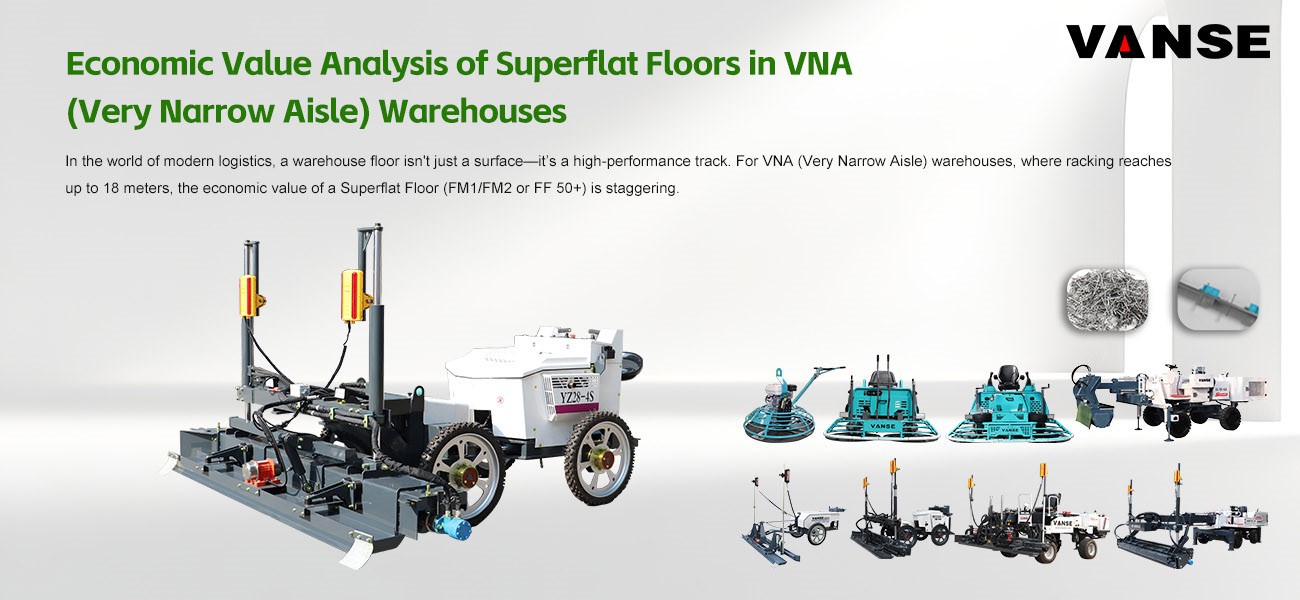
In the world of modern logistics, a warehouse floor isn't just a surface-it’s a high-performance track. For VNA (Very Narrow Aisle) warehouses, where racking reaches up to 18 meters, the economic value of a Superflat Floor (FM1/FM2 or FF 50+) is staggering.
A 1mm deviation at the base of a VNA forklift can translate into a dangerous 15cm "sway" at the top of the mast. If you’re a facility owner or developer, here is why investing in the "Vanse standard" for flooring isn't an expense-it’s a massive ROI driver.
1. Increased Throughput (Efficiency = Revenue)
In a VNA warehouse, the speed of the forklift is limited by the flatness of the floor. On a standard floor, trucks must slow down to avoid vibration and mast-lean.
The Economic Lift: A Superflat floor allows trucks to operate at maximum speed. This can increase "picks per hour" by 20% to 40%. In a high-volume logistics hub, that speed translates into millions of dollars in additional annual revenue.
The Vanse Edge: To hit these numbers, the floor must be leveled with surgical precision. The Vanse YZ30-4E Telescopic Boomed Laser leveling allows for the long-strip pours essential for VNA lanes, ensuring the "track" is perfect from end to end without the "tire tracks" that traditional machines leave behind.
2. Massive Maintenance Savings (OpEx Reduction)
VNA trucks are expensive pieces of machinery with sensitive electronic components and high-pressure tires.
The Economic Lift: Bumpy floors cause "shock loading" on forklift axles and wear out tires 3x faster. A Superflat floor can reduce annual maintenance costs for a fleet of VNA trucks by up to 50%.
The Vanse Edge: Surface durability is just as important as flatness. By using a Vanse Automatic Topping Spreader to apply wear-resistant hardeners uniformly, followed by the high-torque burnishing of a Vanse VS1046H Ride-on Power Trowel, you create a rock-hard finish that won't "spall" or "dust," protecting your trucks for decades.
3. Maximum Space Utilization (Real Estate ROI)
The whole point of VNA is to pack more pallets into a smaller footprint.
The Economic Lift: Without a Superflat floor, you simply cannot use VNA racking safely. A high-quality floor enables you to build higher and narrower, potentially increasing your pallet capacity by 30% within the same building footprint.
The Vanse Edge: For multi-story or tight-access warehouses, the Vanse Mini Dumper and Concrete Distributor allow for precise material placement without disturbing the subgrade, ensuring that even the most difficult-to-reach bays meet the Superflat spec.
Economic Comparison: Standard vs. Vanse-Leveled Superflat Floor
| Feature | Standard Industrial Floor | Vanse Superflat (FM1/VNA) |
| Forklift Speed | Limited (40-60% capacity) | Maximum (100% capacity) |
| Truck Maintenance | High (Vibration damage) | Low (Smooth operation) |
| Space Density | Wide Aisles / Lower Racks | VNA Aisles / High-Bay Racks |
| Project Risk | High (Potential for grinding) | Low (Hit the spec first time) |
| Joint Integrity | Often spalled/ragged | Clean with Floor Saws |
The "Vanse Solution" for High-Value Flooring
When you browse www.vansemac.com, you’re not just looking at machines; you’re looking at Profitability Tools.
YZ Series Laser leveling: Hit the FF/FL specs that VNA trucks require.
Topping Spreaders: Guarantee the wear-resistance needed for repetitive wheel paths.
Power Trowels: Provide the dense, burnished finish that resists high-pressure tire wear.
Concrete Cutting Machines: Protect your joints from the heavy point-loads of VNA traffic.
Final Word
In the logistics world, the floor is the "engine room" of the business. A cheap floor is a constant drain on your profits through slow speeds and high maintenance. A Vanse-leveled Superflat floor is a one-time investment that pays dividends every single hour your warehouse is in operation.
Don't let your floor be a bottleneck. Visit Vanse Machinery today to see how we can help you maximize the economic value of your warehouse.
Note: The parameters provided in this document are for reference only and are not mandatory. Due to differences in technical characteristics between different brands and models of laser levelers, please consult the manufacturer for a suitable solution before actual operation. This reference document assumes no responsibility for any issues arising from failure to follow the manufacturer's instructions.
Thanks to All the Friends Who Support and Trust Shandong Vanse Machinery Technology Co., Ltd.
If you want to know more about Shandong Vanse Machinery Technology Co., Ltd. or have any questions, please feel free to contact us:
Our Factory
Shandong Vanse Machinery Technology Co., Ltd.








Share this article

About the Author: Shandong Vanse Machinery Technology Co., Ltd.
Shandong Vanse Machinery Technology Co., Ltd. is a high-tech manufacturer specializing in concrete construction machinery, including laser screeds and related equipment. The company integrates R&D, production, and global sales, with products exported to over 60 countries and widely used in infrastructure projects worldwide.
Previous Post
Next Post
Related Articles
You Might Also Like
How to construct concrete laser leveling machine in complex environment
Concrete laser leveling operate in complex environments, requiring specialized plans tailored to specific environmental characteristics (such as confined spaces, areas with varying heights, inclement weather, and numerous obstacles), ensuring a balanced balance of efficiency, precision, and safety. The following details construction strategies and key technical points based on common complex environments: The core challenges of confined spaces are limited equipment maneuverability and the susceptibility of laser signals to obstruction. These limitations must be overcome through equipment selection and operational optimization. Select a compact machine: Prefer a small laser leveling (such as a walk-behind or mini-ride model) with a wheelbase ≤ 2.5m and a width ≤ 1.2m. Keep the minimum turning radius within 1.5m to allow for operation in narrow passages (widths ≥ 1.5m). Laser System Adaptation: Utilize multi-transmitter networking technology, placing 2-3 laser transmitters at different locations within the space (e.g., corners, near pillars) to prevent a single transmitter from being blocked by walls or pillars. Use anti-interference laser receivers (operating at 635nm red light or 532nm green light) to reduce signal interference from obstacles. Zoned and Miniaturized Operations: Divide a narrow space into multiple micro-blocks, such as 3m x 3m units, based on the equipment's operating radius (usually 2-3m). Work progresses zone by zone, avoiding frequent equipment maneuvers. Manually Assisted Spreading and Finishing: Due to space constraints, large-scale spreading equipment cannot be used. Manually spread the concrete in advance to a height 3-5cm above the design elevation (to reduce the burden on the equipment). Corners that cannot be reached by the equipment (e.g., walls and pillar bases) are manually leveled using aluminum alloy scrapers and vibrators to ensure a smooth transition with the machine work area. Real-time Signal Monitoring: Assign a dedicated person to monitor the laser receiver indicator light (green indicates normal operation, red indicates signal loss). Immediately stop the machine and adjust the transmitter position if a signal interruption is detected to avoid elevation errors caused by signal deviation. Precise control of elevation gradients is required in areas with complex level differences to avoid step-like errors. The key lies in the flexible adaptability and reference setting of the laser system. Slope Construction: Slope Sensor Interaction: Install a slope sensor (accuracy ±0.1%) on the leveling machine. Interact with the laser system to preset the laser plane inclination angle based on the designed slope (e.g., 2% or 5%). During operation, the machine automatically adjusts the scraper blade height according to the slope, ensuring that the elevation difference per meter meets the designed value (e.g., a 2% slope means a 2cm elevation difference per meter). Step/Platform Construction: Layered Reference Stakes: Set layered reference stakes (spacing ≤3m) at the intersection of height differences. Use a total station to calibrate the top elevation of the stakes. Mount the laser transmitter on the stakes to create a "stepped laser plane." Complete the lower elevation area first, then adjust the laser system parameters to accommodate the higher elevation area. Overlap the work at the intersection by 5-10cm. Preventing Segregation on Slopes: Control the concrete slump to 80-100mm (slightly lower than when working on flat ground) to prevent aggregate sinking due to the slope. Lay the concrete from the bottom of the slope toward the top, with each layer ≤20cm thick to prevent concrete from sliding down. Edge Height Adjustment: Set temporary barriers (height equal to the designed height difference) at the edge of the height difference (e.g., where the platform meets the ramp). After the equipment is in place, manually remove the barriers and trim the edges to ensure a height difference error of ≤3mm. Obstacles (e.g., rebar, pipelines, embedded components, walls) can hinder equipment movement and laser signals, requiring path planning and protective measures. Locate obstacles using 3D modeling: Utilize BIM technology or on-site surveying to mark the location, height, and spacing of obstacles (e.g., pipeline depth, rebar mesh elevation). Generate a feasible equipment route map, avoiding areas with dense obstacles (manual handling is preferred for areas with spacing ≤1m). "Obstacle Avoidance + Compensation" Combined Process: The equipment operates by circumventing obstacles 10-15cm from the edge. Pre-defined obstruction areas are manually compensated using a small vibrator (≤1m in length). After compensation, a 2m ruler is used to level the area with the machine work area to ensure a smooth connection. Signal Blind Spot Solutions: For areas blocked by walls or large structures, use wired references (e.g., installing aluminum alloy guide beams next to the obstacles, attaching the laser receiver to the guide beams, and using the guide beams to transmit the elevation reference). Alternatively, use a handheld laser leveler for real-time calibration of manually adjusted areas. Equipment Collision Protection: Install rubber anti-collision strips on the front of the equipment and wear-resistant alloy plates on the bottom of the scraper to prevent scratching rebar. During operation, a supervisor should be assigned to provide real-time distance between the equipment and obstacles, ensuring a safe distance of ≥5cm. Weather factors can affect concrete performance and equipment stability, requiring targeted adjustments to construction parameters and schedules. Concrete Temperature and Initial Setting Control: Use cooling aggregates (such as ice water mixing) to keep the concrete temperature at ≤ 30°C upon entering the mold. Add a retarding water reducer to extend the initial setting time (from 2-3 hours to 4-5 hours) to prevent initial setting before the equipment is fully operational. Protecting the Laser System from Sun Exposure: Install a sunshade for the laser transmitter to prevent direct sunlight from overheating and freezing the device. Regularly water the receiver to cool it down (keep the surface clean to prevent high temperatures from affecting signal reception sensitivity). Staggered Operation: Choose construction hours between 6:00 AM and 4:00 PM to avoid the midday heat, and shorten the interval between work steps (complete finishing within 30 minutes after leveling). Concrete Insulation and Freeze Protection: Use hot water mixing or add antifreeze to ensure the concrete temperature at ≥ 10°C upon entering the mold. Immediately cover the unused area with a blanket after paving to prevent low temperatures from reducing fluidity. Equipment Preheating and Lubrication: Preheat the engine for 10-15 minutes before starting. Run the hydraulic system at no load for 3-5 minutes until the oil temperature reaches ≥15°C to prevent component wear caused by low temperatures. Install the laser transmitter away from drafts and, if necessary, wrap it in an insulation cover to prevent frost. In high winds (wind speed ≥ Level 5): The laser transmitter must be mounted on a weighted base (weighing ≥50kg) or a windproof transmitter (wind resistance rating ≥ Level 8) must be used. During operation, reduce the laser reception range (adjust the receiver sensitivity to "high") to minimize wind-induced signal fluctuations. In Rain and Snow: In light rain, a temporary awning can be constructed (e.g., covering the work area with tarpaulin). Waterproofing can be added to the concrete. In moderate rain or snow, work should be suspended immediately. Cover the paved concrete with tarpaulin and drain the water. Before resuming work, check the moisture content of the base layer (≤10%). Unstable terrain can cause base settlement or equipment tilt, requiring enhanced base treatment and equipment support. Soft Base Treatment: Use a replacement method (replace with 30-50cm of graded sand and gravel) or reinforce with cement-soil mixing piles to ensure a base bearing capacity ≥150kPa to prevent equipment sinking during operation (settlement ≤2mm/h). Leveling Mountainous Terrain: First, use a bulldozer to roughly level the terrain (slope ≤10%). Then, lay a 10-15cm thick crushed stone cushion and compact it. This serves as the base for the laser leveling machine, reducing the need for frequent adjustments to the equipment due to uneven terrain. Track/Tire Grounding Treatment: Lay steel plates (thickness ≥ 10mm) or roadbed boxes on soft subgrade to increase the equipment's ground contact area (ground pressure ≤ 50kPa) and prevent the equipment from sinking. Tracked equipment can be tightened to improve its climbing ability (maximum climbing angle ≤ 15°). Real-Time Tilt Monitoring: The equipment is equipped with a horizontal tilt sensor that automatically alarms when the tilt angle exceeds 3°, prompting the operator to immediately adjust the equipment's position to avoid leveling errors caused by machine tilt. Emergency Plan Preparation: Develop contingency plans for equipment failure, signal interruption, and abnormal concrete supply, including backup laser transmitters, small generators (for power outages), and manual leveling tool kits (vibrator, scraper, trowel), etc. Real-Time Quality Inspection: After completing every 50 square meters, use a laser leveler (accuracy ±0.5mm) to check levelness. Areas with errors exceeding 5mm require immediate re-leveling to avoid further losses from rework. Specialized team training: Operators undergo complex environment simulation training, focusing on skills such as obstacle avoidance, signal calibration, and emergency shutdown, ensuring that each operator masters at least two emergency response methods. Through these strategies, the concrete laser leveling machine can achieve the goal of "maintaining accuracy and minimizing efficiency loss" in complex environments. The flatness pass rate remains above 90%, and operating efficiency only decreases by 10%-20% compared to conventional environments (400-500 square meters/day in conventional environments, 300-400 square meters/day in complex environments). The core principles are: proactively adapting to the environment, flexibly adjusting parameters, strengthening human-machine collaboration, and strictly controlling quality milestones. ARMOUR JOINT CONCRETE LASER LEVELING MACHINE POWER TROWEL TOPPING SPREADERTwo methods and techniques for concrete pavement leveling, how to improve leveling efficiency and quality?
◑◐Construction method: Use a 3-4m light ruler to scrape the concrete surface, remove excess water and slurry, fill the low-lying areas with concrete, vibrate and re-trim, remove and trim the high parts, and then smooth them appropriately. The vibrator rod will also be used to "quickly insert and slowly pull out" to fully vibrate the concrete. The moving distance of each rod is generally not more than 1.5 times its effective radius (can be controlled as 30cm), and the distance from the template is less than 0.5 times the effective radius of the vibration. Vibrate until the slurry overflows on the surface of the concrete mixture, no longer sinks significantly, and no obvious bubbles overflow; then use the vibration beam to walk back and forth 2-3 times to level and raise the slurry to make the surface flat and uniform. ◑◐Applicable scenarios: Applicable to small projects, rural roads with narrow construction sites or relatively low requirements for flatness. For example, some self-built roads in rural areas, internal roads in small factory areas, etc. ◑◐Advantages: The equipment is simple and easy to obtain, the cost is low, the operation is relatively easy, and the technical requirements for operators are relatively low. ◑◐Disadvantages: The construction efficiency is low, the labor intensity of manual operation is high, the flatness control accuracy is limited, and it is difficult to meet the requirements of large-area, high-precision road projects. ◑◐Construction method: The laser emitted by the transmitter is used as the reference plane, and the leveling head is controlled in real time through the laser receiver on the laser leveling machine. Just like the laser leveling machine equipped with a HONDA GX690 engine (power 18.4kW/25HP, fuel tank capacity 19L), the steel bar is tied after the formwork of the civil engineering project. Before pouring concrete, the elevation is set on the column reinforcement and led to the laser leveling control system. When the pouring personnel scrape the elevation, the elevation is controlled to be 5-10mm higher than the design elevation, and then the machine operator uses the equipment to accurately level the concrete surface. The leveling width is 3m (9.84ft), and it adopts hydraulic screw conveying paving mode. The vibration system is hydraulic vibration, with a maximum excitation force of 2000N, which can be automatically calibrated and controlled at a certain frequency. After the water seepage of the concrete pouring surface is completed, the laser leveling instrument is used for re-measurement, the water accumulation is filled, and the 3-meter scraper is used to rotate and level it, and then the single-disc trowel is used to level the slurry. ◑◐Applicable scenarios: It is widely used in large-scale industrial plants, large shopping malls, warehouses, underground garages, airport runways, docks and other large-scale concrete floor projects with high requirements for ground flatness, horizontality and strength. For example, the workshop floor of a large automobile manufacturing plant, the floor of a large logistics storage center, etc. ◑◐Advantages: It can achieve high-precision and fast leveling of concrete, and the flatness and levelness of the ground are more than 3 times higher than conventional methods, and the density and strength are increased by more than 20%; it can improve work efficiency by more than 50% and save about 35% of labor; it can lay high-strength concrete, low-slump concrete and fiber concrete; and it can also automatically control the longitudinal and transverse slopes. The equipment has an all-aluminum body and is light in weight (net weight 835kgs / 1841lbs), which is convenient for operation under various working conditions. It is also equipped with an anti-skid system, a hydraulic brake system and a trailer system, a more precise height adjustment rod, a standard soft landing system for the working head, and switch detection and valve port calibration functions to ensure stable machine performance after long-term use. It is also equipped with two types of tires (inflated narrow tires and inflated wide tires) to adapt to different working conditions. ◑◐Disadvantages: The equipment has high purchase costs, high professional and technical requirements for operators, and requires professional training; the site requirements are relatively high, and it is inconvenient to operate in narrow and complex terrain sites. ◑◐Pre-construction preparation skills: Before construction, ensure that the roadbed is stable, the formwork is strong and installed straight and flat, and set up a support device every 1m. Accurately measure and lay out the construction site to determine the road elevation and slope. At the same time, clean the construction site to ensure that the ground is clean, dust-free, and oil-free. If there are cracks or unevenness on the ground, it needs to be repaired first. In addition, the quality control of raw materials and mechanical debugging must be done well to ensure the quality of concrete and the normal operation of equipment (such as the laser leveling machine equipped with the HONDA engine mentioned above). ◑◐Concrete spreading skills: Spread the material during pouring. When unloading with a dump truck or a mixer truck, it is strictly forbidden to concentrate the material on a few points to prevent concrete accumulation and ensure that the concrete mixture is evenly distributed. ◑◐Vibration operation skills: Use the vibrator to "insert quickly and pull out slowly" to avoid missing vibration and over-vibration. Control the moving distance of the vibrator and the distance from the formwork. For equipment using a hydraulic vibration system (such as the relevant laser leveling machine), the exciting force should be reasonably adjusted according to the characteristics of the concrete and construction requirements. ◑◐Surface treatment skills: Correct minor defects in the leveling process in time; rub the surface with a grinding disc to compact the slurry before the initial setting to eliminate water seepage channels and tiny cracks; complete the finishing and embossing processes before the final setting, and finish 3-4 times. Moisturize in time during hot and windy weather in summer to prevent the surface from evaporating too quickly and forming a hard shell. ◑◐Equipment upgrade and reasonable configuration: When conditions permit, give priority to equipment such as advanced laser leveling machines with the above parameters. Its hydraulic screw conveying paving mode and larger leveling width can improve construction efficiency. At the same time, according to the scale of the project and the conditions of the construction site, reasonably match other auxiliary equipment, such as concrete mixers, pump trucks, etc., to ensure smooth connection between concrete supply and construction. ◑◐Construction process optimization: Scientifically plan the construction sequence and operation area, adopt a segmented flow operation method, and reduce the waiting time between each process. For example, reasonably arrange the connection between concrete pouring, vibration, and leveling with a laser leveler (operated according to its performance parameters) to avoid idle work. ◑◐Personnel training and management: Strengthen the skills training of operators to enable them to master the operation of construction equipment (especially laser levelers) and construction processes, and improve their operating proficiency and accuracy. At the same time, optimize the division of labor, clarify the responsibilities of each position, and improve the efficiency of teamwork. ◑◐Strictly control the quality of raw materials: Select raw materials such as cement, aggregates, and admixtures of qualified quality, control the mix ratio, and ensure that the strength and workability of concrete meet the design requirements. For example, cement should be selected from brands with stable strength and reliable quality, and the particle size and mud content of aggregates should meet the standards. ◑◐Strengthen process quality inspection: During the construction process, use measuring instruments such as levels and theodolites to monitor road elevation, flatness, slope and other indicators in real time, and make timely adjustments when deviations are found. At the same time, do a good job in testing the slump of concrete and the compaction density. For laser leveling machine construction, it is necessary to regularly check whether the laser system and hydraulic system of the equipment (such as checking the accuracy of its height adjustment rod, the performance of the hydraulic brake system, etc.) are normal. ◑◐Protect the finished product: After the concrete pavement construction is completed, timely take maintenance measures such as covering and sprinkling water, and the maintenance time is not less than 14 days. Set up warning signs to restrict the passage of vehicles and pedestrians before the concrete strength reaches the design requirements to prevent damage to the road surface.Technical Characteristics Of Concrete Laser Leveling Machine
☽1☾. Introduction Concrete laser leveling is a type of equipment widely used in the field of concrete construction. Its technical features include the application of laser technology, mechanical design features, intelligent control systems, material characteristics and selection principles, etc. This article will introduce these technical features in detail to help readers better understand the working principle and application of concrete laser leveling machines. ☽2☾. Application of laser technology 1. Laser measurement and control technology The concrete laser leveling machine adopts advanced laser measurement and control technology, which can achieve precise measurement and control of the concrete surface. The laser measurement and control system uses a high-precision laser range finder. By emitting a laser beam and receiving the reflected signal, it measures the distance between the laser and the measured target, and then obtains information such as the flatness and elevation of the concrete surface. 2.Laser vibrator The concrete laser leveling machine also uses a laser vibrator. The high-frequency vibration generated by the vibrator causes tiny vibrations on the concrete surface, thereby achieving rapid leveling of the concrete surface. This vibration mode can effectively eliminate bubbles and cracks on the concrete surface and improve the density and strength of the concrete. 3. Laser energy field theory The concrete laser leveling also uses laser energy field theory to achieve uniform heating and rapid solidification of the concrete surface by controlling the energy distribution and action time of the laser. This theory can effectively improve the strength and durability of concrete and reduce material waste and environmental pollution during construction. ☽3☾. Mechanical design features 1. Automatic adjustment device The mechanical design of the concrete laser leveler adopts an automatic adjustment device, which can automatically adjust various parameters of the leveler, such as scraper pressure, vibration frequency, etc., according to different construction environments and conditions to ensure the stability of the leveler. and reliability 2. Optimization of driving device The driving device of the concrete laser leveler has also been optimized and designed, using high-performance motors, reducers and other components to ensure the power output and stability of the leveler. At the same time, the driving device also has overload protection and fault diagnosis functions, which improves the safety and reliability of the leveling machine. 3. Improved scraper mechanism The scraper mechanism of the concrete laser leveling has also been improved in design. High-strength, wear-resistant materials are used to make the scraper, which improves the durability and service life of the scraper. At the same time, the scraper mechanism is also adjustable, and the width and angle of the scraper can be adjusted according to different construction needs, improving the adaptability and flexibility of the leveler. ☽4☾. Intelligent control system 1. The operation interface is simple and clear. The intelligent control system of the concrete laser leveling machine has the characteristics of a simple and clear operation interface, which facilitates construction personnel to quickly master the operation methods and various functions of the equipment. At the same time, the control system also has functions such as Chinese interface and voice prompts, which improves the ease of use and humanization of the equipment. 2. Data recording and analysis function The intelligent control system also has data recording and analysis functions, which can record various parameters and working status of the leveling machine in real time, making it convenient for construction personnel to monitor and manage the equipment. At the same time, the system can also perform statistics and analysis on data to provide strong support for quality management and improvement during the construction process. 3. Fault diagnosis and early warning function The intelligent control system also has fault diagnosis and early warning functions, which can monitor the operating status and various parameters of the leveling machine in real time. Once an abnormality or hidden fault is discovered, the system will automatically send out an early warning signal and prompt the fault. The causes and solutions improve the reliability and safety of the equipment. ☽5☾. Material characteristics and selection principles 1. Basis for selecting the working medium characteristics of the laser system. When selecting the working medium of the concrete laser leveling machine, its characteristics such as absorption rate, scattering rate, thermal conductivity, etc. need to be considered. These characteristics will directly affect the distribution and effect of laser energy on the concrete surface. Therefore, the appropriate working medium needs to be selected based on specific construction needs and material properties. 2. Principles of material selection When selecting materials for concrete laser levelings, factors such as durability, wear resistance, and corrosion resistance need to be considered. At the same time, factors such as material cost and environmental performance also need to be considered. Therefore, when selecting materials, it is necessary to comprehensively consider various factors and select appropriate materials to meet construction needs and reduce costs.