Technical Knowledge
In addition to construction, what other fields can laser leveling machines be used in?
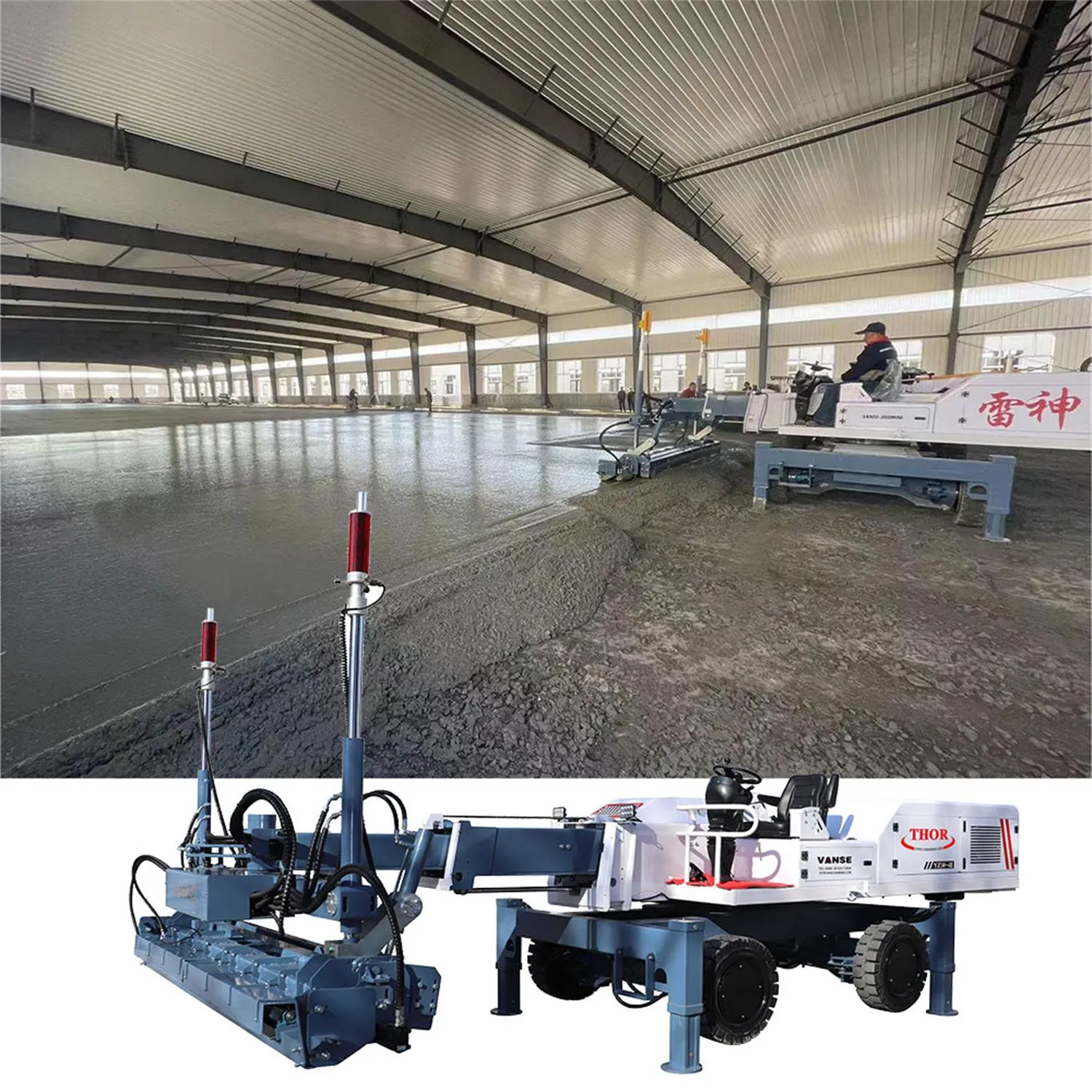
In addition to being widely used in the field of construction, laser leveling machines can also be applied to many other fields to meet the high requirements for ground flatness and precision in different environments.
1. **Industrial plants and warehouses**:
Laser leveling machines are used in large industrial plants, automated warehouses, etc. These places usually require large areas of flat ground to adapt to mechanized operations and cargo storage.
2. **Commercial facilities**:
In large shopping malls, shopping centers, supermarkets and other commercial facilities, laser leveling machines ensure ground flatness and provide a better customer experience.
3. **Logistics and warehousing**:
Logistics centers, warehouse supermarkets and exhibition centers require flat and durable floors, and laser leveling machines can meet these needs.
4. **Transportation infrastructure**:
Airport runways, aprons, port terminals and container yards, etc., these places require high-quality concrete floors to support heavy-load traffic.
5. **Municipal engineering**:
Municipal engineering such as city squares, residential floors, municipal roads, etc., laser leveling machines can improve construction quality and efficiency.
6. **Clean room environment**:
Clean workshops such as electronic appliances, food materials, and medicines, which have strict requirements on the flatness and cleanliness of the ground.
7. **Outdoor floor**:
Including outdoor parking lots, municipal roads, etc., laser leveling machines can cope with various climatic conditions and provide high-quality outdoor floor construction.
8. **Special ground engineering**:
Such as aerospace manufacturing centers, aircraft manufacturing and maintenance workshops, etc., these places have special requirements for the flatness and bearing capacity of the ground.
The versatility and high adaptability of the laser leveling machine enable it to play an important role in a variety of construction environments, improve construction efficiency and quality, and reduce long-term maintenance costs. With the continuous advancement of technology, the application scope of laser leveling machines will continue to expand to meet the construction needs of more fields.
Thanks to All the Friends Who Support and Trust Shandong Vanse Machinery Technology Co., Ltd.
If you want to know more about Shandong Vanse Machinery Technology Co., Ltd. or have any questions, please feel free to contact us:
Our Factory
Shandong Vanse Machinery Technology Co., Ltd.








Share this article

About the Author: Shandong Vanse Machinery Technology Co., Ltd.
Shandong Vanse Machinery Technology Co., Ltd. is a high-tech manufacturer specializing in concrete construction machinery, including laser screeds and related equipment. The company integrates R&D, production, and global sales, with products exported to over 60 countries and widely used in infrastructure projects worldwide.
Previous Post
Next Post
Related Articles
You Might Also Like
Laser leveling machine helps speed up and improve the quality of cast-in-place floor construction in industrial plants!
With the increasing number of warehouse and large production workshop construction projects, the existing conventional construction technology can no longer meet their needs for the flatness and quality of concrete floors. In this situation, laser leveling technology has been successfully introduced. The use of laser leveling machines for construction can not only effectively reduce the occurrence of ground cracking, damage, sanding, etc., but also has a high level of construction automation, fast construction speed, and low construction cost. The economic benefits brought by the cast-in-place floor construction of industrial plants are very considerable. The following is a brief introduction to the specific application of laser leveling machines in the construction of cast-in-place floor slabs of industrial plants. —- Working principle of laser leveling machine Laser leveling consists of four parts: laser transmitter, data processing system, laser receiver, and leveling power system. The laser transmitter rotates continuously at a speed of 600r/min to form a horizontal laser plane in space. After receiving the laser signal, the laser receiver on the laser leveler transmits the data to the data processing system, and the data processing system then sends a signal to the electric push rod on the laser leveler. The electric push rod executes the command at a speed of 10 times/s, so that the fabric spiral, scraper, and vibrator on the laser leveler can adjust the elevation in real time to ensure the levelness of the floor. —-Technical features of laser leveler ❶ High flatness quality: The flatness of the floor can reach a deviation of less than 2mm within a range of 2m. The floor elevation is automatically controlled by the laser and data processing system, and the leveling system is adjusted in real time through the bidirectional electric push rod to ensure accurate leveling. ❷ Good integrity of the floor: Due to t he independent arrangement of the laser transmitter, large-area casting can be achieved during the construction of the main frame cast-in-place floor slab. Compared with the traditional method, the construction joints are greatly reduced, making the cast-in-place floor structure more integrated. ❸ Good concrete density: Since the laser leveling machine itself has a vibration system with a vibration frequency of 3000 times/min, compared with the traditional inserted vibrator, the density of the floor structure plate can be increased by more than 20%, thereby avoiding the risk of floor cracking caused by uneven vibration. ❹ Significantly improved work efficiency: The laser leveling head scraper, fabric spiral, vibrator and leveling beam of the laser leveling machine integrate the leveling, leveling and vibration work in one go. Compared with traditional construction methods, about 300m of leveling work can be completed per hour, and an average of 3000m can be completed per day, reducing labor by more than 30%, and the work efficiency can be increased by about 3 times. —-Cast-in-place floor laser leveling construction technology ❶ Construction preparation: First divide the construction section, and after the template support and steel bars of the pouring construction section are installed and accepted, install and debug the laser leveling machine equipment. The laser transmitter is set up on a special tripod to ensure that the laser emission is not blocked so that the construction area can receive the laser smoothly. The laser transmitter can be set up independently of the main body of the frame to be cast to avoid accidental collision during construction. According to the original leveling point, the fixed reference leveling point on the floor is measured and imported into the laser leveling machine to make the laser transmitter, leveling point, and laser leveling machine correspond. ❷ Casting concrete: Use pumped commercial concrete, and the slump is controlled between 160~180mm. According to the workshop area of each floor of the factory building, it is divided into 8 construction sections for segmented construction. According to the divided construction sections, the columns, beams, and slabs are cast in order from one end to the other. After the column and beam concrete are put into the mold, they are vibrated with an inserted vibrator. The concrete of the casting slab needs to be about 2cm higher than the template to facilitate the laser leveling machine to scrape it flat, and the material reduction or supplementation work can be carried out as needed. To prevent cold joints, the concrete transportation should be as continuous and uniform as possible, and the pauses and intervals in the middle should be minimized. During pouring, the piles of concrete need to be roughly flattened manually, and then the laser leveling machine controls the electric push rod according to the signal of the laser transmitter, and adjusts the horizontal height of the leveling head in real time to ensure that its height is always consistent with the set level point. At the same time, two workers are equipped to level and fill materials at the leveling head to ensure the flatness of the floor, and complete the vibration and compaction work while leveling. ❸ Slurry lifting and finishing: After laser leveling, when the concrete is about 3mm deep when people stand on the concrete surface before and after the initial setting, a disc trowel is used to lift the slurry. The speed of the mechanical trowel should be adjusted appropriately according to the hardening degree of the concrete, and the operation should be carried out in a criss-cross manner. Switch to a blade trowel for polishing, and use manual troweling for corners, column corners and other detailed parts that cannot be polished by the trowel. ❹ Maintenance and finished product protection: After the concrete is finished, water is sprinkled and covered with plastic film to prevent water evaporation and maintain a moist maintenance state. The curing time shall not be less than 7 days, and people are prohibited from stepping on the concrete before the concrete strength reaches 1.2MPa. The above is a brief discussion of the working principle and technical characteristics of the laser leveling machine, as well as a systematic summary of the specific process flow of the lightweight leveling machine used in the construction of cast-in-place floor slabs in industrial plants. By comparing multiple engineering practices, it is found that the effect and economic benefits of using a laser leveling machine for construction are more significant than those of manual construction.How does the concrete laser leveling machine work?
Concrete laser leveling machine is a device that uses laser technology for floor leveling. Its working principle is mainly based on laser measurement and control systems, combined with mechanical automation technology, to achieve high-precision and efficient floor leveling. During the specific work process, the laser leveling machine first emits a laser beam through the laser transmitter, which is projected onto the ground to be constructed and received by the laser receiver. The receiver then feeds back the received signal to the control system, and the control system adjusts the position and height of the leveling head based on the feedback signal to ensure that the leveling head always remains at the set elevation position for operation. The leveling head is the core part of the laser leveling machine. It integrates functional modules such as scraper, spiral and vibrating plate, and can complete the initial leveling, vibration and leveling of concrete at one time. During the leveling process, the role of the scraper and spiral is to evenly distribute the concrete, while the vibrating plate vibrates the concrete to achieve the desired flatness. At the same time, the laser leveling machine adopts a computer laser control system, which receives and processes laser signals through the laser receiver of the mechanical head to make real-time adjustments at a monitoring frequency of 10 times per second to accurately control the floor elevation. This allows the flatness of the entire floor to be accurately controlled and avoids manual errors and construction joint problems in traditional construction methods. In addition, in order to achieve large-area construction, laser leveling machines are usually equipped with automatic navigation systems or remote control systems to achieve automated and efficient construction. This construction method can not only improve construction efficiency and shorten the construction cycle, but also reduce manual operating errors and improve construction quality. To sum up, the working principle of the concrete laser leveling machine is based on the laser measurement and control system. By accurately controlling the floor elevation and flatness, combined with mechanical automation technology, efficient and high-precision floor leveling can be achieved.Analysis of the application of the concrete laser leveling machine in large-area floor construction
The concrete laser leveling machine is a device that uses the laser emitted by the transmitter as the reference plane, and controls the leveling head in real time through the laser receiver on the laser leveling machine, thereby achieving high-precision and rapid leveling of concrete. In large-area floor construction, its application is as follows: – High-precision leveling: The ground elevation is controlled by a laser system consisting of a laser transmitter, a laser receiver and a leveling rod. The laser transmitter emits lasers at a frequency of 10 times or even higher per second to form a control plane. The laser receiver on the laser leveling machine monitors the leveling head elevation in real time. The computer control system automatically adjusts the leveling head height according to the deviation to ensure the flatness and levelness of large-area floors. The accuracy can reach millimeter level (within ±3mm). Compared with traditional methods, the flatness and levelness are improved by more than 3 times. – High construction efficiency: Mechanized construction replaces a large number of manual labor, and the work efficiency is more than 3-5 times that of manual labor. For example, laser screed construction can adopt large-area compartments, with each compartment area up to 2,000 square meters, reducing the setting of construction joints, while reducing the work of force transmission rods and formwork support, speeding up the construction progress. Some large telescopic arm laser screeds can complete the leveling of 15 square meters of concrete each time, and some equipment can spread up to 5,000 square meters per day. – Improve ground quality: The powerful vibrator can vibrate at a frequency of up to 4,000 times/minute, which can ensure that the concrete is vibrated and compacted, making the entire paved concrete matrix homogeneous and dense, and the density and strength are more than 20% higher than traditional methods, effectively enhancing the wear resistance and impact resistance of the ground. – Save labor costs: The use of concrete laser screeds can save about 35% of labor, and some robot equipment can be remotely controlled by one person, which reduces manpower input while also reducing the labor intensity of workers. – Flexible adaptation to various working conditions: It can automatically control the longitudinal and transverse slopes, and can also be equipped with a three-dimensional special-shaped ground processing system to meet the construction of complex-shaped ground with high requirements such as drainage, such as squares with special drainage designs, airport runways and other places. – Industrial Plant: The third phase of the Flanders Plant is an industrial plant for manufacturing transmission parts assembly and testing. The steel fiber concrete metal wear-resistant floor area is 22,000 square meters and the floor thickness is 300 mm. It has high requirements for flatness and bearing capacity. The floor flatness error is required to be controlled within 3 mm. The use of laser leveling machine construction meets high standards. – Underground Garage: The underground garage of the National Treasury Unified Payment Center in Xicheng District, Beijing has an area of 10,500 square meters of metal wear-resistant floor and a floor thickness of 200 mm. The use of this equipment has achieved good results; in the construction of the basement concrete floor of a company's production headquarters project in Suzhou, the four-wheel laser floor leveling robot solved the construction problems of large volume, tight schedule, and high strength, and the flatness deviation was controlled within 5 mm. – New Energy Vehicle Intelligent Industrial Park: In order to ensure the safety of AGV transport vehicles, the Feixi New Energy Vehicle Intelligent Industrial Park EPC project has strict requirements on floor quality. The steel fiber concrete leveling process of this project uses a large laser leveling machine, which greatly improves the flatness of the ground. – Equipment Debugging and Maintenance: Before construction, the laser transmitter, receiver and other equipment must be accurately installed and debugged to ensure that their position is accurate and they operate normally; during the construction process, the equipment must be regularly inspected and maintained to avoid equipment failures affecting the construction quality and progress. – Construction Site and Environment: The construction site should be cleared of obstacles in advance to ensure that the laser signal is not blocked; at the same time, the impact of environmental factors such as temperature and wind on the construction should be considered, and corresponding measures should be taken to deal with it, such as paying attention to the concrete setting speed at high temperatures and avoiding the shaking of the laser transmitter in windy weather. – Concrete Quality Control: Strictly control the mix ratio, slump, initial setting time and other parameters of the concrete to ensure that the quality of the concrete is uniform and stable, so as to ensure the construction effect of the laser leveling machine. – Personnel operating skills: Operators must undergo professional training, be familiar with the operating procedures and techniques of the equipment, and be able to skillfully deal with various construction situations to ensure smooth construction.