Technical Knowledge
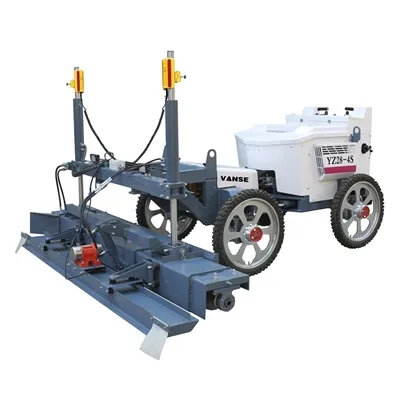
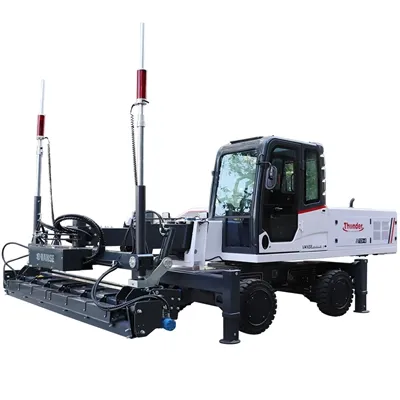
Uses and features of high-quality concrete laser leveling machines

High-quality concrete laser leveling machine is a key equipment for high efficiency and precision in modern concrete construction, and is widely used in various large-area, high-precision concrete base surface construction. The following is a detailed introduction from the two aspects of purpose and features:

🌲 The core use of high-quality concrete laser leveling machine
1. Large-area concrete base surface leveling
– Mainly used for large-area concrete slabs and ground paving and leveling in industrial plants, warehouses, large supermarkets, logistics centers, etc., and can quickly handle construction areas of thousands to tens of thousands of square meters.
– Suitable for municipal engineering (such as squares, parking lots), airport runways, highway service areas and other scenes with high requirements for ground flatness.
2. High-precision leveling and control
– Cooperate with the laser system to achieve precise leveling of the concrete surface, ensuring that the base surface flatness error is controlled at the millimeter level (usually ≤3mm/2m), meeting the basic requirements for subsequent fine construction such as epoxy flooring and wear-resistant flooring.
3. Improve construction efficiency and quality
– Replace traditional manual scraper, vibrator and other tools, greatly reduce labor costs, and the construction efficiency can reach 3-5 times that of traditional methods (such as paving 300-500㎡ per hour).
– Through mechanical vibration and laser positioning, reduce concrete bubbles, honeycomb surface and other defects, and enhance the density and strength of the base surface.

🌲 The significant features of high-quality concrete laser leveling machine
1. Laser guidance, extremely high precision
– Equipped with imported laser transmitters and receivers, the height of the leveling mechanism is controlled in real time through laser signals to ensure that the leveling plane is consistent with the laser plane, avoiding the accumulation of errors in manual operation.
2. Integrated construction, efficient process
– Integrate paving, vibration, leveling and slurry raising functions: the spiral spreader is used to evenly spread concrete, and the high-frequency vibrator (vibration frequency can reach 3000 times/minute) removes bubbles and compacts the concrete, and then the leveling beam is used to complete precise leveling, reducing the connection time of the process.
3. Adaptable to complex working conditions, strong flexibility
– Some models adopt four-wheel drive or crawler design, which can be stably driven on ramps (slope ≤5°) and uneven ground; the width of the fuselage can be adjusted (such as 2-6 meters) to adapt to different construction spaces.
– Support manual/automatic mode switching, manual operation can be performed near corners and obstacles, taking into account large-scale construction and detail processing.
4. Intelligent control, convenient operation
– Equipped with an LCD display, which displays laser signals, vibration frequency, driving speed and other parameters in real time, which is convenient for operators to monitor; some high-end models have fault self-diagnosis function to reduce maintenance difficulty.
5. Strong durability, adaptable to harsh environments
– Key components (such as laser receivers, hydraulic systems, and vibration motors) are made of high-quality materials, with excellent waterproof and dustproof performance. They can work stably for a long time in high temperature and humidity construction sites, and their service life can reach more than 10 years (under normal maintenance).
6. Reduce dependence on manual labor and ensure construction safety
– Reduce manual bending operations and reduce the labor intensity of workers; mechanical operation reduces the number of people stepping on the concrete before initial setting, avoids damage to the base surface, and reduces the risk of safety accidents.

🌲 Summary
The high-quality concrete laser leveling machine solves the pain points of poor flatness, low efficiency, and high labor costs in traditional concrete construction through laser precision control and integrated efficient construction. It is the core equipment for achieving high-standard ground construction in modern industrial and civil buildings, especially suitable for projects with strict requirements on ground accuracy and strength.
Click the below to jump immediately!!!


CONCRETE LEVELING MACHINE


TRACKED MINI DUMPER
Thanks to All the Friends Who Support and Trust Shandong Vanse Machinery Technology Co., Ltd.
If you want to know more about Shandong Vanse Machinery Technology Co., Ltd. or have any questions, please feel free to contact us:
Our Factory
Shandong Vanse Machinery Technology Co., Ltd.








Share this article

About the Author: Shandong Vanse Machinery Technology Co., Ltd.
Shandong Vanse Machinery Technology Co., Ltd. is a high-tech manufacturer specializing in concrete construction machinery, including laser screeds and related equipment. The company integrates R&D, production, and global sales, with products exported to over 60 countries and widely used in infrastructure projects worldwide.
Previous Post
Next Post
Related Articles
You Might Also Like
How to achieve ultra-high floor flatness standards of FF ≥ 50 through equipment collaboration?
Achieving ultra-high standards of FF ≥ 50 (flatness) and FL ≥ 35 (levelness) has elevated floor construction to a "surgical" level of precision. This is no longer about the performance of a single piece of equipment, but rather a deep collaboration of three elements: **"laser initial leveling + manual precision trimming + ride-on power trowel fine compaction."** The following is a practical equipment collaboration plan for achieving FF ≥ 50: To achieve FF ≥ 50, the error propagation between equipment must be controlled at the millimeter level. Equipment Selection: A large telescopic arm laser leveling machine must be used, as its leveling head stability is far superior to smaller machines. Coordination Techniques: The laser sensor frequency should be set to the highest level. During the leveling process, the operator needs to reduce the travel speed by 30%, giving the hydraulic system more ample response time to correct the elevation. Role: This is the decisive factor in crossing the threshold from FF30 to FF50. Coordination Techniques: After laser leveling and before the initial setting of the concrete, two experienced technicians use 3m – 4.5m long-handled straightedges to perform a crisscross, back-and-forth leveling in a grid pattern. Accuracy Correction: The straightedge must be perpendicular to the direction of travel of the laser leveling machine, aiming to eliminate the subtle waviness generated by the laser head during gear changes or overlapping paving. In projects where FF ≥ 50, power trowels are used not only for polishing but also to eliminate small bumps through compaction. Equipment: Heavy-duty ride-on power trowel. Coordination: Real-time monitoring with an infrared level is essential. If any localized elevation deviations are detected, use the power trowel's disc to "push and fill" the slurry to correct the level. Angle Control: The tilt angle of the trowel blades must be strictly consistent. Overlapping Coverage: Use the "1/2 overlap method," meaning the path of the second pass must overlap half of the first pass to ensure there are no unpolished areas or steps. In ultra-high standard construction, testing cannot wait until the next day; it must be a process of **"construction, testing, and correction simultaneously."** Equipment: Dipstick automatic flatness tester (or similar F-Number testing instrument). Immediately after the first pass of fine leveling and finishing, the technician conducts spot checks on the floor. If a downward trend in the FF value is detected, the finishing machine operator is immediately instructed via radio to repeatedly compact the high spots or add small amounts of material to the low areas. Thermal Correction: Corrections are completed while the concrete is still plastic; this is the last opportunity to achieve FF50. Stages Equipment coordinated operation Accuracy Objectives Spreading Laser Leveling for uniform spreading + manual assistance for filling material at the edges of the formwork Error: ±3 mm Initial leveling Long-handled Leveling (horizontal + vertical) reciprocating motion for more than 3 passes Eliminate mechanical undulations Grouting Ride-on power trowel (with disc attachment) for overlapping compaction Ensure uniform density Fine leveling Final manual leveling using a 3-meter Leveling Eliminate grout ridges left by the disc Final finishing High-speed trowel blades for finishing + real-time monitoring and feedback Achieve FF ≥ 50 Even the best equipment cannot achieve the desired results if the materials are not compatible: Slump coordination: The slump variation of each batch of concrete must be controlled within ±10 mm. Temperature control coordination: Indoor wind speed should be controlled below 2 m/s to prevent rapid water loss from the surface, which can lead to drying shrinkage and damage the achieved flatness. Note: The parameters provided in this document are for reference only and are not mandatory. Due to differences in technical characteristics between different brands and models of laser levelers, please consult the manufacturer for a suitable solution before actual operation. This reference document assumes no responsibility for any issues arising from failure to follow the manufacturer's instructions.What are the market prospects & development trends of concrete laser leveling machines?
Concrete laser leveling machine is a device that uses laser technology to level the concrete surface. Compared with traditional manual leveling methods, concrete laser leveling machines have the advantages of high precision, high efficiency, and high quality, so they are widely used in various construction sites, such as highways, bridges, tunnels, airport runways, and squares. , parking lot, etc. The market prospects and development trends of concrete laser leveling machines will be discussed below from the aspects of application fields, technological innovation, etc. 1. Application fields As urbanization continues to accelerate, various infrastructure construction projects continue to increase, and the application fields of concrete laser leveling machines are becoming more and more extensive. In addition to use on construction sites, concrete laser levelings can also be used in the following areas: Urban road construction Urban roads are an important part of urban transportation, and their quality directly affects the development of the city and the quality of life of residents. The concrete laser leveling machine can quickly and accurately complete the leveling work of the road surface, improving the road quality and shortening the construction period. Bridge construction Bridges are an important part of urban transportation and have very high quality requirements. The concrete laser leveling machine can provide high-precision road leveling for bridge construction, effectively improving the quality and stability of the bridge. Tunnel construction Tunnels are an important part of urban traffic and have very high requirements for road surface quality. The use of concrete laser leveling machines can provide high-precision, high-quality road leveling for tunnel construction, effectively improving the quality and safety of tunnels. Airport runway construction The airport runway is an important place for aircraft to take off and land, and has very high requirements for the quality of the road surface. The use of concrete laser leveling machines can provide high-precision, high-quality road leveling for airport runways, effectively ensuring the safety of aircraft takeoffs and landings. Plaza and parking lot construction Squares and parking lots are one of the indispensable infrastructures in the city, and they have high requirements for the smoothness and quality of the road surface. The use of concrete laser leveling machines can provide high-precision, high-quality road leveling for squares and parking lots, effectively improving the quality and user experience of these places. 2. Technological innovation With the continuous advancement and innovation of science and technology, the technology of concrete laser levelings is also constantly upgraded and innovated. In the future, concrete laser leveling machines will develop in a more intelligent, automated, and efficient direction. Specifically, the technological innovation direction of concrete laser leveling machines includes the following aspects: Intelligent control system Intelligent control system is one of the important trends in the future development of concrete laser leveling machines. By introducing advanced sensors, controllers and other intelligent hardware and software, we can realize automatic control and intelligent management of concrete laser levelings and improve the accuracy, stability and reliability of the equipment. For example, the Internet of Things technology is used to realize remote monitoring and management of equipment; machine vision technology is used to realize automatic identification and measurement of equipment, etc. High efficiency engine system The engine system is one of the core components of the concrete laser leveling, and its performance directly affects the operating efficiency and stability of the equipment. In the future, the engine system of concrete laser leveling machines will develop in the direction of being more efficient, energy-saving and environmentally friendly. For example, high-pressure fuel injection technology is used to improve engine combustion efficiency; exhaust gas recirculation technology is used to reduce engine emissions. High-precision navigation system The navigation system is one of the key components of the concrete laser leveling, and its accuracy directly affects the leveling effect and quality of the equipment. In the future, the navigation system of concrete laser leveling machines will develop towards higher precision, stability and reliability. For example, inertial measurement unit (IMU) technology is used to achieve high-precision measurement of the attitude and position of the device; satellite navigation technology is used to improve the positioning accuracy of the device. Multifunctional operating system Multifunctional operating system is one of the important trends in the future development of concrete laser leveling machines. By adding a variety of operating devices and functional modules to the equipment, the equipment can be used for multiple purposes and improve the adaptability and utilization of the equipment. For example, a breaker hammer device can be added to realize the crushing function of the equipment; a smoothing device can be added to realize the smoothing and light-collecting functions of the equipment. In short, with the continuous progress and innovation of science and technology, the application fields of concrete laser levelings will be more extensive, and technological innovations will emerge in endlessly. In the future, concrete laser leveling machines will develop in a more intelligent, automated, efficient, and multifunctional direction, providing more efficient, accurate, and reliable concrete leveling services for various construction sites.What to do if the efficiency of laser leveling machine drops?
In the process of using the laser leveling machine, pay attention to the harm caused by unfavorable factors to the leveling machine, because the working environment of the leveling machine has always been relatively harsh, so when the leveling machine is working, it will inevitably be damaged by the surrounding unfavorable factors, and it will also lead to a decline in the working efficiency of the laser leveling machine. Later, the failure will inevitably become more and more serious, so everyone should be careful when using it. 1. Avoid impurities: For laser leveling machines that work in harsh environments and complex conditions, first of all, use high-quality and matching parts, lubricating oil, and grease to block the source of harmful impurities; secondly, do a good job of mechanical protection at the work site to ensure that the corresponding mechanisms can work normally and prevent various impurities from entering the interior of the machine. For the faulty laser leveling machine, try to go to the regular repair place for repair. When on-site repairs, protective measures must also be taken to prevent the parts replaced during on-site repairs from being polluted by impurities such as dust before entering the machine. 2. Applicable temperature: During the use of the laser leveling machine, firstly, it is necessary to prevent overload operation at low temperature, ensure the normal operation in the low-speed preheating stage, and make the machine reach the specified temperature before driving or working. Do not ignore its important role because there is no problem at that time; secondly, prevent the laser leveling machine from operating at high temperature. During the operation of the machine, the values on various thermometers should be checked frequently. For those who can't find the reason for a while, the laser leveling machine must still work with the disease without treatment. In normal work, pay attention to check the working condition of the cooling system. For water-cooled machines, it is necessary to check and add cooling water before work every day; for air-cooled machines, the dust on the air-cooling system should also be cleaned regularly to ensure the smooth flow of cooling air ducts. 3. Anti-corrosion: In the use of laser leveling machines, management and operators should take effective measures according to the local weather conditions and air pollution conditions at that time to reduce the impact of chemical corrosion on laser leveling machines. The focus is to prevent the intrusion of rainwater and chemical components in the air to the machinery. Based on all the above contents, do you have a comprehensive understanding of the laser leveling machine to avoid the infringement of unfavorable factors? If the content we shared has helped you, welcome to continue to pay attention to our website, we will continue to update the newsletter for you, and strive to provide customers with better services.