Technical Knowledge
Precision Control Principle of Laser Leveling Machine in Superflat Floor Construction
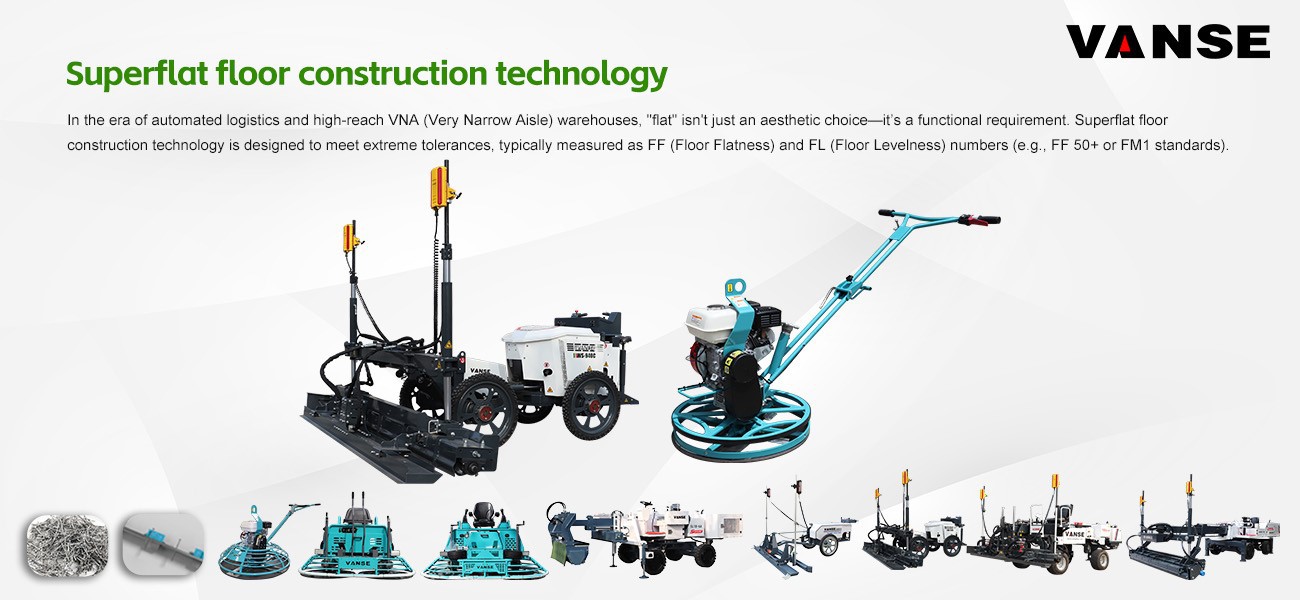
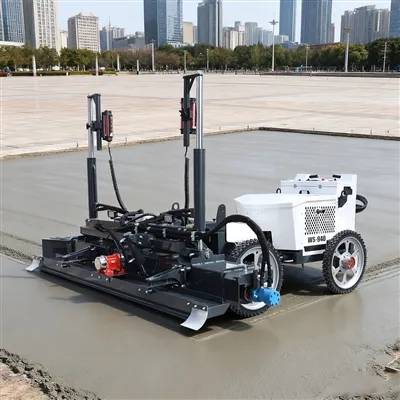
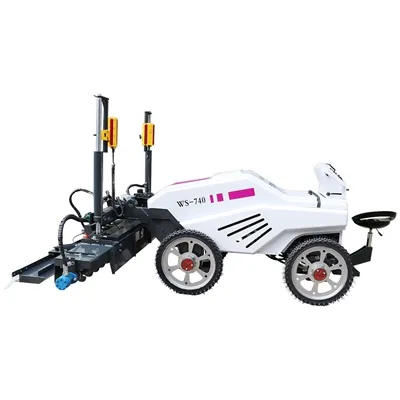
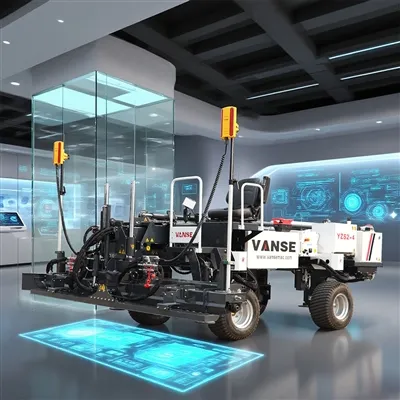
Achieving a Superflat floor (FM1/FM2 or FF 50+) isn't just about having a steady hand; it’s about high-speed physics and real-time data. If you’re a contractor looking to bid on high-spec logistics hubs or robotic warehouses, you need to understand the Precision Control Principle that makes a Concrete Laser Leveling Machine the undisputed king of the job site.
Here is the "under-the-hood" breakdown of how this technology works, and how the Vanse professional fleet turns these principles into flawless results.
1. The "Benchmark": Constant Laser Reference
The heart of the system is the Laser Transmitter. It sends out a 360-degree rotating beam that creates a perfectly horizontal (or sloped) reference plane over the entire work area.
The Vanse Advantage: Most Vanse machines, are designed to work with world-class laser systems (Leica/Trimble). This transmitter stays stationary, ensuring that the "zero point" never shifts, regardless of the terrain or machine movement.
2. The "Eyes": High-Frequency Receivers
Mounted on both sides of the machine's leveling head are the Laser Receivers.
The Principle: These receivers detect the laser beam and send height data to the on-board computer 10 times every second. This is far faster and more accurate than any human eye could ever hope to be.
The Vanse Workflow: Because the Vanse YZ30-4E Telescopic Boomed Laser leveling has such a long reach (6 meters), the receivers can maintain a "clean" signal without the interference of moving wheels on wet concrete, which is a major factor in hitting those ultra-high FL (Levelness) numbers.
3. The "Muscle": Instant Hydraulic Feedback
This is where the magic happens. The computer compares the data from the receivers to the benchmark. If the head is even 1mm too high or low, it sends an immediate command to the Hydraulic System.
The Principle: The hydraulic actuators make micro-adjustments to the leveling head's elevation in real-time. This ensures that the auger (which removes excess concrete) and the vibrator (which consolidates the slab) are always at the exact elevation required.
Vanse Integration: To make this process smoother, it helps if the concrete is placed evenly first. Using a Vanse Concrete Distributor or a Mini Dumper to place the mix prevents the laser leveling from "fighting" massive piles of concrete, allowing the hydraulic system to focus on precision rather than heavy lifting.
4. Consolidated Finishing: Preserving the Level
The precision control doesn't stop once the leveling passes. The surface must be finished without losing that laser-perfect flatness.
The Principle: You need to densify the slab without creating new "waves."
The Vanse Workflow:
Use a Vanse Automatic Topping Spreader to apply hardener uniformly. Manual throwing creates "hills" that ruin FF scores.
Follow up with a Vanse Ride-on Power Trowel. With its high-torque engine and precision pitch control, it burnishes the floor to a mirror finish while maintaining the flatness established by the laser leveling.
Finally, use a Vanse Concrete Cutting Machine (Floor Saw) for crisp contraction joints that won't spall or lift, preserving the floor's long-term FF/FL integrity.
Why "The Vanse System" Wins the FF/FL Game
Foreign buyers and engineers don't just look for a "smoothing tool"; they look for a System of Precision. Here is the ROI for your business:
| Control Element | Traditional Manual Result | Vanse Laser Control Result |
| Reaction Speed | Slow (Human observation) | Instant (10x per second) |
| Leveling Accuracy | ±5-10mm over 3m | ±1mm over 3m (Superflat) |
| Surface Density | Uneven (Manual vibration) | Uniform (High-frequency vibration) |
| Joint Quality | Ragged (Hand-tooling) | Clean & Straight (Floor Saw) |
| Labor Cost | High (12+ man crew) | Low (4-6 man crew) |
Final Thought
Precision control isn't a "feature"-it’s a requirement. If you are bidding on modern industrial projects, you aren't just competing on price; you are competing on accuracy. By utilizing a complete fleet from Vanse Machinery (www.vansemac.com), you are guaranteeing that every square meter of your floor meets the highest international standards.
Ready to hit those FM1 numbers? Explore the full technical breakdown at Vanse and see how our laser leveling technology can revolutionize your business.
Note: The parameters provided in this document are for reference only and are not mandatory. Due to differences in technical characteristics between different brands and models of laser levelers, please consult the manufacturer for a suitable solution before actual operation. This reference document assumes no responsibility for any issues arising from failure to follow the manufacturer's instructions.
Thanks to All the Friends Who Support and Trust Shandong Vanse Machinery Technology Co., Ltd.
If you want to know more about Shandong Vanse Machinery Technology Co., Ltd. or have any questions, please feel free to contact us:
Our Factory
Shandong Vanse Machinery Technology Co., Ltd.








Share this article

About the Author: Shandong Vanse Machinery Technology Co., Ltd.
Shandong Vanse Machinery Technology Co., Ltd. is a high-tech manufacturer specializing in concrete construction machinery, including laser screeds and related equipment. The company integrates R&D, production, and global sales, with products exported to over 60 countries and widely used in infrastructure projects worldwide.
Previous Post
Next Post
Related Articles
You Might Also Like
The Purpose and Significance of Management and Maintenance of Concrete Laser Leveling Equipment
As core equipment for high-precision, high-efficiency floor leveling in modern construction, the management and maintenance of Concrete Laser Levelings not only impacts the stable performance of the equipment but also directly impacts project quality, construction costs, and enterprise competitiveness. The following analysis examines the purpose and significance of Concrete Laser Leveling management and maintenance: Laser Leveling machines achieve millimeter-level precision control through their laser transmitters and receivers. Issues such as calibration deviations, sensor failure, or mechanical wear can directly result in substandard floor flatness, leading to rework and quality disputes. Regular maintenance ensures that key components, such as the laser system, vibration motor, and travel mechanism, are in optimal condition, ensuring that construction accuracy meets design requirements. Concrete construction is a harsh environment, and equipment is susceptible to cement corrosion, mechanical vibration, and dust abrasion. Through scientific management (such as standardized operating procedures and maintenance records) and preventive maintenance (such as regular cleaning, lubrication, and replacement of wearing parts), unplanned downtime can be reduced, equipment degradation can be delayed, and repair costs and the frequency of replacements can be significantly reduced. Equipment failure or performance degradation can lead to construction interruptions and reduced efficiency. For example, loss of laser system signal may require recalibration, which is time-consuming and impacts progress. Routine inspections and rapid maintenance can minimize downtime, ensure continuous and efficient equipment operation, and contribute to on-time project delivery. Laser Leveling machines involve high-speed rotating parts, hydraulic systems, and overhead work (such as telescopic boom models). Improper maintenance can lead to mechanical failure, hydraulic leaks, or even casualties. Regularly inspecting safety devices (such as emergency stop buttons and protective covers), hydraulic lines, and electrical systems can eliminate potential safety hazards and protect both operators and equipment. Surface flatness is a core indicator of concrete construction quality, directly impacting subsequent floor laying, equipment installation, and building aesthetics. Precise maintenance of the laser transmitter, receiver, and screed head ensures surface flatness within ±2mm, meeting the requirements of high-standard industrial plants, logistics warehouses, and other scenarios, while avoiding customer complaints or claims due to quality issues. Reduce direct costs: Preventive maintenance costs are far lower than repair costs. For example, regularly changing hydraulic oil can prevent system downtime caused by oil line blockage, saving tens of thousands of yuan in repair costs. Improve equipment utilization: By optimizing maintenance plans, equipment idle time can be reduced, increasing output per unit time and indirectly increasing company revenue. Enhance market competitiveness: Stable and reliable equipment performance is key to earning customer trust, helping companies establish a professional image and expand into the high-end market. Standardized equipment management (such as establishing a maintenance database and applying IoT monitoring technology) can accumulate extensive operational data, providing a basis for optimized equipment design, fault prediction, and intelligent maintenance, driving the industry's development towards digitalization and refinement. Furthermore, a comprehensive maintenance system helps standardize construction standards and elevate the industry's overall technical capabilities. Extending equipment lifespan and reducing resource waste are key aspects of green construction. Reducing equipment scrap rates through scientific maintenance can reduce the consumption of raw materials such as metals and plastics, lower carbon emissions, and help the construction industry achieve its "dual carbon" goals. The management and maintenance of Concrete Laser Leveling machines is crucial for ensuring construction quality, controlling costs, improving efficiency, and ensuring safety. Companies should establish a full lifecycle management system that prioritizes prevention and prioritizes maintenance. Incorporating intelligent monitoring technologies, these systems enable real-time monitoring of equipment status and optimal allocation of maintenance resources. This will help companies gain an advantage in the fiercely competitive market and promote high-quality development in the industry. Note: The parameters provided in this document are for reference only and are not mandatory. Due to differences in technical characteristics between different brands and models of laser levelers, please consult the manufacturer for a suitable solution before actual operation. This reference document assumes no responsibility for any issues arising from failure to follow the manufacturer's instructions.How does the laser leveling machine ensure the uniform distribution and flatness of the concrete during the leveling process?
As an advanced construction equipment, laser leveling machine is widely used in concrete floor leveling operations. It utilizes laser technology for precise control, enabling efficient and precise leveling operations. However, ensuring even distribution and flatness of concrete is a crucial challenge during the leveling process. This article will explore in detail how laser levelings ensure uniform distribution and flatness of concrete, and analyze the key factors that influence these two factors and the corresponding solutions. ••• ★ ••• The importance of uniform distribution of concrete and its influencing factors 1. Importance: Uniform distribution of concrete is essential to ensure the quality and service life of the ground. If the concrete is unevenly distributed, it may cause cracks, settlement and other problems on the ground, seriously affecting the use effect and safety. 2. Influencing factors: Factors affecting the uniform distribution of concrete mainly include the material properties of concrete, construction technology and the performance of the leveler. For example, the water-cement ratio and aggregate particle size of concrete will affect its fluidity and distribution effect; the rationality of the construction process, such as the execution of steps such as spreading and vibration, will also have a direct impact on the uniform distribution of concrete; In addition, performance parameters such as laser leveling accuracy, power and vibration frequency will also have an impact on the uniform distribution of concrete. ••• ★ ••• The importance of flatness control and its influencing factors 1. Importance: Flatness is one of the important indicators to measure the quality of concrete floor. Good flatness can not only improve the aesthetics of the floor, but also ensure the functionality and safety of the floor. If the ground flatness is insufficient, it may lead to problems such as uneven ground and water accumulation, which will affect the use effect. 2. Influencing factors: Factors affecting flatness include the accuracy of the leveler, the skill level of the operator, the construction environment, etc. The accuracy of the leveler directly determines the smoothness of the ground, while the skill level of the operator affects the performance of the leveler. In addition, the construction environment such as temperature, humidity, etc. will also have an impact on flatness. ••• ★ ••• Laser leveling's specific measures to ensure uniform distribution and flatness of concrete 1. Equipment selection and calibration: Select a laser leveler with stable performance and high precision, and perform regular equipment calibration and maintenance to ensure that the equipment is in optimal working condition. 2. Optimize the construction process: Develop a reasonable construction process, including spreading, vibrating, leveling and other steps to ensure uniform distribution of concrete. At the same time, the construction process parameters, such as cloth speed, vibration frequency, etc., are adjusted according to the actual conditions on site to obtain the best leveling effect. 3. Improve the skill level of the selected characters: Strengthen the training and education of the operating characters, improve their skill level and professional knowledge, and ensure that the selected characters can be practiced through regular skill assessment and practical work drills The operating skills of leather grip laser leveling machine ensure the uniform distribution and flatness of concrete. 4. Environmental monitoring and adjustment: Pay close attention to changes in the construction environment during the construction process, such as temperature, humidity, etc. Timely adjust construction technology and equipment parameters according to environmental changes to ensure the stability and reliability of leveling operations. ••• ★ ••• Implement effectiveness evaluation and continuous improvement After the above measures are implemented, the leveling effect needs to be regularly evaluated to understand the actual effect of the measures. Evaluation can be carried out by observing the appearance quality of the ground, measuring flatness indicators, collecting usage feedback, etc. Based on the evaluation results, measures are continuously optimized and improved to adapt to different engineering needs and construction environments. ••• ★ ••• Conclusion During the leveling process, the laser leveling machine can effectively ensure the uniform distribution and flatness of concrete through reasonable equipment selection, calibration, optimization of construction technology, improvement of operator skills, and environmental monitoring and adjustment. The implementation of these measures requires comprehensive consideration of multiple factors, including equipment performance, construction technology, operator skill level, and construction environment. By continuously improving and optimizing these measures, the leveling effect of the laser leveling machine can be further improved, providing strong support for the healthy development of the construction industry.Technical guarantee measures for safe production of concrete projects
Technical objective: Through standardized technical management, precise process control, and scientific risk prediction, quality and safety hazards such as collapse, cracking, and leakage in concrete projects are eliminated from the technical level, ensuring the safety of personnel, equipment, and structures during the construction process, and guaranteeing that concrete projects comply with the "Code for Acceptance of Construction Quality of Concrete Structures" (GB50204) and relevant safety production regulations. Scope of application: This measure is applicable to the entire life cycle of concrete engineering, including all links such as the selection of concrete raw materials, mix proportion design, mixing and transportation, pouring and vibration, curing and formwork removal, covering various concrete structure projects such as housing construction, municipal works, Bridges and tunnels. Raw material selection and inspection: Strictly screen raw materials such as cement, sand and gravel, admixtures, and admixtures. Select cement products that meet the design strength grade (such as P.O42.5 and above), and the sand and gravel gradation should comply with the specification requirements (the particle size of the gravel is determined based on the structural dimensions, with the maximum particle size not exceeding 1/4 of the minimum cross-sectional size of the component). After each batch of raw materials arrives at the site, a third-party testing institution is entrusted to conduct performance tests (such as cement strength and stability, mud content and crushing value of sand and gravel, water reduction rate and setting time of admixtures). Only after passing the tests can they be used. Technical requirements for raw material storage: Cement should be stored in a closed warehouse, stacked in zones according to the batches entering the site, and kept at least 30cm above the ground to prevent moisture and caking. The sand and gravel yard is hardened and treated, with rain shelters set up. Sand and gravel of different specifications are stored separately to avoid mixing. Admixtures are stored in dedicated tanks and labeled to prevent confusion with other materials. Customized mix ratio: According to the type of engineering structure (such as beams, slabs, columns, foundations), strength grade (such as C30, C40), construction environment (temperature, humidity) and construction technology (pumping, self-compaction), entrust a qualified laboratory to design a special mix ratio. Clarify key parameters such as water-binder ratio, sand ratio, and admixture dosage (for example, the slump of pumped concrete should be controlled at 120-160mm, and the spread of self-compacting concrete should be ≥550mm). Mix proportion optimization technology: By adding admixtures such as fly ash and mineral powder, the amount of cement is reduced, the heat of hydration is lowered, and temperature cracks in mass concrete are avoided. For winter construction, early-strength admixtures should be added to the mix proportion to ensure the early strength growth of concrete. During summer construction, adjust the dosage of retarder, extend the initial setting time, and prevent the initial setting of concrete during transportation. Plan formulation and review: Prepare a special construction plan for concrete projects, clearly defining the construction process, technical parameters (such as the thickness of each pouring layer, vibration time, and curing period), and quality and safety control points. For special projects such as large-volume concrete (pouring volume ≥1000m³ or thickness ≥1m), ultra-high pumping concrete (pumping height ≥100m), and special-shaped structure concrete, experts are organized to conduct technical arguments on the plans, with a focus on reviewing temperature control, support systems, and distribution methods, etc., to ensure the scientific and feasible nature of the plans. Technical briefing and Training: After the plan is approved, a comprehensive technical briefing will be conducted for technical personnel and construction teams, detailing the mix ratio requirements, pouring sequence, vibration key points, and emergency response measures. Organize technical training for operators, conduct practical exercises on key procedures such as the use of vibrators and the connection of pumps and pipes, and only allow them to take up their posts after passing the assessment. Technical supervision of the mixing process: The mixing plant adopts a fully automatic metering system to ensure that the metering deviation of raw materials complies with the specification requirements (the metering deviation of cement and admixtures is ≤±1%, and that of sand and gravel is ≤±2%). The mixing time should be strictly controlled (for ordinary concrete, the mixing time should be ≥90 seconds; for concrete with admixtures or admixtures, it should be ≥120 seconds). During the mixing process, technicians should be arranged to inspect and observe the workability of the concrete (such as slump, cohesion, and water retention). If problems such as segregation and bleeding occur, the mix proportion should be adjusted immediately or the mixing should be stopped. Technical support during transportation: Special tank trucks are used for concrete transportation. The inner walls of the tank trucks are thoroughly cleaned to prevent residual concrete from affecting the quality of fresh concrete. The transportation route should be planned in advance to avoid congested sections and ensure that the transportation time is ≤ the initial setting time of the concrete (≤2 hours at normal temperature and ≤1.5 hours at high temperature). During transportation, the tanker should maintain a low rotational speed (2-4r/min) to prevent concrete segregation. After the concrete arrives, technicians will test the slump on site. If the deviation exceeds ±20mm, the laboratory will issue an adjustment plan. It is strictly prohibited to add water at will. Pouring sequence technical optimization: Follow the principle of "layered pouring, symmetrical advancement, and continuous operation". The concrete pouring of beams and slabs should be advanced from one end to the other, while the concrete pouring of columns and walls should be done layer by layer, with each layer thickness ≤500mm (when using insert-type vibrators), to avoid local accumulation causing overloading of formwork supports. The "inclined plane layering" pouring method is adopted for mass concrete, with a layering thickness of 300-500mm. The pouring speed is controlled (generally ≤2m/h) to reduce internal temperature stress. Vibration Technical: Specification The type of vibrator should be selected based on the slump of the concrete (high-frequency vibrators should be used for a smaller slump, and medium-frequency vibrators for a larger slump). When using an insertable vibrator for vibration, the spacing between the vibration rods should be no more than 400mm, and the insertion depth should be 50-100mm to the lower layer of concrete. The vibration time should be controlled at 15-30 seconds (until the concrete surface shows slurry and no air bubbles escape). Over-vibration (to prevent aggregate segregation) or missed vibration (to avoid honeycomb and pitted surfaces) is strictly prohibited. During the vibration process, avoid the vibration rod touching the steel bars, formwork and embedded parts to prevent structural deformation or displacement of embedded parts. Temperature control for bulk concrete: The "internal reduction and external protection" technical measure is adopted. Temperature measurement tubes are pre-embedded inside (with one temperature measurement point set every 50-100 square meters) to monitor the internal and surface temperatures of the concrete in real time, with the temperature difference controlled at ≤25℃. Circulating cooling water can be introduced inside to lower the core temperature. The surface is covered with thermal insulation cotton and plastic film to reduce heat loss and prevent temperature cracks. When the temperature difference exceeds the limit, add insulation layers or adjust the flow rate of cooling water. Conventional concrete moisture control: Within 12 hours after the concrete pouring is completed, cover it with moisture-retaining materials (such as gunny bags, geotextiles). During the hot summer, water it in time for maintenance to keep the surface moist. During winter construction, methods such as covering with electric blankets and steam curing should be adopted to ensure that the curing temperature is ≥5℃. The curing time should be carried out in accordance with the specifications (≥7 days for ordinary concrete, ≥14 days for concrete with retarding admixtures or with impermeability requirements) to prevent shrinkage cracks caused by rapid water loss in the concrete. The determination of formwork removal time: The formwork removal time is determined based on the strength of the concrete test blocks under the same curing conditions. For bending members such as beams and slabs, formwork removal can only be carried out when the strength of the test blocks reaches 75% (for spans ≤8m) or 100% (for spans > 8m) of the designed strength. For vertical components such as columns and walls, the side formwork can be removed when the strength of the test block is ≥1.2MPa. Before formwork removal, technicians should issue a formwork removal application, which can be implemented after approval by the supervision unit. It is strictly prohibited to remove formwork in advance, which may cause structural cracking or collapse. Technical Specifications for formwork removal operations: Formwork removal follows the principle of "install first and then remove, install later and then remove first, from top to bottom". Rough formwork removal is strictly prohibited. When removing large formwork, a crane should be used for hoisting, and a dedicated person should be assigned for command. No one is allowed to stand under the formwork. After formwork removal, promptly clean up the residual concrete on the surface of the formwork, check the flatness and deformation of the formwork, and repair the damaged parts before putting it back into use. Structural entity inspection: 28 days after the concrete pouring is completed, a third-party inspection agency is entrusted to conduct structural entity inspection, including concrete strength rebound, steel bar cover thickness inspection, structural dimensional deviation inspection, etc. Conduct core drilling and sampling tests on large-volume concrete and important components (such as frame columns and main beams of Bridges) to ensure that the concrete strength meets the design requirements. For the parts that fail the inspection, a special treatment plan shall be formulated and implemented after being approved by the design unit (such as reinforcement by high-pressure grouting, external concrete coating, etc.). Defect repair technology: For defects such as honeycomb, pitted surface and exposed bars on the concrete surface, the "surface treatment method" is adopted for repair: Clean the loose concrete at the defect area, rinse it clean with a high-pressure water gun, apply an interface agent, and then repair it with fine aggregate concrete or mortar in the same proportion as the original concrete. After repair, cover and maintain it. For crack defects, the repair method should be selected based on the crack width (surface sealing method for width ≤0.2mm, pressure grouting method for width > 0.2mm). During the repair process, technical records should be kept well to ensure the repair quality. Establish technical archives for concrete engineering, collect and organize raw material inspection reports, mix proportion notices, construction logs, temperature measurement records, curing records, formwork removal applications, physical inspection reports and other materials to ensure that the materials are complete, accurate and traceable. Technical archives are filed and preserved in accordance with the prescribed requirements, serving as an important basis for project acceptance and later maintenance. Regularly review and analyze the technical data of concrete engineering, summarize the technical problems during the construction process (such as the optimization effect of mix proportion and the accuracy of temperature control), form a technical summary report, provide technical references for subsequent similar projects, and continuously improve the safety production technology level of concrete engineering. Emergency technology for concrete supply interruption: If the supply of concrete is interrupted due to a malfunction of the mixing plant or traffic congestion, immediately stop pouring, vibrate and compact the surface of the already poured concrete, and cover it with moisture-retaining materials. When the interval time exceeds the initial setting time of the concrete, handle it according to the requirements of the construction joint (set up a vertical construction joint, clean the surface floating slurry and loose aggregates, and apply an interface agent). After the concrete supply is restored, re-pour to ensure that the construction joint is tightly combined. Emergency techniques for structural cracks: If early cracks are found on the concrete surface during the pouring process, stop pouring immediately, check the width and depth of the cracks. If they are surface dry shrinkage cracks, cover them with water in time and strengthen moisture retention and maintenance. If it is a temperature crack, add an insulation layer and adjust the temperature control measures. If the cracks continue to develop, immediately organize the evacuation of personnel, entrust the design unit to formulate a reinforcement plan, and adopt technical measures such as temporary supports and grouting sealing to prevent the cracks from expanding and causing structural safety accidents. Instructions for Use: This plan is a general template. Before the specific implementation of each project, it should be refined and supplemented according to the characteristics of the project (such as super-high, super-heavy, large-span structures, etc.), especially the control measures for major hazard sources.