Technical Knowledge
Why is the price difference of laser leveling machines so big?

Compared with manual work, laser leveling machines are more efficient and effective, so more and more people are choosing laser leveling machines. So do you know why the price difference between laser leveling machines is so big? The editor will give you a brief introduction, let's take a look.
The main reason why the prices of laser leveling machines vary in the market is the difference in quality and brand. Many products look very similar, but when you actually use them, you will find that these products actually seem to be somewhat different. Learn to conduct a comprehensive analysis of the quality of the products, so that you can better Make sure you end up buying a good product. Of course, you still have to make comparisons when faced with different prices.
Features of an excellent laser leveler:
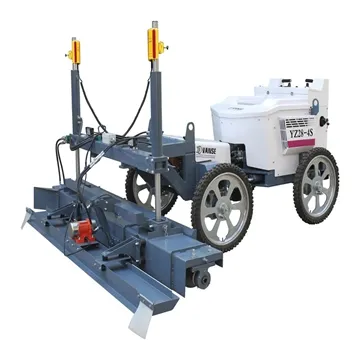
1. The leveling principle of the laser leveling machine is achieved by using precision laser technology, closed-loop control technology and a highly precise hydraulic system, under the automatic control of a computer. This is its most prominent feature that distinguishes it from other floor construction processes. .
2. The leveling principle of the laser leveling machine is to rely on the hydraulically driven leveling head to cooperate with the laser system and computer control system to complete the leveling work while automatically leveling. The leveling head is equipped with an integrated scraper, vibrator and leveling plate, which integrates all leveling, leveling, vibration and compaction work into one and completes it at one time. The computer control system automatically adjusts the height 10 times per second in real time, and the balanced designed vibrator has a vibration frequency of 3,000 times per minute.
3. The laser transmitter used to control the ground elevation is arranged independently. In this way, the floor elevation is not controlled by the template and does not produce cumulative errors.
4. The laser leveling machine can also automatically control the longitudinal and transverse slopes, which is also completed by the laser system, computer system, hydraulic system and mechanical system. For complex-shaped floors with high requirements such as drainage, a three-dimensional special-shaped ground treatment system can also be selected.

Thanks to All the Friends Who Support and Trust Shandong Vanse Machinery Technology Co., Ltd.
If you want to know more about Shandong Vanse Machinery Technology Co., Ltd. or have any questions, please feel free to contact us:
Our Factory
Shandong Vanse Machinery Technology Co., Ltd.








Share this article

About the Author: Shandong Vanse Machinery Technology Co., Ltd.
Shandong Vanse Machinery Technology Co., Ltd. is a high-tech manufacturer specializing in concrete construction machinery, including laser screeds and related equipment. The company integrates R&D, production, and global sales, with products exported to over 60 countries and widely used in infrastructure projects worldwide.
Previous Post
Next Post
Related Articles
You Might Also Like
Tell you how effective the concrete laser leveling machine is!
Tell you how effective the concrete laser leveling machine is! Many consumers are still hesitating whether they should buy a concrete laser leveling machine, because they have no concept of the construction effect of the equipment. Today we will introduce the use effect of the equipment. First of all, the biggest feature of this equipment is that it is fast, and the time-consuming is 1/10 of manual work, which is enough to make many construction teams excited; secondly, it is flat, and the ground level error after paving is small , is almost negligible. 1. Requirements for concrete and formwork ① Concrete: Concrete must be produced, conveyed or pumped to the flooring site by a commercial concrete production plant. ② Concrete specifications: C25~C30 concrete, the strength of which is not less than 25MPa in 28 days, according to the design requirements. ③ Water-cement ratio: N o more than 0.5, no water can be added during the feeding process. ④ Cement: Use ordinary Portland cement with a grade of not less than 42.5. ⑤ Aggregate: Well-graded aggregate should be used. Crushed granite or pebbles are used as coarse aggregate, and the maximum diameter is not more than 25mm. The fine aggregate is clean river sand with a fineness modulus of 2.4-2.7. ⑥ Concrete mix ratio: The amount of cement is not less than 350Kg/m3. In order to avoid surface quality problems, the sand rate should be controlled at 35% to 40%. ⑦ Concrete slump: 14±2cm, maximum 16cm. ⑧ Setting time: The initial setting time should be controlled within 3-5 hours. In order to avoid the excessive deviation of the surface elevation affecting the joints, the formwork should be steel formwork. The height of the formwork should be controlled within +0 and -2mm, and the steel formwork should be within 1-1.2 meters from the surrounding walls. 2. Construction cooperation requirements ① The concrete feeding speed should be determined according to the ground thickness and pouring area to determine the minimum hourly feeding speed. For a floor with a thickness of 200 mm, if the width of one-time pouring reaches 40 meters, the minimum feeding speed should reach 40 cubic meters per hour, otherwise there will be cold joint problems, which will affect the quality of ground construction. ② Manually coordinate the concrete sent to the platform, and workers need to remove it as soon as possible and roughly level it. In addition, the areas around the formwork, walls, columns, trenches, equipment foundations, floor drains or around pipelines that cannot be leveled require manual cooperation for local leveling. Generally, 3-4 workers are required to cooperate with the construction (provided by Party A). ③ Other precautions In order to ensure the flatness of the ground, attention should be paid to: 1) The slump of concrete sent to the platform must be consistent each time. 2) Ensure that the concrete feeding speed reaches 40 cubic meters per hour or above, and the initial setting time of each batch of concrete must be consistent. 3) Ensure that the formwork elevation is accurate and cannot be disturbed during construction. 4) Environmental cooperation. The concrete floor that has just been constructed cannot be exposed to sunlight, wind, rain, etc. that are unfavorable to concrete health. ④ Other requirements: A. In order to avoid random cracks in the floor, the cutting time of shrinkage joints should be carried out as early as possible (within 24 hours). B. At the same time as the construction of the laser leveling machine, there should be no electric welding machines on site, and no reflective objects (such as glass windows). C. The foundation must reach a certain hardness to ensure that the laser leveling machine does not collapse when working on the ground. D. The height of the ground in the factory building shall be calibrated by Party A, and the points must be evenly distributed, and there must be no error in the levelness. E. Pouring concrete must be operated according to the requirements of Party B's technicians.Which components of the concrete laser leveling are most prone to damage and need to be stocked in advance?
As a high-precision and high-strength construction equipment, the wear and damage of the components of the concrete laser leveling machine are inevitable. To minimize downtime and ensure construction progress, it is a very wise move to stock up on key vulnerable components in advance. Based on the structure and working principle of the equipment, the following components are the most prone to damage. It is recommended that you stock up in advance according to the construction intensity and project conditions These are the "legs and feet" of the leveling, which have the highest working intensity and come into direct contact with the concrete, making them the most prone to wear and tear. The reason is that it directly rubs against and flattens the concrete aggregates, making it the component that wears out the fastest. It is usually made of wear-resistant steel plates, but after long-term use, it will inevitably wear out and become thinner, losing its smooth effect. Suggestion: This is a component that must be stocked in stock, and 2-3 sets of spare parts with different degrees of wear and tear should be prepared according to the scale of the project. The reason is that walking on unsolidified concrete makes it easy to be scratched or punctured by sharp aggregates such as stones and steel bar ends. Although most of them are solid tires, the rubber itself can also wear out. It is highly recommended to have a complete set of tire assemblies for the entire vehicle (usually four), especially for construction sites with complex ground environments and exposed steel bars. Reason: The load is heavy when driving the entire machine to move. Although it is not prone to damage itself, the internal drive gears, bearings, seals and other components are vulnerable points. Especially when the sealing parts age and cause oil leakage, it will accelerate internal wear. Suggestion: It is advisable to prepare a set of reducer assembly as a core backup, or at least a set of drive gear and seal maintenance kits for quick repair. This is the "blood circulation system" of the leveling machine. Faults often lead to the paralysis of the entire machine. The reason is that there are a large number of seals at all parts of the hydraulic system (cylinders, motors, valve block interfaces). Due to long-term operation under high pressure and high temperature, rubber will age and wear out, leading to oil leakage, which is the most common hydraulic failure. Suggestion: Purchase a set of maintenance kits for the entire machine's sealing parts. It is not expensive, but it can quickly solve the problem when oil leakage occurs, making it the spare part with the best cost performance. The reason is that the cleanliness of the hydraulic oil is directly related to the lifespan of the entire hydraulic system. Regular replacement of the filter element is a necessary maintenance item. If the filter element is clogged or fails, it will cause severe wear of core components such as hydraulic pumps and motors. Suggestion: According to the equipment maintenance manual, always keep at least one set (such as return oil filter elements, suction oil filter elements, etc.) on hand. The reason is that the drive shaft connecting the engine (or hydraulic motor) and the hydraulic pump operates under high torque. If it is poorly lubricated or subjected to shock, the universal joint bearing is prone to damage. Suggestion: Prepare a complete drive shaft assembly or at least a universal joint maintenance kit. This is the "eyes and brain" of the leveling, where the precision lies and requires careful protection. Reason: Although it is an electronic component itself, the construction site environment is harsh and it may be damaged due to collision or splashing concrete. It is the key to ensuring flatness.Suggestion: This is a core electronic component that is strongly recommended as a backup. Once damaged, the entire machine will not be able to level itself automatically. Reason: As a precision optical instrument, it is vulnerable to dropping, shock and dust. Although it is more durable than the receiver, once a problem occurs, it will affect the entire working area.Suggestion: If the project is of great significance and the schedule is tight, it is advisable to consider having one as a backup. For construction sites where multiple leveling machines work in coordination, having a spare transmitter is a standard operation. The reason is that there are a large number of seals at all parts of the hydraulic system (cylinders, motors, valve block interfaces). Due to long-term operation under high pressure and high temperature, rubber will age and wear out, leading to oil leakage, which is the most common hydraulic failure. Suggestion: Purchase a set of maintenance kits for the entire machine's sealing parts. It is not expensive, but it can quickly solve the problem when oil leakage occurs, making it the spare part with the best cost performance. The reason is that the cleanliness of the hydraulic oil is directly related to the lifespan of the entire hydraulic system. Regular replacement of the filter element is a necessary maintenance item. If the filter element is clogged or fails, it will cause severe wear of core components such as hydraulic pumps and motors. Suggestion: According to the equipment maintenance manual, always keep at least one set (such as return oil filter elements, suction oil filter elements, etc.) on hand. The reason is that the drive shaft connecting the engine (or hydraulic motor) and the hydraulic pump operates under high torque. If it is poorly lubricated or subjected to shock, the universal joint bearing is prone to damage. Suggestion: Prepare a complete drive shaft assembly or at least a universal joint maintenance kit. Priority Component name Stock preparation suggestions ★★★★★ (Highest) Scraper bottom plate It is necessary to stock up. Prepare 2 to 3 sets according to the project volume Hydraulic seal kit It offers the best cost performance and must be stocked Walking tire It is strongly recommended to prepare a complete set ★★★★ (High) Laser receiver It is recommended to have one core electronic component Hydraulic filter element Essential maintenance items should be stocked according to the maintenance cycle Reducer gears/seals It is determined based on the historical failure conditions of the equipment ★★★ (Middle) Universal joint for drive shaft Maintenance kits or assemblies are available Vibrating rod/bearing It is determined by the frequency of equipment usage Laser emitter Large or key projects are recommended as backups ★★ (Low) Battery It depends on the condition of the old battery Here's a tip for you finally: When purchasing equipment, one should ask the manufacturer or supplier for a recommended list of vulnerable parts and understand the expected service life of these components. At the same time, establish maintenance files for your own equipment, recording the replacement times of each component. Only in this way can you carry out predictive stocking more scientifically, ensuring that your equipment is always in the best condition and creating the greatest value for the project. Note: The parameters provided in this document are for reference only and are not mandatory. Due to differences in technical characteristics between different brands and models of laser levelers, please consult the manufacturer for a suitable solution before actual operation. This reference document assumes no responsibility for any issues arising from failure to follow the manufacturer's instructions.How should equipment maintenance standard be implemented during concrete construction?
Implementing equipment maintenance standards in concrete construction requires establishing systems, personnel training, equipment inspection and maintenance, and other aspects, as follows: Establish a comprehensive maintenance system: Clarify the responsibilities, frequency, and content of equipment maintenance, covering all aspects of equipment procurement, operation, maintenance, inspection, and accountability. Designate a dedicated individual for each piece of equipment to ensure thorough maintenance. Establish a dedicated maintenance staff: Employ professional mechanical maintenance personnel and provide regular training to enhance their technical skills, enabling them to promptly diagnose faults and provide optimization recommendations. Perform a thorough pre-use inspection of equipment: Operators should conduct a comprehensive inspection of mechanical equipment before each day's operation, focusing on oil, lubrication, fasteners, hydraulic systems, and electrical wiring to ensure the equipment is in proper condition and avoid accidents caused by negligence during prior inspections. Strengthen daily maintenance and care: Integrate routine maintenance into every shift, implementing daily cleaning and inspection. Regularly replace lubricating oil and grease, inspect filters and oil lines for blockages or leaks, tighten all bolts and nuts, and clean the equipment of dust and dirt. Perform regular special maintenance: Based on equipment usage frequency and manufacturer recommendations, perform comprehensive maintenance monthly or quarterly. This includes disassembly and cleaning, replacing wearing parts, testing component wear, and adjusting equipment parameters to prevent major failures and extend equipment life. Effective emergency response: Establish a fault emergency plan that clearly defines the maintenance process, responsible personnel, and spare parts inventory. When equipment malfunctions, maintenance personnel can quickly and accurately address them, minimizing equipment downtime. Improve equipment file management: Detailed records of equipment maintenance, inspections, malfunctions, and component replacements are maintained in a comprehensive file. By reviewing the files, you can analyze the equipment's operating status and provide data support for developing more effective maintenance strategies. Note: The parameters provided in this document are for reference only and are not mandatory. Due to differences in technical characteristics between different brands and models of laser levelers, please consult the manufacturer for a suitable solution before actual operation. This reference document assumes no responsibility for any issues arising from failure to follow the manufacturer's instructions.