Technical Knowledge
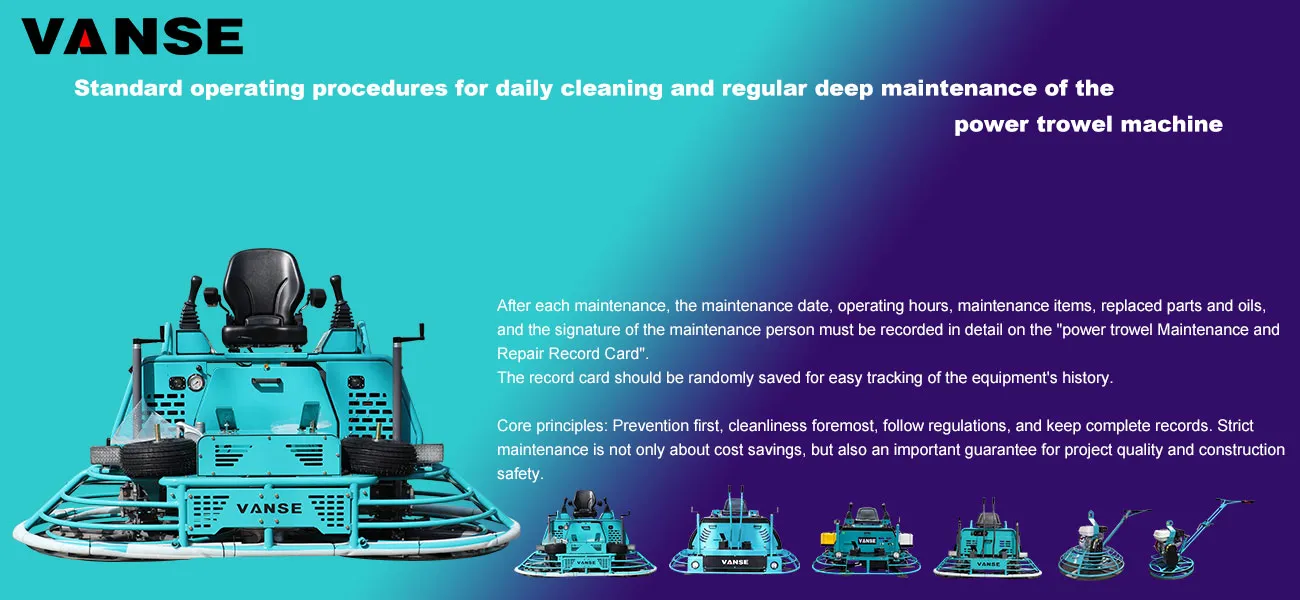
Standard operating procedures for daily cleaning and regular deep maintenance of the power trowel machine
This SOP is designed to ensure equipment performance, extend service life and guarantee operational safety.
Standard Operating Procedure (SOP) for Daily Cleaning and Regular Deep Maintenance of power trowels
1. Purpose
Standardize the daily cleaning and regular maintenance of the power trowel machine to ensure that the equipment is always in good working condition, reduce the failure rate, eliminate potential safety hazards, optimize the construction quality and extend the service life of the equipment.
2. Scope of application
This program is applicable to the maintenance and servicing of all electric, gasoline or hydraulic-driven power trowels (including driver-operated and hand-guided types) of our company.
3. Responsibilities
Operator: Responsible for performing daily cleaning and inspection, and reporting any abnormal conditions.
Equipment Administrator/Mechanic: Responsible for conducting regular deep maintenance, repair and record-keeping.
Project Manager/Supervisor: Responsible for supervising the implementation of the maintenance plan and providing resource support.
4. Safety Instructions
Before carrying out any maintenance, make sure that the equipment has been completely turned off, the engine/motor has stopped, the key has been removed, and all moving parts have come to a standstill and cooled down.
Wear appropriate personal protective equipment (PPE), such as gloves and safety glasses.
Do not clean or maintain the equipment while it is in operation.
When handling fuel, engine oil and lubricating oil, keep away from fire sources and do it in a well-ventilated area.
Part One: Daily Cleaning and Inspection (After each shift or daily)
Operation process: Cleaning -> Inspection -> Report
Step 1: Basic cleaning
Remove large debris: Use a scraper or wooden chips to remove large pieces of concrete and mortar adhering to the power trowel plate, the bottom of the blades and the protective cover.
Rinse/Wipe
Timing: If the concrete has solidified, wipe it with a damp cloth. If the equipment permits and the circuit/air filter is protected, low-pressure water can be used for flushing. However, it is strictly forbidden to directly direct water at key parts such as the engine, motor, bearing housing, and control box.
Key areas: power trowel plate, blades, chassis, walking wheels (or tracks).
Drying and rust prevention: Use a dry cloth to wipe off water stains on the surface of the equipment. For exposed metal parts (non-friction surfaces), apply a small amount of lubricating oil for rust prevention.
Step 2: Inspection of key parts
Power trowel and blade: Check for excessive wear, cracks or deformation. Make sure the installation bolts are tight and not loose.
Transmission system
Gearbox/reducer: Check for any oil leakage or abnormal noise.
Belt/chain (if any) : Check the tension and wear condition, and adjust or replace them.
Engine/Motor
Gasoline engine: Check if the air filter is clean and visually inspect the oil dipstick (it should be in a horizontal position).
Electric motor: Check if the power cord is damaged and if the plug is intact.
Walking mechanism: Check the tire pressure and wear of the walking wheels, or the tightness and wear of the tracks.
Fasteners: Quickly check whether the visible bolts and nuts at all parts are loose, especially at the connection points of the power trowel and the fixing points of the handle.
Safety: Check whether the emergency shut-off switch and protective cover are in good condition and effective.
Step 3: Recording and reporting
Fill in the "Daily Inspection Form for Equipment".
If any abnormality is detected (such as abnormal noise, oil leakage, severe vibration, inability to start, etc.), immediately hang the "Under Repair" sign and report to the equipment administrator.
Part Two: Regular Deep Maintenance (carried out by operating hours or cycles)
A. First-level maintenance (every 50 to 100 hours of operation or monthly)
In addition to the daily content, add:
Engine maintenance (gasoline engine)
Change the engine oil (refer to the manufacturer's manual. The first maintenance is usually carried out after 20 to 30 hours of operation).
Clean or replace the air filter element (more frequently in dusty environments).
Check the spark plugs, clean the carbon deposits, adjust the clearance or replace them.
Check and clean the fuel filter.
Transmission system
Gearbox: Check the oil level and replenish or replace the specified gear oil if necessary.
Bearings: Apply high-temperature lithium-based grease to the main shaft bearings of the power trowel plate, the bearings of the walking wheels, etc.
Comprehensive tightening: Use a torque wrench to re-tighten all key bolts in accordance with the torque values specified by the manufacturer.
Electrical system: Check whether all wire connections are firm and clean the dust on the heat sink of the motor housing.
B. Secondary maintenance/comprehensive maintenance (every 300-500 hours of operation or every quarter)
Carried out by professional mechanics, it includes all first-level maintenance contents and adds:
Deep cleaning and inspection
Remove the protective cover and thoroughly clean the accumulated dust and oil stains inside.
Check the wear condition of the clutch plates (if any).
Deep maintenance of the transmission system
Replace all the lubricating oil in the gearbox.
Check for wear on the belts/chains and replace them in groups if necessary.
Check the clearance and abnormal noise of the bearings, and replace them if necessary.
Fuel system (gasoline engine)
Clean the carburetor.
Empty and clean the fuel tank (this must be done before long-term storage).
Walking mechanism
Inspect the wheel axles and steering mechanism, and apply grease.
For the driving type power trowel, check the hydraulic oil level and whether there is any leakage in the hydraulic pipeline.
Performance test
After the maintenance is completed, run the equipment no-load for 10 to 15 minutes to check for any abnormal sounds, vibrations, overheating or oil leakage, and to ensure that each control lever operates flexibly and effectively.
C. Long-term storage and maintenance (equipment not in use for more than 30 days)
Thorough cleaning: As mentioned earlier, thoroughly clean the equipment and dry it.
Fuel treatment (gasoline engine) :
Drain the fuel from the fuel tank and carburetor, or add fuel stabilizer and run the engine for 5 minutes to fill the stabilizer system.
Engine maintenance
Change the engine oil.
Remove the spark plug, inject about 15 milliliters of engine oil into the cylinder, pull the starting rope several times to distribute the oil, and then reinstall the spark plug.
Anti-corrosion treatment:
Apply anti-rust oil to all exposed metal surfaces.
Apply butter to the smears and leaves to prevent rust.
Storage location: Store the equipment in a dry, well-ventilated and flat indoor area. Lower the power trowel plate to the ground to release the pressure of the hydraulic system (if applicable). Lift the tire off the ground or maintain the standard air pressure.
Maintenance records
After each maintenance, the maintenance date, operating hours, maintenance items, replaced parts and oils, and the signature of the maintenance person must be recorded in detail on the "power trowel Maintenance and Repair Record Card".
The record card should be randomly saved for easy tracking of the equipment's history.
Core principles: Prevention first, cleanliness foremost, follow regulations, and keep complete records. Strict maintenance is not only about cost savings, but also an important guarantee for project quality and construction safety.
Note: The parameters provided in this document are for reference only and are not mandatory. Due to differences in technical characteristics between different brands and models of laser levelers, please consult the manufacturer for a suitable solution before actual operation. This reference document assumes no responsibility for any issues arising from failure to follow the manufacturer's instructions.
Thanks to All the Friends Who Support and Trust Shandong Vanse Machinery Technology Co., Ltd.
If you want to know more about Shandong Vanse Machinery Technology Co., Ltd. or have any questions, please feel free to contact us:
Our Factory
Shandong Vanse Machinery Technology Co., Ltd.








Share this article

About the Author: Shandong Vanse Machinery Technology Co., Ltd.
Shandong Vanse Machinery Technology Co., Ltd. is a high-tech manufacturer specializing in concrete construction machinery, including laser screeds and related equipment. The company integrates R&D, production, and global sales, with products exported to over 60 countries and widely used in infrastructure projects worldwide.
Previous Post
Next Post
Related Articles
You Might Also Like
Safety measures in concrete floor construction
Safety measures in concrete floor construction Concrete floor construction is a complex project involving many links, among which safety issues are particularly critical. From safety preparation before construction to management of the construction site, to the operation of mechanical equipment, personal protection and equipment, high-altitude operations and protection, electrical safety and fire prevention, as well as emergency handling and rescue, each link is directly related to the life safety of construction personnel and the smooth progress of the project. Therefore, this article will focus on these aspects and discuss in detail the safety measures in concrete floor construction: 1. Safety preparation before construction Safety preparation before construction is the basis for ensuring the smooth progress of concrete floor construction. First of all, the construction unit should formulate a detailed safety construction plan, clarify the safety construction goals, responsible persons and safety measures, and conduct safety technical briefings for construction personnel so that they can fully understand the safety risks and countermeasures that may be encountered during construction. Secondly, a comprehensive inspection should be carried out on the construction site to eliminate safety hazards, such as checking whether the construction power lines are intact and whether the mechanical equipment is operating normally. At the same time, according to the needs of the construction, the construction area should be reasonably arranged, and obvious safety warning signs should be set up to ensure that construction personnel can clearly identify dangerous areas. 2. Construction site management Construction site management is an important link to ensure the safety of concrete floor construction. The construction unit should establish a sound construction site management system and clarify various safety management regulations, such as prohibiting smoking at the construction site and prohibiting the random discarding of construction waste. At the same time, a dedicated person should be set up to be responsible for on-site safety management, regularly inspect the construction site, and promptly correct violations. In addition, the construction site should be kept clean and orderly, and construction materials and equipment should be stored in categories to avoid confusion and misoperation. 3. Safety of mechanical equipment operation Concrete floor construction involves a large number of mechanical equipment, such as mixers, rollers, pumping equipment, etc. In order to ensure the safety of mechanical equipment operation, first of all, it should be ensured that the operator has the corresponding operating qualifications and skills, and is familiar with the working principle and operating procedures of mechanical equipment. Secondly, mechanical equipment should be regularly maintained to ensure that it is in good working condition. At the same time, when operating mechanical equipment, it should be strictly carried out in accordance with the operating procedures, and overload operation or illegal operation is prohibited. 4. Personal protection and equipment Construction workers in concrete floor construction need to wear appropriate personal protective equipment to reduce the risk of injury. First of all, construction workers should wear basic protective equipment such as safety helmets, safety shoes and protective glasses. To deal with possible injuries such as falling objects and splashes. Secondly, depending on the construction environment, construction workers should also wear specific protective equipment such as dustproof mouthpieces and anti-noise earplugs to deal with occupational hazards such as dust and noise. In addition, construction units should regularly check and replace personal protective equipment to ensure that it is always in an effective state. 5. High-altitude work and protection In the construction of concrete floors, high-altitude work is inevitable. In order to ensure the safety of high-altitude work, construction units should set up special safety nets, safety fibers and other protective facilities to prevent construction workers from falling and causing accidents. At the same time, construction workers should wear safety belts when working at heights, and ensure that the connection between the safety belts and the fixed points is firm and reliable. In addition, construction units should also regularly inspect the high-altitude work areas to eliminate potential safety hazards in a timely manner. 6. Electrical safety and fire prevention Electrical safety and fire prevention are safety issues that require special attention in the construction of concrete floors. Construction units should strictly abide by the relevant national regulations on electrical safety and fire prevention to ensure that the electrical equipment and lines at the construction site are safe and reliable. At the same time, the construction site should be equipped with a sufficient number of fire-fighting equipment and facilities, such as fire extinguishers, fire hydrants, etc., to deal with possible fire accidents. In addition, construction workers should master basic firefighting knowledge and skills, and be able to quickly take effective countermeasures when a fire occurs. 7. Emergency handling and rescue Although we can take various preventive measures to reduce the safety risks in concrete floor construction, accidents may still occur. Therefore, it is crucial to establish a sound emergency handling and rescue mechanism. The construction unit should formulate a detailed emergency plan to clarify the response measures and rescue procedures for various accidents. At the same time, emergency drills should be organized regularly to improve the emergency handling capabilities and rescue skills of construction personnel. In the event of an accident, the construction unit should immediately activate the emergency plan and quickly organize rescue forces to deal with it, minimizing the losses caused by the accident. In summary, safety measures in concrete floor construction involve many aspects, which require the joint efforts of construction units and construction personnel. By strengthening pre-construction safety preparation, construction site management, mechanical equipment operation safety, personal protection and equipment, high-altitude operations and protection, electrical safety and fire prevention, and emergency handling and rescue, we can effectively reduce the safety risks in concrete floor construction and ensure the life safety of construction personnel and the smooth progress of the project. At the same time, construction units and construction personnel should continue to learn new knowledge and master new technologies to adapt to the ever-changing safety needs and challenges in concrete floor construction.How Does The Concrete Laser Leveling Machine Ensure The Flatness And Smoothness Of The Concrete During The Construction Process?
With the continuous advancement of modern construction technology, concrete laser levelings have become an efficient tool to ensure the flatness and smoothness of the ground. During the construction process, how to make full use of this technology to ensure the quality of concrete is the key that every construction worker needs to study and master in depth. This article will cover an overview of laser leveling machine technology, pre-construction preparation and material selection, laser leveling machine operation points, flatness control technical measures, smoothness improvement methods, construction quality inspection and evaluation, common problems and preventive measures, and construction safety and Environmental protection and other aspects, discuss how to ensure the flatness and smoothness of concrete during the construction process. ✔ Laser Leveling Machine Technology Overview The concrete laser leveling machine uses laser technology to perform precision leveling, which has the advantages of high efficiency, high precision and high stability. During the construction process, the laser leveling machine can adjust the height and position of the leveling tool in real time through the laser beam emitted by the laser transmitter to ensure that the flatness of the ground meets the design requirements. ✔ Pre-construction preparation and material selection Before construction, adequate preparations need to be made, including cleaning the construction site, ensuring the ground is solid and flat, and selecting appropriate concrete materials. The selection of concrete materials has a direct impact on flatness and smoothness. Concrete materials with stable quality and excellent performance should be selected, and the mix ratio of concrete should be adjusted according to the construction environment and requirements. ✔ Key points for laser leveling machine operation When operating the laser leveling machine, you need to pay attention to the following points: 1. Strictly follow the equipment instructions to ensure normal operation of the equipment. 2. Adjust the parameters of the laser leveler according to the construction requirements, such as leveling speed, leveling height, etc. 3. During the leveling process, keep driving at a constant speed and avoid sudden acceleration or braking. 4. Regularly check the wear of leveling tools and replace seriously worn tools in a timely manner. ✔ Technical measures for flatness control To ensure the flatness of concrete, the following technical measures can be taken: 1. Use a laser leveling machine for multiple levels to ensure that the flatness of the ground gradually improves. 2. During the leveling process, debris and accumulated water on the ground should be cleaned up in time to avoid affecting the leveling effect. 3. For areas with uneven ground, local leveling can be used. ✔ How to improve smoothness To improve the smoothness of concrete, you can do the following: 1. Before the initial setting of the concrete, use a professional trowel to perform troweling treatment to make the ground smoother. 2. During the troweling process, pay attention to controlling the speed and angle of the troweling machine to avoid excessive scratches. 3. For floors with special requirements, an appropriate amount of lubricant can be added to the concrete to improve the smoothness of the ground. ✔ Construction quality inspection and evaluation During the construction process, the construction quality should be regularly tested and evaluated. Specific contents include: 1. Use a spirit level, laser rangefinder and other equipment to check the flatness of the ground to ensure it meets the design requirements. 2. Observe the smoothness of the ground and check whether there are obvious scratches or pitting. 3. Record and analyze the test results, discover problems in a timely manner and take measures to improve them. ✔ Frequently asked questions and preventive measures During the construction process, some common problems may occur, such as sanding and cracking on the ground. To address these issues, the following preventive measures can be taken: 1. Control the concrete mix ratio and water-cement ratio to prevent the concrete from being too dry or too wet. 2. During the leveling process, avoid excessive vibration or impact on the ground to avoid cracking the ground. 3. For areas prone to sanding, you can increase the number of times of troweling or use professional sand control agents. ✔ Construction safety and environmental protection During the construction process, attention should be paid to construction safety and environmental protection. Specific measures include 1. Construction workers should wear safety protective equipment, such as hard hats, protective glasses, etc. 2. Obvious safety warning signs should be set up at the construction site to remind personnel to pay attention to safety. 3. To avoid noise, dust and other pollution during the construction process, noise reduction, dust reduction and other measures can be taken to reduce the impact on the surrounding environment. To sum up, ensuring the flatness and smoothness of concrete requires many aspects, including selecting appropriate materials, correct equipment, taking technical measures, conducting quality inspection and evaluation, and doing a good job in construction safety and environmental protection. Only by comprehensively considering and strictly implementing these measures can we ensure that the construction quality meets the expected requirements. At the same time, with the continuous advancement of technology and the accumulation of experience, we have reason to believe that concrete laser levelings will play a greater role in future construction. , providing a more reliable guarantee for improving the flatness and smoothness of the ground.What are the precautions for operating the concrete laser leveling machine?
When operating a concrete laser leveling, safety regulations and equipment operating procedures must be strictly followed to ensure construction quality, efficiency and personnel safety. The following are key operating precautions: – Check whether the laser transmitter and receiver are working properly, calibrate the laser signal accuracy (ensure that the horizontal error is ≤±1mm/3m), and avoid signal interference (such as strong light, obstacles) affecting the measurement accuracy. – Check the mechanical parts of the leveling: engine oil level, fuel volume, hydraulic system oil level and sealing, whether the scraper, vibrator, travel wheel and other parts are tightened, and ensure that there is no looseness or wear. – Debug the vibration frequency (generally 50-100Hz is recommended, adjusted according to the slump of concrete: reduce the frequency when the slump is large to prevent segregation; increase the frequency when the slump is small to enhance the density). – Clear obstacles (such as steel bars and stones) in the construction area, level the surface of the base, ensure that the laser transmitter is installed without obstruction, and the reference points (such as leveling points) are clearly marked. – Check the construction environment: It is not suitable to operate on rainy days, when the wind force is ≥ level 5 or the temperature is lower than 5℃ (special measures are required for winter construction) to avoid affecting the initial setting of concrete and the stability of the equipment. – Operators must undergo professional training, be familiar with the equipment operation process, and wear protective equipment such as safety helmets, non-slip shoes, and reflective vests. – Define the operation warning area and prohibit non-construction personnel from entering, especially avoid walking between the laser transmitter and the receiver to prevent signal obstruction. – The laser transmitter must be fixed on a stable bracket, away from vibration sources (such as pump trucks, vibrators), to avoid signal deviation due to jitter. – The receiver needs to be kept clean to avoid concrete splashing and covering the sensing area; if the signal is interrupted, the machine should be stopped and checked immediately, and recalibrated after removing the obstruction. – The concrete material should be evenly distributed, and the thickness should be slightly higher than the design elevation (generally 5-10cm higher) to avoid the scraper from not being able to operate normally due to insufficient material. – Maintain a uniform speed during operation (recommended speed 0.5-1.5m/min), and adjust according to the initial setting speed of the concrete: speed up when the initial setting is fast, and slow down when it is slow, to ensure that the leveling and vibration are completed simultaneously. – The insertion depth of the vibrating rod needs to cover the full thickness of the concrete layer (error ≤±5mm), and the adjacent vibration areas overlap by 10-15cm to prevent vibration leakage; 5-10cm needs to be reserved at the edge, and manual trimming should be carried out to avoid the equipment rolling the formwork. – When turning or adjusting the direction, you need to slow down and avoid sharp turns that may cause the scraper to deviate and affect the flatness; when working in narrow areas, leave enough turning space to prevent collision with the template or equipment. – When going up and down slopes (slope ≤ 5°), keep the machine body in the same direction as the slope, and do not drive horizontally to prevent rollover. – After the operation, immediately clean the residual concrete on the machine body (especially the scraper, vibrator, and laser receiver surface) to avoid damage to the components after solidification; when flushing with water, prevent water from entering the motor or laser system. – Check the wear of each component: if the rubber sleeve of the vibrator is damaged, it needs to be replaced in time, if the scraper is deformed, it needs to be corrected, and if the hydraulic pipe joint is leaking, it needs to be tightened. – Use a 2m ruler to check the flatness of the ground after leveling, the error should be ≤3mm; if local unevenness is found, it needs to be manually assisted before the initial setting of the concrete. – Record construction parameters (such as vibration frequency, driving speed) to provide reference for subsequent similar projects. – The equipment is parked in a dry and flat place, and the laser transmitter is stored separately in a moisture-proof box; if it is not used for a long time, the fuel and hydraulic oil need to be drained, and anti-rust oil should be applied to protect the metal parts. – If there is a sudden power outage or engine shutdown, the power supply of the equipment must be turned off immediately, and the unsolidified concrete must be manually cleaned to prevent the equipment from sticking to the ground. – If the laser signal is interfered with (such as a strong electromagnetic field nearby), you can switch to wired control mode (supported by some equipment) or change the transmitter position away from the interference source. Following the above precautions can not only ensure the flatness (up to laser-level accuracy) and density of the concrete floor, but also extend the service life of the equipment and reduce the risk of safety accidents. In actual operation, it is also necessary to flexibly adjust the parameters in combination with specific project requirements (such as floor strength grade and area size). Click the below to jump immediately!!! ARMOUR JOINT CONCRETE LEVELING MACHINE LIGHT TOWER POWER TROWEL SLIPFORM MACHINE STEEL FIBER TOPPING SPREADER TRACKED MINI DUMPER