Technical Knowledge
What should be paid attention to when adding oil to laser leveling machine?
Any kind of mechanical equipment, in the process of normal use, needs to add an appropriate amount of oil to ensure the safe operation and service life of the machinery, which is no exception for the laser leveling machine, a new type of concrete road leveling equipment. Although the addition of laser leveling machine oil seems simple, it is actually quite knowledgeable. In order to avoid unnecessary troubles, our company has sorted out in detail several common misunderstandings when adding oil to laser leveling machines. To avoid in time.

▼Do not use the lubricating oil if it turns black: the lubricating oil turns black, which means that the lubricating oil has deteriorated: modern lubricating oils are added with various additives in order to improve their lubricating performance. It is a normal phenomenon that the lubricating oil of internal combustion machinery with detergent and dispersant will turn black shortly after use, and it cannot be replaced easily as "the oil has deteriorated"; the lubricating oil with additives will often make the surface of the bearing black during use. It is also a normal phenomenon. Therefore, when we determine whether the lubricating oil has deteriorated, we cannot judge by vision alone, but must conduct a comprehensive analysis. When conditions permit, the oil should be inspected and tested to change the oil according to the quality;
▼Always change the oil according to the requirements of the machine: the oil level stipulated in the instruction manual of the laser leveling machine is for general working conditions. In the practice of machine oil change and maintenance, the actual conditions of use should also be considered , if the actual service conditions are harsher than the specified service conditions, you should (through the test) choose a higher grade of oil, or appropriately shorten the oil change interval;
▼More engine oil than less: We know that less oil in the laser leveling machine will cause insufficient oil supply, poor lubrication, and lead to mechanical accidents. Therefore, when refueling, you should not "prefer to add more" because you are afraid of insufficient oil. In fact, too much oil will not only increase the power consumption of the crankshaft due to the increased rotational resistance, but also the oil is prone to air bubbles, emulsification and leakage, resulting in poor lubrication;
▼The use of high-viscosity engine oil can solve the problems of engine weakness and oil leakage: engine weakness, oil consumption, and engine oil leakage are external characteristics of engine technical deterioration. There is insufficient evidence for "using high-viscosity engine oil to solve the above problems". On the contrary, it will increase the starting resistance of the laser leveling machine engine, deteriorate the lubrication performance, and aggravate the wear of the machine parts;
▼The engine oil with high viscosity is more beneficial to the engine than the oil with low viscosity: If the viscosity grade of lubricating oil is too high, the pumping performance of the oil pump will be poor, the flow rate will be reduced, and its lubricity, washing and heat dissipation will be deteriorated. It is easy to cause semi-dry friction of laser leveling machine parts, causing failures such as tile burning and shaft holding.
The above are some common wrong behaviors when adding oil to the laser leveling machine. In order to ensure the normal use of the equipment and avoid unnecessary maintenance costs, it is also hoped that the relevant maintenance and management personnel must strictly follow the product manual to add engine oil reasonably, and actively avoid common misunderstandings.

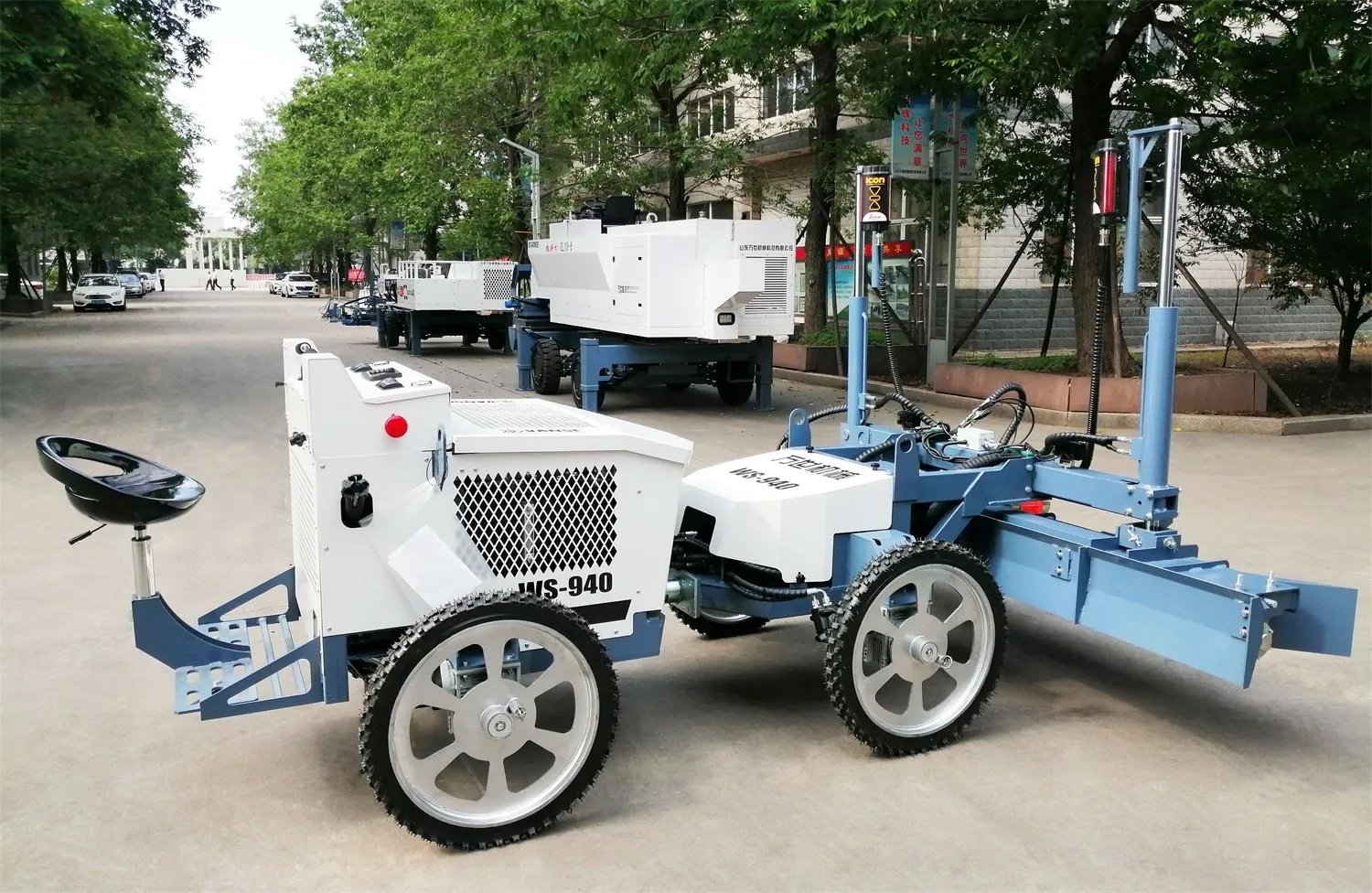
Thanks to All the Friends Who Support and Trust Shandong Vanse Machinery Technology Co., Ltd.
If you want to know more about Shandong Vanse Machinery Technology Co., Ltd. or have any questions, please feel free to contact us:
Our Factory
Shandong Vanse Machinery Technology Co., Ltd.








Share this article

About the Author: Shandong Vanse Machinery Technology Co., Ltd.
Shandong Vanse Machinery Technology Co., Ltd. is a high-tech manufacturer specializing in concrete construction machinery, including laser screeds and related equipment. The company integrates R&D, production, and global sales, with products exported to over 60 countries and widely used in infrastructure projects worldwide.
Previous Post
Next Post
Related Articles
You Might Also Like
How to sync spreader speed with concrete laser leveling machine construction?
To achieve a high-quality "F-number" (floor flatness) rating, the synchronization of your spreader (placer) and your laser leveling is critical. If the spreader is too fast, you get piles of concrete that the leveling has to fight; if it's too slow, the concrete begins to set, causing the leveling to "tear" the surface. Here is how to sync the two speeds for a continuous, fluid pour. The spreader's primary job is to maintain a consistent "head" of concrete-a small surge or roll-in front of the laser leveling's auger or plow. The Golden Rule: The spreader should maintain a consistent surcharge of roughly 10% to 15% above the finished slab height. Visual Sync: If the laser leveling's auger is struggling to move concrete to the sides, the spreader is moving too fast (over-filling). If the leveling's vibrating plate is hitting "air," the spreader is moving too slow. You must match the linear meters per hour of both machines. leveling Speed = Width of leveling Head × Cycle Time / Total Surface Area Pace Matching: Most modern laser leveling operate on a 1-minute to 2-minute "pass and reset" cycle. The spreader must be timed to place enough volume for the next pass during the 15-20 seconds the laser leveling is repositioning its boom. The "Leapfrog" Method: The spreader should stay exactly one boom-length ahead of the leveling. In hot weather or high-slump pours, reduce this distance to prevent premature crusting. Since construction sites are loud, the operators need a non-verbal "sync" system: The Grade Pole: A dedicated laborer with a laser receiver rod should stand between the two machines. They provide the "Thumb Up" (more concrete) or "Thumb Down" (less concrete) signal to the spreader operator based on the real-time grade. The Auger Depth: The laser leveling operator monitors the Auger Pressure Gauge. High pressure means the spreader is dumping too much material; the spreader operator should observe the leveling's auger behavior and adjust their travel speed accordingly. Component Target Behavior Impact of Desync Spreader Travel Continuous, low-speed crawl. Stop-and-go creates "cold joints." leveling Boom Smooth, steady retraction. Fast retraction causes "dipping." Pump Output Matches spreader travel speed. Over-pumping causes "mounding" that the laser can't level. The speed sync must change based on the concrete's slump. Low Slump (Stiff): Spreader must move slower and stay closer to the leveling, as the material won't "flow" to fill gaps. High Slump (Wet): Spreader can move faster, but must be careful not to create "waves" that the laser leveling's vibrating head might skip over. Would you like a specific calculation based on your pump's cubic-yard-per-hour capacity and your leveling's boom width? Contact us NOW Note: The parameters provided in this document are for reference only and are not mandatory. Due to differences in technical characteristics between different brands and models of laser levelers, please consult the manufacturer for a suitable solution before actual operation. This reference document assumes no responsibility for any issues arising from failure to follow the manufacturer's instructions.See how the laser leveling machine can show its skills in leveling construction
Laser leveling machines are convenient to use, without complicated operating techniques. Even inexperienced users can flexibly operate them. Secondly, traditional leveling machines will cause uneven construction when used, which will bring a lot of trouble to the construction. Moreover, the equipment can achieve large-area construction when used. This construction method effectively shortens the construction time and effectively ensures the smooth progress of the later work. 1. Small error: Laser leveling machine is used for large-area construction ground. The ground elevation is easy to control and the ground flatness error is very small. Because of the laser point, the entire building only needs 1-2 reference point elevation, which can reduce the error caused by multiple reference points. The laser is independent of the decoration. The ground height rotates the laser to emit a beam of plane control. As long as the laser is not affected by interference, the laser leveling machine can ensure that the overall level of the paved ground is not affected. Therefore, the ground construction is laid in one area, and the level and smoothness of the entire ground can be ensured. The laser level measurement and control system of the laser leveling machine is controlled in real time. The leveling does not require the control of the line, nor does it require the middle horizontal template to control the ground elevation, avoiding the construction process due to the vibration (channel) of the template elevation error, and also reducing the elevation error caused by the traditional artificial block template. 2. The ground is more integrated: Laser leveling machine, concrete is used in ground construction, it is easy to achieve large-area paving, one-time whole-sound paving process can be carried out according to the needs of any panel block construction, continuous operation and whole-layer construction, so that the surface is complete, which is the traditional construction process, the traditional laser leveling machine construction process, one day of death, pouring concrete, one day only jumps to construction, even if it is a limitation, it cannot be operated continuously, and the integrity is not good, which is easy to cause construction joint cumulative errors. 3. The ground is more compact and more uniform: In ordinary concrete, the laser leveling machine always moves at a constant speed, and there is a high-frequency vibrator of 4000 times per minute, which makes the entire flat plate vibrate evenly, making the concrete floor more uniform. The above basic knowledge about the laser leveling machine is basically over here. If you have good suggestions or opinions, you can communicate with us in time. We will have professional technicians to help you solve the problem. Thank you for your attention and support.How does a concrete laser leveling improve the flatness?
Concrete laser levelings improve flatness by: 1. Utilize laser technology to ensure the flatness and thickness of the concrete surface by precisely controlling the position and height of the laser beam. 2. Automated control technology can realize continuous and automatic leveling operations and improve work efficiency. 3. When performing automatic leveling, there is an accurate reference plane. Generally, when the main focus is to control the height, the tightrope method is suitable; when the main focus is to control the thickness, the floating datum beam method is adopted. Generally, tightrope is used for the bottom layer, and the floating datum beam method is used for the middle layer and surface layer. 4. The leveling machine has a vibration function, which can effectively compact the concrete materials evenly to the required thickness, further improving the flatness. 5. Leveling machines are usually equipped with high-precision sensors and controllers that can monitor and adjust the flatness and height of the concrete surface in real time. Therefore, through the above methods, the concrete laser leveling can effectively improve the flatness of the concrete surface, thereby improving the quality of stinging.