Technical Knowledge
When is the best time to start using a power trowel to treat the concrete surface?
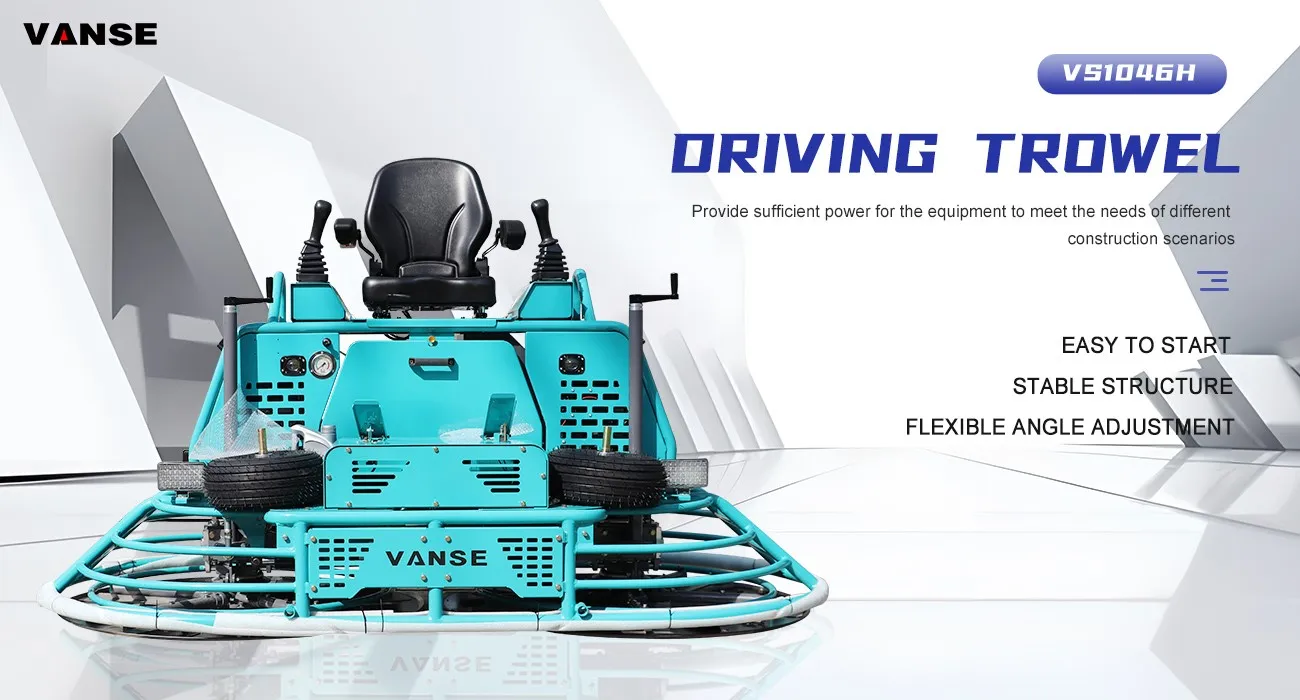
The best time to use a power trowel to treat the concrete surface depends on many factors. Including the type of concrete, environmental conditions, and specific construction requirements.
Generally speaking, when the bleeding on the concrete surface has basically disappeared, and the concrete has reached a certain strength and can withstand the weight of the ride on power trowel machine without obvious deformation and footprints, it is a good time to use a power trowel machine for treatment. Usually within 1-3 hours after the concrete is poured, the specific time will vary depending on the concrete mix ratio, ambient temperature, humidity and other conditions.
If the treatment time is too early, there is too much water in the concrete, and the concrete machinery power trowel is easy to cause bleeding and sand on the concrete surface during operation, affecting the surface quality; if the treatment time is too late, the concrete strength is too high, and the power trowel is difficult to effectively smooth the concrete surface and may damage the equipment.
In actual construction, construction personnel need to judge the best smoothing time based on the specific state of the concrete on site and experience to ensure that a smooth, flat and wear-resistant concrete surface is obtained through the treatment of the concrete power trowel machine.
When determining the power trowel machine use time, environmental factors also need to be considered. In a high temperature and dry environment, the moisture in the concrete evaporates quickly, and the initial setting time may be advanced. It is necessary to observe the state of the concrete surface in time and use the trowel machine as soon as possible; in a low temperature and humid environment, the initial setting time of the concrete will be prolonged, and the use of the trowel machine should be appropriately postponed to avoid affecting the smoothing effect.
In addition, different power trowel manufacturers may give different suggestions on the use time of the trowel machine based on their product characteristics. Therefore, before construction , the trowel machine's instruction manual should be carefully read and adjusted according to the actual situation to ensure the best concrete surface treatment effect.
Click the below to jump immediately!!!


CONCRETE LASER LEVELING MACHINE


SLIPFORM MACHINE

Thanks to All the Friends Who Support and Trust Shandong Vanse Machinery Technology Co., Ltd.
If you want to know more about Shandong Vanse Machinery Technology Co., Ltd. or have any questions, please feel free to contact us:
Our Factory
Shandong Vanse Machinery Technology Co., Ltd.








Share this article

About the Author: Shandong Vanse Machinery Technology Co., Ltd.
Shandong Vanse Machinery Technology Co., Ltd. is a high-tech manufacturer specializing in concrete construction machinery, including laser screeds and related equipment. The company integrates R&D, production, and global sales, with products exported to over 60 countries and widely used in infrastructure projects worldwide.
Previous Post
Next Post
Related Articles
You Might Also Like
What are the common faults and solutions of riding power trowel machines?
Fuel problem: Insufficient fuel or poor fuel quality may cause the engine to fail to start. For example, using fuel containing impurities or too much water will affect the combustion process. Spark plug failure: The spark plug is worn or seriously carbonized, and cannot produce a strong enough spark to ignite the mixture. This is prone to happen to the spark plug after long-term use or working in harsh environments. Air filter blockage: Air cannot enter the engine smoothly, causing the mixture ratio to be unbalanced, affecting combustion. In a dusty construction environment, the air filter is easily blocked. Starter motor failure: The starter motor is damaged and cannot drive the engine crankshaft to rotate, so it cannot start. Motor brush wear, winding short circuit, etc. may cause failures. Check the fuel: Make sure there is enough fuel and use qualified fuel. If you suspect there is a problem with the fuel, you can replace it with new fuel. Check and replace spark plugs: Check the status of spark plugs regularly, clean carbon deposits or replace worn spark plugs. Generally speaking, the service life of spark plugs varies according to the frequency of use and working conditions, and they need to be checked about every 100-200 hours of working time. Clean or replace air filter: Clean the air filter regularly according to the dust conditions in the working environment. If the blockage is serious, replace the new filter in time. Check the starter motor: If the starter motor is faulty, it needs to be repaired or replaced by a professional. Improper installation of the trowel or spatula: The trowel or spatula is not installed firmly, which will cause looseness and abnormal vibration during operation. It may be that the mounting screws are not tightened, or the spatula is displaced by impact during use. Bearing damage: The bearings of the trowel machine may wear or be damaged after long-term use, causing abnormal vibration of the machine. For example, the bearings may be damaged by lack of lubrication or excessive load. Engine is unstable: The engine vibrates when it is working, which will be transmitted to the working parts of the trowel machine, causing abnormal overall vibration. This may be caused by reasons such as engine throttle failure and nozzle blockage. Check and reinstall the trowel and spatula: Carefully check the installation of the trowel and spatula before use, and ensure that the screws are tightened and the spatula is evenly arranged. If the spatula is found to be damaged or deformed, it should be replaced in time. Replace the bearing: When the bearing is suspected to be damaged, it is necessary to disassemble the relevant parts to check the bearing status. If the bearing is damaged, it should be replaced with a bearing of the same model as the original, and ensure that it is installed correctly, and add an appropriate amount of grease. Check the engine stability: Perform a comprehensive inspection of the engine, including the opening of the throttle, the injection of the nozzle, etc. Professional diagnostic tools can be used to detect the working parameters of the engine, and corresponding repairs and adjustments can be made according to the test results. Trowel wear: After long-term use, the blade of the trowel will wear and become less sharp, affecting the trowel effect. For example, when smoothing a concrete surface with a higher hardness, the trowel will wear out faster. Improper machine travel speed: If the travel speed of the ride-on trowel is too fast or too slow, the ideal smoothing effect cannot be achieved. If the speed is too fast, the trowel will act on each part for a short time and cannot smooth the surface; if the speed is too slow, it will affect work efficiency. Excessive unevenness of the concrete surface: If the unevenness of the concrete surface itself exceeds the processing range of the trowel, such as large protrusions or depressions, it is also difficult to obtain a good smoothing effect. Replace the trowel: Check the wear of the trowel regularly, and replace it with a new one in time when the trowel is worn to a certain extent. Generally speaking, the trowel needs to be replaced if the blade wears more than 2-3 mm. Adjust the machine travel speed: According to the state of the concrete and the requirements for smoothing, reasonably adjust the travel speed of the trowel. In the initial smoothing stage, you can slow down the speed appropriately to ensure that the trowel can fully act on the concrete surface; in the fine smoothing stage, you can speed up appropriately. Pre-treat the concrete surface: Before using the trowel, preliminarily treat the concrete surface, such as using a scraper or other tools to roughly flatten the surface so that the unevenness is within the effective working range of the trowel. Tire damage: Punctured, severely worn or insufficient tire pressure will affect the driving stability and normal driving of the trowel. At the construction site, sharp objects can easily puncture tires. Steering system failure: Damage or wear of steering system components such as steering shafts and knuckles will cause the trowel to turn inflexibly or lose control. For example, a loose connection at the steering shaft will cause inaccurate steering operations. Transmission system failure: Broken or loose transmission chains or belts, or problems with the gearbox will affect the power transmission of the trowel and cause abnormal driving. Check and repair tires: Regularly check the tire pressure and wear, and repair or replace tires in time if they are damaged. Keep the tire pressure within the specified range. Generally, the tire pressure of a riding trowel is about 2-3 atmospheres. Check and repair the steering system: Check the steering system, tighten loose parts, and replace worn parts. For example, if the steering knuckle is severely worn, it should be replaced with a new one, and the steering clearance should be adjusted. Check the transmission system: Check the tightness of the transmission chain or belt, and adjust or replace it if necessary. For problems with the gearbox, such as difficulty in shifting gears, abnormal noises, etc., professional maintenance personnel are required to inspect and repair.How should the cooling system of the laser leveler be optimized under high temperature conditions?
Under high temperature conditions, it is very important to optimize the cooling system of the laser leveler to ensure that the equipment can operate normally without malfunctioning due to overheating. Here are several measures that can be taken to optimize the cooling system of the laser leveler: 1. **Increase cooling capacity**: – If the existing cooling system is not sufficient to cope with the high temperature, consider increasing the number of cooling fans or increasing the fan speed to enhance air circulation and heat dissipation. – For water-cooled systems, ensure that there is enough cooling water and that the cooling system is not leaking. It may be necessary to increase the capacity of the cooling water circulation pump or improve the flow path of the cooling water. 2. **Improve radiator efficiency**: – Clean the radiator and remove dust and dirt on it, which may hinder the dissipation of heat. – If the radiator is old or damaged, it may be necessary to replace it with a new radiator to improve the heat dissipation efficiency. 3. **Optimize the working environment**: – Place the laser leveler in a cool and ventilated place as much as possible to avoid direct sunlight. – When working outdoors, you can build a temporary awning to provide shade for the equipment. 4. **Adjust working hours**: – Avoid working during the hottest time of the day. You can choose to work in the morning or evening when the temperature is lower. – Develop a reasonable work plan to allow the equipment to have sufficient rest time during high temperature periods. 5. **Monitor temperature**: – Install temperature sensors to monitor the temperature of key components in real time, such as engines, hydraulic systems, etc. – Set up an alarm system to issue a warning when the temperature approaches or reaches the critical value so that timely measures can be taken. 6. **Use appropriate lubricants**: – Choose lubricating oils and greases suitable for high temperature work. They can maintain good lubrication performance at higher temperatures and reduce the heat generated by friction. 7. **Regular maintenance**: – Regularly check and maintain the cooling system, including replacing worn parts, tightening loose connections, etc. – Regularly replace the coolant in the radiator to ensure that it has good thermal conductivity. 8. **Upgrade cooling materials**: – Consider using higher performance cooling materials, such as copper or aluminum alloys, which have better thermal conductivity. 9. **Thermal management strategy**: – Implement effective thermal management strategies, such as using heat pipes or thermoelectric cooling modules to help transfer and dissipate heat. Through the above measures, the heat dissipation capacity of the laser leveler in high temperature environments can be effectively improved, ensuring the normal operation of the equipment, extending the service life, and improving work efficiency. Before making any improvements, it is recommended to consult the machine manufacturer or professional technicians to ensure that the measures taken will not affect the safety and warranty terms of the equipment. At the same time, we have professional customer service, online 24 hours a day, welcome to call.How to make laser leveling machine parts last longer?
As a brand-new floor construction equipment, the laser leveling/ leveling machine has been widely concerned by the industry due to its excellent construction efficiency and construction accuracy once it has entered the market, and has been more and more used in warehouses, basements, parking lots, Large-area concrete floors such as industrial plants are under construction. Like other construction machinery, the laser leveling/ leveling machine is also a whole composed of many parts, and the construction environment is relatively complicated, so it is easier to wear than the parts of general machinery during long-term work. In order to prolong the effective life of the laser leveling/ leveling machine, the following is a brief introduction to the main components of its components and the skills of use and maintenance. —-THE CORE COMPONENTS AND FUNCTIONS OF LASER LEVELING/ leveling MACHINE— ➤Drive Train: mainly composed of transmission, universal joint, drive shaft and drive axle; ➤Driving System: composed of frame/axle/suspension/wheels, etc. The function is to support the quality of the whole vehicle and ensure the driving of the laser leveling machine; ➤Steering system: composed of steering wheel, steering gear, steering knuckle, steering knuckle arm, tie rod, straight tie rod, etc., the function is steering; ➤Hydraulic brake: The hydraulic brake device is composed of brake pedal, brake pump, wheel cylinder, drum brake and oil pipe and other parts; ➤Transmission: It is composed of transmission housing, transmission cover, first shaft, second shaft, intermediate shaft, reverse gear shaft, gears, bearings, operating mechanism and other parts, used for changing speed and output torque of laser leveling machine; ➤Leaf Spring and Shock Absorber: The role of the leaf spring is to maintain an elastic connection between the frame and body and the wheels or axles. The function of the shock absorber is to ease the vibration when the laser leveling machine is subjected to shock; ➤Starter: The function is to convert electrical energy into mechanical energy, drive the crankshaft to rotate, and start the engine. If the continuous starting time is too long, it will cause a large amount of battery discharge and the starter coil will overheat and smoke, which will easily damage the laser leveling machine parts; ➤Battery: The role of the battery is to supply electricity to the starter, and to supply power to the engine ignition system and other electrical equipment when the engine is started or running at low speed. When the engine is running at high speed, the generator generates enough electricity, and the battery can store excess electricity; ➤Motor: The motor is the power device of the laser leveling machine. Its main function is to generate driving torque as a power source for electrical appliances or various machinery. Its main function is to convert mechanical energy into electrical energy. At present, it is more commonly used to use heat energy, water energy, etc. to drive the rotor of the generator to generate electricity. —USE AND MAINTENANCE OF CORE COMPONENTS OF LASER LEVELING MACHINE— ➤Change lubricating oil regularly: Regularly replace the lubricating oil to ensure that all parts of the machine are well lubricated and reduce the wear of the parts; ➤Clean the whole machine and parts regularly: Keep regular cleaning of the whole and each part, and fasten loose parts in time to prevent parts from being worn or lost due to looseness; ➤Pay attention to the working load of each component during the running-in period: Pay attention to the workload of each component during the running-in period. Generally, the workload during the running-in period should not exceed 80% of the rated workload, and an appropriate workload should be deployed to prevent damage caused by the long-term continuous operation of the laser leveler. The occurrence of overheating; ➤Start the leveling engine every half a month: Start the leveling engine once every half a month, charge the battery, and run all hydraulic actuators at the same time, such as rotating hydraulic motors, telescopic cylinders, etc. Do not remove the battery from the machine to prevent damage to the controller caused by long-term parking of the equipment Symptoms of missing internal software programs; ➤Start the leveling regularly: Start the leveling machine regularly and turn on all hydraulic functions on the machine, so that the hydraulic drive components work regularly to prevent the related seals from being damaged due to long-term parking, and metal components such as cylinder rods from rusting and other failures. Shrink all the cylinder rods into the hydraulic cylinder chamber to better protect the surface of the cylinder rods. Reasonable use and regular maintenance of various parts are effective ways to prolong the service life of the laser leveling machine and improve the economic efficiency of the operation. It is suggested that before using the leveling machine, one should be fully familiar with the composition and function of each component of the machine, master the correct operation method, and strengthen daily maintenance and maintenance.