Technical Knowledge
What’s the process for setting the technical specifications and performance requirements for a concrete laser leveling machine?
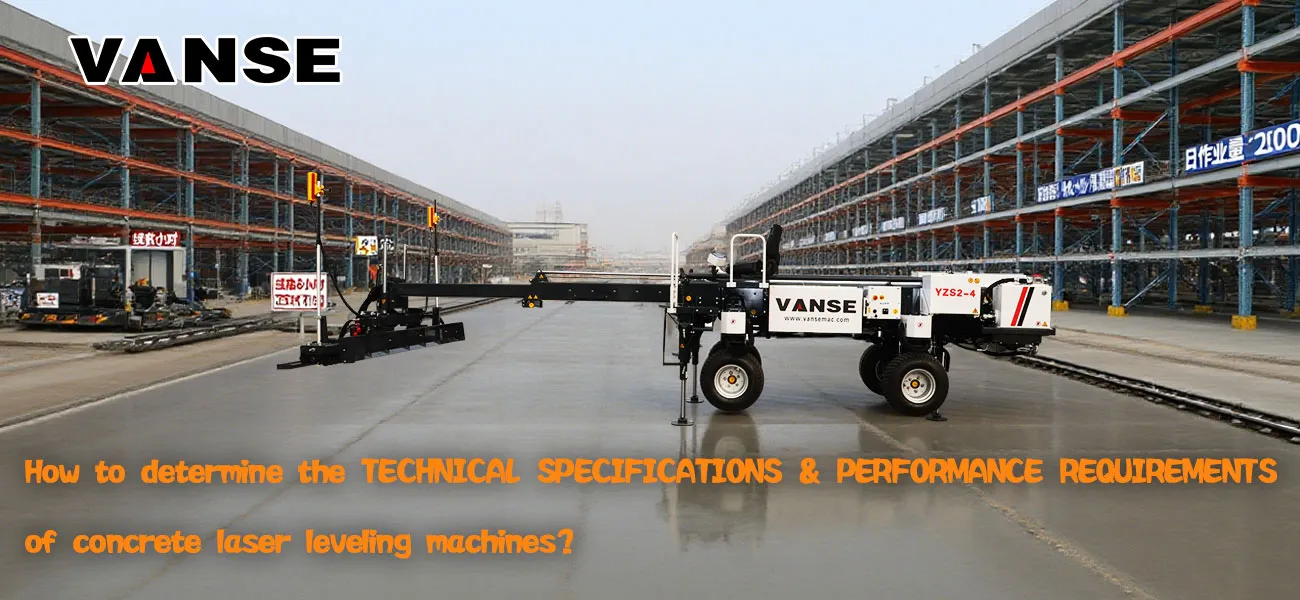
To determine the technical specifications and performance requirements of the concrete laser leveling machine, it is necessary to combine:Construction scenario requirements, concrete properties, and engineering quality standards. The three core dimensions are gradually deduced through the logic of "clarifying application boundaries → breaking down technical parameters → verifying performance compatibility," ultimately forming a feasible selection or customization standard. The following are the specific breaking steps and key considerations:
1. Step 1: Clarify the core application boundaries (first determine "where to use", then determine "what to need")
The starting point for technical specifications is "what scenario the problem is being solved." Different application scenarios have vastly different core requirements for devices, so the following four key boundaries must be clearly defined:
| Application boundary dimension | Key decision points | Example of impact on technical specifications |
| Construction area and site form | – Small area (such as indoor garages and workshops, ≤1000㎡) vs. large area (such as factories and airport runways, ≥5000㎡) | Large areas require high endurance and wide operating width; small areas/special-shaped sites require flexible equipment (narrow body and small turning radius) |
| Is the site regular (rectangular/irregular) and are there any obstacles (pillars, pipelines)? | ||
| Concrete type and thickness | – Ordinary commercial concrete (C20-C40) vs. special concrete (permeable, fiber, large aggregate concrete) | Special concrete requires strong power for mixing/paving; thick pouring requires high vibration frequency (to prevent hollowing) and large counterweight (for compaction) |
| – Casting thickness (thin type ≤ 100mm, regular type 100-300mm, thick type ≥ 300mm) | ||
| Engineering quality standards | – Flatness requirements (e.g. industrial flooring ≤2mm/2m, ordinary residential flooring ≤5mm/2m, refer to GB 50209) | High-precision requirements require upgrading the laser system (such as dual laser heads, closed-loop control) and adding ultrasonic detection modules |
| – Slope accuracy (e.g. drainage slope 0.5%, slope accuracy ±0.1%) | ||
| Construction environment conditions | – Indoor (floor height, ventilation) vs outdoor (wind speed, temperature) | A wind-resistant laser receiver is required for outdoor use (stable when wind speed is ≥5m/s); a foldable operating arm is required for indoor low-lying spaces (floor height ≤2.5m) |
| – Ground foundation (whether there is a risk of settlement, flatness of the base layer) |
Step 2: Deconstructing Core Technical Specifications (Quantifying "Hard Parameters" and Matching Application Requirements)
Further refine the device according to the application boundaryMechanical performance, laser system, power system, control systemThe technical parameters of the four modules must correspond to clear "standards" or "test methods":
1. Mechanical performance specifications (determines "construction efficiency" and "work adaptability")
| Technical Parameters | Definitions and Key Indicators | Selection/customization basis |
| Working width | Concrete width covered by a single leveling operation (commonly 2.5m, 3.5m, 4.5m) | For large areas, choose a wide width (e.g. 4.5m width, 40% efficiency improvement); for small spaces, choose a narrow width of ≤2.5m (flexible obstacle avoidance) |
| Leveling thickness range | The equipment can effectively handle the concrete pouring thickness (conventional 100-300mm, customized up to 50-500mm) | For thin floors (such as indoor cushions), choose 50-150mm; for thick structures (such as equipment foundations), choose 200-500mm |
| Vibration frequency and amplitude | The vibration frequency (commonly 50-100Hz) and amplitude (0.3-0.8mm) of the vibrator determine the density of the concrete. | Ordinary concrete should be 60-80Hz; large aggregate/fiber concrete should be ≥80Hz (to prevent aggregate accumulation) |
| Travel speed and turning method | Operating speed (0-6m/min), idling speed (0-12m/min), whether the steering is "crab steering" (all-wheel steering) | Large areas require high operating speed (5-6m/min); special-shaped sites must use crab steering (minimum turning radius ≤1.5m) |
| Body size and weight | Length × width × height (e.g. 3500 × 2500 × 2800 mm), machine weight (3-8 tonnes) | Indoor operations require controlled height (≤2.5m) and weight (≤5t to avoid damaging the base layer); weight restrictions can be relaxed for outdoor operations. |
2. Laser system specifications (determines "flatness accuracy", core technology)
The laser system is the "eye" of the leveling machine. Its accuracy directly determines the quality of the project. The following parameters need to be paid special attention to:
Laser transmitter accuracy:
The core indicator is "laser plane error", which is generally required to be ≤±0.1mm/m, and ≤±0.05mm/m for high-precision scenarios (such as industrial floors); it must support "single plane" and "dual slope" (such as drainage slope) modes, with a slope adjustment range of 0-5%.
Laser receiver sensitivity:
Receiving distance (indoors ≥50m, outdoor ≥30m, anti-interference), response speed ≤0.1s; for outdoor operation, select "anti-strong light receiver" (can work stably under direct sunlight to avoid signal loss).
Control system type:
Give priority to the "closed-loop automatic control system" (real-time detection of flatness deviation, automatic adjustment of vibrating arm height, deviation compensation speed ≤ 0.5s), and avoid the open-loop system (frequent manual correction is required and the accuracy is low).
Auxiliary detection module:
For high-precision scenarios, it is recommended to add "ultrasonic thickness detection" (real-time monitoring of concrete thickness, error ≤ 2mm) and "real-time flatness display" (the onboard screen synchronously displays 2m ruler data).
3. Powertrain specifications (determines "range" and "environmental adaptability")
Select the appropriate power type based on the power supply/fuel supply conditions at the construction site. The core parameters are as follows:
| Power type | Key Parameters (Example) | Applicable Scenarios |
| Electric (lithium battery) | Battery capacity (e.g. 60V/100Ah, 4-6 hours of battery life), charging time (2-3 hours for fast charging) | Indoor operations (no exhaust, noise ≤ 70dB), small-area construction (battery life sufficient for a single day's workload) |
| Diesel engine | Power (e.g., 25-40kW), fuel consumption (4-6L/h), emission standards (National III/National IV) | Outdoor large-area construction (no charging restrictions), high-load scenarios (such as thick concrete vibration) |
| Hybrid | Hybrid-electric switching endurance (8-10 hours), fuel consumption in energy-saving mode (≤3L/h) | Cross-scenario construction (electric power indoors, diesel power outdoors), long-term projects (reducing downtime and recharging time) |
4. Control and safety specifications (determines "ease of use" and "construction safety")
Control method:
Support "onboard control console + wireless remote control" dual mode (the effective distance of the remote control is ≥10m, which is convenient for observing corner construction); the control interface must be displayed in Chinese and the buttons must be simple (to avoid complex operations and reduce training costs).
Safety protection function:
It must include "laser loss protection" (when the laser signal is interrupted, the equipment automatically shuts down to avoid out-of-tolerance), "overload protection" (frequency is reduced when the vibration load is too large to prevent motor burning), and "emergency stop button" (dual emergency stop onboard + remote control).
Accessibility:
For large-scale construction, it is recommended to choose "GPS positioning + work track recording" (to facilitate tracing the construction area and avoid omissions); LED work lights (illuminance ≥ 500lux) are required for night construction.
3. Step 3: Verify performance requirements (ensure compliance through "actual measurement + benchmarking")
After the technical specifications are determined, "performance testing" is required to verify whether they meet actual construction requirements. The core verification items include:
1. Accuracy performance test (most critical)
Flatness test: According to GB 50209 standard, use a 2m ruler to randomly select 10 points on the concrete surface after construction and measure the maximum deviation value (must be ≤ the preset standard, such as industrial floor ≤ 2mm);
Slope accuracy test: When constructing on a site with a preset slope (e.g. 0.5%), use a slope meter to measure the actual slope deviation (needs to be ≤±0.1%).
2. Efficiency performance test
Actual operating efficiency:
Under standard working conditions (such as 300mm thick C30 concrete), record the leveling area per hour (must be ≥ the theoretical calculated value, such as 4.5m width × 5m/min speed = 1350㎡/h);
Battery life and energy efficiency:
Electric equipment is tested for continuous operation time at full charge (needs ≥4h, sufficient for half-day construction); diesel equipment is tested for full fuel endurance (needs ≥8h, sufficient for full-day construction).
3. Adaptability performance test
Site adaptability:
Test turning and obstacle avoidance capabilities in a field with obstacles (such as pillars spaced 3 meters apart) (no collisions are required, and the edges and corners must be flat and without blind spots);
Concrete adaptability:
Use target concrete (such as fiber concrete) to test the vibration effect (there must be no aggregate accumulation and no honeycombed surface).
4. Step 4: Refer to industry standards and cases (avoid "false parameter marking")
Mandatory standards: It must comply with the industry standard "Concrete Laser Screed Machine" (JG/T 415-2013), focusing on mandatory requirements such as "flatness error", "noise limit", and "safety protection";
Case Benchmarking: Refer to the equipment selection of similar projects (for example, "4.5m width + dual laser heads" equipment is commonly used for airport runways, and "2.5m width + electric power" equipment is commonly used for indoor garages);
Manufacturer's Commitment: Manufacturers are required to provide a "parameter measurement report" (issued by a third-party testing agency) and clearly state in the contract the "rectification responsibility when the accuracy does not meet the standards" (such as free rework and compensation for losses).
Summary: Determine the core logic of technical specifications
Derived from "demand" to "parameters"Instead of blindly pursuing "high parameters", we focus on "construction scenarios and quality standards" and select parameters that have a direct impact on the actual results (such as laser accuracy and vibration frequency);
Combining "hard parameters" with "soft performance": In addition to mechanical/laser parameters, attention should also be paid to ease of operation, safety protection, and after-sales service (such as spare parts supply and repair response time);
Verify "parameters" through "actual measurement": Avoid just looking at the manufacturer's promotional page. You must conduct on-site testing or refer to third-party reports to ensure that the parameters are real and feasible.
Through the above steps, the technical specifications and performance requirements of the concrete laser leveling machine that "precisely match needs, taking into account efficiency and quality" can be formed, avoiding project quality problems or cost waste caused by selection deviations.
Click the below to jump immediately!!!
Thanks to All the Friends Who Support and Trust Shandong Vanse Machinery Technology Co., Ltd.
If you want to know more about Shandong Vanse Machinery Technology Co., Ltd. or have any questions, please feel free to contact us:
Our Factory
Shandong Vanse Machinery Technology Co., Ltd.








Share this article

About the Author: Shandong Vanse Machinery Technology Co., Ltd.
Shandong Vanse Machinery Technology Co., Ltd. is a high-tech manufacturer specializing in concrete construction machinery, including laser screeds and related equipment. The company integrates R&D, production, and global sales, with products exported to over 60 countries and widely used in infrastructure projects worldwide.
Previous Post
Next Post
Related Articles
You Might Also Like
New technology application of concrete laser leveling machine
Based on the current application of new technologies and major trends in the construction industry, its future development will focus on the core dimensions of "intelligence," "unmanned operation," "greening," and "integration." The following is a detailed outlook: This is one of the ultimate goals of future development. Current automation only assists operators, but in the future, true "unmanned operation" will be achieved. Environmental Perception and Obstacle Avoidance: leveling machines will be integrated with advanced sensors such as LiDAR, millimeter-wave radar, and computer vision cameras, enabling real-time perception of their surroundings, identifying obstacles (such as materials, workers, and other equipment), and automatically planning paths or initiating emergency braking to ensure construction safety. High-Precision Navigation and Positioning: Combining GNSS (Global Navigation Satellite System), RTK (Real-Time Kinematic), and SLAM (Simultaneous Localization and Mapping) technologies, leveling machines will achieve centimeter-level positioning and autonomous movement in the dynamic and unstructured environment of construction sites, without the need for human intervention. Cluster collaborative work: On a large construction site, multiple unmanned leveling machines, unmanned trowels, and unmanned transport vehicles will be uniformly dispatched and directed by a central control system ("honeycomb brain"), working together like a swarm of bees, automatically dividing areas, and efficiently and seamlessly connecting to achieve 24-hour uninterrupted construction. AI will be upgraded from a "support" role to a "decision-making" one. AI Predicting Construction Quality: Using machine learning models, AI can analyze data such as vibration frequency, concrete slump feedback, and ambient temperature and humidity during the leveling process in real time to predict potential quality issues (such as cracking and sanding) in the final floor, and instantly adjust leveling parameters (such as speed and vibration intensity) to avoid defects. Intelligent Path Planning and Optimization: AI algorithms will automatically calculate and select the most efficient and appropriate leveling path and sequence based on factors such as the work area shape and the initial setting time of concrete, maximizing equipment utilization and construction efficiency. Predictive Maintenance Upgrade: Future systems will not only generate alarms but also accurately predict the remaining life of components (such as engines and hydraulic pumps) by analyzing historical data and real-time operating status (such as hydraulic oil temperature and engine vibration spectrum). This allows for pre-ordering of parts and scheduling of repairs, significantly reducing the risk of unplanned downtime. The leveling machine will become a key data collection terminal for building a "digital twin construction site." Real-time Mapping: Sensors on the leveling machine will simultaneously generate a high-precision digital twin model of the physical floor during construction. This model includes not only geometric dimensions but also attribute data such as construction time and compaction level. Full Traceability: Owners and project managers can review every moment of floor construction and access construction data at any point, enabling precise tracing of quality issues and significantly streamlining the acceptance process. Providing a Foundation for Subsequent Processes: The resulting high-precision digital model can be directly used for subsequent automated construction (such as AGV navigation and rack installation), facilities management (FM), and operations and maintenance (BIM operations and maintenance), becoming the data cornerstone for building lifecycle management. Full-Scale Adoption of Pure Electric Vehicles: With increasing battery energy density and decreasing costs, pure electric levelings will become mainstream, particularly in indoor applications and areas with stringent environmental requirements. Their advantages of quiet operation, zero emissions, and low operating costs are irreplaceable. Exploring Hydrogen Fuel Cells: For large-scale, outdoor projects requiring long, continuous operations, hydrogen fuel cells may become a complementary solution, offering faster energy replenishment and longer battery life, enabling truly zero-carbon construction. Lightweighting and New Material Applications: The use of more advanced composite materials and optimized structural designs can reduce equipment weight, reducing stress on unpaved floors and improving energy efficiency. Quick-Change Attachments: The main machine design will be more modular, allowing for quick connection and replacement of actuators with different functions, such as switching from a "leveling head" to a "dry hardener spreader" or "curing agent sprayer." This allows for multiple uses of one machine and reduces equipment investment costs. Adaptability to Diverse Materials: With the increasing use of new concrete materials (such as self-leveling, ultra-high-strength, and fiber-reinforced concrete), the leveling machine's vibration system and scraper design will become more intelligent and adjustable to adapt to the rheological properties of different materials for optimal application results. The future concrete laser leveling will no longer be a single-function construction machine, but a self-driving robot with an integrated AI brain and perceptual capabilities. It will be an intelligent node in the smart construction site network, seamlessly connected to all aspects of the process, including design, scheduling, and operations and maintenance, via the cloud. For construction companies, this means: Ultimate Quality: Construction results will closely resemble the perfect design of the digital model. Maximize Efficiency: Labor costs will drop dramatically, and construction cycles will be significantly shortened. Digital Management: Decisions will be based on real, comprehensive data, resulting in more transparent and precise management. Safer/Greener Operations: Reduced manual labor risks will enable low-carbon, environmentally friendly construction. Click the below to jump immediately!!!What is the current after-sales service for concrete laser leveling machines? How perfect is it?
Speaking of after-sales service, in fact, the after-sales service of the entire flooring industry has always been lacking. When there is a problem with a customer's equipment, there is always the problem of the manufacturer not responding in time, or even not responding at all. There have been many customers in the past who were unable to receive timely after-sales service due to problems when purchasing concrete laser leveling machines from other manufacturers. This not only delayed the construction period, but also caused a certain degree of losses. As a service benchmark in the flooring industry, Wanshi Machinery has always put the needs of customers first and adhered to its "three ones" commitment. In fact, after-sales service is not just about helping customers, but also about helping yourself. For a company, credibility and reputation are crucial, and after-sales service is the cornerstone of credibility and reputation. Wanshi Machinery fulfills the Three Ones promise, "response within a quarter of an hour, arrive within one day, and solve the problem within one day." Only a quarter-of-an-hour response can reassure customers, arrival within one day can ensure that the construction period is not delayed, and solving problems within one day is a reflection of technical strength. These three points bring confidence to customers and guarantee their decision to choose Wanshi Concrete Laser Leveling Machine. The customer's problems are the company's problems, and the customer's confidence is the company's confidence. The two are closely connected, which is the relationship between water and boat. Wanshi Machinery always keeps customers in mind and adheres to the three one promises. Not only do we want customers to choose Wanshi Machinery, but we also want customers to have no regrets about their choice.The Service Life And Reliability Of Concrete Laser Leveling Machine
As an important equipment in modern building construction, the service life and reliability of concrete laser leveling are of great significance to ensure construction quality, improve construction efficiency and reduce maintenance costs. This article will discuss the service life and reliability issues of concrete laser leveling machines in detail, and propose corresponding maintenance measures to extend the service life of the equipment and improve its reliability: ▪♢♢▪◇▷ Factors affecting the service life of equipment The service life of a concrete laser leveling is affected by many factors, including the following aspects: ▲1. Equipment quality: The manufacturing quality and material selection of the equipment are directly related to its service life. High-quality equipment uses high-quality materials and advanced manufacturing processes to better resist the effects of external environments and workloads, thereby extending its service life. ▲2. Usage environment: The environmental conditions at the construction site have an important impact on the service life of the equipment. For example, harsh environments such as high temperature, moisture, and dust will accelerate the wear and corrosion of equipment and shorten its service life. ▲3. Workload: The workload and frequency of use of the equipment are also important factors that affect the service life. Long-term overloading or frequent use will cause excessive wear and tear on the equipment and reduce its service life. ▲4. Maintenance: Equipment maintenance is the key to extending its service life. Regular cleaning, lubrication, tightening and other operations can keep the equipment in good condition, reduce wear and failure, and extend the service life. ▪♢♢▪◇▷ Measures to improve equipment reliability In order to improve the reliability of the concrete laser leveling, the following measures can be taken: ▲1. Choose high-quality equipment: When purchasing equipment, you should choose a manufacturer with good reputation and advanced technology to ensure that the quality and performance of the equipment meet the requirements. ▲2. Optimize the use environment: At the construction site, try to provide a good use environment for the equipment. For example, set up sun protection and rain protection facilities, keep the area around the equipment clean and dry, and reduce the intrusion of dust and impurities. ▲3. Reasonable allocation of workload: When using equipment, the workload should be reasonably allocated based on its rated load and performance requirements. Avoid long-term overloading or frequent use to reduce equipment wear and failure. ▲4. Strengthen maintenance: Establish a sound maintenance system and conduct comprehensive inspections and maintenance of equipment on a regular basis. This includes cleaning equipment surfaces, checking loose parts of the lubrication system, etc. Through timely maintenance, potential problems can be discovered and solved, and the reliability and stability of the equipment can be improved. ▲5. Train operators: Provide professional training to operators to make them familiar with the operating procedures and safety requirements of the equipment. Operators should master the correct operating methods and avoid misoperation or rough operation to reduce the risk of equipment damage and failure. ▲6. Regular inspection and maintenance: Establish a regular inspection and maintenance system to conduct comprehensive performance inspection and fault diagnosis of the equipment. Through regular inspections, equipment abnormalities can be discovered in time, and damaged parts can be repaired and replaced. At the same time, the maintenance plan can be adjusted according to the usage of the equipment to ensure the normal operation of the equipment. ▪♢♢▪◇▷ Case analysis In order to better understand the service life and reliability issues of concrete laser leveling machines, we can refer to some actual cases. For example, in a large construction project, multiple concrete laser leveling machines were used for ground leveling operations. By tracking and analyzing the use of these equipment, we found that equipment maintenance has an important impact on service life and reliability. With proper maintenance, equipment can run stably for a long time and break down less frequently. In the absence of adequate maintenance, equipment is prone to various failures, which can even lead to downtime and increased maintenance costs. ▪♢♢▪◇▷ Conclusion To sum up, the service life and reliability of concrete laser leveling machines are affected by many factors, including equipment quality, usage environment, workload, maintenance, etc. In order to improve the service life and reliability of equipment, we should choose high-quality equipment, optimize the use environment, reasonably distribute the workload, strengthen maintenance, train operators, and conduct regular inspections and repairs. Through the implementation of these measures, we can ensure that the concrete Laser leveling machines play their greatest role in construction, improve construction efficiency and quality, and create greater value for enterprises. At the same time, this is also in line with the concept of sustainable development and helps to reduce resource waste and environmental pollution.