Technical Knowledge
What engineering scenarios are thr small concrete trowels suitable for?
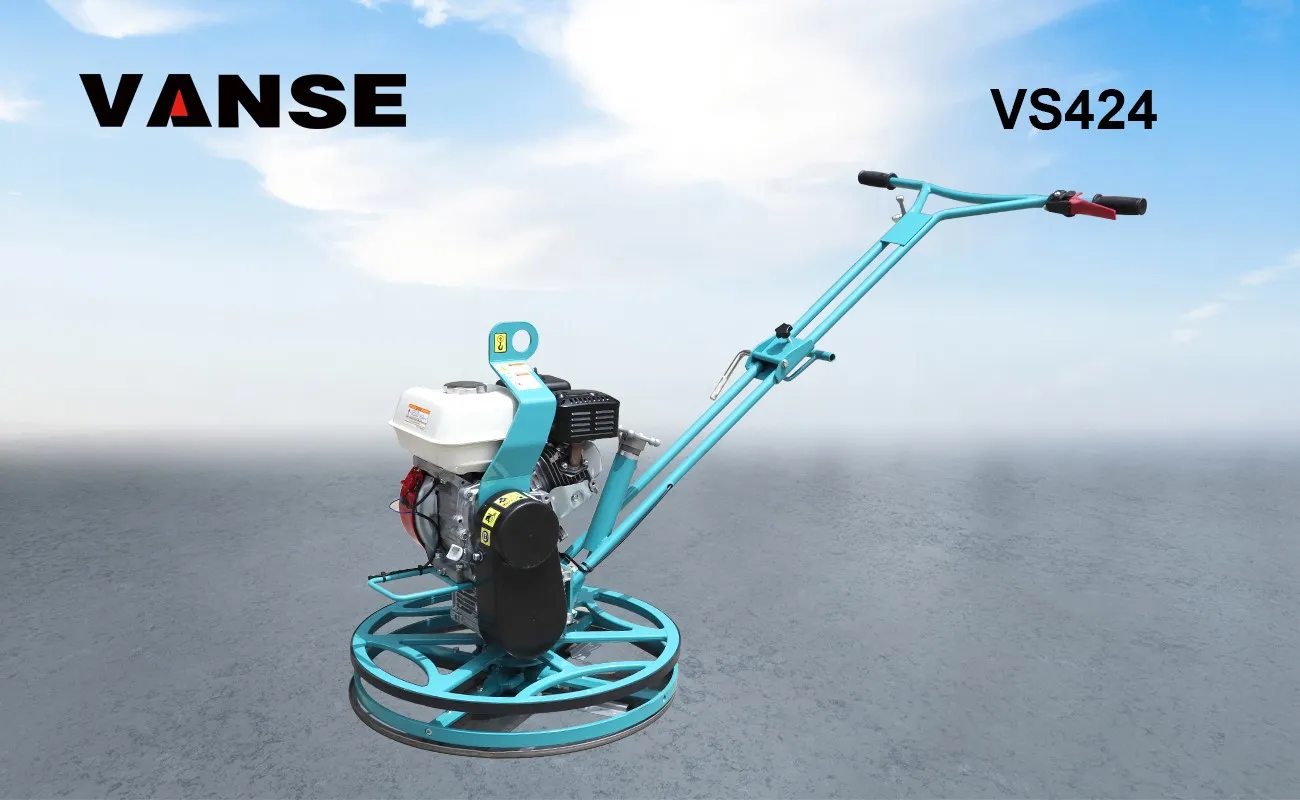
Small concrete trowels are suitable for a variety of engineering scenarios. The following is a detailed introduction:
1.Indoor floor engineering
-Residential floor construction: During the construction or decoration of family houses, small concrete trowels can be used for concrete troweling of floors such as living rooms, bedrooms, kitchens and bathrooms. The floor area of these areas is relatively small, and small trowels are easy to operate, which can make the floor flat and smooth, providing a good foundation for the subsequent laying of floor tiles, wooden floors and other decorative materials.
-Indoor floor of small commercial buildings: Small concrete trowels are also suitable for indoor floor construction in commercial places such as small shops and offices. It can ensure that the flatness of the floor meets the requirements and create suitable conditions for installing various floor coverings or directly using the floor.
2.Small warehouse floor construction
– For some small warehouses, small concrete trowels can efficiently polish the floor. It can make the warehouse floor more solid and flat, which is convenient for the stacking of goods and the driving of handling equipment. In addition, the floor after polishing is more wear-resistant and can effectively resist the friction of goods and vehicles in the warehouse.
3.Sidewalks and small square surfaces
-Sidewalk construction: In the construction of urban sidewalks, small concrete trowels can be used to smooth the concrete pavement of sidewalks. Since the width of the sidewalk is relatively narrow, the small trowel can flexibly operate along the edge and middle part of the road to make the sidewalk surface smooth, improve the comfort of pedestrians, and also facilitate drainage.
-Small squares: For places such as leisure squares and small commercial squares in residential areas where the ground area is not particularly large, small concrete trowels can well complete the polishing of the concrete surface. It can create a smooth and beautiful ground to meet people's daily leisure and activity needs.
4.Repairing the surface of small concrete structures
– After repairing some small concrete structures, such as the local repair of the bridge deck of a small bridge, and the local damage repair of the concrete wall or ground of a building, the small concrete trowel can be used to smooth the repair area. It can make the repaired surface smooth and consistent with the original structure surface, ensuring the appearance and performance of the structure.
Thanks to All the Friends Who Support and Trust Shandong Vanse Machinery Technology Co., Ltd.
If you want to know more about Shandong Vanse Machinery Technology Co., Ltd. or have any questions, please feel free to contact us:
Our Factory
Shandong Vanse Machinery Technology Co., Ltd.








Share this article

About the Author: Shandong Vanse Machinery Technology Co., Ltd.
Shandong Vanse Machinery Technology Co., Ltd. is a high-tech manufacturer specializing in concrete construction machinery, including laser screeds and related equipment. The company integrates R&D, production, and global sales, with products exported to over 60 countries and widely used in infrastructure projects worldwide.
Previous Post
Next Post
Related Articles
You Might Also Like
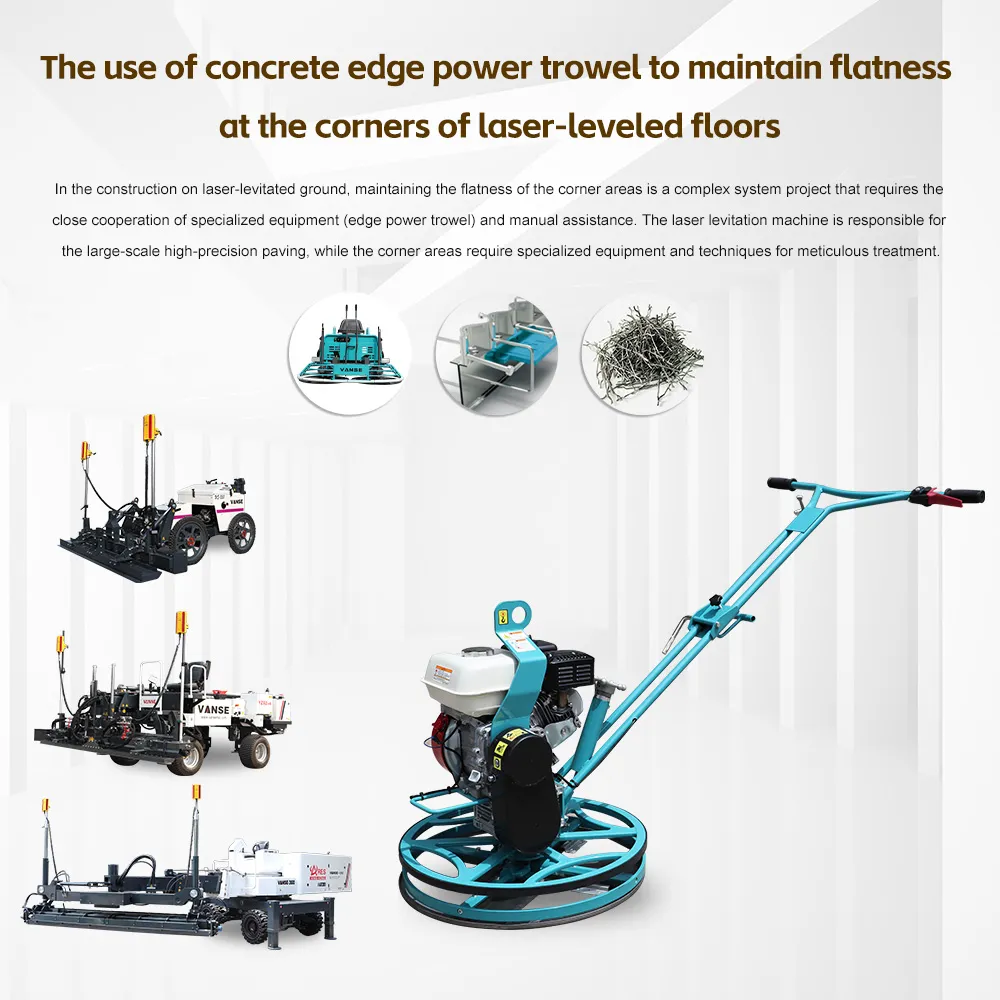
The use of concrete edge power trowel to maintain flatness at the corners of laser-leveled floors
In the construction on laser-levitated ground, maintaining the flatness of the corner areas is a complex system project that requires the close cooperation of specialized equipment (edge power trowel) and manual assistance. The laser levitation machine is responsible for the large-scale high-precision paving, while the corner areas require specialized equipment and techniques for meticulous treatment. For areas along the walls or at the base of columns that the laser leveling machine cannot reach, the edge power trowel (also known as the corner smoothing machine) is the core tool for maintaining the levelness. It is compact in size and can penetrate into narrow areas, extending the flatness of the large surface to every corner. Process stage Core equipment/tools Key operation points: Functions and Objectives 1. Laser leveling and rough leveling Laser leveling machine After the concrete is poured, the laser leveling machine conducts large-scale vibration and leveling, setting the overall ground elevation benchmark. Establish an initial flatness of ±3mm/3m for the entire floor, which serves as the foundation for corner treatment. 2. Initial treatment of corner areas Manual trowel, iron trowel After the laser leveling machine operation, immediately use the manual trowel to level the concrete at the corners, making it consistent with the leveled large surface elevation. Eliminate local height differences caused by the machine's inability to operate, and incorporate the overall flatness into the corners. 3. Edge power trowel for slurry application and compaction Edge power trowel (requires installation of a disc) Before and after the initial setting of the concrete (when footprints are about 3-5mm deep when stepped on), install the circular disc of the edge trowel and compact and smooth the corner area. Completely compact the concrete, remove the marks left by the trowel, and make the surface structure consistent with the large area. 4. Edge power trowel for finishing Edge power trowel (requires replacement with a blade) As the concrete further hardens, replace the circular disc with a blade, adjust the blade angle, and perform fine polishing to make the corner surface reach the same density and glossiness as the large surface. Complete the final surface effect, ensuring uniform color and density of the corners and the entire floor. 5. Manual detail adjustment Handmade steel trowel For the extremely small areas that the edge trowel cannot reach (such as the corner dead space of columns), finally use the manual steel trowel for final polishing. Ensure there are no missed areas and achieve a perfect overall effect. To ensure the best performance of the corner smoothing machine, effective coordination during the construction process is crucial: Timing accuracy: The operation of the edge power trowel must be synchronized with that of the large surface smoothing machine. When the large surface is performing the first round disc finishing, the corner must also start immediately without waiting. If the window for concrete hardening is missed, the corner will be difficult to compact and may even crack. Flow consistency: During the first round disc operation, the walking path of the edge power trowel should ideally be perpendicular or at a 45-degree angle to that of the large surface smoothing machine. This helps eliminate the fine scratches left by the machine and makes the transition smoother. Height linkage: During the laser leveling operation, workers should use handheld laser receivers to check the height of the corner area in real time. If there is a shortage of material, it should be manually filled immediately. This step is a key preventive measure to ensure that the flatness of the corner does not deviate. Handling the corner area cannot rely solely on a single tool; instead, a complete process chain of "laser leveling establishes the benchmark → manual scraper introduces → edge power trowel forms → manual trowel finishes" should be formed. Among them, the edge power trowel is the core guarantee for extending the high precision of the large surface to every corner. Is your project's corner area complex? For example, are there particularly dense columns or irregular shapes? Please tell me the specific situation, and I can help you further analyze whether additional equipment or adjustment of the construction sequence is needed. Contact us NOW Note: The parameters provided in this document are for reference only and are not mandatory. Due to differences in technical characteristics between different brands and models of laser levelers, please consult the manufacturer for a suitable solution before actual operation. This reference document assumes no responsibility for any issues arising from failure to follow the manufacturer's instructions.The one-step forming construction technique for high-precision, wear-resistant floors without cutting joints, which is based on laser leveling technology
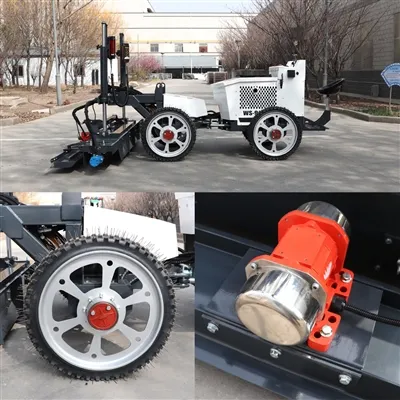
The equipment is equipped with a HONDA GX690 engine with a power of 18.4kW (25HP). It uses gasoline as fuel. The 20L fuel tank capacity can ensure that the equipment can operate stably for a certain period of time and provide reliable power for floor construction. This power configuration enables the equipment to operate stably for a long time in large-area floor construction scenes such as large industrial plants and commercial plazas, avoiding the impact of insufficient power on the construction progress. ❶. **Vibration leveling equipment**: The vibration system of the equipment is driven by an electric motor with an excitation force of 2000N. After the concrete is poured, the equipment makes the concrete more compact through vibration, effectively eliminates the gaps and bubbles inside the concrete, and lays the foundation for creating a high-precision wear-resistant floor. In actual operation, this vibration leveling equipment can quickly and evenly process the concrete surface to ensure the flatness of subsequent construction. ❷. **Paving and leveling equipment**: It adopts hydraulic screw conveying paving mode with a leveling width of 2.5m (8.20ft). During the construction process, it can spread the concrete evenly and level it accurately. Whether it is indoor flooring or outdoor road flooring construction, this paving and leveling method can ensure that the thickness and flatness of the concrete meet high-precision requirements. The equipment is equipped with two types of solid anti-skid tires and pneumatic wide tires. The net weight of the whole machine is 990kgs (2183lbs) and the overall dimensions are 3600x3000x1650mm (11.81×9.84×5.41ft). Such tire configuration and body specifications enable the equipment to move flexibly and operate stably under different ground conditions, such as on rough construction site floors or smooth indoor floors. Before construction, the construction site needs to be accurately measured and cleaned. At the same time, debug the construction equipment to ensure that the engine is running normally, the vibration system and hydraulic system are in good performance, and the laser receiving device can accurately receive signals, so as to make full preparations for construction. The mixed concrete is transported to the construction site for pouring, and the pouring thickness and speed of the concrete are controlled to provide a good foundation for subsequent leveling operations. The laser transmitter is used to establish a reference plane. After the laser receiver on the equipment receives the signal, the scraper height is automatically adjusted. Through the hydraulic screw conveying paving mode, precise leveling is performed according to the leveling width of 2.5m (8.20ft). At the same time, the vibration system works with an exciting force of 2000N to make the concrete dense and the surface flat. When the floor concrete is initially set, evenly spread the wear-resistant material. Afterwards, professional equipment is used to perform surface finishing treatment to make the floor surface smooth and flat, improve the wear resistance and aesthetics of the floor, and complete the one-time molding construction of high-precision wear-resistant floor without cutting. With the help of laser leveling technology and advanced equipment, the flatness of the floor can be accurately controlled, and the error can be controlled within a very small range, meeting the needs of various places with extremely high requirements for floor accuracy, such as precision instrument manufacturing workshops, electronic production workshops, etc. By optimizing the concrete mix ratio and construction process, the generation of floor cracks is effectively reduced, and free cutting construction is achieved, which not only improves the overall aesthetics of the floor, but also reduces the subsequent maintenance costs. The high-performance parameters of the equipment, such as the powerful engine, efficient hydraulic paving system and stable vibration system, ensure the rapid advancement of construction, greatly shorten the construction period and improve construction efficiency. Equipment equipped with two types of tires can adapt to different working site conditions, whether indoors or outdoors, dry or wet ground, can stably and efficiently complete construction tasks.What factors affect the price of concrete power trowel?
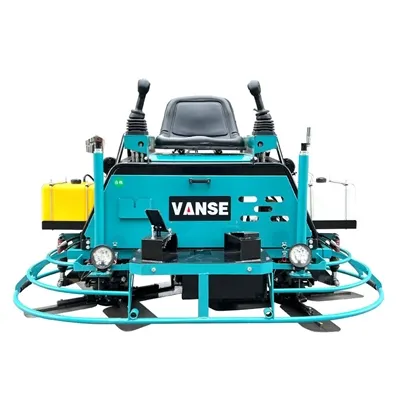
Hand-held and ride-on: Hand-held trowels are relatively simple in structure and flexible in operation, but have lower working efficiency and are slightly cheaper; ride-on trowels are more efficient and can be equipped with two trowel discs at the same time, with a larger construction area, but are also more expensive. Different models: Even for trowels of the same type, different models will have differences in functions and performance, which will affect the price. For example, some models of ride-on trowels are equipped with more advanced control systems, larger water tanks, more powerful engines, etc., and the price will be higher than the basic models. Brand influence: Well-known brands usually invest more in R&D, production processes, quality control, after-sales service, etc., and the product quality and performance are more guaranteed, and the price will be relatively high. Some small or unknown brands of trowels, although the price is low, may have certain risks in terms of quality and after-sales. Product quality: High-quality trowels perform better in terms of material selection, component precision, overall performance, etc., have longer service life, and are more expensive. For example, trowels made of high-quality manganese steel blades are more expensive than blades made of ordinary materials, and the product price will also rise accordingly. Engine type: Common ones are gasoline engines, diesel engines, and electric engines. Gasoline engine trowels have high power and are more flexible to use, but the fuel consumption is relatively high and the price is moderate; diesel engine trowels have high torque and strong power, which are suitable for large-area, high-intensity operations, but the price is relatively high; electric trowels have the advantages of environmental protection, low noise, and low maintenance costs, but their power and endurance are limited, and the price varies depending on the battery capacity and motor performance. Engine power: The more powerful the engine, the stronger the power it can provide, making the trowel more efficient, but it will also increase costs and lead to price increases. For example, a ride-on trowel equipped with a 24-horsepower genuine Jialing Honda gasoline engine will be more expensive than an engine with a smaller power. Tread diameter: The larger the diameter of the trowel, the larger the area covered at one time and the higher the work efficiency, but the corresponding machine size and weight will also increase, and the price will also increase accordingly. Common trowel diameters are 1 meter, 1.2 meters, 1.5 meters, 2 meters, etc. The larger the diameter of the trowel, the higher the price of the matching trowel. Treadblade quantity and quality: The more trowels there are, the better the troweling effect and the higher the efficiency. At the same time, a good quality spatula, such as a hardened, forged, thickened and wear-resistant manganese steel spatula, can ensure the quality and service life of the trowel, but it will also increase the cost and price of the trowel machine. Whether to have a sprinkler: The ride-on trowel machine usually comes with an extra-large water tank and a sprinkler, which can automatically sprinkle water during the trowel process, saving manpower and improving work efficiency, but the price of the trowel machine with a sprinkler will be higher than that of the ordinary one. Lighting system: Some trowel machines are equipped with LED front and rear lighting systems, which are convenient for operation at night or in dimly lit environments, increasing the convenience and safety of the machine, but also increasing the price. Steering operating system: The mechanical steering operating system is responsive and easy to control, which can improve the accuracy and efficiency of the operation. The trowel machine equipped with this steering system will also be reflected in the price. Production process: Advanced production technology can improve the production efficiency and product quality of the trowel machine, but it will also increase the production cost. For example, the use of high-precision processing equipment and strict quality inspection processes can ensure the accuracy of the components and overall performance of the trowel machine, but these will be reflected in the product price. Raw material cost: Fluctuations in the prices of raw materials such as steel, rubber, and plastic will also affect the cost and price of the trowel machine. If the price of raw materials rises, the price of the trowel machine may also increase accordingly. Market demand: When the market demand for concrete trowel machines is strong, the price may rise; conversely, when the market demand is insufficient, the price may fall. For example, in the peak season of construction, the demand for trowel machines is large and the price is relatively high; while in the off-season, the demand decreases and the price may be reduced. Competition status: The degree of competition for concrete trowel machines in the market will also affect the price. If the competition is fierce, manufacturers may lower prices or provide more preferential measures in order to attract customers; if the market competition is small, manufacturers may maintain a higher price level.