Technical Knowledge
What are the differences in the specific application effects of laser leveling machines in different types of municipal projects (I)?

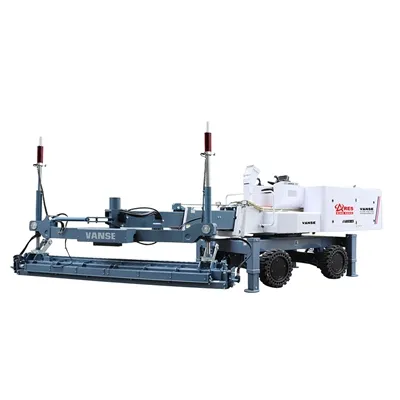
The difference in the application effect of laser leveling machines in different types of municipal projects is mainly reflected in the following aspects:
1. **Construction efficiency**:
In large-scale municipal projects such as squares and large public facilities, laser leveling machines can significantly improve the construction speed. For example, the construction area of a laser leveling machine can reach 3,000 square meters to 5,000 square meters per day, while the traditional process can only cover an area of about 2,000 square meters per day and requires more manpower.
2. **Construction accuracy**:
The laser leveling machine achieves high-precision elevation control through laser transmitters and receivers, reducing the errors caused by formwork support and pull control lines in traditional processes. This makes the laser leveling machine more effective in projects requiring high precision.
3. **Ground integrity**:
The laser leveling machine can achieve one-time paving of large areas of concrete, improve the integrity of the ground, and avoid the cumulative error of construction joints caused by block construction in traditional processes, which is particularly important in municipal projects.
4. **Ground density and uniformity**:
The high-frequency vibrator equipped with the laser leveling machine makes the concrete floor more dense and uniform. This is especially important in ground construction of municipal projects that need to bear heavy loads or high wear resistance, such as logistics parks and industrial plants.
5. **Quality control**:
The application of laser leveling machines simplifies the construction process and reduces quality problems caused by human factors. In an article published in the journal "Guangdong Building Materials", the technical specifications and requirements, basic construction processes, coordination and precautions of laser leveling machines were fully introduced through the floor concrete construction of a certain project, and it was proved that laser leveling machines achieved good quality and economic effects in actual projects.
6. **Economic benefits**:
Laser leveling machines reduce labor costs and improve construction efficiency, thereby creating huge economic benefits. In some engineering cases, the application of laser leveling machines not only improves the quality of the project, but also effectively reduces the construction cost.
7. **Environmental adaptability**:
Laser leveling machines can maintain construction effects under different climatic conditions. For example, in hot or cold climates, through appropriate construction strategy adjustments, laser leveling machines can still ensure construction quality.
From the above analysis, it can be seen that laser leveling machines can improve construction efficiency and quality in different types of municipal projects. Especially in projects with special requirements for ground flatness, bearing capacity and wear resistance, the application effect of laser leveling machines is more significant.
Thanks to All the Friends Who Support and Trust Shandong Vanse Machinery Technology Co., Ltd.
If you want to know more about Shandong Vanse Machinery Technology Co., Ltd. or have any questions, please feel free to contact us:
Our Factory
Shandong Vanse Machinery Technology Co., Ltd.








Share this article

About the Author: Shandong Vanse Machinery Technology Co., Ltd.
Shandong Vanse Machinery Technology Co., Ltd. is a high-tech manufacturer specializing in concrete construction machinery, including laser screeds and related equipment. The company integrates R&D, production, and global sales, with products exported to over 60 countries and widely used in infrastructure projects worldwide.
Previous Post
Next Post
Related Articles
You Might Also Like
The maintenance and maintenance of the laser leveling machine that comes during the rainy season cannot be ignored
Recently lying storms throughout our country, the rainy season comes laser screed machine maintenance has become very important, the rainy season concrete ground outside can not be constructed, in the concrete laser flatflating machine idle, should be placed in a dry place, to avoid the air humidity and affect the engine start. In addition, the construction environment of the concrete laser flattening machine is not very good, after the rain will have a lot of potholes and puddles of mud accumulation, the first thing to pay attention to after the rainy season is the cleaning of the laser flatflater, of course, not only the rainy season, usually after the use of laser flatflating machine should also be cleaned in time, Failure to do so can lead to the laser leveling machine walking track under the gap in the accumulation of sludge, is a place where moisture is hidden, but also most likely to cause the track rust. The acidic composition in the rainhast water has a strong corrosive effect on the paint surface of the laser screed machine, and over time it will cause damage to the paint surface of the laser flattener, so in the season with more rain, it is best to give the laser leveling machine a paint finish. The simplest is waxing, the longer and more effective is to seal the glaze. No matter what method, All to the laser leveling machine put on a protective coat, to prevent the paint surface fade aging. The chassis of the laser screed is the closest to the ground, especially affected by road conditions, this part is most prone to rust spots, the wheel shell may even loosen perforation. Therefore, we must pay attention to the laser leveling machine chassis clean rust treatment. Rainy days, such as encountering indoor construction, laser screed machine engine is not easy to start the problem, sometimes even if forced to start up, but also has air power. The most likely is a leakage due to moisture in the ignition system, which loses its normal ignition function. Once found that because of the moisture of the ignition system caused bad ignition, engine performance, it is best to use dry paper towels or dry cloth to the inside and outside of the cable and wire drying, and then use a special desiccant spray can to spray the dryer in the split disk cap, battery connector, line connector, high-voltage line, etc. , and so on after a while can start the engineAutomatic concrete spreader VS manual spreading Which ensures more uniform distribution of hardener for super flat floors
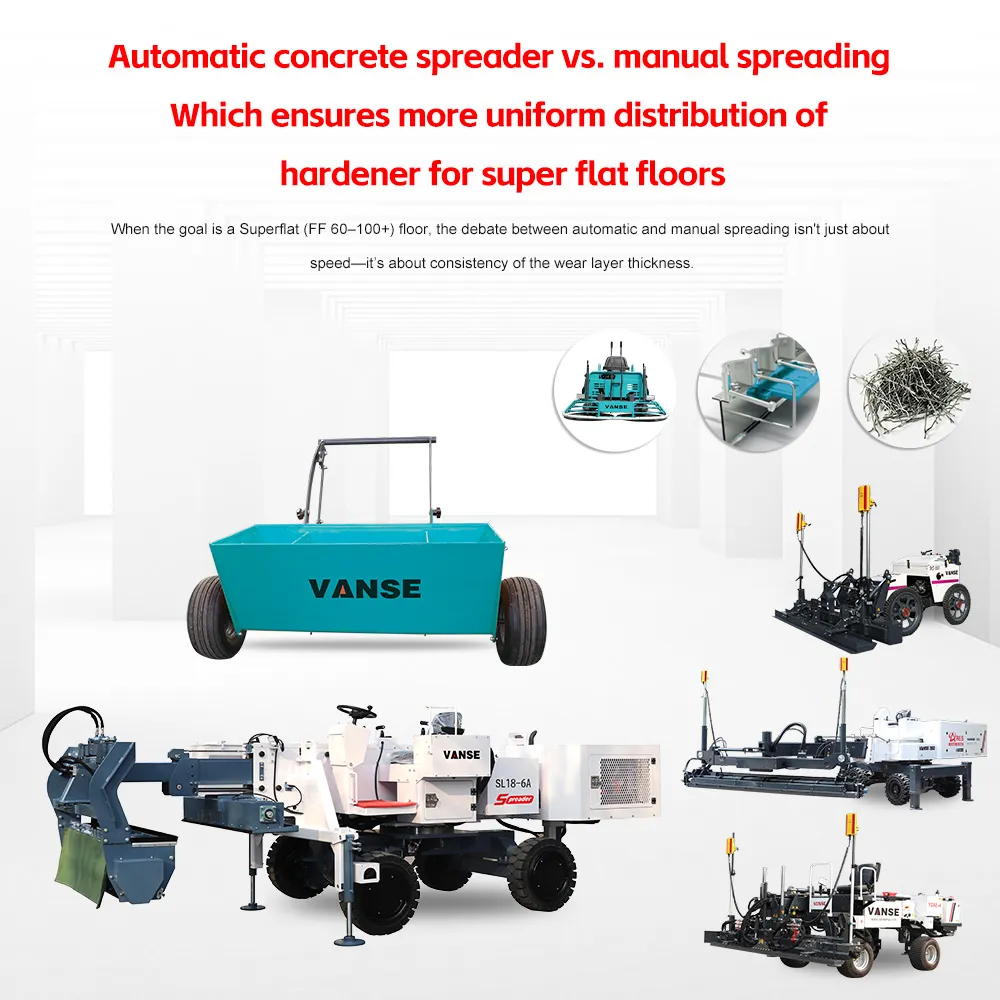
When the goal is a Superflat (FF 60–100+) floor, the debate between automatic and manual spreading isn't just about speed-it's about consistency of the wear layer thickness. For high-precision projects, Automatic Spreading wins decisively. Here is the technical breakdown of why manual spreading is often the "weak link" in achieving Superflat tolerances. To maintain a Superflat surface, the concrete must hydrate and shrink at exactly the same rate across the entire slab. Automatic Spreader: Uses a computer-controlled, fluted rotor (similar to an agricultural seed drill). It drops a metered amount of material (e.g., exactly 5.0 kg/㎡) regardless of travel speed. This ensures the "chemical demand" for water from the base slab is identical everywhere. Manual Spreading: Relies on a worker tossing material from a bucket or bag. Even the most skilled worker will create "heavy" spots (where the pile is 8 mm thick) and "light" spots (where it is 2 mm thick). The Superflat Consequence: Heavy spots suck more moisture out of the slab, causing localized "humps" or "blisters" that a power float cannot easily fix. A Superflat floor requires a perfectly level plane. Automatic (Telescopic): Machines like use a telescopic boom to "fly" the spreader head over the concrete. The head never touches the wet slab, meaning it doesn't leave ruts or footprints that would disturb the FL established by the laser Leveling. Manual: Requires workers to walk on the wet concrete (even with "snowshoes"). Every footstep is a displacement of aggregate and a micro-dip in the levelness that must be "re-floated." In Superflat construction, every time you touch the concrete, you risk degrading the F-number. Feature Automatic Spreader Manual Spreading Precision ± 2% variance ± 20-30% variance Surface Integrity No contact with slab (Telescopic) High contact (Footprints/Ruts) Timing Fast; covers large areas in minutes Slow; can lead to "cold joints" Dust Control Integrated skirts (low dust) High dust (affects laser receivers) Bond Strength Even hydration = uniform bond Uneven hydration = delamination risk In Superflat projects, the laser transmitter is the "Source of Truth." Manual spreading often creates a cloud of cement dust as workers toss the hardener. This dust can refract or "scatter" the laser beam, causing the laser Leveling or the laser-guided power floats to receive false signals. Automatic spreaders have enclosed hoppers and drop the material from a height of only a few centimeters, keeping the air clear and the laser signals accurate. The only time manual spreading is preferred is in extremely tight corners or around complex "box-outs" where a large machine cannot reach. However, for the main "runway" of a VNA (Very Narrow Aisle) warehouse, manual spreading is generally prohibited by high-end specifications. Automatic spreading is mandatory. Manual spreading introduces too much human error in volume distribution. On a Superflat project, an extra 2 mm of dry-shake in one spot can create a "peak" that fails the FF floor profiler test after the concrete cures. Would you like me to provide a sample specification clause that contractors use to mandate automatic spreading for VNA warehouse projects? Contact us NOW Note: The parameters provided in this document are for reference only and are not mandatory. Due to differences in technical characteristics between different brands and models of laser levelers, please consult the manufacturer for a suitable solution before actual operation. This reference document assumes no responsibility for any issues arising from failure to follow the manufacturer's instructions.Just a few steps to teach you how to operate a ride-on trowel
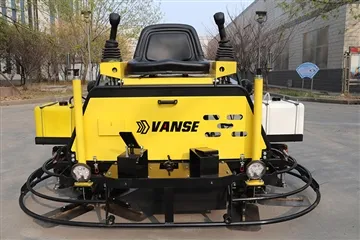
The car-mounted trowel, which plays a dominant role in pavement engineering, has a wide range of applications and can be applied to many construction sites such as squares, airports, workshops, factories, parking lots, etc., and is deeply loved and welcomed by users. Using this equipment Finishing and smoothing the concrete floor can greatly reduce the labor intensity of workers, and the construction work becomes easier and more efficient. The road surface constructed by the ride-on trowel is smooth and flat, and the concrete surface has good compactness and wear resistance. Car trowel 1. Start the troweling machine and operate the handle; 2. Hold the joystick tightly to keep the body balanced; 3. When the troweling machine is working, be sure to hold the troweling machine steady, and adjust the direction in time when working on the floor. To prevent the machine from losing control; 4. First coarse grinding, then fine grinding. After the bottom grinding disc is roughly ground, remove the grinding disc when the ground is suitable for fine grinding, and finely grind with a spatula. Driving trowel The ride-on troweling machine has high working efficiency and good finishing effect, and can easily meet the engineering construction standards. This car troweling machine is easy to operate and calmly cope with different harsh working conditions. It is an indispensable good equipment in concrete troweling construction! Full hydraulic troweling machine