Technical Knowledge
What are the differences in construction technology between concrete pavements with large slump and concrete pavements with small slump?
There are many differences in the construction process between concrete pavement with large slump and concrete pavement with small slump, as follows
Mixing
Concrete with large slump: The mixing time needs to be appropriately increased, generally 30-60 seconds longer than concrete with small slump, to ensure that the concrete is mixed evenly, so that the excess water is fully mixed with cement and other materials to avoid segregation. At the same time, the amount of water should be strictly controlled and accurately measured, because the amount of water has a greater impact on the slump.
Concrete with small slump: When mixing, pay attention to controlling the mixing force and time to avoid excessive mixing that causes the concrete to be too dry and hard, and lose good workability. Generally, the mixing time is relatively short, so that all materials can be evenly mixed.
Transportation
Concrete with large slump: Prevent concrete from segregation and water evaporation during transportation. The mixer truck should maintain a uniform speed, avoid sudden braking and sharp turns, and reduce the shaking of the concrete in the tank. At the same time, the tank body can be covered with a sunshade to prevent direct sunlight from causing water to evaporate too quickly and affect the slump.
Concrete with small slump: During transportation, care should be taken to prevent excessive loss of concrete slump. If the transportation time is long, some plastic preservation measures can be considered, such as adding an appropriate amount of retarder. However, attention should be paid to the amount of retarder added to avoid affecting the setting time and strength of the concrete.
Pouring
Concrete with large slump: The pouring speed should not be too fast and should be controlled within a certain range, such as the pouring volume per minute should not exceed 1-1.5 cubic meters to avoid rapid flow and accumulation of concrete in the formwork, resulting in loose vibration or segregation. At the same time, it is necessary to avoid excessive free fall height of concrete. When it exceeds 2m, auxiliary tools such as string barrels and chutes need to be used.
Concrete with small slump: Due to its poor fluidity, some auxiliary measures are needed during pouring to ensure that the concrete can fill every corner of the formwork. For example, artificial auxiliary spreading can be used to evenly distribute the concrete in the formwork to avoid concrete accumulation or local vacancies.
Vibration
Concrete with large slump:
It is advisable to use a low-frequency vibrator, and the vibration frequency is generally 2000-3000 times/minute. Avoid using a high-frequency vibrator to cause over-vibration of the concrete. The vibration time should not be too long. The vibration time at each point should be controlled within 20-30 seconds, and the concrete surface no longer sinks significantly, no bubbles appear, and cement slurry appears on the surface.
Concrete with small slump:
It is usually necessary to use a high-frequency vibrator, and the vibration frequency is generally 3000-5000 times/minute to improve the fluidity and density of the concrete. The vibration time should be appropriately extended, and the vibration time at each point may take 30-40 seconds to ensure that the concrete is vibrated and dense, but it is also necessary to prevent excessive slurry on the concrete surface due to over-vibration.
Surface finishing and maintenance
Concrete with large slump: When finishing, wait for the surface moisture to evaporate properly before proceeding, generally 1-2 hours after the concrete pouring is completed. The specific time is determined according to the site environment and the concrete coagulation. Usually 2-3 times of plastering are required to eliminate moisture and defects on the surface. Plastic film, geotextile, etc. should be used to cover the surface immediately during curing to prevent the water from evaporating too quickly and causing the surface to lose water and crack. The curing time is generally not less than 14 days.
Concrete with small slump: Plastering can be done in time after the concrete surface is slightly dry, generally about 0.5-1 hour after pouring. Due to its low moisture content and fast surface drying, fewer plastering times may be required, but attention should be paid to the plastering quality to ensure that the surface is flat and smooth. It should also be covered and moisturized in time during curing. The curing time is generally not less than 7 days, but if the environment is dry or the temperature is high, the curing time should be appropriately extended.
Thanks to All the Friends Who Support and Trust Shandong Vanse Machinery Technology Co., Ltd.
If you want to know more about Shandong Vanse Machinery Technology Co., Ltd. or have any questions, please feel free to contact us:
Our Factory
Shandong Vanse Machinery Technology Co., Ltd.








Share this article

About the Author: Shandong Vanse Machinery Technology Co., Ltd.
Shandong Vanse Machinery Technology Co., Ltd. is a high-tech manufacturer specializing in concrete construction machinery, including laser screeds and related equipment. The company integrates R&D, production, and global sales, with products exported to over 60 countries and widely used in infrastructure projects worldwide.
Previous Post
Next Post
Related Articles
You Might Also Like
How to choose the right armoured joint
Why use armoured joints at all? Construction joints are an essential part of creating a concrete floor. But left unprotected, they will quickly become damaged once the building is brought into use –leaving the building owner or operator with repair costs and expensive down-time. A damaged construction joint is more than just unsightly. Materials handling vehicles can suffer costly damage too on an uneven surface; and it can even present a health and safety issue for forklift drivers. The best solution is to armour joint arrises during construction, to build in protection from the start. It is easy and cost-effective, and reaps benefits for the lifetime of the building. Guidance on choosing the right joint Here are some of the factors to consider when choosing an armoured joint. Our helpful joint selector can also guide you in choosing the best product to armour joint arrises on your project. Building use. Consider whether the building will have one use in its lifetime, or if this may change. You can future-proof the floor by choosing a versatile joint, such as Permaban Signature or Wave. These allow vehicles to cross the floor freely in any direction, now and in future. Traffic. Consider the type of vehicle wheel being used, plus traffic frequency and speed ('duty'). Vehicle direction determines how much impact a joint endures. Straight joints such as AlphaJoint are Eclipse are fine where vehicles won't cross directly. Otherwise, choose Signature or Wave to prevent impact (see below). Service. If cleaning chemicals are regularly used, a stainless steel joint (AlphaJoint CSS) will withstand these and look good for longer. If a joint is likely to be regularly exposed to wet conditions, choose our galvanised Signature, Eclipse or Wave. Hazards. If the building handles substances which must not leach into the ground, or where the joint gap itself would pose a hazard to pedestrians, then cover the gap permanently with SignatureSlide, or fill with a joint sealant. Floor construction. 'Jointless' floors include armoured joints, but not saw-cut joints, so the gap sizes can be slightly larger. Take the likely gap size into account, and how it might be filled. SignatureSlide handles larger gaps and ensures no joint gapis exposed. What is impact? If a vehicle crosses a straight joint at 90° there is a risk of impact damage. This is because the wheels drop momentarily in the gap between the two straight sides of the joint. Repeated impact on a saw-cut joint, or even a straight armoured joint,causes damage to the surrounding concrete, leading to maintenance costs and downtime. A shaped joint arris (Signature or Wave) has no straight lines–hence the wheels cannot fall between the two sides, so no impact can occur. Shaped joints therefore make the ideal choice for directional traffic situations, or where a building owner wants to ensure flexibility for how a building may be used in the future. The value-engineered approach Traditional-style armoured joints only account for about 5% of the material cost of the floor slab. Joints are a small part of the overall cost –but can make an enormous difference to the floor's lifetime performance. By using a combination of Permaban armoured joints you can create an optimum specification without a significant cost increase. For example, using Signature and Eclipse together in a specification will provide superior joint protection, but with a less than 1% increase in material cost. Using Signature alone means only a 3% increase in material cost. But remember that any additional up-front costs will be more than recouped over the life of the building, due to reduced floor and vehicle maintenance costs. The building's versatility, and saleability, can also be improved. Download our quick comparison guide to find the best product to armour joint arrises on your project.How to ensure the mix ratio of concrete during construction?
♦♦♦♦♦ Introduction As an indispensable material in construction projects, the quality of concrete is directly related to the safety and durability of the building structure. The mix proportion design of concrete is a key link to ensure the quality of concrete. During the construction process, how to ensure the mix ratio of concrete has become a problem that every construction worker must face and solve. This article will elaborate on how to ensure the mix ratio of concrete during the construction process from the aspects of concrete mix design, control measures during construction, and common problems and treatment methods. ♦♦♦♦♦ Concrete mix design 1. Clarify the project requirements. Before designing the concrete mix ratio, the project requirements for concrete must be clarified, including strength level, durability, impermeability, frost resistance, etc. These requirements will directly determine the various parameters of the concrete mix proportion. Select appropriate raw materials Concrete raw materials include cement, aggregates (sand, stone), admixtures (fly ash, slag powder, etc.) and admixtures. 2. Selecting appropriate raw materials is the basis for ensuring the concrete mix ratio. For example, the selection of cement should consider its strength grade, initial and final setting time and other factors; the selection of aggregate should consider its particle size distribution, mud content and other factors. 3. Carry out mix ratio design. According to the project requirements and raw material properties, parameters such as the water-cement ratio, aggregate dosage, admixture dosage, and admixture dosage of concrete are determined through experiments to obtain the concrete mix ratio. The mix design should follow the principles of economy, rationality, and feasibility, while meeting the project's requirements for concrete performance. ♦♦♦♦♦ Control measures during construction 1. Strictly control the quality of raw materials: During the construction process, the quality of raw materials should be regularly tested to ensure that they meet the design requirements. Unqualified raw materials should be replaced or disposed of in a timely manner. At the same time, the storage and preservation of raw materials should also be done well to prevent changes in the properties of raw materials due to improper storage. 2. Ensure accurate measurement: Various parameters of the concrete mix ratio need to be achieved through accurate measurement. Therefore, during the construction process, calibrated measuring equipment should be used to ensure accurate measurement of various raw materials. At the same time, metering equipment should be maintained and inspected regularly to ensure that it is in good working condition. 3. Strengthen mixing management: Mixing is a key link in concrete production and an important link in ensuring the concrete mix ratio. During the construction process, the management of the mixing station should be strengthened to ensure that mixing time, mixing speed and other parameters meet the design requirements. At the same time, the mixing equipment should be maintained and inspected regularly to ensure its normal operation. 4. Control the transportation and pouring process: During the concrete transportation and pouring process, effective measures should be taken to prevent concrete from segregating, bleeding and other phenomena. For example, during transportation, the vehicle speed should be appropriately slowed down and sharp turns should be reduced; during the pouring process, pouring points should be reasonably arranged and the pouring speed should be controlled. In addition, corresponding insulation or cooling measures should be taken according to weather conditions to ensure that the concrete maintains a suitable temperature during the pouring process. ♦♦♦♦♦ Frequently asked questions and solutions 1. Insufficient strength of concrete Reasons: Improper mix design, unqualified raw material quality, uneven mixing, insufficient maintenance, etc. Treatment method: Re-design the mix ratio, replace qualified raw materials, strengthen mixing management, ensure maintenance time, etc. 2. Concrete has poor workability Reasons: improper water-cement ratio, large changes in aggregate moisture content, improper use of admixtures, etc. Treatment methods: adjust water-cement ratio, control aggregate moisture content, select appropriate admixtures, etc. 3. Concrete segregation and bleeding Reasons: Insufficient mixing time, too long transportation distance, too fast pouring speed, etc. Treatment methods: increase mixing time, reduce transportation distance, control pouring speed, etc. ♦♦♦♦♦ Summary and Outlook Ensuring the mix ratio of concrete is a key link in ensuring concrete quality. During the construction process, measures such as reasonable mix ratio design, strict raw material quality control, accurate measurement management, strengthening mixing management, and controlling the transportation and pouring process should be adopted to ensure that the concrete mix ratio is effectively guaranteed. At the same time, in response to common problems that may arise during the construction process, corresponding measures should be taken in a timely manner to ensure that the quality of the concrete meets the project requirements. With the continuous advancement of science and technology and the continuous emergence of new building materials, the mix design and construction control technology of concrete will continue to be updated and improved in the future.Which types of concrete admixtures can improve the plasticity of the concrete used for laser leveling construction?
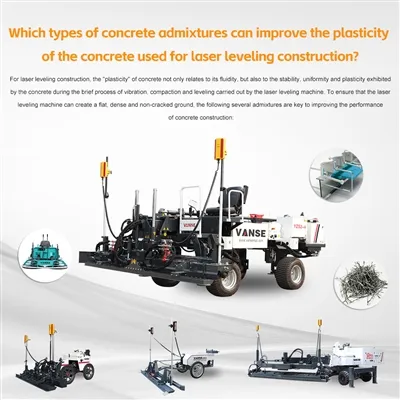
For laser leveling construction, the "plasticity" of concrete not only relates to its fluidity, but also to the stability, uniformity and plasticity exhibited by the concrete during the brief process of vibration, compaction and leveling carried out by the laser leveling machine. To ensure that the laser leveling machine can create a flat, dense and non-cracked ground, the following several admixtures are key to improving the performance of concrete construction: Type of admixture The core role of laser leveling in plasticity Applicable Scenarios and Advantages Key points to note Water reducer / High-efficiency water reducer Core role: While maintaining fluidity, significantly reduces the water-cement ratio, making the concrete slurry denser, more uniform, and more stable. It is the preferred choice for almost all laser-leveling of floors, especially for industrial floors that require high wear resistance and high strength. The dosage must be strictly controlled. Excessive dosage may cause the concrete to become too thick, thereby increasing the load on the leveling machine. Impact on construction: Reduces bleeding and segregation, allowing the surface of the laser leveling machine to immediately set concrete after vibration, facilitating surface finishing; at the same time, prevents "edge collapse" due to excessive softness after spreading, ensuring flatness. Retarding agent Core role: Delays the cement hydration reaction, prolonging the plastic state of the concrete. Large-scale and large-volume flooring construction, or construction under hot weather conditions. The dosage must be precisely adjusted according to the temperature and the construction speed. Excessive retardation will seriously affect the construction schedule. Impact on construction: Provides sufficient operating window periods for the laser leveling machine's spreading, vibrating, and repeated leveling, ensuring that the joints of large-area flooring can be perfectly integrated and eliminating cold joints. Air-entraining agent Core role: Introduces a large number of stable, tiny closed air bubbles into the concrete. For ground that requires freeze-thaw cycles (such as outdoor parking lots), or to address the construction challenges posed by high clay content in sand and gravel. It will slightly reduce the strength of the concrete. Special equipment is required to measure the air content and keep it within a reasonable range (usually 4% – 6%). Impact on construction: These bubbles are like "micro-rollers", significantly improving the cohesion and plasticity of the concrete, making the mixture softer and easier to level, and reducing bleeding and segregation. Adhesive agent / Viscosity regulator Core role: Increases the viscosity of the cement slurry and enhances its ability to encapsulate the aggregate. Used for preparing self-compacting concrete or pumped concrete, it prevents segregation during the vibration of the laser leveling machine, ensuring the uniformity of the concrete. It is often used in combination with high-efficiency water reducing agents to balance fluidity and anti-dewatering properties. In actual engineering projects, to achieve the best plastic effect, these additives are usually used in combination. A typical "golden combination" is: high-efficiency water reducer + retarder. This combination can ensure that the concrete has the excellent fluidity required for laser leveling (facilitating spreading), provide sufficient construction time (facilitating leveling), and ensure the strength and stability after hardening. If your construction environment is complex, such as during hot summer construction, or if the aggregate gradation you use is not ideal, you can consider adding air-entraining agent or tackifier to further optimize the workability of the concrete. Which additives are currently used in your concrete mix ratio? Or did you encounter specific plasticity problems during construction (such as poor fluidity, rapid setting, or easy bleeding)? Please tell me these details, and I can help you analyze how to optimize the combination of additives. Contact us NOW Note: The parameters provided in this document are for reference only and are not mandatory. Due to differences in technical characteristics between different brands and models of laser levelers, please consult the manufacturer for a suitable solution before actual operation. This reference document assumes no responsibility for any issues arising from failure to follow the manufacturer's instructions.