Technical Knowledge
What effect will improper adjustment of the power trowel blade angle have on the concrete surface?

Improper adjustment of the trowel blade angle will have the following adverse effects on the concrete surface
Poor surface flatness
If the blade angle is too large, the blade will cut into the concrete surface excessively when the trowel is running, resulting in scratches of varying depths on the concrete surface, making it difficult to form a flat surface.
If the blade angle is too small, the contact area between the blade and the concrete surface is too large, and the pressure is insufficient, so that the unevenness of the concrete surface cannot be effectively smoothed, making the concrete surface flatness fail to meet the requirements.
Reduced finish
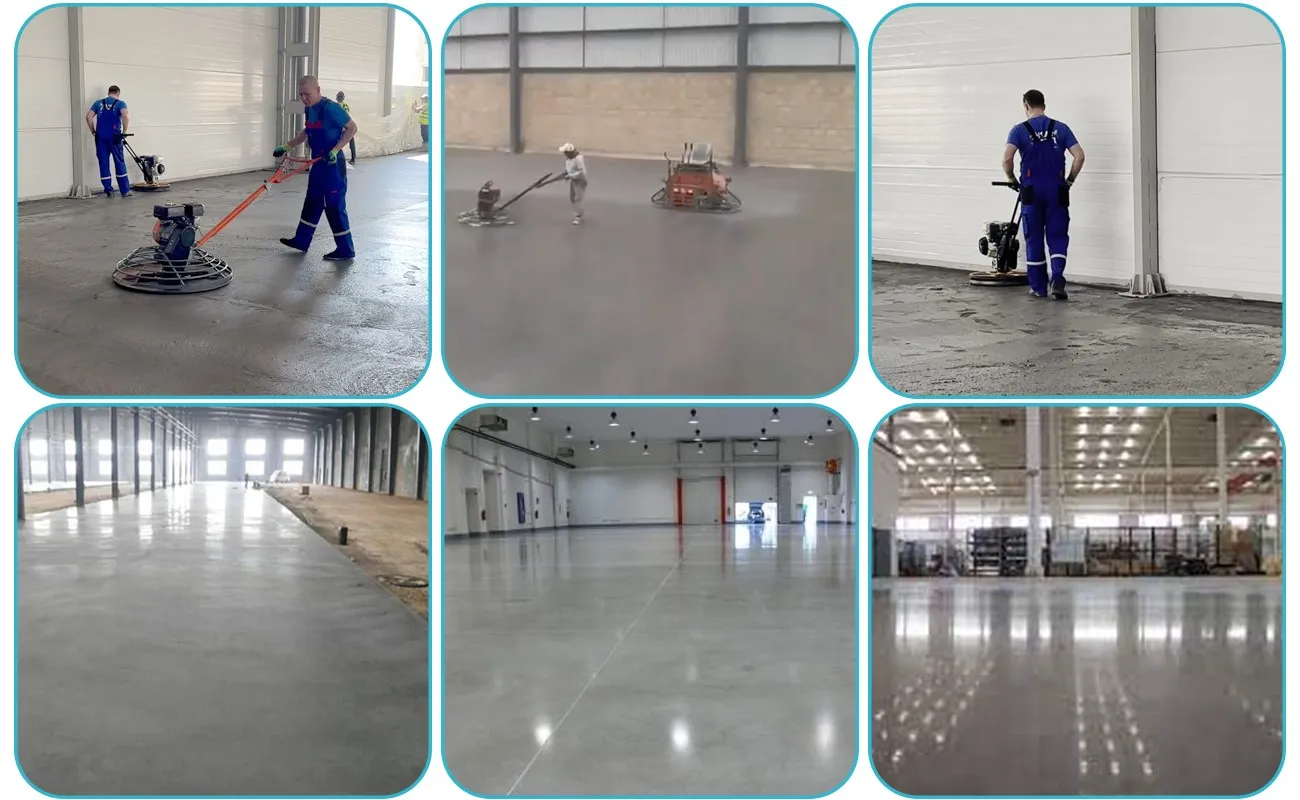
When the blade angle is not appropriate, such as a slightly large angle, the blade cannot evenly squeeze and smooth the concrete surface during the troweling process, which will cause uneven distribution of cement slurry on the surface. In some places, the cement slurry is excessively scraped away, and in some places, too much is retained, thereby affecting the surface finish and making the surface look rough and matte.
If the angle is too small, the blade will not compact the concrete surface enough, and the pores on the surface cannot be effectively filled and closed, which will also reduce the surface finish of the concrete.
Marks and cracks
Improper blade angle adjustment will cause the trowel to exert uneven force on the concrete surface during operation. If the angle is too large, the scraping force of the blade will be too strong, which will easily leave obvious marks on the concrete surface. In severe cases, excessive scraping may cause micro cracks on the concrete surface.
Uneven force caused by inappropriate angles may also cause inconsistent shrinkage in different parts of the concrete surface, which in turn causes surface cracks and affects the durability and aesthetics of the concrete structure.
Uneven strength distribution
Due to improper blade angles, the compaction degree of the concrete surface is different during the troweling process, which will lead to differences in the density of different areas of the concrete surface.
For example, in areas with too large angles, the concrete is over-extended and the surface is too dense, while in areas with smaller angles, the concrete density is insufficient, which makes the strength distribution of the concrete surface uneven, reducing the overall quality and performance of the concrete.
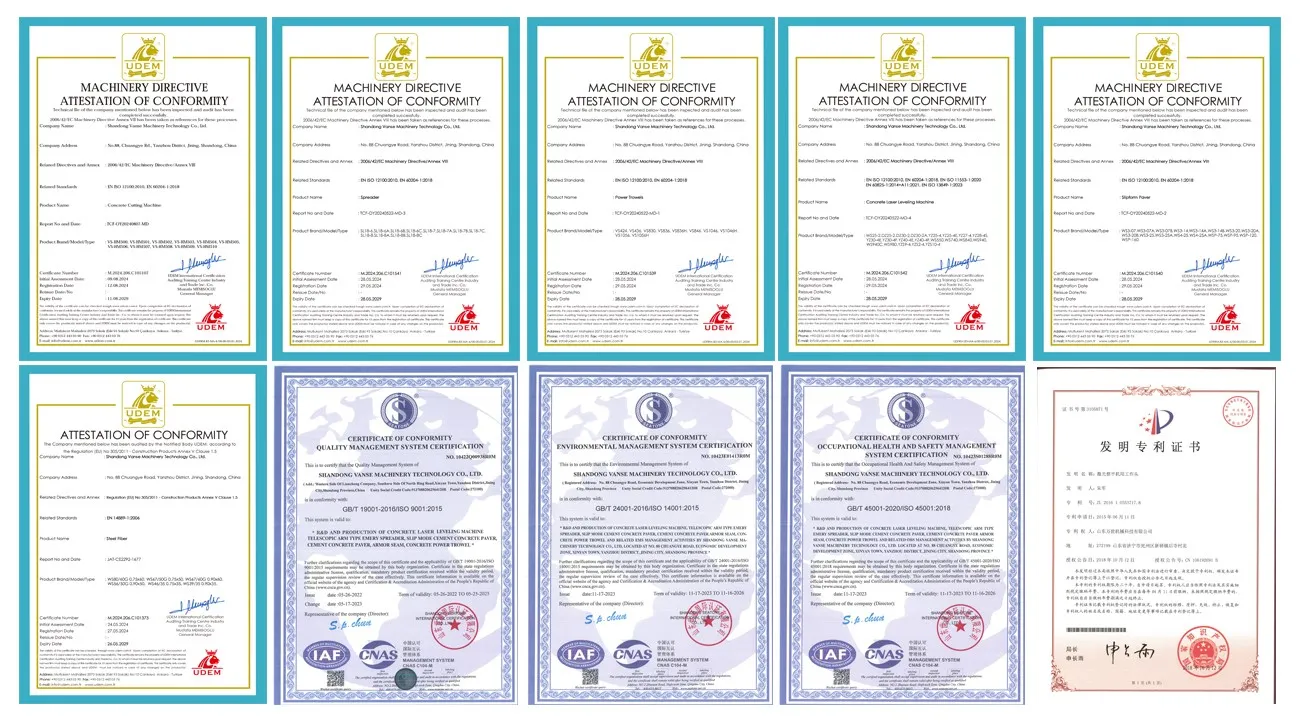
Thanks to All the Friends Who Support and Trust Shandong Vanse Machinery Technology Co., Ltd.
If you want to know more about Shandong Vanse Machinery Technology Co., Ltd. or have any questions, please feel free to contact us:
Our Factory
Shandong Vanse Machinery Technology Co., Ltd.








Share this article

About the Author: Shandong Vanse Machinery Technology Co., Ltd.
Shandong Vanse Machinery Technology Co., Ltd. is a high-tech manufacturer specializing in concrete construction machinery, including laser screeds and related equipment. The company integrates R&D, production, and global sales, with products exported to over 60 countries and widely used in infrastructure projects worldwide.
Previous Post
Next Post
Related Articles
You Might Also Like
Experience in adjusting the operating parameters of the power trowel machine (such as rotational speed and blade Angle) for different concrete mix ratios and additives
Adjusting the operating parameters of the power trowel machine for different concrete ratios and additives is a key technology for achieving high-grade floor quality (such as super-flat floors and wear-resistant floors). The following are the experiences and guidelines for adjusting the operating parameters of the power trowel machine according to the characteristics of different concretes: Understanding the interaction: The "temperament" of concrete (setting speed, hardness, bleeding) determines how the power trowel should "treat" it. Observation is more important than presetting: Parameters have no fixed values, and the only criterion is the state of the concrete surface. An excellent operator is one who "watches the work" during construction rather than mechanically timing. Step by step: From low speed to high speed, from large angles to small angles, gradually apply pressure and improve precision. Characteristics: High cement content, dense slurry, fast setting speed, high early strength, and low bleeding. Operational challenge: The operation window period is short, making it easy to miss the best polishing opportunity. The surface is prone to rapid hardening and it is difficult to extract slurry. Adjustment strategy Rotational speed The first pass (disc slurry lifting) : It should be done a little earlier and at a medium to low speed (about 60-80 RPM). Because the slurry is thick, sufficient force is needed to bring it to the surface, but if the rotational speed is too high, it will curl the slurry and roughen the surface. Second and third coats (power trowel polishing) : After the surface is slightly dry, immediately change the power trowel and use medium-high speed (about 90-120 RPM). High speed helps to make the surface very dense and bright. Once you notice a significant increase in machine resistance and the surface starts to feel "rough", it indicates that the final setting is approaching and you need to stop immediately. Blade Angle The first power trowel: The Angle can be slightly level (about 3-5°), mainly for leveling and avoiding too deep a cut. Subsequent power trowel: As the surface hardness increases, gradually raise the blade Angle (about 5-10°), and use the sharp edge of the blade to perform a "cutting" type of polishing to achieve an extremely high gloss. Core experience: "Racing against time". Personnel and equipment must be ready. Once the concrete meets the conditions for machine operation, continuous work should be carried out immediately until completion. Characteristics: The initial and final setting times are significantly prolonged. The surface remains in a "soft" state for a long time, but the interior is slowly setting. Operational challenges: Prone to premature operation, which can damage the surface structure; The long waiting time affects the construction efficiency. It may be accompanied by bleeding. Adjustment strategy Rotational speed First round (disc) : You must wait! Until the depth of the foot depression is less than 5mm. Use a low speed (about 50-70 RPM) to lift the slurry smoothly, as the surface support force is still insufficient. Subsequent polishing: The interval between each application is quite long, requiring great patience. Always use medium and low speeds to avoid surface "wavy" or "curled skin" caused by excessive speed. Blade Angle Throughout the entire process, always maintain a relatively small Angle (approximately 0-5°). Because concrete is soft, if the Angle is too large, it will overly erode the surface and form grooves. Core experience: "Patience". Never be in a hurry to use the computer. If there is bleeding on the surface, it should be scraped off with water first or wait for it to evaporate. The operation mainly involves "gentle kneading". Characteristics: Fast setting speed and rapid strength growth. Operational challenge: The operational window period is extremely short, almost an "accelerated version" of high-grade concrete, making it easier to miss the opportunity. Adjustment strategy Rotational speed All rounds: The pace should be fast. The disc and the first power trowel operation can be combined or carried out quickly and continuously. The rotational speed can be medium to high (80-100 RPM) to complete compaction and smoothness within a limited time. Blade Angle The blade Angle can be raised relatively quickly. When applying the second coat of gloss, a relatively large Angle (about 7-10°) can be adopted to seize the final opportunity for pressing. Core experience: "Prediction and connection". The operator must constantly observe the surface changes. After the disc operation, the power trowel operation should be seamlessly connected. Machines can't stop. When people rest, the machines don't. Characteristics: The early strength is relatively low, and the setting speed is slightly slower, but the later strength is high, and the surface is easier to smooth. Operational challenges: Low surface strength in the early stage and prone to damage; However, the slurry has good lubricity and is prone to excessive polishing, which can lead to bleeding. Adjustment strategy Rotational speed First pass (disc) : The waiting time is similar to or slightly longer than that of ordinary concrete. Lift the slurry smoothly at medium speed (about 70-90 RPM). Subsequent polishing: Due to its excellent lubricity and wear resistance, it can be polished multiple times at medium speed, making it easy Concrete type Disk stage rotational speed The rotational speed of the power trowel stage Suggested blade Angle Core operational philosophy High grade/low water-binder ratio Medium and low speed (60-80 Medium and high speeds (90-120) From flat (3-5°) to steep (5-10°) Race against time and increase pressure step by step Add retarder Low speed (50-70 Medium and low speed (70-90) Always maintain a small Angle (0-5°) Wait patiently and operate gently Adulterated with early strength agents Medium and high speeds (80-100) Medium and high speeds (90-110 Quickly increase the Angle (7-10°) Predictive connection, quick and decisive High-admixture Medium speed (70-90) Medium speed (80-100) Medium Angle (5-8° Gentle multiple times, taking advantage of the characteristics Note: The unit of rotational speed is RPM (revolutions per minute), which is an empirical reference value. The specific speed should be subject to the machine model and on-site conditions. The "Better late than early" rule: No matter what the ratio is, it is better to apply the gloss on the machine a little later than a little earlier. The machine may be strenuous at night, but in the morning it will completely damage the surface structure and cannot be remedied. Footprint Method for timing: Disc operation: Footprint depth is approximately 3 to 5 mm. The first power trowel: The depth of the footprint is approximately 1-2 mm. Final polished: The footprints are extremely shallow or non-existent, and the foot feel is hard. Listen to its sound, observe its trace Too high rotational speed/too early timing: The machine makes a dull sound, has high resistance, and there are "slurry" or "scratches" marks on the back of the blade. Too low speed/too late timing: The machine jumps severely, the blade "floats" on the surface and cannot be eaten, leaving white scratches without luster. The Angle and rotational speed are optimally matched: the machine operates smoothly, with uniform sound, and the blade leaves a uniform, bright, and traceless surface after passing through. Mastering these adjustment experiences requires a great deal of practice and careful observation. The best approach is to consciously associate the concrete mix ratio, weather conditions, the adopted operation parameters and the final effect with each construction, constantly accumulate and correct one's own "experience database", and thus become an expert in concrete plastering capable of handling any "temper". Note: The parameters provided in this document are for reference only and are not mandatory. Due to differences in technical characteristics between different brands and models of laser levelers, please consult the manufacturer for a suitable solution before actual operation. This reference document assumes no responsibility for any issues arising from failure to follow the manufacturer's instructions.Concrete finishing equipment for high FF scores
When a client asks for Superflat floors (FM1/FM2 or FF 50+), they aren't just looking for a smooth finish-they are looking for mathematical precision. In the world of industrial flooring, achieving high FF (Floor Flatness) scores is a game of inches, and your equipment choices determine whether you pass inspection or face costly grinding. To consistently hit those high-spec numbers, you need a synchronized fleet. Here is the professional equipment breakdown for high FF scores, featuring the specialized lineup from Vanse Machinery. You can't finish a floor flat if it wasn't placed flat. The Concrete Laser Leveling Machine is the most critical variable for FF scores. The Vanse Approach: For large-scale warehouse projects, the Vanse YZ30-4E Telescopic Boomed Laser leveling is the industry standard. Its 360-degree rotation and 6-meter telescopic boom allow the leveling head to reach out and strike off the concrete while the machine remains stationary. This prevents "tire track" deviations. For tighter workspaces, the WS940/WS940C/YZ28-4S/YZ25-4 offers the same high-frequency vibration and laser precision in a more agile frame. Consistency is the enemy of "dips" and "mounds." If your concrete is dumped in massive, uneven piles, the leveling has to work harder, which can lead to inconsistencies in FF scores. The Workflow: Use a Vanse Concrete Distributor to ensure an even "ribbon" of concrete is placed across the bay. To get material into the strips quickly without disturbing the subgrade, the Vanse Mini Dumper (available in electric and gasoline) is the perfect support tool. It allows for controlled, precise dumping that makes the laser leveling's job much easier. High FF floors often require a dry-shake hardener for wear resistance. If you spread this manually, you risk creating "hills" and "valleys" that ruin your flatness numbers. The Vanse Approach: The Vanse Automatic Topping Spreader applies the material with mechanical consistency. By linking the spreader's output to the machine's travel speed, you get a uniform layer that integrates perfectly with the wet concrete, preserving the flatness achieved by the laser leveling machine. Once the slab is leveled, you need to densify it. However, a "chattering" trowel can actually lower your FF score. The Workflow: Transition to a Vanse VS1046 Ride-on Power Trowel. With its heavy-duty gearbox and high-torque BRIGGS & STRATTON engine, it provides the steady, powerful compaction needed to "burnish" the floor. Its precision pitch control allows the operator to make micro-adjustments to the blades, smoothing out the surface to a mirror finish without introducing new waves into the slab. Even a Superflat floor will fail if the joints are ragged or spalled. The Workflow: As soon as the concrete can support it, use a Vanse Concrete Cutting Machine (Floor Saw) for your contraction joints. A stable, high-speed saw ensures the edges of the joints stay crisp, which is vital for the long-term maintenance of FF scores once heavy forklift traffic begins. When you browse www.vansemac.com, you're looking at a complete Superflat Solution. Here's why this workflow is the gold standard for international buyers: Labor Efficiency: A full Vanse fleet can turn a 12-man manual crew into a high-output 5-man team. Data-Driven Results: These machines are designed to meet ACI 117 and TR34 standards. When you use a Vanse laser leveling followed by a Vanse power trowel, you are practically guaranteed higher F-numbers. Reliability: In high-spec flooring, equipment downtime can ruin a pour. Vanse uses world-class components (Honda, Rexroth, Danfoss) to ensure your fleet keeps moving until the last pass is done. Achieving high FF scores isn't a secret-it's a process. By combining the placement precision of the Concrete Distributor, the leveling power of the Laser leveling, and the finishing torque of the Power Trowel, you create a floor that isn't just flat-it's Vanse Flat. Visit www.vansemac.com to see our full lineup and start hitting those FM1 numbers on your next project. Note: The parameters provided in this document are for reference only and are not mandatory. Due to differences in technical characteristics between different brands and models of laser levelers, please consult the manufacturer for a suitable solution before actual operation. This reference document assumes no responsibility for any issues arising from failure to follow the manufacturer's instructions.How to troubleshoot the laser signal loss fault of the concrete laser leveling machine? Can I solve it myself or do I need to find professional maintenance personnel?
If the laser signal of the concrete laser leveling is lost, in most cases, you can first check it step by step by yourself. If the problem still cannot be solved after checking, you need to contact professional maintenance personnel. The core troubleshooting logic is "gradually locating from the signal source to the receiving end", first eliminating external interference and simple connection issues, and then determining hardware faults. Troubleshooting in the following order can solve over 80% of signal loss problems without the need for professional tools: Check the status of the laser emitter Confirm whether the transmitter is powered on and whether the power indicator light is on normally (if it is not on, check whether the power cord is plugged in tightly and whether the power adapter is damaged). Observe whether the transmitter is placed horizontally and whether the bottom leveling bubble is in the center (tilting will cause signal deviation, and manual leveling needs to be re-done or the automatic leveling function should be enabled). Investigate signal occlusion and interference Check if there are any obstacles such as steel bars, construction tools, personnel, etc. between the transmitter and the receiving probe of the leveling machine, and clear the straight area between the two. Stay away from other strong light sources or electromagnetic equipment, such as electric welding machines, large frequency converters, and powerful flashlights, as these devices can interfere with the laser signal. Check the connection of the receiving system Check whether the laser receiving probe on the leveling machine is loose or displaced, and whether there is dust or concrete slurry on the probe lens. Wipe the lens with a clean soft cloth. Check the connection cable between the probe and the main unit, and confirm whether the plug is tightly inserted and whether the cable is damaged (if the cable is damaged, it can be temporarily wrapped with insulating tape, and needs to be replaced later). Restart the device and restore factory Settings Turn off the power of the transmitter and the leveler, wait for 1 to 2 minutes, and then restart them. Some temporary signal disorders can be resolved by restarting. If restarting is ineffective, refer to the equipment manual and restore the laser control system to its factory Settings (Note: Record the commonly used parameters before restoring). Test the signal receiving range Move the leveler to a position close to the transmitter (such as within 3 to 5 meters) and observe whether the signal can be received. If it can receive at close range but not at long range, it might be due to insufficient power of the transmitter or a decrease in the sensitivity of the probe. Further hardware testing is required. If the signal is still lost after completing the above troubleshooting, it indicates a hardware fault. It is not recommended to disassemble it by yourself. Please contact the maintenance personnel Transmitter failure: For instance, if the laser tube of the transmitter burns out or the internal circuit board is damaged, it will be manifested as no laser being emitted after power-on, or the laser intensity significantly weakening. The receiving probe is damaged: The internal photosensitive element of the probe is faulty. Even without obstruction, it cannot receive signals. The sensitivity of the probe needs to be tested with a dedicated instrument. Host control system failure: The communication module between the host and the receiving system is damaged, which is manifested as a direct error "signal interruption" after the equipment is turned on. Professional personnel are required to inspect the circuit or replace the module. Note: The parameters provided in this document are for reference only and are not mandatory. Due to differences in technical characteristics between different brands and models of laser levelers, please consult the manufacturer for a suitable solution before actual operation. This reference document assumes no responsibility for any issues arising from failure to follow the manufacturer's instructions.