Technical Knowledge
Two hours after the laser leveling machine construction, it started raining: How to quickly cover without damaging the fresh surface?
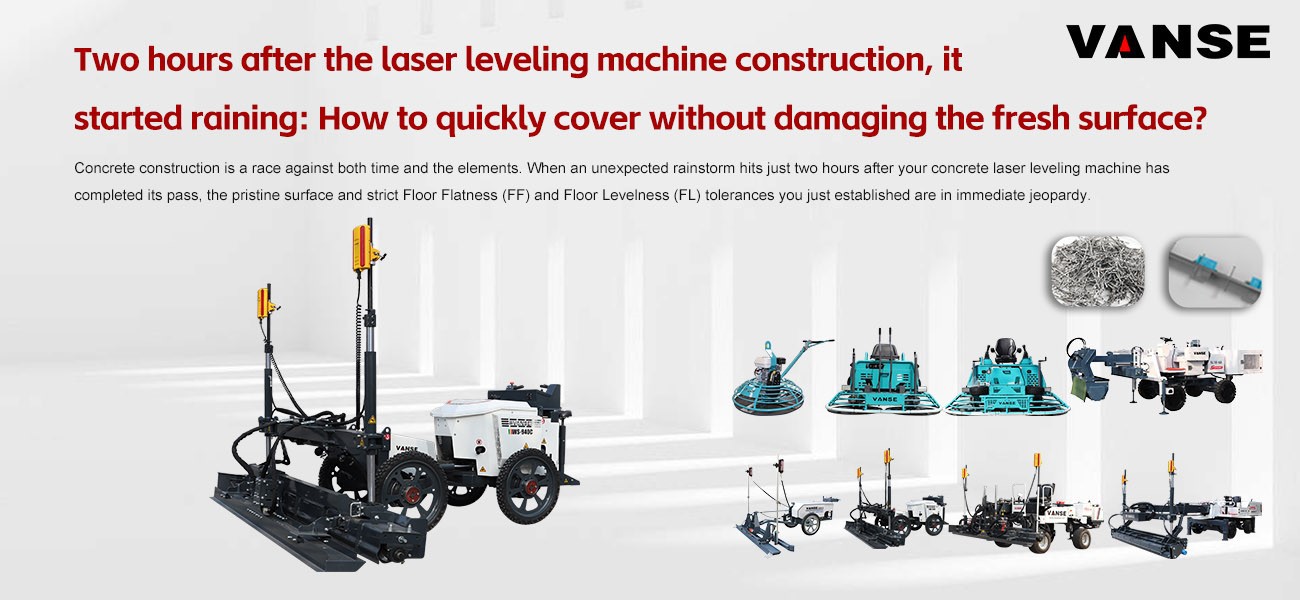
Concrete construction is a race against both time and the elements. When an unexpected rainstorm hits just two hours after your concrete laser leveling machine has completed its pass, the pristine surface and strict Floor Flatness (FF) and Floor Levelness (FL) tolerances you just established are in immediate jeopardy.
Two hours post-pour is a highly vulnerable stage: the concrete has likely stopped bleeding, but it has not reached its final set. Heavy rain can wash away the critical cement paste (creating a weak, dusting surface) and cause severe pitting.
1. Assess the 2-Hour Curing Window
At the two-hour mark, the slab is typically in the "initial set" phase.
The Risk: The surface cannot support human weight without leaving deep footprints, yet it is soft enough that heavy raindrops will physically punch holes in the cream (cement paste).
The Goal: You must create a waterproof barrier that floats lightly on the surface or hovers just above it, without dragging or scraping the concrete texture.
2. Choose the Right Covering Material
Do not use heavy canvas tarpaulins or thick, rigid construction blankets. They are too heavy and will leave permanent drag marks and wrinkles in the slab.
The Solution: Use 4-mil to 6-mil clear or white polyethylene sheeting (plastic visqueen). It is entirely waterproof, incredibly lightweight, and can be pulled taut over wide expanses.
3. The "Roll and Float" Deployment Strategy
To maintain the precise FF/FL metrics established by your laser Leveling, no worker can step onto the concrete. You must deploy the sheeting from the perimeter.
Step 1: The PVC Roller Method. Wrap the roll of poly sheeting around a long, lightweight PVC pipe (or a straight, light aluminum Leveling board).
Step 2: Perimeter Deployment. Position workers on opposite sides of the slab (off the concrete, on the formwork, or on pre-existing adjacent slabs).
Step 3: Unroll in Mid-Air. Pull the plastic sheeting across the slab, keeping it elevated. Once the sheet is pulled taut across the designated area, gently lower it straight down onto the wet concrete.
Step 4: Secure the Edges. Weight down the edges of the plastic with lumber, sandbags, or excess rebar resting outside the formwork so the wind does not lift it. Do not attempt to smooth out minor wrinkles in the middle of the slab; the pressure will cause more damage than the wrinkle itself.
4. Post-Rain Recovery and the Vanse Machinery Advantage
Once the rain passes and the ambient temperature begins to dry the slab, carefully peel back the plastic sheeting. If the deployment was successful, the concrete paste will still be intact, though there may be minor surface blemishes or wrinkles from the plastic.
This is where the right finishing equipment salvages the project. As engineered by Shandong Vanse Machinery Technology Co., Ltd. (www.vansemac.com), achieving a seamless industrial floor requires a synergistic equipment ecosystem.
Preserving the Grade: By deploying the plastic correctly, you protected the macro-levelness achieved by your Vanse YZ30-4E or YZ40-4E telescopic boom laser Leveling.
Mechanical Correction: To erase the minor wrinkles or light rain pitting left behind by the plastic, deploy a heavy-duty ride-on power trowel (such as the Vanse VS836/ VS1046). The high-speed, dual-rotor mechanical compaction will aggressively knead the surface paste, burnishing out the superficial rain/plastic marks and restoring the dense, highly wear-resistant finish required for commercial floors.
Conclusion
A sudden downpour does not have to be a disaster. By stocking lightweight poly sheeting on every job site and utilizing a "no-step" deployment method, contractors can protect the fresh paste. Relying on advanced, heavy-duty finishing equipment afterward ensures that the final floor still meets rigorous international specifications.
Note: The parameters provided in this document are for reference only and are not mandatory. Due to differences in technical characteristics between different brands and models of laser levelers, please consult the manufacturer for a suitable solution before actual operation. This reference document assumes no responsibility for any issues arising from failure to follow the manufacturer's instructions.
Thanks to All the Friends Who Support and Trust Shandong Vanse Machinery Technology Co., Ltd.
If you want to know more about Shandong Vanse Machinery Technology Co., Ltd. or have any questions, please feel free to contact us:
Our Factory
Shandong Vanse Machinery Technology Co., Ltd.








Share this article

About the Author: Shandong Vanse Machinery Technology Co., Ltd.
Shandong Vanse Machinery Technology Co., Ltd. is a high-tech manufacturer specializing in concrete construction machinery, including laser screeds and related equipment. The company integrates R&D, production, and global sales, with products exported to over 60 countries and widely used in infrastructure projects worldwide.
Previous Post
Next Post
Related Articles
You Might Also Like
How to ensure construction quality and efficiency at the same time during real-time monitoring?
Ensure construction quality and efficiency during real-time monitoring During the construction process, real-time monitoring is a key link to ensure construction quality and efficiency. Through real-time monitoring, the construction process can be comprehensively controlled, and problems can be discovered and solved in time, thereby ensuring construction quality and improving construction efficiency. The following is the specific content of how to ensure construction quality and construction efficiency at the same time during real-time monitoring. ▷▷▷▷ Clarify monitoring goals Before conducting real-time monitoring, the monitoring objectives must first be clarified. This includes a comprehensive understanding of the key parameters during construction, the construction environment and construction quality standards. By clarifying the monitoring objectives, the accuracy and effectiveness of monitoring data can be ensured, providing a basis for subsequent construction quality control and efficiency improvement. ▷▷▷▷ Choose appropriate monitoring technology and equipment Choosing appropriate monitoring technology and equipment is key to real-time monitoring. According to the specific construction project and monitoring objectives, select monitoring equipment with high accuracy, high stability and high reliability. At the same time, it is necessary to ensure that the monitoring equipment can monitor key parameters during the construction process in real time, such as temperature, temperature, pressure, vibration, etc. In addition, the ease of operation and maintenance of the equipment should also be considered to ensure the smooth progress of the monitoring work. ▷▷▷▷ Establish an effective monitoring network Establishing an effective monitoring network is an important means to ensure construction quality and efficiency. By arranging multiple monitoring points at the construction site to form a comprehensive monitoring network, all-round monitoring of the construction process can be achieved. At the same time, it is necessary to ensure that the data transmission and processing speed of the monitoring network is fast enough to detect problems in time and take corresponding measures. treatment measures. ▷▷▷▷ Implement real-time monitoring and data analysis During the implementation of real-time monitoring, it is necessary to pay close attention to the changing trends of monitoring data. Through real-time analysis of monitoring data, abnormal conditions or potential problems during the construction process can be discovered in time. Once a problem is discovered, appropriate measures should be taken immediately to ensure construction quality and efficiency. ▷▷▷▷ Optimize construction process and resource allocation Real-time monitoring data can not only be used for quality control, but also provide a basis for the optimization of construction processes and resource allocation. Through the analysis of real-time monitoring data, bottlenecks and problem points in the construction process can be identified, thereby optimizing the construction process, adjusting resource allocation, and improving construction efficiency. For example, the operating parameters of construction equipment can be adjusted based on real-time monitoring data, and the work arrangements of the construction team can be optimized. ▷▷▷▷ Strengthen personnel training and team building During the real-time monitoring process, the quality and skill level of personnel are crucial to ensuring construction quality and efficiency. Therefore, it is necessary to strengthen personnel training and team building, and improve the professional skills and sense of responsibility of monitoring personnel. Through regular training and assessment, it is ensured that monitoring personnel are proficient in monitoring technology and equipment operation methods, and can accurately analyze monitoring data and take corresponding processing measures. At the same time, it is necessary to strengthen team building and cultivate the spirit of collaboration and communication skills among team members to ensure the smooth progress of monitoring work. ▷▷▷▷ Strengthen safety management and environmental awareness During the real-time monitoring process, safety management and environmental awareness must always be strengthened. Ensure safe production during the monitoring process by formulating strict safety management systems and operating procedures. At the same time, it is necessary to strengthen the awareness of environmental protection on construction sites and reduce the impact of construction on the environment. For example, noise reduction, dust reduction and other measures can be taken to reduce the impact on surrounding residents; construction waste can be reasonably disposed of to reduce environmental pollution. To sum up, ensuring construction quality and efficiency during real-time monitoring requires multiple aspects. By clarifying monitoring objectives, selecting appropriate testing technologies and equipment, establishing an effective temporary testing network to implement real-time monitoring and data analysis, optimizing construction processes and source configuration, strengthening personnel training and team building, and strengthening safety management and environmental awareness, etc. Comprehensive measures can achieve the goal of simultaneously ensuring construction quality and construction efficiency during real-time monitoring. This will help improve the overall level of construction and promote the sustainable development of the construction industry.What are some common troubleshooting steps for laser system failures?
The laser system of the concrete laser leveling is the core for achieving high-precision screing. Once a malfunction occurs, it will lead to a decrease in the leveling accuracy and affect the construction quality. The following are systematic and common troubleshooting steps. It is recommended to follow the principle of "from simple to complex and from outside to inside". Stop the machine immediately: Turn off the leveling machine and make sure the laser emitter is also turned off to prevent the laser from causing harm to the eyes. Confirm whether the battery power of the laser transmitter and receiver is sufficient. Low battery power can cause unstable signals. Check all cables and plugs for any damage, looseness or poor contact (especially the connection line between the receiver and the main unit of the leveler). Laser receiver: Clean its sensing panel to ensure there is no cement slurry, dust or oil stains covering it. Laser emitter: Clean the emission window to ensure the lens is clean. Mast/Benchmark: Check whether the mast on which the receiver is installed is vertical, stable and free from deformation. Confirm the status of the transmitter Make sure the laser emitter is turned on and in the rotating (sweeping) mode. Check if it is level (observe the bubble level it comes with). Listen to the sound and observe: During normal operation, there should be the sound of the motor rotating, and a moving red dot can be seen on the obstacle when the laser beam appears. Height and position inspection Height: Ensure that the receiver is within the effective working height of the laser plane (usually, the laser plane is best at the middle position of the receiver's sensing rod). If the receiver is too high or too low, no signal will be received. Location: Move the receiver directly near the laser emitter to see if there is a signal. If it is present near but not far away, it might be that the laser plane is blocked or the emitter is not level. Interference screening Check whether there is strong direct sunlight, other laser equipment or strong light source interference in the work area. Try to cover the receiver with a light shield. Equipment replacement test (if conditions permit) : Test with a confirmed normal receiver, or take the faulty receiver to another normally working transmitter for testing. This can quickly determine whether the fault point is the transmitter or the receiver. Inspect the ground and foundation Is the laser emitter tripod set up on a solid and stable ground? The vibration or subsidence of the ground during the pouring process can cause the launcher to shake. Check whether the leveling machine itself shakes violently when moving. Check the mechanical connections Is the connection between the receiver and the mast, as well as the connection between the mast and the body of the leveling machine, firm? Any loosening will cause signal jitter. Check whether the connection hydraulic cylinder/hinge point between the scraper or rammer plate of the leveling machine and the body is too loose, causing free travel. Electrical interference Lay the cables of the laser system separately from the main power line and hydraulic line of the leveling machine to avoid parallel and close contact, so as to reduce electromagnetic interference. Environmental review Is there a large amount of dust and steam in the air? These will scatter laser, causing the signal to weaken and become unstable. High-temperature heat waves can also cause light refraction. Calibration check (the most common cause) : Transmitter calibration: Use the dedicated calibration tool provided randomly and follow the steps in the manual to check and calibrate the horizontal accuracy of the laser transmitter itself. This is the most crucial step. Receiver zero point calibration: At a reference point of known height (such as a pre-set reference post), perform the operation of "zeroing" the receiver or setting the reference height. Reference point and setting check Recheck whether the construction reference point (elevation) is accurate and whether the height set on the transmitter is correct. Confirm whether the mode selected on the control panel of the leveling machine (such as the "Leveling" mode) is correct. Mechanical system linkage inspection After the laser system gives the correct signal, check whether the hydraulic lifting system of the leveling machine responds promptly and accurately. Are there any problems such as clogged hydraulic valves or leakage inside the cylinder? The lifting action can be manually operated to test whether it is smooth and powerful. If none of the above steps can solve the problem, it may involve an internal fault: Transmitter: Internal level sensor failure, motor drive module damage, laser tube aging, etc. Receiver: Damaged sensing element, mainboard failure, etc. Contact the equipment supplier or professional maintenance personnel. Provide detailed fault phenomena and the troubleshooting steps that have been taken. Do not disassemble the core components of the laser emitter or receiver by yourself, especially since the laser emitter has precise optical components and high-precision sensors inside. Non-professional disassembly may lead to permanent damage or calibration failure. Proper storage: After use, clean the equipment thoroughly and store it in a dry, shockproof toolbox. Regular calibration: In accordance with the requirements of the operation manual, conduct official calibration of the laser system on a regular basis (such as every quarter or before the start of each major project). Battery management: Use original or high-quality batteries. Remove the batteries when not in use for a long time. Avoid impact: Handle with care to prevent the laser equipment from being subjected to severe impacts or drops. Observe the fault phenomenon → Power off for safety inspection → Cleaning and appearance inspection → Power supply and wiring inspection → Select the above path for troubleshooting based on the phenomenon (no signal/unstable/poor precision) → Try to replace the component for testing → Contact professional maintenance. Through the above systematic steps, the vast majority of common faults of the laser system of the concrete laser leveling can be solved. Note: The parameters provided in this document are for reference only and are not mandatory. Due to differences in technical characteristics between different brands and models of laser levelers, please consult the manufacturer for a suitable solution before actual operation. This reference document assumes no responsibility for any issues arising from failure to follow the manufacturer's instructions.Working Principle Of Concrete Laser Leveling Machine
1. Laser transmitter and receiver The concrete laser leveling machine uses a laser transmitter and a receiver. The laser beam emitted by the laser transmitter is received by the receiver and converted into an electrical signal. These electrical signals are used to control the movement of the leveling and the smoothness of the concrete surface. 2. Positioning and calibration of laser beam The positioning and calibration of the laser beam is one of the important working principles of the concrete laser leveling. Before construction, the laser beam needs to be positioned and calibrated by the leveling to ensure that the laser beam can be accurately projected onto the concrete surface. This is usually achieved by setting a reference point before construction. The leveling machine receives the signal of the reference point through the receiver and aligns the laser beam with the reference point to achieve positioning and calibration of the laser beam. 3. Work flow of leveling machine The workflow of the concrete laser leveling machine includes the following steps: ★1. Preparation before construction: Before construction, the leveling machine needs to be debugged and calibrated to ensure the normal operation of the equipment. At the same time, the concrete surface also needs to be cleaned and prepared to ensure the construction effect. ★2. Laser beam positioning and calibration: By setting the reference point, the leveler receiver receives the signal of the reference point and aligns the laser beam with the reference point, thereby achieving the positioning and calibration of the laser beam. ★3. Concrete laying: After the laser beam positioning and calibration is completed, the concrete laying work can be carried out. The leveling machine can level and trim the surface of mixed soil according to preset flatness and height parameters. ★4. Surface treatment: After the concrete laying is completed, the leveling machine can further process the concrete surface, such as compaction, smoothing, lightening, etc., to ensure the flatness and smoothness of the surface. ★5. Construction completed: After completing the surface treatment, the leveler can stop working and wait for the concrete to solidify. After the concrete has solidified, subsequent construction work can be carried out. 4. Main components of leveling machine The main components of the concrete laser leveling machine include laser transmitter, receiver, mixer, scraper, trowel, etc. These components play an important role in the operation of the leveler ★1. Laser emitter: The laser emitter is one of the core components of the leveler. It is responsible for emitting a laser beam and controlling its projection onto the concrete surface. The quality and performance of the laser transmitter have an important impact on the effectiveness and service life of the leveler. ★2. Receiver: The receiver is another core component of the leveling machine. It is responsible for receiving the laser beam and converting it into an electrical signal. These electrical signals are used to control the movement of the leveling and the smoothness of the concrete surface. ★3. Mixer: The mixer is one of the auxiliary parts of the leveling machine. It is responsible for mixing the concrete evenly to ensure the construction effect. The quality and performance of the agitator also affects the effectiveness and service life of the leveler. ★4. Scraper and trowel: Scraper and trowel are tool parts of the leveling machine. They are used for smoothing and trimming the concrete surface. The quality and performance of these tools will also affect the effectiveness and longevity of the leveler. 5. Machine adjustment and operation When using a concrete laser leveling, it needs to be adjusted and operated according to specific construction requirements and equipment performance. Here are some common adjustments and how-tos ★1. Adjust the projection angle of the laser beam: According to the construction requirements and equipment performance, the projection angle of the laser beam can be adjusted to achieve different flatness and height requirements for the concrete surface. ★2. Adjust the pressure of the scraper and trowel: When using the scraper and trowel, the pressure of the scraper and trowel needs to be adjusted according to the hardness of the concrete and construction requirements to ensure the flatness and smoothness of the surface. ★3. Control the speed of the mixer: The speed of the mixer needs to be adjusted according to the hardness of the concrete and construction requirements to ensure the uniformity of mixing and construction effect of the concrete. ★4. Operation control panel: The leveling machine is usually equipped with a control panel through which the equipment can be remotely controlled and adjusted. The operator needs to choose the appropriate control mode and parameter settings according to the actual situation. 6. Machine maintenance and upkeep In order to ensure the long-term stable operation and service life of the concrete laser leveling machine, regular maintenance and upkeep work is required. The following are some common maintenance and care methods ★1. Clean equipment: Clean various parts and surfaces of the equipment regularly to prevent the impact of dust, debris and other dirt. ★2. Check components: Regularly check whether each component of the equipment is working properly, such as laser transmitter and receiver, stirrer, scraper and trowel, etc. If any damage or abnormality is found, it needs to be replaced or repaired in time ★3. Lubrication equipment: Regularly lubricate various parts of the equipment, such as bearings, chains, etc., to reduce wear and failure ★4. Adjust parameters: During use, the parameter settings of the equipment need to be adjusted according to the actual situation, such as the projection angle of the laser beam, the pressure of the scraper and trowel, etc. ★5. Storage equipment: When the equipment is not in use, it needs to be stored in a dry, well-ventilated environment to prevent moisture, corrosion and other environmental factors.