Technical Knowledge
Training guidelines and certification system for concrete laser leveling machine operators
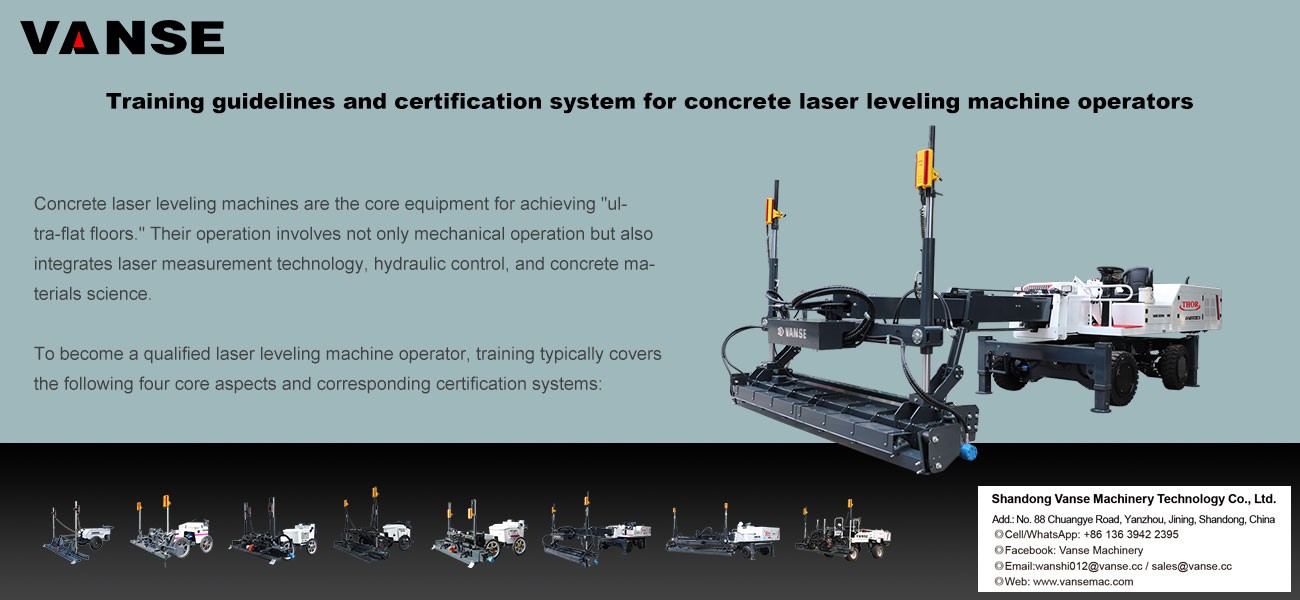
Concrete laser leveling machines are the core equipment for achieving "ultra-flat floors." Their operation involves not only mechanical operation but also integrates laser measurement technology, hydraulic control, and concrete materials science.
To become a qualified laser leveling machine operator, training typically covers the following four core aspects and corresponding certification systems:
I. Key Points of Operator Training
1. Equipment Structure and Laser System Debugging
Laser Emitter Setup: Master the horizontal calibration and height setting of the emitter. Operators must ensure the emitter is in a stable, vibration-free interference-free area.
Receiver and Control System: Learn how to set parameters through the control panel (such as Somero's OASIS system) to achieve automatic balancing.
Leveling Head Adjustment: Adjust the depth of the auger and the frequency of the vibrating plate according to the concrete slump.
2. Concrete Material Characteristics Identification
Slump Sensing: Operators must be able to visually identify the consistency of the concrete. Concrete that is too thin (excessive slump) will cause "waves" after leveling, while concrete that is too dry will result in excessive resistance at the leveling head.
Initial Setting Time Judgment: Determine the concrete's setting state based on air temperature and wind speed to determine the leveling machine's travel speed.
3. Practical Skills and Anomaly Handling
Overlap Area Handling: Master the overlap width between each leveling path (usually 15cm-30cm) to avoid uneven joint heights.
Complex Area Construction: Learn the "manual switching" mode in laser-restricted areas such as column edges, floor drains, and wall corners.
Troubleshooting: Emergency procedures in case of laser signal loss, hydraulic hose rupture, or sensor alarm.
4. Digitalization and Simulation Training (New Technology Trends)
VR Simulator Training: Top manufacturers (such as Somero) have launched VR simulation systems that allow trainees to practice the entire operation process in a virtual cockpit without entering a real construction site.
II. Certification System (International and Domestic Status Quo)
Currently, there is no globally unified legally recognized certification for operating laser leveling machines. Professional certification is primarily obtained through the following three channels:
1. Manufacturer Certification (Most Authoritative)
Somero Concrete Institute (SCI): The most globally recognized certification. Training covers everything from basic operations to advanced 3D floor systems. Those who pass the examination receive an officially issued Operator Certification.
(1) Domestic Manufacturer Certification: Leading domestic brands such as Vanse also provide their customers with system operator technical assessments and authorization certificates.
2. Industry Association Certification
American Concrete Institute (ACI): Offers Flatwork Technician/Finisher certification. While not specifically for any particular machine, it covers the core theory for achieving FF/FL values and is a plus in international project bidding.
CITB (UK): In the UK, operators must attend a standard course developed by the Construction Industry Training Board (CITB) and undergo practical assessments.
3. Domestic Professional Qualifications (Industry Reference)
In China, laser leveling operators typically hold one of the following two types of certificates:
Special Equipment/Construction Machinery Operator Certificate: A "Laser leveling Operator" certificate issued by relevant industry associations (such as the China Construction Machinery Industry Association).
Vocational Skill Level Certificate: A skill level certificate issued by local construction skills training institutions (such as advanced-level certificates for plasterers and concrete workers).
III. Examples of Training Evaluation Indicators
| Assessment Dimensions | Standards for Completion: |
| Theoretical Foundation | Closed-book exam score ≥ 80%, able to explain the working principle of laser leveling; |
| Preparation Work | Laser emitter setup error ≤ 1 mm, leveling head installation time meets standards; |
| Practical Skills | Actual measured F_F value in simulated field not less than 45; |
| Safety Awareness | Strictly implement three-level safety training, able to correctly identify hazards in the work area. |
Note: The parameters provided in this document are for reference only and are not mandatory. Due to differences in technical characteristics between different brands and models of laser levelers, please consult the manufacturer for a suitable solution before actual operation. This reference document assumes no responsibility for any issues arising from failure to follow the manufacturer's instructions.
Thanks to All the Friends Who Support and Trust Shandong Vanse Machinery Technology Co., Ltd.
If you want to know more about Shandong Vanse Machinery Technology Co., Ltd. or have any questions, please feel free to contact us:
Our Factory
Shandong Vanse Machinery Technology Co., Ltd.








Share this article

About the Author: Shandong Vanse Machinery Technology Co., Ltd.
Shandong Vanse Machinery Technology Co., Ltd. is a high-tech manufacturer specializing in concrete construction machinery, including laser screeds and related equipment. The company integrates R&D, production, and global sales, with products exported to over 60 countries and widely used in infrastructure projects worldwide.
Previous Post
Next Post
Related Articles
You Might Also Like
Working principle of concrete leveling machine
Thanks to the rapid development and prosperity of the flooring industry, laser leveling machines are increasingly used in floor construction. However, because the laser leveling machine industry is still an emerging industry, many people are not familiar with laser leveling. The leveling principle of the floor laser leveling machine is still in a vague state. Today, I will give you a detailed answer based on the principle of the floor laser leveling machine. First of all, we need to clarify what a laser leveling is. A laser leveling is a machine and equipment that is guided by a laser and used to level and level concrete. It can also be understood this way: when constructing large-area concrete floors, a laser leveling machine is used to vibrate, level and control the ground elevation of newly poured concrete. Let's explain in detail the working principle of the laser leveling machine leveling system. The principle of concrete laser leveling: the laser transmitter produces a rotating laser, and the laser receiver on the leveling machine receives the signal, which is analyzed by the laser measurement and control system. The deviation will be fed back to the sensitive computer control system on the leveling machine. The right electric The push rod will adjust the height of the scraper to ensure leveling accuracy. Paving, scraping, vibrating, and leveling floor concrete, mainly spreading the concrete to an elevation greater than the design requirements, and vibrating and leveling the concrete. The traditional method is: use mortar to punch the pier, find the elevation, lay out the support side formwork, transport alkali with a dump truck, perform preliminary leveling manually, use a flat plate to level the concrete, vibrate the concrete with a vibrator, and then use a special double-row steel pipe to vibrate. The concrete laser leveling machine uses a scraper to take away the elevated concrete and initially scrape it, compact it, and level it back and forth. to the design required elevation. It adopts a two-wheel automatic walking system with a vibration frequency of 3000 times/minute, which drives the entire vibrating plate to vibrate the concrete together. The construction width of the concrete laser leveling is 3 meters. The leveling of the laser leveling machine does not require a control line or a support side template to control the ground elevation. Instead, it is controlled by the laser measurement and control system on the leveling machine. As long as the laser transmitter is not disturbed, no matter where the leveling machine moves, This can ensure that the overall elevation of the paved ground is not affected. The use of laser leveling machines can reduce high-intensity labor by about 60%, save about 50% of construction costs, shorten the construction period by about 50%, and increase the strength and compactness of the floor by about 25%.How serviceable is the concrete laser leveling machine?
Maintenance of concrete laser leveling machines is crucial to ensure the normal operation and service life of the machine. Here are some suggestions for maintenance and repair of concrete laser levelings: ★Regular inspection: All components of the concrete laser leveling machine, including laser transmitter, receiver, drive system, control system, etc., should be inspected regularly to ensure the normal operation of the machine. In addition, the machine's cables and plugs should be checked regularly for loose or damaged cables to prevent electrical failures. ★Keep it clean: The concrete laser leveling machine should be kept clean, especially to avoid dust and other impurities from entering the inside of the machine during use. When cleaning the machine, use a dry cloth to wipe the surface of the machine and avoid water or other liquids from entering the inside of the machine. ★Replace consumables: Some parts of the concrete laser leveling, such as the laser transmitter and receiver, may require regular replacement of consumables. These parts should be inspected and replaced regularly according to the recommendations and operating instructions provided by the manufacturer to ensure the normal operation of the machine. ★Adjustment and calibration: The concrete laser leveling machine should be adjusted and calibrated regularly during use to ensure the accuracy and reliability of the machine. This includes calibration of the laser transmitter and receiver, as well as adjustments to the height and level of the machine. ★Preventive maintenance: Concrete laser leveling machines should undergo preventive maintenance to reduce machine failures and extend service life. This includes regular inspections of the machine's lubrication system, cleaning of deposits inside the machine, checking of wires and plugs, etc. ★Training and maintenance manual: A training and maintenance manual should be provided for the concrete laser leveling machine to ensure that the operator can properly use and maintain the machine. These manuals should include operating instructions, maintenance recommendations, troubleshooting guides, etc. so that operators can reference and learn as needed. Overall, concrete laser leveling machine maintenance requires attention and maintenance in terms of regular inspections, keeping it clean, replacing consumables, adjustments and calibrations, preventive maintenance, and providing training and maintenance manuals. Through correct maintenance, the normal operation and service life of the concrete laser leveling can be ensured, and the efficiency and accuracy of the machine can be improved.Concrete laser leveling machine’s skill requirements and cultural quality requirements for workers
The concrete laser leveling is a high-precision construction equipment that requires high skills and cultural quality of workers. At the same time, in order to ensure safe operation, workers need to strictly abide by safe operating procedures. The following are considerations for the skill requirements, cultural quality requirements, and understanding and compliance of safe operating procedures for workers with concrete laser levelings. 1. Skill requirements 1】Operating skills: Operating a concrete laser leveling requires certain skills and experience. Workers need to master equipment operation methods, basic maintenance skills, and simple troubleshooting skills. In addition, workers also need to understand the performance characteristics, scope of application and usage limitations of the equipment to ensure correct and safe operation. 2】Construction skills: When using a concrete laser leveler for construction, workers need to have corresponding construction skills. This includes understanding of concrete materials, basic knowledge of concrete construction technology, mastery of laser leveling technology, and the ability to coordinate with other types of work. 3] Safety skills: Workers need to master the safe operating procedures of concrete laser leveling machines and have corresponding safety awareness. During the operation, workers need to abide by safety regulations and use safety protective equipment correctly to avoid safety accidents caused by improper operation. 2. Cultural quality requirements 1] Cultural level: Workers who use concrete laser leveling machines need to have basic cultural qualities. They should be able to understand operating instructions, safety procedures and other relevant technical documentation and be able to perform simple reading and writing. 2】Professional ethics: Workers should have professional ethics, abide by professional ethics, be serious and responsible for their work, and ensure construction quality and safety. 3】Learning ability: Workers should have the ability to learn, be able to master the operating skills and construction techniques of concrete laser leveling machines through training and practice, and continuously improve their professional level and comprehensive quality. 3. Understanding and complying with safe operating procedures 1] Safety awareness: Workers should have safety awareness and be aware of the safety risks and precautions when using concrete laser leveling machines. During the operation, you should always remain vigilant to discover and eliminate safety hazards in a timely manner. 2】Safe operating procedures: Workers should carefully study and strictly abide by the safe operating procedures of the concrete laser leveler. This includes the starting, running, stopping of equipment and handling of emergencies. Only by correctly following safe operating procedures can the safety of equipment and workers be ensured. 3] Safety protective equipment: Workers should use and wear safety protective equipment correctly. When using a concrete laser leveling, workers should wear professional protective glasses, protective clothing, earplugs and other supplies to avoid injuries caused by noise, vibration and splashing concrete particles during operation. 4】Construction site safety: Workers should pay attention to safety management at the construction site. When operating the concrete laser leveling, make sure there are no other irrelevant people or obstacles around to avoid accidental injuries or property losses caused by improper operation. At the same time, workers should pay attention to on-site fire protection, electrical and other aspects to ensure safe production at the construction site. 5】Maintenance safety: When performing maintenance on the concrete laser leveling, workers should strictly abide by the maintenance procedures. When the equipment is shut down, workers should perform necessary inspection, lubrication and cleaning work. When the equipment is in operation, workers should not perform any maintenance work to avoid safety accidents. In short, workers who use concrete laser levelinging machines need to have certain skills and cultural quality requirements, and strictly abide by safe operating procedures. Only in this way can the normal operation of equipment and the safety of workers be ensured, and high-efficiency, high-quality construction goals be achieved.