Technical Knowledge
Concrete finishing-trowel machine
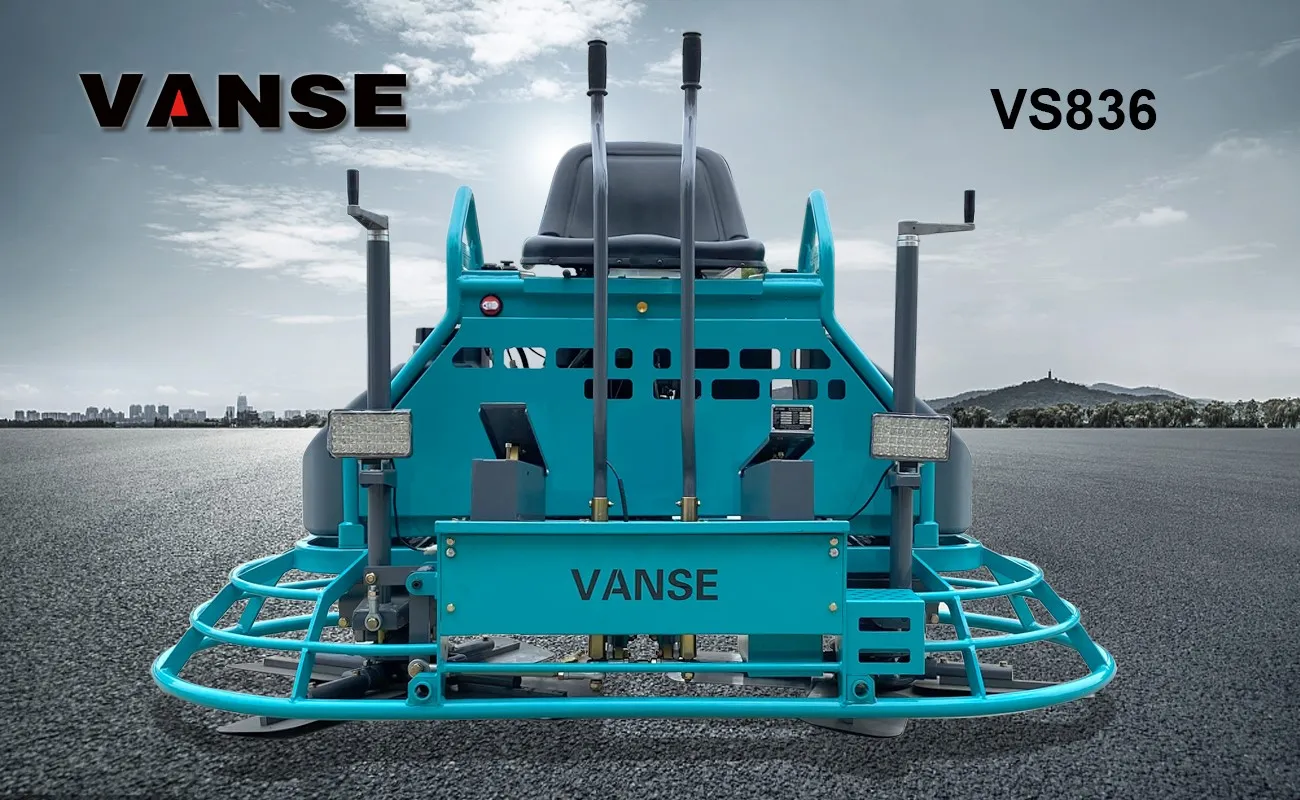
Concrete finishing is not an easy job. During construction, workers' hands, backs and knees are easily injured. The advent of trowels allows construction workers to stand and operate when finishing concrete. Based on the size of the project, the number of people and the customer's requirements for the surface layer, the construction party can consider purchasing a trowel. If you are a construction party specializing in concrete coloring, dyeing or home decoration polishing, you may not need to buy a ride-on trowel (double-disc machine). This type of trowel is not only expensive, but also has a higher hardness after finishing, and there is no such high requirement for the above-mentioned types of floors. In fact, a walk-behind trowel is sufficient to meet the work requirements of small-area floor slurry finishing.
Under what circumstances should you consider investing in a trowel? Generally speaking, the construction area is an important consideration. "Even small-area projects can use trowels, even if the project is only a few hundred square meters. As long as the construction area reaches 100 square meters, a trowel must be used. If it exceeds 300 square meters, a small ride-on trowel must be considered." From another perspective, the working efficiency of a single-disc trowel is equivalent to that of three construction workers using traditional manual finishing tools such as scrapers.
It seems that the biggest advantage of the trowel is to increase the construction speed. But this is only a one-sided understanding of the advantages of the trowel. The trowel does not simply increase the speed but the efficiency when dealing with large-area construction. To put it further, the trowel allows the construction party to choose a more appropriate time to start the machine when dealing with large-area construction, instead of having to start early because of the need to consider the overall area of construction like traditional construction.
Operation steps for trowels:
1. Before use, check whether the motor, electrical switch, cable and wiring are normal and meet the regulations, and install a leakage protector.
2. Before use, check and clean the debris on the trowel to avoid the whole machine jumping during use.
3. After the power is turned on, the test run is carried out. The blades rotate in a clockwise direction and must not be reversed.
4. The operator should wear insulating shoes and insulating gloves. The cable is carried by the assistant, who should also wear insulating shoes and insulating gloves. Be careful to prevent the cable insulation layer from being scratched and causing electric shock accidents.
5. If the trowel fails, it needs to be shut down and the power is cut off before it can be repaired.
6. The trowel should be stored in a dry, clean environment without corrosive gases. The handle should be placed in the specified position. It should not be loaded and unloaded rudely during transfer.
Construction precautions:
1. During construction, pay attention to the temperature of the motor reducer not exceeding 80°
2. The oil of the turbine box needs to be checked frequently. If it is lower than the oil mark, please add oil in time. The machine should be cleaned in time after each use, especially the wiper should be clean and stored in a dry, clean and non-corrosive environment. When the wiper is worn to 30mm on one side, loosen the nut, turn the wiper around and tighten the screw again to achieve the purpose of using two pairs. The angle of the trowel can be adjusted by turning the hand wheel to achieve the ideal effect of rough trowel. If you need to stop the machine during construction, please turn off the power in time. When the gasoline engine stops, press the switch on the handle in time to stop the machine.
The floor effect after the trowel is processed is more uniform, the construction speed is faster, and the operation is more convenient. Long-term operation with a handheld trowel will easily fatigue the construction worker's knees, shoulders and elbows, which will affect the construction effect. Simply put, using a trowel makes the originally difficult operation easier, and it is a better equipment for floor finishing.
Thanks to All the Friends Who Support and Trust Shandong Vanse Machinery Technology Co., Ltd.
If you want to know more about Shandong Vanse Machinery Technology Co., Ltd. or have any questions, please feel free to contact us:
Our Factory
Shandong Vanse Machinery Technology Co., Ltd.








Share this article

About the Author: Shandong Vanse Machinery Technology Co., Ltd.
Shandong Vanse Machinery Technology Co., Ltd. is a high-tech manufacturer specializing in concrete construction machinery, including laser screeds and related equipment. The company integrates R&D, production, and global sales, with products exported to over 60 countries and widely used in infrastructure projects worldwide.
Previous Post
Next Post
Related Articles
You Might Also Like
Revealing the importance of relaxation angle during laser leveling machine construction
The laser leveling machine equipment produced by our manufacturer has good precision. It can perform leveling work efficiently and accurately under any conditions, saving a lot of manual maintenance operations and truly realizing the advantages of intelligent performance. If users want to truly play the role of the laser leveling machine, they can only better apply the equipment by understanding its operating points. So, what is the importance of adjusting the relaxation angle during the construction of the laser leveling machine? The molds used in the field of precision stamping processing are equipped with guide pins to correct the length of the material fed into the mold each time to ensure the accuracy of the stamping production. If this correction is to be truly realized, the laser leveling machine must be equipped with a relaxation device to achieve it. After the tip of the mold guide pin enters the stamping material, the laser leveling machine clamp is in a relaxed state. At this time, the guide pin can correct the error in time, and this relaxation time is the relaxation angle of the laser leveling machine. When professional technicians install laser levelers for customers to debug and test molds, they will adjust the leveling height, leveling angle and relaxation angle of the leveler according to the molds used by the customers for actual mold testing. After single punching and mold testing, continuous punching will be performed to ensure that the continuous punching reaches the predetermined accuracy. At the same time, they will provide detailed training to the operators of the punch laser leveler production line, teaching them how to use, debug, maintain and repair the laser leveler equipment on a daily basis. However, in actual use, many operators use laser levelers for the first time. After replacing the new mold for the punch, they often only remember to adjust the height of the laser leveler (because after changing the mold, the mold height is different, and the leveling height needs to change, which is very intuitive), but ignore the adjustment of the relaxation angle of the leveler. At this time, the leveling will be inaccurate. The operator is not familiar with the leveler and often can't think of the problem. At this time, the operator will complain that the leveler is not good and can only be used for one mold. In fact, this is because the relaxation angle of the laser leveler has not been adjusted correctly, resulting in inaccurate leveling. The laser leveling machine manufacturer told us that the adjustment of the leveling angle of the laser leveling machine after changing the mold is an indispensable link. The adjustment standard is that when the mold guide pin enters the material hole and relaxes, the guide pin is not out of the material pinhole when the mold rises. The precision laser leveling machine clamps the material as the basic principle, so as to truly ensure the high-precision punching production. The equipment provided by the laser leveling machine manufacturer has a more advanced function, can perform leveling operations efficiently, and our price is reasonable and the product quality is good. I don't know if you have gained some new knowledge about the laser leveling machine through our detailed introduction above? If our sharing provides you with corresponding help, please continue to pay attention to our website. We will share more exciting news with you later. Thank you for your support.How to choose the appropriate laser receiver according to different construction environments?
According to different construction environments and conditions, the following factors need to be considered when selecting a suitable laser receiver: 1. Construction accuracy requirements: Different construction projects have different requirements for flatness. If high-precision construction effects are required, a laser receiver with higher sensitivity should be selected to better capture the laser signal and reduce errors. 2. Construction environment: Consider whether there are obstructions, reflectors or other interference factors in the construction environment. If these factors exist, a laser receiver with strong anti-interference ability should be selected to ensure signal stability and accuracy. 3. Construction scope and speed: Evaluate the size of the construction scope and the speed of construction. If the construction scope is large or the construction speed is fast, a laser receiver with a wider reception range should be selected to cover a wider area. 4. Working conditions: Consider the temperature, humidity, air pressure and other conditions of the construction environment. These conditions may affect the performance and stability of the laser receiver. Choose a suitable laser receiver based on actual working conditions to ensure its normal operation and long service life. 5. Budget and cost: Choose a suitable laser receiver based on budget and cost considerations. The prices of laser receivers of different brands and models vary greatly, and trade-offs need to be made based on actual needs and budget. 6. Compatibility and scalability: Consider the compatibility and scalability of the laser receiver with other devices. If you need to integrate the laser receiver with other devices such as control systems and sensors, you should ensure that they have good compatibility and scalability. 7. After-sales service and technical support: Understand the supplier's after-sales service and technical support. Choose a supplier with good after-sales service and technical support so that you can receive timely technical support and maintenance services during use. To sum up, there are many factors to consider when choosing a suitable laser receiver, including construction accuracy requirements, construction environment, construction scope and speed, working conditions, budget and cost, compatibility and scalability, as well as after-sales service and technical support, etc. It is recommended to conduct sufficient market research and comparison before selection, and communicate with suppliers to ensure that a suitable laser receiver is selected and meets actual construction needs.Application Techniques of Concrete Laser Leveling Machine in Slope Ground Construction
In the routine application of concrete laser leveling machines (Laser leveling), 90% of the cases are for creating "horizontal" surfaces. However, when dealing with slope conditions such as parking lot ramps, drainage slope finding, and outdoor squares with slopes, many construction teams tend to encounter problems and "go off track". When using a laser leveling machine on a slope, the key lies in **"deceiving the machine's reference point"** and **"controlling the flow of concrete"**. Here are some advanced application techniques for slope construction: The machine itself only recognizes laser planes. To create a slope, it is necessary to first have the laser emitter emit a "tilted reference surface". Alignment: The Y-axis (or X-axis, depending on the brand) of the laser emitter must be precisely parallel to the direction of the slope. If the axis is off, the resulting slope will be crooked (like the blades of a propeller). Input slope: Directly enter the slope percentage (%) on the transmitter. Formula: Slope % = (Height Difference / Length) × 10 Example: The length is 100 meters. The height of the top is 2 meters higher than the bottom, and the slope is 2.00%. If the slope change is complex (such as a funnel-shaped drainage), ordinary single/double slope laser emitters cannot handle it. At this point, a 3D spreading system (3D Profiler System) must be used. It does not rely on a single laser plane but instead tracks the machine's position in real time using a total station (Total Station), and adjusts the scraper height in real time based on the CAD topographic map in the computer. ⚠️ Important blind spot: After setting the slope laser, it is essential to use the handheld receiver to verify the elevation at the bottom, middle, and top of the slope. Even if the machine is "blind", it won't tell you if it's off; only a person can do the verification. On the slope, the greatest enemy is not the precision of the machinery, but gravity. The concrete is too thin. As soon as the machine finishes leveling it, the concrete starts to flow down, causing the top of the slope to become thinner and the bottom to become thicker. Gold slump value: The slump value of concrete during slope construction must be lower (more dry) than that on flat ground. Recommended value: 100mm – 120mm. If the slope exceeds 2% (that is, a 100-meter drop of 2 meters), the recommended slump range is 80mm – 100mm. Admixtures: Avoid using formulations with excessive retarders, as the concrete needs to "lose its fluidity" and set up as soon as possible. The driving logic of the operator on the slope is completely different from that on the flat ground. Operation steps Tips and Precautions Direction of movement Recommendation: Walk vertically in the direction of the slope (horizontally) (if the width of the site allows it). This way, the machine will always work in a relatively horizontal state, the tire grip will be more stable, and the pressure on both sides of the scraper will be balanced. Alternative: Retreat from the lower position to the higher position. If you must work along the slope, try to have the front of the machine facing upwards and back up to level it out. This way, the scraper can "support" the concrete, preventing it from flowing. It is strictly prohibited to level from a higher position to a lower position; otherwise, the concrete will flow over the scraper like an avalanche and cannot be scraped at all. Leveling Head floating Many machines have "floating mode" or "tilt compensation for machine head". On slopes, the vehicle body is inclined, but the scraper must be parallel to the laser surface. Ensure that the hydraulic system can sensitively compensate for the errors caused by the vehicle body's inclination. Fabric quantity The spreading here must be "eat less, more frequently" than on flat ground. If the accumulated material in front of the scraper is too heavy, it will drag the machine and cause it to slip (especially for tire-type machines). Solution: Use a crawler-type laser leveling machine, or install anti-skid chains on the tires (if they are rubber wheels). Beyond this slope, the hydraulic oil may tilt in the tank, causing it to be depleted, or the engine may not be adequately lubricated. If the slope is greater than 6%, it is recommended to use a **roller leveling** or to combine manual work with vibration-reducing beams for construction. If your project involves a spiral ramp in an underground garage, a laser leveling machine is usually not applicable (because it is curved and has a narrow space). However, if it is a large-scale logistics park unloading ramp, then a laser leveling machine would be an ideal solution. We suggest that before conducting a large-scale formal construction, you should first create a "test section" measuring 5 meters by 5 meters, specifically to test whether the concrete you ordered will "flow" under this slope condition. Note: The parameters provided in this document are for reference only and are not mandatory. Due to differences in technical characteristics between different brands and models of laser levelers, please consult the manufacturer for a suitable solution before actual operation. This reference document assumes no responsibility for any issues arising from failure to follow the manufacturer's instructions.