Technical Knowledge
Does the adjustment of the scraper Angle of the concrete laser leveling have a significant impact on the leveling effect? How can it be precisely adjusted?
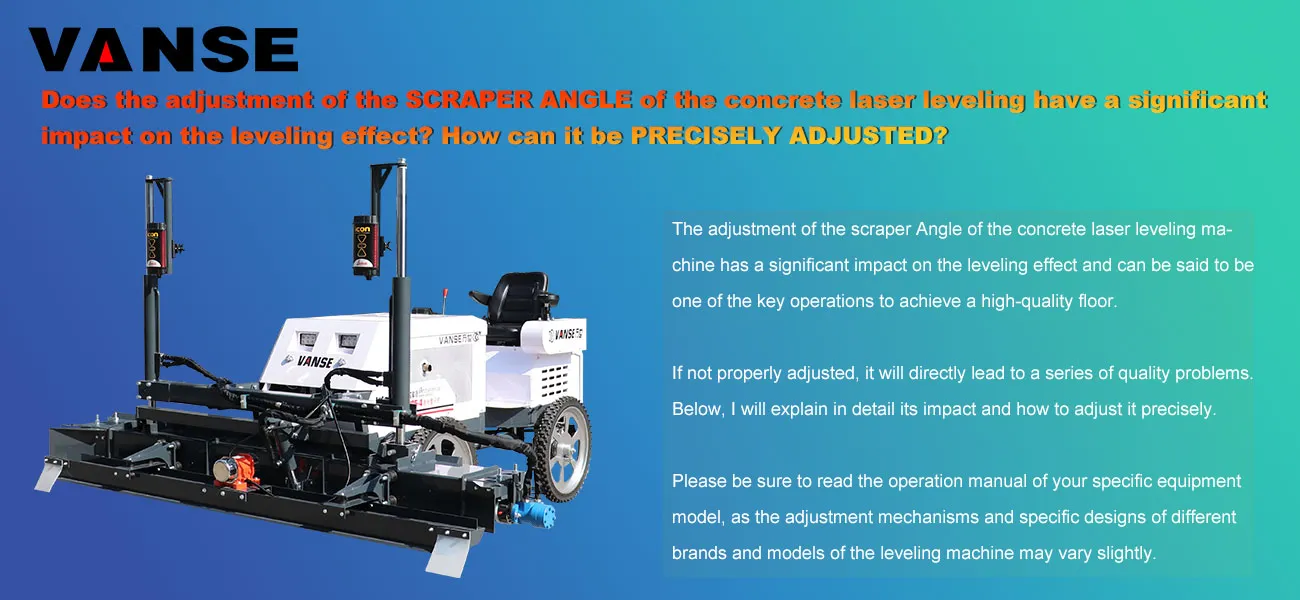
The adjustment of the scraper Angle of the concrete laser leveling machine has a significant impact on the leveling effect and can be said to be one of the key operations to achieve a high-quality floor.
If not properly adjusted, it will directly lead to a series of quality problems. Below, I will explain in detail its impact and how to adjust it precisely.
I. The influence of scraper Angle on the leveling effect
The main functions of the scraper (also known as the scraper plate or scraper shovel) are twofold: scraping off excess concrete and preliminary leveling. Its Angle directly determines the way it interacts with concrete.
The Angle is too large (too "upright") :
The scraper acts like a "wall", pushing the concrete in front instead of flattening it.
Consequences: It leads to material accumulation, creates a wavy surface, and is prone to scraping out aggregates (stones), resulting in surface defects. The walking resistance of the leveling machine has increased, affecting its efficiency.
The Angle is too small (too "lying down") :
The scraper is unable to effectively lift and remove the excess concrete.
Consequence: It is unable to effectively fill the low-lying areas, the leveling effect is poor, and it is easy to form a "mirror-like" but uneven surface. Excess slurry will flow under the scraper, resulting in uneven slurry distribution on the surface.
Moderate Angle (ideal state)
Effect: The front edge of the scraper can smoothly lift and guide the excess concrete to fill the low-lying areas without over-pushing or leaving scratches. It can form a slight "material pile", providing uniform and appropriate concrete for the subsequent laser vibration plate, thereby achieving high-precision leveling.
Summary: Incorrect scraper angles can disrupt the homogeneity of concrete, affect the elevation accuracy controlled by the laser system, and ultimately lead to substandard floor flatness, poor surface appearance, and even later problems such as sanding and cracking.
Ⅱ. How to Precisely Adjust the Angle of the scraper
Precise adjustment requires following a standard process and making fine adjustments in combination with the actual working conditions. The following are the detailed steps:
Step 1: Understand the reference position
Most laser leveling machines have an adjustable mechanical structure for the scraper (such as a hydraulic cylinder, screw or pin hole position). First, it is necessary to find its "zero position" or "neutral position".
Usually, at this position, the bottom cutting edge of the scraper is parallel to the base plate of the leveling machine (or the ground). Please refer to your device operation manual to confirm how to find this reference position.
Step 2: Initial Angle setting
Based on the reference position, make the initial Settings:
General rule: Let the front edge of the scraper blade be slightly higher than the back edge to form a small forward inclination Angle (usually recommended between 2° and 5°). This Angle is sufficient for the scraper to scrape away the excess material without over-pushing it.
Visual management: Some experienced operators will use a simple visual inspection method: Standing on the side of the machine, the edge of the scraper seems to have just touched the ground, but in fact, there is about a 3-5 millimeter gap between the rear end and the ground.
Step 3: Conduct a trial laying and fine-tuning
This is the most crucial step. Theoretical Settings must be tested through practice.
Test laying should be conducted beside the area under formal construction or at the starting point of a section of construction.
Observe the state of the concrete after the scraper:
If the concrete is pushed along and forms obvious waves, it indicates that the Angle is too large. The Angle needs to be reduced to make the scraper flatter.
If there is no small amount of excess concrete left after the scraper to fill the low-lying areas, it indicates that the Angle is too small. The Angle needs to be increased to make the scraper stand more upright.
Ideal state: A uniform and appropriate amount of surplus concrete is left behind the scraper, which is further leveled by the subsequent vibrating plate, and the surface is smooth without any pushing marks.
Step 4: Dynamically adjust according to the concrete working conditions
The slump (dryness and thinness) of concrete is the most important basis for adjusting the Angle.
For relatively dry concrete with a small slump:
Characteristics: High internal friction and poor fluidity.
Adjustment: It is necessary to appropriately increase the Angle of the scraper to provide stronger scraping and pushing force, ensuring effective leveling.
For thinner concrete with a large slump:
Characteristics: Good fluidity and easy to bleed water.
Adjustment: It is necessary to appropriately reduce the Angle of the scraper to avoid excessive pushing and stirring, and prevent aggregate separation and surface bleeding.
Step 5: Detailed inspection and confirmation
Use measuring tools: In the trial laying area, immediately check the flatness with a 3-meter or 4-meter straightedge. If uneven areas are found to be related to the traveling pattern of the scraper, it is very likely that the Angle still needs to be fine-tuned.
Observe the surface slurry: After the scraper, there should be a uniform layer of cement slurry on the surface, but there should not be too much water or slurry being scraped to one side.
Precise adjustment mnemonic and key point summary
Push the material flat, accumulate it upright : When you find the material being pushed, level it a little; when you find the material that cannot be scraped off, straighten it a little.
Stand firm when dry and level when thin : When the concrete is dry, the Angle should be larger; when it is thin, the Angle should be smaller.
Be diligent in observation: Don't set it once and then leave it alone. As the construction progresses and the batches of concrete change, it is necessary to develop the habit of observing and making minor adjustments at any time.
Keep clean: Ensure that the bottom surface of the scraper is clean and free of hardened cement slurry blocks, otherwise it will seriously affect the leveling effect.
Finally, please be sure to read the operation manual of your specific equipment model, as the adjustment mechanisms and specific designs of different brands and models of the leveling machine may vary slightly.
Through the above-mentioned system adjustment methods, you can master the control of the scraper Angle proficiently, thereby fully exerting the performance of the laser leveling machine and pouring high-standard and high-quality concrete wear-resistant floors.
Note: The parameters provided in this document are for reference only and are not mandatory. Due to differences in technical characteristics between different brands and models of laser levelers, please consult the manufacturer for a suitable solution before actual operation. This reference document assumes no responsibility for any issues arising from failure to follow the manufacturer's instructions.
Thanks to All the Friends Who Support and Trust Shandong Vanse Machinery Technology Co., Ltd.
If you want to know more about Shandong Vanse Machinery Technology Co., Ltd. or have any questions, please feel free to contact us:
Our Factory
Shandong Vanse Machinery Technology Co., Ltd.








Share this article

About the Author: Shandong Vanse Machinery Technology Co., Ltd.
Shandong Vanse Machinery Technology Co., Ltd. is a high-tech manufacturer specializing in concrete construction machinery, including laser screeds and related equipment. The company integrates R&D, production, and global sales, with products exported to over 60 countries and widely used in infrastructure projects worldwide.
Previous Post
Next Post
Related Articles
You Might Also Like
What accessories should I consider when buying a concrete power trowel?
– Trowelling blades are made of various materials, such as alloy steel, rubber, polyurethane, etc. Alloy steel trowels are highly wear-resistant and suitable for large-area, high-strength concrete troweling, such as large-scale factory buildings, warehouses and other ground construction. Rubber trowels have good elasticity and have a certain buffering and protective effect on the ground. They are suitable for use in more delicate indoor floors or occasions with high requirements for ground flatness, such as residential floors and indoor floors of shopping malls. Polyurethane trowels are more suitable for troweling special floors such as epoxy floors with high surface quality requirements. – The size of the trowel should be selected according to the model of the trowel machine and the construction scene. Common round trowels have diameters of 60 cm, 80 cm, 1 meter, etc. Large-diameter trowels are suitable for troweling large areas of ground, which can improve work efficiency; small-diameter trowels are more flexible in corner areas. Square trowels can better fit the shape for troweling in right-angle areas such as corners. When purchasing, consider whether there are matching square trowels or special-shaped trowels (such as special-shaped trowels for edge troweling). – Since trowels are easily worn parts, in order to ensure the continuity of construction, it is best to purchase an appropriate number of spare trowels. It is generally recommended to equip at least 2-3 sets of trowels, especially in large-scale construction or long-term continuous construction, so that the trowels can be replaced in time after wear. – For belt-driven trowels, consider the quality and specifications of the belt. High-quality drive belts have good flexibility and wear resistance, and can stably transmit power from the motor to the trowel parts. When purchasing, pay attention to whether the belt model matches the trowel machine. For example, the belt length, width and tooth shape (if it is a synchronous belt) and other parameters must meet the design requirements of the trowel machine. For chain-driven trowels, attention should be paid to the strength and precision of the chain. High-strength chains can ensure the stability of power transmission and prevent chain breakage or tooth skipping during operation. – The quality of pulleys and sprockets is also important. Their dimensional accuracy and surface quality will affect the efficiency and stability of transmission. When purchasing, check the material of the pulley or sprocket. Generally, metal materials (such as cast iron and steel) are used, and ensure that its processing accuracy is high. For example, the groove size of the pulley is accurate and can fit tightly with the transmission belt; the tooth shape of the sprocket is high in precision and meshes well with the chain to reduce energy loss and vibration during power transmission. – The design of the operating handle should be ergonomic, comfortable to hold, and convenient for long-term operation. Some handles have anti-slip designs, such as rubber wrapping or textured surfaces, which can reduce hand fatigue and operating errors. When purchasing, you can actually hold and feel the comfort of the handle and the convenience of operation. – Control components include start/stop buttons, speed adjustment buttons, steering control buttons (for ride-on trowels), etc. These buttons should be sensitive and reliable, with reasonable layout and easy operation. For example, the speed adjustment button should be able to accurately control the working speed of the trowel and can be used normally in different working environments (such as different ground hardness and trowel requirements). At the same time, the waterproof performance of the control components is also important, especially in outdoor construction or scenes where water may be exposed, to prevent short circuits or damage caused by water ingress. – In some construction scenes with high environmental requirements, such as indoor decoration or food processing workshop floor construction, dust collection devices are required. When purchasing, consider the suction power, dust collection capacity and quality of the filtration system of the dust collection device. A dust collection device with strong enough suction can effectively collect dust and debris generated during the troweling process and keep the construction environment clean. A larger dust collection capacity can reduce the number of dumping times and improve work efficiency. A good filtration system can prevent dust leakage and protect the health of construction workers and the environment. – When a walk-behind trowel is not in use or needs to be moved over long distances, transport wheels can facilitate the movement of the machine. When purchasing, pay attention to the quality and size of the transport wheels. Good quality transport wheels can bear the weight of the trowel and roll flexibly, making it easy to move the trowel on different terrains (such as uneven ground, stairs, etc. on the construction site). At the same time, the installation method of the transport wheels should be simple and convenient, and easy to disassemble and install.What influence does the speed of the power trowel’s disk have on the construction effect?
– When the trowel speed is moderate, it can effectively flatten the raised parts of the concrete surface and fill the sunken parts. For example, in general indoor floor construction, if the trowel speed is set in a suitable range, such as 70-100 rpm, the blade on the trowel can initially level the newly poured concrete surface as the trowel moves forward. Because at this speed, the pressure and flattening effect of the blade on the concrete are relatively uniform, and it will not be over-cut due to too fast a speed, nor will it be unable to effectively deal with the unevenness of the surface due to too slow a speed. – When the trowel speed is too high, the cutting force of the trowel blade on the concrete surface is too large. This may cause over-cutting of the concrete surface, destroy the original structure of the concrete, and cause fine cracks or pits on the surface. Especially for concrete whose strength has not yet fully developed, too high a speed may excessively disturb the cement slurry layer on the surface, affecting the final quality of the concrete. – On the contrary, if the trowel speed is too low, the trowel blade will not have enough force on the concrete surface. This will make it impossible to effectively deal with the uneven parts of the concrete surface. For example, on the concrete surface with large stone protrusions or template splicing marks, the trowel at a low speed may not be able to remove these defects, resulting in the ground flatness not meeting the requirements. – Appropriate trowel speed helps to improve the compaction of the concrete surface. When the trowel rotates at a certain speed, the weight of the trowel and the rotation of the blade work together to exert pressure on the concrete surface, so that the particles in the concrete are arranged more closely. For example, in concrete construction with high bearing capacity requirements such as industrial plant floors, the trowel speed is controlled at about 80-120 rpm, which can make the concrete surface better compacted during the troweling process, thereby improving the bearing capacity and wear resistance of the ground. – When the speed is too high, although the surface looks smoother, it may actually make the mortar layer on the concrete surface too loose. Because too high a rotation speed will cause the water in the mortar layer to evaporate too quickly, and excessive rotation will destroy the bonding force between the mortar particles, resulting in insufficient surface compaction, which is prone to quality problems such as sanding and peeling during later use. – If the speed of the trowel is too low, it will not generate enough pressure to compact the concrete surface. This will make the porosity of the concrete surface larger and reduce the compactness of the concrete. Such a concrete surface is easily damaged when there are heavy objects rolling or frequent friction. – A higher trowel speed can make the concrete surface have better gloss. When the speed reaches a certain level, such as 100-150 rpm, the trowel blade can further smooth the mortar layer on the concrete surface during rapid rotation, making the surface more delicate and producing gloss. In some places with high requirements for appearance, such as shopping mall floors and exhibition hall floors, by appropriately increasing the trowel speed, a smooth mirror effect can be created. – However, if the speed is too high, it may cause wavy textures on the concrete surface, affecting the uniformity of gloss. This is because too high a speed will cause the trowel to vibrate during the rotation process, and this vibration is transmitted to the concrete surface, affecting the surface flatness and destroying the uniformity of the gloss. – When the speed is too low, the surface roughness of the concrete is greater and the glossiness is poor. Because the trowel rotating at a low speed cannot fully smooth the microscopic unevenness of the concrete surface, it cannot form a smooth surface, and can only obtain a relatively rough matte effect.How does the construction technology and construction process of concrete laser leveling machine ensure construction quality?
The concrete laser leveling machine combines "precision control + standardized processes," from construction process design to full-process management and control, systematically addressing core quality issues such as concrete surface flatness, density, and thickness uniformity. Its quality assurance logic can be broken down into two components: process principle assurance and full-process management and control. The details are as follows: The quality advantage of the concrete laser leveling machine stems from its unique process design. Its core technology replaces traditional manual wire drawing with "laser reference positioning," combined with a "hydraulic-driven leveling mechanism" to achieve millimeter-level precision control. Key process details are as follows: Principle: A laser transmitter (rotatable 360°) establishes a horizontal reference plane. A laser receiver (mounted on the leveling frame) receives the signal in real time. If the machine deviates from the reference plane, the control system immediately activates the hydraulic cylinder to adjust the frame height, ensuring that the leveling mechanism always operates within the reference plane. Quality Assurance: This eliminates the "segmental errors" associated with traditional manual wire drawing (e.g., height differences caused by wire slack and line of sight deviation). The reference surface covers a range of up to 50 meters, with a global flatness error of ≤3mm/2m (far exceeding the 5-8mm/2m error of traditional methods). A laser transmitter can be used to preset slopes (0.1%-5%), enabling precise drainage slope construction and preventing subsequent water accumulation (e.g., drainage needs in garages, rooftops, and factory floors). Leveling Mechanism: Utilizes a "spiral blade + scraper" combination. The spiral blades first evenly spread the concrete (controlling the amount of concrete spread based on the preset thickness), followed by the scraper for preliminary leveling to prevent spot buildup or missed vibrations. Vibration System: The machine is equipped with a high-frequency vibrator (vibration frequency 2000-3000 times/minute), capable of vibrating to a depth of 150-300mm (adjusted based on concrete thickness). Compared to manual vibration: More uniform density: High-frequency vibration effectively removes air bubbles from the concrete, preventing honeycombing and rough surfaces, and can increase the concrete's compressive strength by 10%-15%. Preventing "over-vibration segregation": The control system automatically adjusts the vibration frequency to match the concrete slump (e.g., for a slump of 120-180mm, the frequency is set to 2500 times/minute), preventing aggregate sinking and mortar floating, which can cause surface sanding. The leveling machine utilizes "four-wheel drive + intelligent travel" technology. Its travel speed can be adjusted (0.5-1.5 m/min) based on the initial setting time of the concrete (typically 2-4 hours) and the construction area. This avoids: Traveling too fast, resulting in uneven distribution and incomplete leveling; Traveling too slowly, resulting in disturbance of the concrete after initial setting, causing cracks or peeling. For large-scale construction (such as factories and logistics warehouses), a "zoned skipping method" is used. A 100-150 mm wide "post-pouring strip" is reserved at the zone boundaries to prevent cracking caused by thermal stress. Quality cannot be fully guaranteed through process design alone. Standardized process control is required to cover key quality milestones throughout the construction cycle: Preparation Core Requirements Quality Impact Base preparation 1. The flatness tolerance of the base layer (e.g., subgrade, roadbed) must be ≤5mm/2m. Protrusions and depressions must be manually repaired. If the base layer is uneven, a laser leveling can control the surface layer, but this can lead to uneven concrete thickness (thin areas can cause cracking, while thick areas increase costs). A dry base layer can cause rapid water loss from the concrete surface, resulting in sanding. 2. The base layer surface must be moistened with water (moisture content 10%-15%) to prevent moisture absorption from the concrete and cracking. Laser system calibration 1. The laser transmitter must be mounted on a stable support (away from vibration sources such as rollers). Laser system deviation is a "hidden quality issue" that can cause the leveling layer to tilt (for example, a garage with a reversed drainage slope), leading to extremely high rework costs. 2. Use a 2m straightedge and a level to calibrate the laser reference surface to an accuracy of ≤1mm. Concrete mix control 1. Slump: 50-100mm (for dry, hard concrete to avoid run-off after leveling). Excessive slump: Concrete tends to segregate, resulting in sanding. Excessive slump: The leveling has difficulty leveling, resulting in poor vibration compaction and honeycombing. 2. Aggregate Grading: Coarse aggregate (5-25mm) should account for 60%-65%, and fine aggregate (0.3-5mm) should account for 30%-35%. Avoid excessive coarse aggregate, which can cause surface unevenness. Material Distribution Control: Concrete must be distributed directly to the construction site via a chute or pump. The distribution height should be 50-80mm above the intended surface layer (allowing for leveling margins) to prevent aggregate separation caused by manual shoveling. The leveling machine must be started within 30 minutes of distribution to prevent initial setting of the concrete (in summer, this time should be shortened to 20 minutes; shade cloth can be used to delay initial setting). leveling Machine Operating Specifications: The operator must monitor the laser receiver indicator light (green: normal, red: deviation from the reference). If a red light appears, immediately stop the machine and inspect the laser system (for obstructions or transmitter offset). For every 100 square meters of surface area leveled, use a 2-meter ruler to randomly check 3-5 points. The flatness deviation must be ≤3mm. If it exceeds this standard, immediately adjust the laser reference or machine parameters. Surface Finishing: After laser leveling, wait for the concrete surface to initially set (no noticeable indentation when pressed with a finger, approximately 1-2 hours). Then, use an electric trowel to apply finishing (1-2 passes) to eliminate surface bubbles and scratches and improve surface smoothness (to prevent later sanding). When finishing, avoid staying in one spot for too long to prevent "smear marks" on the surface. Stage 3: Post-construction Curing (to prevent later quality defects) Cover Curing: Within 1-2 hours after finishing, cover the concrete with geotextile or plastic film to ensure the surface is moist (avoid direct sunlight or strong winds). During high summer temperatures, water the geotextile every 2-3 hours to keep it moist. During low winter temperatures, cover with insulation (when ambient temperature is ≤5°C, use floor heating or hot air curing to prevent freezing damage). Curation Cycle: The curing period for ordinary concrete (C30-C40) is ≥ 7 days; the curing period for high-strength concrete (C50 and above) is ≥ 14 days. During the curing period, personnel and vehicles (especially heavy vehicles) are prohibited from passing through to avoid surface indentations or cracks. Joint cutting and caulking: After 3-5 days of curing, use a joint cutter to cut shrinkage joints (spaced 6-8 meters apart and 1/3-1/4 the concrete thickness) to prevent irregular cracking caused by thermal stress. Within 24 hours of cutting, fill the joints with polyurethane sealant to prevent rainwater from seeping into the base layer, which could cause hollowing and peeling of the surface layer. Even if the process is strictly followed, unexpected quality issues may still occur and require prompt attention: Cause: Dry base layer, poor curing, and delayed crack cutting. Solution: If the crack width is ≤ 0.3mm, fill with epoxy resin. If the crack width is > 0.3mm, cut a 10mm wide and 20mm deep groove, fill with sealant, and re-finish. Cause: Laser system offset, uneven distribution of concrete. Solution: If the concrete has not initially set (within 1 hour of pouring), recalibrate the laser system and perform a second leveling. If it has already set, manually remove any raised areas with an angle grinder and then level with repair mortar. Cause: Improper concrete mix (excessive fine aggregate) and inadequate curing. Solution: Apply a "concrete sealer and hardener" to the surface (penetration depth 3-5mm) to increase surface hardness (Mohs hardness up to 6-7) and prevent sanding. The quality assurance principle for concrete laser leveling machines is "precision technology + standardized processes." In terms of technology, laser positioning eliminates manual errors, and high-frequency vibration ensures compaction, reducing quality defects at the root. In terms of process, pre-calibration, in-process testing, and post-process maintenance form a closed-loop quality loop, avoiding late-stage rework caused by "hidden issues" (such as laser offset and insufficient curing). Only by combining these two methods can a high-quality concrete surface layer with high flatness, excellent density, and no cracks or sanding be achieved. Note: The parameters provided in this document are for reference only and are not mandatory. Due to differences in technical characteristics between different brands and models of laser levelers, please consult the manufacturer for a suitable solution before actual operation. This reference document assumes no responsibility for any issues arising from failure to follow the manufacturer's instructions.